Iowa Nutrient Reduction Strategy Annual Progress Report 2016-2017 - - PDF document

iowa nutrient reduction strategy annual progress report
SMART_READER_LITE
LIVE PREVIEW

Iowa Nutrient Reduction Strategy Annual Progress Report 2016-2017 - - PDF document

9/28/2017 Iowa Nutrient Reduction Strategy Annual Progress Report 2016-2017 Water Resources Coordinating Council Meeting 21 S eptember 2017 INRS Overview Point Source Nonpoint Source Contribute 93% to states N load Contribute 7% to


slide-1
SLIDE 1

9/28/2017 1

Iowa Nutrient Reduction Strategy Annual Progress Report 2016-2017

Water Resources Coordinating Council Meeting 21 S eptember 2017

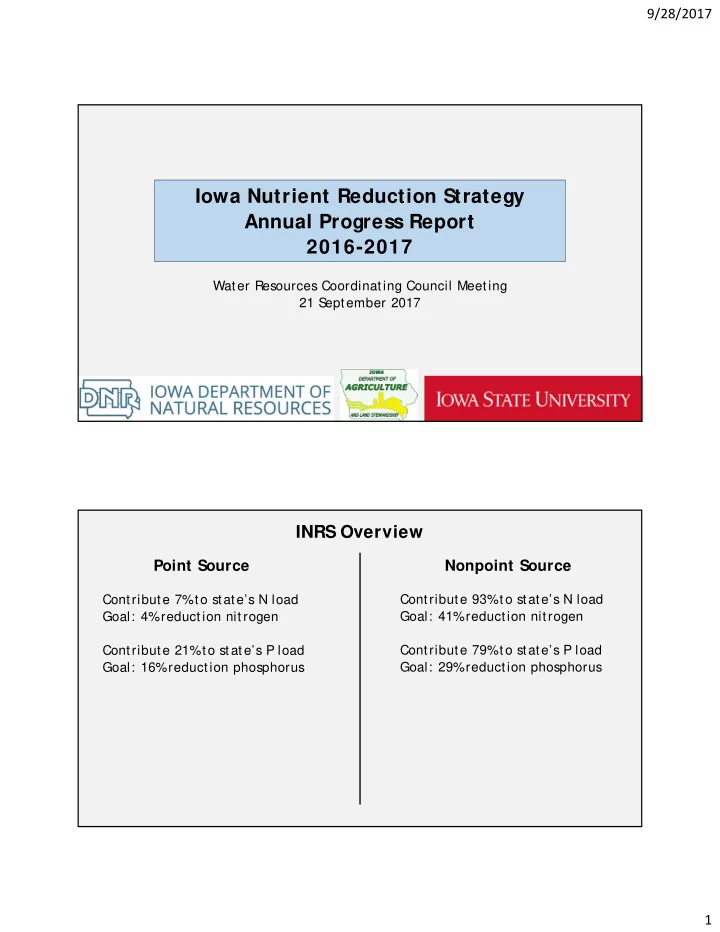
INRS Overview

Point Source Nonpoint Source

Contribute 7% to state’s N load Goal: 4% reduction nitrogen Contribute 21% to state’s P load Goal: 16% reduction phosphorus Contribute 93% to state’s N load Goal: 41% reduction nitrogen Contribute 79% to state’s P load Goal: 29% reduction phosphorus

slide-2
SLIDE 2

9/28/2017 2

  • Funding
  • S

taff

  • Point source

permits

  • Outreach
  • Farmer

knowledge

  • Farmer

attitudes

  • Land-use change
  • In-field practices
  • Edge-of-field and

erosion control practices

  • Addressing data

gaps

  • Monitoring:
  • EOF
  • S

mall WS

  • Medium WS
  • Large WS
  • Nitrogen export

S elected non-quantified topics discussed in the annual report:

  • Activity in priority watersheds
  • Nutrient loss research
  • Practice added: blind inlets
  • Refining the measurement process
  • S
  • urce water protection
  • Watershed Academy and retaiN
slide-3
SLIDE 3

9/28/2017 3

[CATEGOR Y NAME],

[VALUE ]

[CATEGOR Y NAME],

[VALUE ]

[CATEGOR Y NAME],

[VALUE ]

63 20 66 2016

Point Source Permits Issued

slide-4
SLIDE 4

9/28/2017 4

2016 - Revised

Number of Events Average Attendance Total Reported Attendance

Conference

6 214 1,281

Community Outreach

55 52 8,877

Field Day

88 47 4,159

Workshop

32 37 1,172

Y

  • uth and S

chool Visits

65 88 5,704

2016 Total

246 21,193 2017 Conference

13 252 3,279

Community Outreach

168 69 20,400

Field Day

112 53 10,562

Workshop

55 37 1,695

Y

  • uth and S

chool Visits

127 146 18,542

2017 Total

474 54,478

Outreach and Education Outreach and Education

slide-5
SLIDE 5

9/28/2017 5

Farmer awareness and attitudes

“How knowledgeable are you about the Nutrient Reduction Strategy?”

Iowa HUC6

Farmer awareness and attitudes

Next Steps: Statistical analysis

  • Causal mediation analysis
  • How do certain variables affect the

knowledge ‐> attitude ‐> behavior pathway?

  • Analysis conducted, will be submitted for peer review
  • “Neighboring effects” as an independent variable
  • Comparison of priority watersheds vs. non‐priority areas
slide-6
SLIDE 6

9/28/2017 6

CRP Land Retirement

slide-7
SLIDE 7

9/28/2017 7

CRP Land Retirement Cover Crops

slide-8
SLIDE 8

9/28/2017 8

Cover Crops, 2016 Cost-Share Programs CREP Wetlands

Inset text: Number of wetlands constructed annually

42,000 new acres treated since 2011

slide-9
SLIDE 9

9/28/2017 9

Terraces & WASCOBs, Cost-Share Programs

Terraces: 137,000 new acres treated since 2011 WASCOBs and GS: 112,000 new acres treated since 2011

Addressing Data Gaps Moving beyond cost-share data

  • 1. Mapping of Structural

Practices

  • 2. Public‐Private Partnership

Ag retailers survey farmers on in‐field practice use

  • 3. Work closely with NRCS and IDALS to

make appropriate estimates based on cost‐share data

slide-10
SLIDE 10

9/28/2017 10

Mapping Structural Practices Mapping Structural Practices

slide-11
SLIDE 11

9/28/2017 11

Surface Water Monitoring Efforts

Edge-of-Field or Delivery Scale Small Watershed < 100 sq. mi. Medium Watershed 100 – 1,000 sq. mi. Large Watershed > 1,000 sq. mi. Mississippi River Basin

Estimating Changes in Nutrient Export Two-pronged approach:

  • 1. Measuring nutrient concentrations through

surface water monitoring

  • 2. Modeling nutrient loss reductions affected by

conservation practices

slide-12
SLIDE 12

9/28/2017 12

Surface Water Monitoring Efforts

Fixed Stream Monitoring Sites and Nitrate Probe Sites

Surface Water Monitoring Efforts

Small Watershed Monitoring < 100 sq. mi.

slide-13
SLIDE 13

9/28/2017 13

Surface Water Monitoring Efforts

Medium Watershed Monitoring 100 – 1,000 sq. mi.

Surface Water Monitoring Efforts

Large Watershed Monitoring > 1,000 sq. mi.

slide-14
SLIDE 14

9/28/2017 14

Iowa’s Annual Nitrogen Export Estimated Load Reductions From Conservation Practices

Baseline Estimates from the NRS Nitrogen Phosphorus

Statewide Baseline Load (tons) 307,000 16,800 Load Reduction Needed for 45% Reduction 138,150 7,560 NPS Portion of Load Reduction 125,870 4,872 PS Portion of Load Reduction 12,280 2,688 % of Target Load Reduction from NPS 91.1% 64.4% % of Target Overall Load Reduction from PS 8.9% 35.6%

slide-15
SLIDE 15

9/28/2017 15

Estimated Load Reductions From Conservation Practices - Nitrogen

Baseline Estimates from the NRS Nitrogen Phosphorus

Statewide Baseline Load (tons) 307,000 16,800 Load Reduction Needed for 45% Reduction 138,150 7,560 NPS Portion of Load Reduction 125,870 4,872 PS Portion of Load Reduction 12,280 2,688 % of Target Load Reduction from NPS 91.1% 64.4% % of Target Overall Load Reduction from PS 8.9% 35.6%

Practice 2011 2012 2013 2014 2015 2016 Cover Crops Acres Installed Annually 14,683 43,709 183,776 155,441 252,948 302,136 N Loss Reduction (tons) 67.5 195.2 810.1 694.9 1,141.3 1,375.4 Bioreactors Acres Benefitted (cumulative 2011‐2016) 500 550 800 900 950 N Loss Reduction (tons) 0.0 2.9 3.2 4.6 5.3 5.6 CREP Wetlands Acres Benefitted (cumulative 2011‐2016) 6,965 20,484 26,818 31,758 31,758 42,206 N Loss Reduction (tons) 44.7 136.0 179.8 214.0 214.0 286.7 Conversion of row crop to perennials (CRP) Total Acres Benefitted Annually 1,661,876 1,643,927 1,524,532 1,457,053 1,484,119 1,688,616 Net N Loss Reduction compared to 2011 (tons) 228.1

Practice 2011 2012 2013 2014 2015 2016 Cover Crops Acres Installed Annually 14,683 43,709 183,776 155,441 252,948 302,136 P Loss Reduction (tons) 4.1 12.0 60.6 50.3 83.2 103.6 Terraces Acres Benefitted (cumulative 2011‐2016) 29,943 52,286 70,867 94,290 116,042 136,759 P Loss Reduction (tons) 18.5 32.7 44.2 58.3 72.1 82.8 Conversion to perennials (CRP) Total Acres Benefitted Annually 1,661,876 1,643,927 1,524,532 1,457,053 1,484,119 1,688,616 Net P Loss Reduction compared to 2011 (tons) 10.0

Estimated Load Reductions From Conservation Practices - Phosphorus

Baseline Estimates from the NRS Nitrogen Phosphorus

Statewide Baseline Load (tons) 307,000 16,800 Load Reduction Needed for 45% Reduction 138,150 7,560 NPS Portion of Load Reduction 125,870 4,872 PS Portion of Load Reduction 12,280 2,688 % of Target Load Reduction from NPS 91.1% 64.4% % of Target Overall Load Reduction from PS 8.9% 35.6%

slide-16
SLIDE 16

9/28/2017 16

Point Source Facilities’ Reduction of Effluent Concentration

Estimate (Target) POTW Industry Total Nitrogen (average) number of facilities 63 9 raw waste (mg/L) 25 29.7 (range 11.9 – 83.6) 79.6 (range 16.5 – 314.6) final effluent (mg/L) 10 16.6 (range 2.1 – 58.3) 21.7 (range 4.5 – 79.9) % removal 66% 41.8% (range ‐10.0% ‐ 91.9%) 69.0% (range 20.9% ‐ 89.3%) Total Phosphorus (average) 63 14 raw waste (mg/L) 4 5.1 (range 1.9 – 31.8) 20.6 (range 2.5 – 51.5) final effluent (mg/L) 1 3.1 (range 0.7 – 24.9) 12.8 (range 0.8 – 73.0) % removal 75% 40.5% (range ‐14.7% ‐ 82.8%) 48.8% (range ‐41.9% ‐ 84.8%) Annual Load Reduction (2015‐2016) Total nitrogen (tons) ‐ 5,068069 517 Total phosphorus (tons) ‐ 937 273

Point Source Facilities’ Reduction of Effluent Concentration

TN TP Estimated potential PS load reductions 11,000 T/yr 2,170 T/yr Actual load reduction in 2015‐16 for 63 POTWs and 9 industries 5,585 T/yr 1,210 T/yr Estimated % removals w/BNR 66% 75% Actual % removals by POTWs today (Pounds) 40.5% 39.7% Actual % removals by industries today (Pounds) 69.6% 53.6% Estimated raw waste concentrations1 25 mg/L 4.0 mg/L Actual raw waste concentrations ‐ POTWs 29.7 mg/l 5.1 mg/l Actual raw waste concentrations ‐ industries 79.6 mg/l 20.6 mg/l

slide-17
SLIDE 17

9/28/2017 17

Thank you Laurie Nowatzke lwissler@iastate.edu 515‐294‐0527

Nutrient Reduction Strategy Staff - 2017 Reporting Period FTE S taff Forming Infrast ruct ure FTE S taff for Research FTE S taff for Implement at ion FTE S taff for Ot her Areas

184 18 442 23

666 Full-Time Equivalent Staff in Iowa

conducting work that promot es the NRS and water quality

No change compared t o 665 FTEs report ed in 2016

slide-18
SLIDE 18

9/28/2017 18 Farmer awareness and attitudes

Level of agreement with statements related to attitude

Iowa HUC6

‐Percent‐ Statement

Strongly disagree Disagree Uncertain Agree Strongly agree

"I would like to improve conservation practices on the land I farm to help meet the Nutrient Reduction Strategy's goals."

2017

1.1 1.7 22.0 60.9 14.4

2016

0.7 3.2 20.7 59.3 16.1

2015

0.9 2.0 22.6 59.1 15.5 "I am concerned about agriculture's impacts

  • n water quality."

2017

1.3 4.6 14.5 62.5 17.2

2016

0.5 2.8 13.5 64.7 18.4

2015

1.2 3.8 13.2 63.0 18.8 "The nutrient management practices I use are sufficient to prevent loss of nutrients into waterways."

2017

0.2 2.5 40.4 49.7 7.2

2016

0.5 3.6 42.5 47.0 6.4

2015

0.7 3.3 42.4 46.9 6.8

Mapping Structural Practices

1980

slide-19
SLIDE 19

9/28/2017 19 Mapping Structural Practices

2010

Mapping Structural Practices

2016

slide-20
SLIDE 20

9/28/2017 20 Iowa Soybean Association Tile Nitrate Testing

2014 2014

2017

Iowa Soybean Association Tile Nitrate Testing