Investor Presentation March 2018 Alaskan Way Viaduct (SR 99) - - PowerPoint PPT Presentation

investor presentation march 2018
SMART_READER_LITE
LIVE PREVIEW

Investor Presentation March 2018 Alaskan Way Viaduct (SR 99) - - PowerPoint PPT Presentation

Investor Presentation March 2018 Alaskan Way Viaduct (SR 99) Replacement Project, Seattle Forward-Looking Statements Statements contained in this presentation that are not purely historical are forward-looking statements within the meaning of


slide-1
SLIDE 1

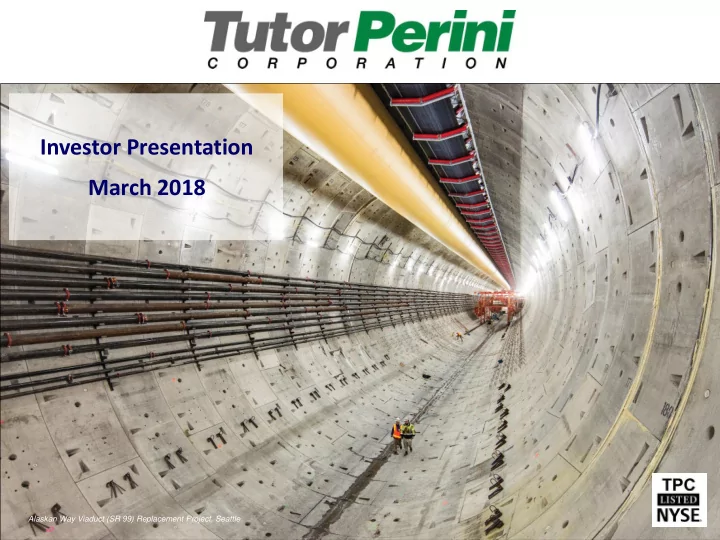
Investor Presentation March 2018

Alaskan Way Viaduct (SR 99) Replacement Project, Seattle
slide-2
SLIDE 2

Forward-Looking Statements

Statements contained in this presentation that are not purely historical are forward-looking statements within the meaning of the Private Securities Litigation Reform Act of 1995, including without limitation, statements regarding the Company’s expectations, hopes, beliefs, intentions or strategies regarding the future and statements regarding future guidance or estimates and non- historical performance. These forward-looking statements are based on the Company’s current expectations and beliefs concerning future developments and their potential effects on the Company. While the Company’s expectations, beliefs and projections are expressed in good faith and the Company believes there is a reasonable basis for them, there can be no assurance that future developments affecting the Company will be those that we have anticipated. These forward-looking statements involve a number

  • f risks, uncertainties (some of which are beyond the control of the Company) or other assumptions that may cause actual results
  • r performance to be materially different from those expressed or implied by such forward-looking statements. These risks and

uncertainties include, but are not limited to, the Company’s ability to win new contracts and convert backlog into revenue; the Company's ability to successfully and timely complete construction projects; increased competition and failure to secure new contracts; the outcomes of pending or future litigation, arbitration or other dispute resolution proceedings and the timing of related collections; the potential delay, suspension, termination or reduction in scope of construction projects; the continuing validity of the underlying assumptions and estimates of total forecasted project revenues, costs and profits and project schedules; the availability of borrowed funds on terms acceptable to the Company; failure to meet our obligations under our debt agreements; the ability to retain certain members of management; the ability to obtain surety bonds to secure the Company’s performance under certain construction contracts; possible labor disputes or work stoppages within the construction industry; changes in federal and state appropriations for infrastructure projects and the impact of changing economic conditions on federal, state and local funding for infrastructure projects; possible changes or developments in international or domestic political, social, economic, business, industry, market and regulatory conditions or circumstances; failure to comply with laws and regulations related to government contracts; actions taken or not taken by third parties, including the Company’s customers, suppliers, business partners, and competitors and legislative, regulatory, judicial and other governmental authorities and officials; impairments of our goodwill or other indefinite-lived intangible assets; possible systems and information technology disruptions; the impact of inclement weather conditions on projects; and other risks and uncertainties discussed under the heading “Risk Factors” in our Annual Report on Form 10-K for the year ended December 31, 2017 filed with the Securities and Exchange Commission on February 27, 2018. The Company undertakes no obligation to publicly update or revise any forward-looking statements, whether as a result of new information, future events or otherwise, except as may be required under applicable securities laws.

2

slide-3
SLIDE 3

Company Overview

  • Leading global provider of diversified general contracting,

design-build and self-perform construction services for public and private clients

  • Civil segment infrastructure projects drive profitability
  • Significant increase in infrastructure spending on the horizon
  • Over 120 years of successful project execution
  • Consistently ranked by Engineering News-Record among the top

U.S. contractors

  • Headquartered in Los Angeles with operations throughout the U.S.

and in select international locations

  • Approximately 10,000 employees worldwide

3

Tutor Perini rankings (2017):

#1 Specialty Contractor in NY region* #3 Domestic Heavy Contractor #4 Builder in Transportation #5 Builder in Electrical* #9 Builder in Domestic Building/Mfg. #9 General Contractor #10 Specialty Contractor* #12 Builder in Mechanical*

* Includes multiple subsidiaries The Cosmopolitan Resort and Casino, Las Vegas

  • St. Croix Crossing Bridge, Oak Park Heights, MN East Side Access Project, New York
slide-4
SLIDE 4

Diverse Geographical Footprint

Well positioned to capture work in all 50 states and in targeted international markets

4

slide-5
SLIDE 5

Significant Projects Driving Performance

(approximate award values)

Leading market position and scale allows TPC to win large, complex projects

5

  • Various New York MTA East Side Access Projects – $2.7B
  • California High-Speed Rail (JV) – $1.4B
  • Alaskan Way Viaduct (SR 99) Replacement, WA (JV) – $1.4B
  • Los Angeles MTA Purple Line Section 2 (JV) – $1.3B
  • Hudson Yards Tower D and Platform, NY – $1.3B
  • Technology Office Facility, CA – $975M
  • San Francisco MTA Central Subway – $840M
  • I-74 Bridge Replacement Project, IA – $320M
  • Pechanga Resort and Casino Expansion, CA – $320M
  • Kemano T2 Tunnel (JV), British Columbia – $265M

California High-Speed Rail Project, Central California Alaskan Way Viaduct (SR 99) Replacement, Seattle Pechanga Resort and Casino Expansion, Temecula, CA Central Subway T-Line Extension, San Francisco

slide-6
SLIDE 6

Segment Overview and 2017 Financials

A Leading Construction Services Firm

Revenue: $4.8B Income from Construction Ops. (ICO): $179.5M(1) (3.8% Op. Margin) Net Income Attributable to TPC: $148.4M(2) Operating Cash Flow: $163.6M (record high) Q4-17 Backlog: $7.3B

Building Segment

Revenue: $1.9B ICO: $34.2M(3)

  • Op. Margin: 1.8%

Q4-17 Backlog: $1.7B

Civil Segment

Revenue: $1.6B ICO: $192.2M(3)

  • Op. Margin: 12.0%

Q4-17 Backlog: $4.1B  Commonly uses guaranteed maximum price and cost plus fee contracts  Specializes in:

  • Health Care
  • Corporate Offices
  • Mixed Use
  • Education
  • Hospitality / Gaming
  • Sports Facilities

 Commonly uses fixed price and unit price contracts  Specializes in:

  • Bridges and Tunnels
  • Mass-Transit Systems
  • Highways
  • Wastewater Treatment

Facilities

Specialty Contractors Segment

Revenue: $1.2B ICO: $18.9M(3)

  • Op. Margin: 1.6%

Q4-17 Backlog: $1.5B  Commonly uses fixed price, unit price and cost plus fee contracts  Specializes in:

  • Electrical
  • Mechanical
  • Plumbing and Heating
  • Pneumatic Concrete Placement

6

(1) Includes the impact of corporate general and administrative expenses of $65.9M; excludes other income of $43.9M. (2) Includes a tax benefit of $53.3M primarily related to the remeasurement of deferred tax assets and liabilities due to the Tax Cuts and Jobs Act of 2017. (3) Segment ICO amounts do not sum to total ICO amount due to corporate general and administrative expenses and rounding.

slide-7
SLIDE 7

Other 11% Mass Transit 62% Bridges 15% Transportation 12%

Civil Segment Drives TPC’s Profitability

54% year over year Civil segment backlog growth

 Construction and rehabilitation of highways, bridges, tunnels, mass-transit systems and wastewater treatment facilities  TPC’s highest margin segment (12.0% operating margin in 2017)  Focused on large-scale, complex projects ($100M to $1B+)  One of few leaders in the industry positioned to capture the largest projects

— Faces fewer competitors, as smaller contractors lack the technical experience, capability and bonding capacity to support large projects — Strong self-performance capabilities — Centralized, experienced cost estimating capabilities and sizeable equipment fleet

Civil Construction Success Drivers Q4-17 Backlog by End Market: $4.1B

 Very strong bidding activity and bid pipeline over the next several years  Significant infrastructure spending boost expected due to recent voter- approved funding measures (e.g., $120B L.A. County Measure M; $54B Seattle Sound Transit 3), $52B 10-year California transportation bill and President Trump’s $1.5T infrastructure plan  Experience and past performance on projects  Financial strength key to obtaining bonding and pre-bid qualification  Only major U.S. or international contractor with an office in Guam (presence for 40 years)

— Prepared for multi-billion-dollar troop relocation project opportunities CA High-Speed Rail, CA

7

East Side Access Project, NY

Winning Large and Highly Visible Projects

(1) Includes the Company’s tunnel projects

(1)

slide-8
SLIDE 8

Office 1% Industrial 15% Gov't 20% Health Care 22% Hospitality and Gaming 13% Mixed Use 10% Condos 8% Education 6% Other 5%

Building Segment

Strong demand for building projects in California, the Southwest and Northeast U.S.

Building Construction Success Drivers

 Large and active bid pipeline over at least the next two years — Significant volume of prospective awards for projects in California, the Southwest and Northeast U.S. given strengths of Rudolph and Sletten and Tutor Perini Building Corp.  Strong customer relationships and end market expertise  Integrated business model with significant self-perform capabilities  Established track record on numerous large government contracts

Q4-17 Backlog by End Market: $1.7B

 Leading Builder in California  Large Corporate Customer Base  Private / Non-Residential and Public Projects  Expertise in Hospitality and Gaming, Design-Build and Accelerated Delivery  Southeastern U.S. Focus  Private / Non-Residential and Public Projects  Construction and design-build services worldwide for U.S. military and government agencies and surety companies

CityCenter Las Vegas

8

The Cosmopolitan Resort & Casino, Las Vegas

slide-9
SLIDE 9

Condos 8% Mass Transit 53% Industrial 7% Transportation 4% Mixed Use 9% Other 2% Education 7% Health Care 5% Water 5%

Specialty Contractors Segment

TPC’s specialty construction capabilities provide a strong competitive advantage

Q4-17 Backlog by End Market: $1.5B Specialty Contractors Success Drivers

 Strong demand, especially in New York City  Strong electrical and mechanical proficiencies  Performing substantial work for the Civil and Building groups — Positions TPC as a full-service contractor with greater control over scheduled work, project delivery and risk management  Continuing to serve existing external customers  Focused on New York City, Texas, California and Florida 9

East Side Access Queens Tunnels, NY World Trade Center, NY

 One of the largest electrical contractors in New York City  Electrical contractor with offices in Houston, Miami, New Orleans and Los Angeles  Mechanical contractor with offices in New York City and Miami  Mechanical contractor with offices in Los Angeles and Las Vegas  Expertise in Pneumatic Concrete Placement  Offices in Los Angeles and New York City

FIVE STAR ELECTRIC

slide-10
SLIDE 10

Vertical Integration: A Competitive Advantage

Key Success Drivers

  • Integrated civil, building and specialty service

capabilities proving to be a competitive advantage

 Greater control over schedule  Greater visibility into price

  • Collaborative bidding approach

10

Example Projects:

Hudson Yards Development

Platform, tunnel and buildings Midtown Manhattan, NY

Total project volume: $2.3B+

New York MTA East Side Access

Subway stations, tracks and systems Queens to Manhattan, NY

Project value: $2.7B

SFMTA Central Subway

Underground stations, tracks and systems San Francisco, CA

Project value: $840M

Hudson Yards Development, New York Central Subway T-Line Extension, San Francisco

TPC’s Civil, Building and Specialty Contracting groups provide a differentiated, one-stop-shop competitive advantage

slide-11
SLIDE 11

Core Strengths Provide Significant Benefits

Core Strengths

  • Greater project cost and schedule

certainty

  • Durable competitive advantage
  • Higher profit margin opportunities
  • Larger project pursuits with fewer

competitors

  • Profitable fixed price execution
  • Rapid mobilization of resources
  • Public-private partnership project
  • pportunities

11

  • Cost estimating
  • Self-perform capabilities
  • Diverse construction experience – Civil,

Building and Specialty Contractors

  • Construction risk management
  • Project management talent, depth and

experience

  • Sizeable equipment fleet
  • Broad domestic geographic footprint
  • Strong balance sheet and bonding capacity

TPC’s competitive strengths provide opportunities for higher margins Benefits Realized

slide-12
SLIDE 12

$7.3B Backlog to Drive Growth

(as of Q4-17)

Strong pipeline of prospective bids and awards over the next several years

12

Backlog by Segment Backlog by Customer

17% year over year backlog growth in 2017

Civil 57% ($4.1B) Building 23% ($1.7B) Specialty Contractors 20% ($1.5B) Private 26%

($1.9B)

Federal Government 8%

($553M)

State and Local Government 66%

($4.8B)

slide-13
SLIDE 13

$4,176 $4,492 $4,920 $4,973 $4,757 $0 $1,000 $2,000 $3,000 $4,000 $5,000 $6,000 2013 2014 2015 2016 2017 Revenue $244 $287 $184 $276 $269 5.8% 6.4% 3.8% 5.6% 5.7% 2.0% 3.0% 4.0% 5.0% 6.0% 7.0% $0 $25 $50 $75 $100 $125 $150 $175 $200 $225 $250 $275 $300 $325 2013 2014 2015 2016 2017 EBITDA Margin EBITDA EBITDA EBITDA Margin

Revenue EBITDA

(a)

Financials

($ in millions)

13

(a) EBITDA and adjusted EBITDA (for 2015) are non-GAAP financial measures; see reconciliation to net income attributable to Tutor Perini Corp. in appendix. Net income attributable to Tutor Perini Corp. for 2013-2017 was $87.3M, $107.9M, $45.3M, $95.8M and $148.4M, respectively. (b) Represents adjusted EBITDA for 2015, which excludes a Civil segment litigation charge of $23.9M.

($ in millions)

(b)

**

slide-14
SLIDE 14

Guidance

(as of February 27, 2018) * Assumptions:

  • General and administrative expenses are expected to increase modestly in 2018 on a

dollar basis, but will be lower on a margin basis compared to 2017

  • Includes $0.62 ($45M) of depreciation and amortization expense
  • Includes $0.79 ($57M) of interest expense, of which $0.17 ($12M) will be non-cash
  • Approximately 29% - 30% effective tax rate
  • Approximately $15M - $20M of non-controlling interests
  • $51M weighted-average diluted shares outstanding
  • Approximately $50M of capital expenditures in 2018

14

FY18 Guidance

EPS Range* $1.90 - $2.30

slide-15
SLIDE 15

Why Invest in Tutor Perini?

15

  • Market leader with strong résumé of successfully completed projects
  • Significant wave of infrastructure spending anticipated due to several large recent voter-approved funding

measures, the $52B 10-yr. California transportation bill and President Trump’s $1.5T infrastructure plan

  • Domestically focused
  • Strong backlog of $7.3B to support growth; 57% of backlog comprised of higher-margin civil projects
  • Unprecedented civil project bidding activity and pipeline of prospective projects, reflecting strong market

demand in the area of our greatest strengths and profitability

  • Focused on cash flow and deleveraging the balance sheet
  • Operating cash has exceeded net income for two consecutive years
  • Record annual cash generation of $163.6M in 2017

East Side Access Project, New York

slide-16
SLIDE 16

Contact: Jorge Casado Vice President, Investor Relations (818) 408-5746 Jorge.Casado@tutorperini.com

slide-17
SLIDE 17

Appendix: Reconciliation to Net Income

17

(1) Net income for 2017 includes a tax benefit of $53.3M primarily related to the remeasurement of deferred tax assets and liabilities due to the Tax Cuts and Jobs Act of 2017. (2) Includes amortization of discounts and debt issuance costs. Historical amortization and interest expense have been restated to reflect the adoption of Accounting Standards

Update 2015-03.

(3) Legal charge in Q3 2015 related to legacy litigation for a Frontier-Kemper (FK) joint venture, for which FK had a 20% non-sponsorship interest. Tutor Perini acquired FK in

2011, after the joint venture project was complete and already in litigation.

($ in thousands) 2013A 2014A 2015A 2016A 2017A Net Income Attributable to Tutor Perini Corp.(1) $87,296 $107,936 $45,292 $95,822 $148,382 Interest Expense(2) 47,515 46,035 45,143 59,782 69,384 Income Tax Expense 52,319 79,502 28,547 53,293 (569) Depreciation 43,383 40,216 37,919 63,759 48,387 Amortization(2) 13,082 13,486 3,715 3,543 3,543 EBITDA 243,595 287,175 160,616 276,199 269,127 Litigation-Related Charge (pre-tax)(3)

  • 23,860
  • Adjusted EBITDA

$243,595 $287,175 $184,476 $276,199 $269,127