Investor Presentation for FY2019 Main Q&A Q Please explain why - - PDF document

investor presentation for fy2019 main q amp a
SMART_READER_LITE
LIVE PREVIEW

Investor Presentation for FY2019 Main Q&A Q Please explain why - - PDF document

Investor Presentation for FY2019 Main Q&A Q Please explain why you have been appointed as the new Group CEO in the context of the current business environment as well as your view of what the Board of Directors is expecting of you. A


slide-1
SLIDE 1

1

Investor Presentation for FY2019 Main Q&A

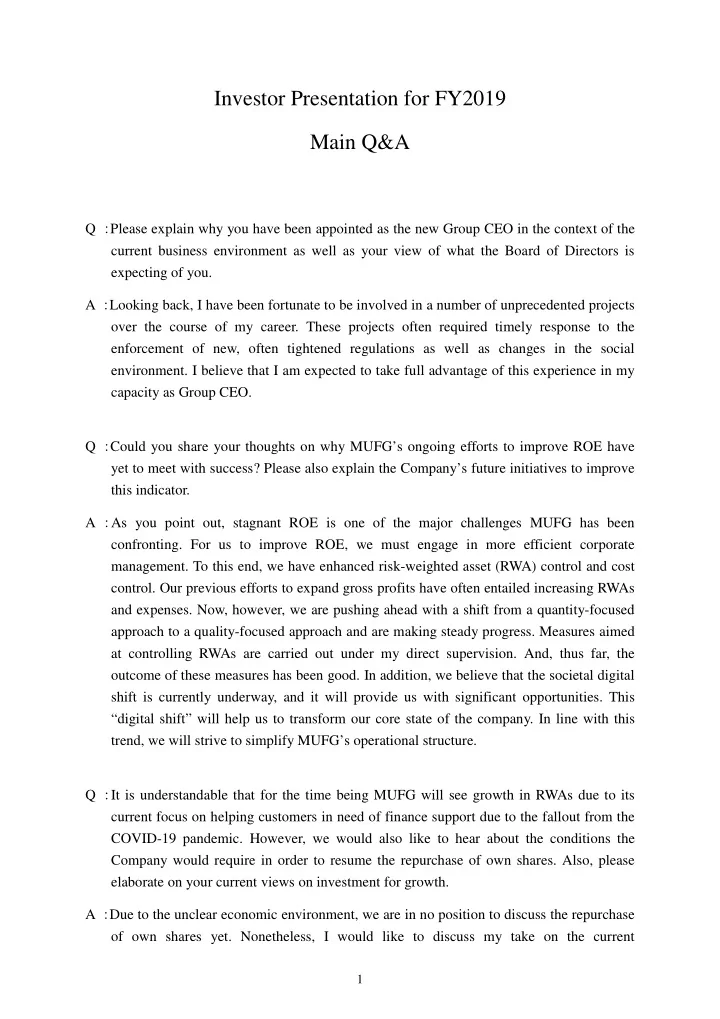
Q :Please explain why you have been appointed as the new Group CEO in the context of the current business environment as well as your view of what the Board of Directors is expecting of you. A :Looking back, I have been fortunate to be involved in a number of unprecedented projects

  • ver the course of my career. These projects often required timely response to the

enforcement of new, often tightened regulations as well as changes in the social

  • environment. I believe that I am expected to take full advantage of this experience in my

capacity as Group CEO. Q :Could you share your thoughts on why MUFG’s ongoing efforts to improve ROE have yet to meet with success? Please also explain the Company’s future initiatives to improve this indicator. A :As you point out, stagnant ROE is one of the major challenges MUFG has been

  • confronting. For us to improve ROE, we must engage in more efficient corporate
  • management. To this end, we have enhanced risk-weighted asset (RWA) control and cost
  • control. Our previous efforts to expand gross profits have often entailed increasing RWAs

and expenses. Now, however, we are pushing ahead with a shift from a quantity-focused approach to a quality-focused approach and are making steady progress. Measures aimed at controlling RWAs are carried out under my direct supervision. And, thus far, the

  • utcome of these measures has been good. In addition, we believe that the societal digital

shift is currently underway, and it will provide us with significant opportunities. This “digital shift” will help us to transform our core state of the company. In line with this trend, we will strive to simplify MUFG’s operational structure. Q : It is understandable that for the time being MUFG will see growth in RWAs due to its current focus on helping customers in need of finance support due to the fallout from the COVID-19 pandemic. However, we would also like to hear about the conditions the Company would require in order to resume the repurchase of own shares. Also, please elaborate on your current views on investment for growth. A :Due to the unclear economic environment, we are in no position to discuss the repurchase

  • f own shares yet. Nonetheless, I would like to discuss my take on the current
slide-2
SLIDE 2

2

circumstances, focusing on two points. First, MUFG has achieved turnarounds in consolidated net operating profits as well as in net operating profits in domestic customer segments, which excludes the impact of foreign exchange rates. We have made steady progress in reducing costs associated with domestic operations. These efforts are certainly helping enhance profits. Second, MUFG has shifted its focus from pursuing quantitative growth centered on

  • verseas to pursuing quality and its approach enables us to exercise more robust risk

control even as we secure profits. Moreover, as I explained earlier in my presentation on strategic emphasis, we will push ahead with digitalization in order to achieve a lower break-even point for our domestic retail operations, reshaping our global strategy, and

  • verhaul our business infrastructure and process innovation. By doing so, we will

eventually be able to secure some capital surplus. As for investment for growth, we believe that it is now time for MUFG to secure returns from a variety of the investments it has undertaken to date. Although we have completed

  • ur ASEAN commercial banking platform, we were still looking for the chance to make a

strategic investment in Asia’s digital field. Successfully, we have invested in Grab Holdings, a company engaged in digital-based services across ASEAN regions. We will go on to secure returns by connecting ASEAN’s conventional commercial banking business with digital technologies. At the same time, even though the downward trend in prices prevailing in the current market might provide us with opportunities for strategic investment, we will nevertheless place the utmost emphasis on assisting customers in their fundraising efforts. When the situation normalizes, we will then consider utilizing

  • ur capital for strategic purposes.

Q :Please explain your policies regarding the reduction of investment in and financing for coal fired power generation projects. A :In May 2019, we introduced more stringent policies with regard to financing for the coal fired power generation sector. In line with these policies, MUFG will not provide financing to new coal fired power generation projects. However, there might be exceptions wherein MUFG would engage in financing for such a project if no other technologies are available and the project is deemed consistent with the energy policies, circumstances of the related countries, and international standards. We expect the balance

  • f financing for the coal fired power generation sector to decline over the mid-to

long-term as we will not provide financing to new projects. Q :What are your projections on RWAs going forward? Please explain your thinking, including on how RWAs will be affected by the finance support in response to the crisis arising from the COVID-19 pandemic. Also, how are you simultaneously securing

slide-3
SLIDE 3

3

soundness and engaging in the support? A :MUFG is receiving a number of requests for consultations associated with fundraising needs arising from the crisis triggered by the COVID-19 pandemic. We receive such requests even from large corporates. Given this, we expect RWAs to grow by ¥5 trillion, due to the finance support to customers. We have introduced the framework to control RWAs carefully. If we must meet further fundraising needs going forward, we will introduce a variety of measures to control RWAs while keeping an eye on changes in the

  • environment. Regarding credit costs, we expect the level to almost double compared with

fiscal 2019 and amount to ¥450.0 billion in fiscal 2020. We believe that this credit cost projection, which considers the status of our portfolio amid the COVID-19 pandemic, can be deemed enough and is not an underestimation, even when considering the radical growth in credit costs following the global financial crisis. Although we are aware of risks arising from changes in the environment and the resulting volatility in credit costs, we think that the quality of our credit portfolio has improved since then. Therefore, we are confident that MUFG can maintain soundness as it engages in the finance support to its customers. Q :Please tell us your thoughts on how long it will be until MUFG’s profits return to the pre-pandemic level? We would like you to explain the relationship between financial targets for fiscal 2020 and the current mid-term business plan. A :As described on page 23 of the presentation material, we formulated our assumptions with reference to IMF’s baseline scenario released in April, expecting that, by the end of 2021, key indices regarding the Japanese economy will have improved nearly to the levels seen in 2019. In addition, our fiscal 2020 target for profits attributable to owners of the parent was formulated by factoring in a negative impact of approximately ¥420.0 billion, assuming 30% of corporate tax rate, due to the fallout from the pandemic. Before the crisis, we have been aiming to achieve profits attributable to owners of the parent of upper ¥900 billion. Likewise, the impact of the COVID-19 pandemic on net operating profits is expected to amount to negative ¥300.0 billion. If it had not been for the pandemic, MUFG would, we believe, have been able to set net operating profits target at approximately ¥1,350.0 billion, an increase of about ¥170.0 billion year on year. Q :Please explain your views on credit risks associated with the energy and mining- and air transportation-related portfolios. Regarding those in the energy and mining-related sector, please share your assumptions regarding WTI oil price as well as the results of sensitivity analyses, if any. A :For fiscal 2020, we have formulated a credit cost forecast totaling approximately ¥30.0

slide-4
SLIDE 4

4

billion specifically for the energy and mining-related portfolio based on an assumed WTI

  • il price of around US$30 per barrel. If the WTI oil price drops about US$5, we can

expect relevant credit costs to increase by approximately ¥20.0 billion. For the air transportation-related portfolio, we formulated a credit cost forecast totaling more than ¥10.0 billion. In addition, the volume of credit extended to customers in the air transportation-related sector grew to ¥1.8 trillion, reflecting the inclusion of a total of ¥500.0 billion in lending assets transferred from DVB Bank in November 2019. Of these, relatively high-risk assets account for only 20% or so and the majority have relatively low Loan-to-Value (LTV) ratios. However, as we are aware of various risks specific to aircraft finance, we will pay close attention to the credit portfolio in this sector. In addition, we can receive supports from a specialist team of DVB Bank charged with aircraft collateral

  • management. Thanks to this team, the Group can utilize robust expertise in the collection
  • f claims and the disposal of collateral.

Q :What is your future outlook on capital allocation? Please also share your thoughts on key variables that could affect capital allocation. A :Primary variables include an expected increase in RWAs. Although we anticipate this increase to reach up to around ¥5 trillion, we expect the Common Equity Tier 1 (CET1) capital ratio to somewhat fall short of 11% should this scenario come into play. Q :Currently, the outlook for Asian economies suggests that growth rates will decelerate, and interest rates in the region are lower than ever before. The profitability of commercial banking operations is thus expected to decline in Asia. Given this, please tell us your criteria regarding additional strategic investment or withdrawal from existing investment. A :Our judgments on investment and withdrawal are based on a framework that manages ROI vis-à-vis capital costs. Although on a global basis we anticipate changes triggered by the COVID-19 pandemic in a variety of areas, our fundamental policy of seizing

  • pportunities arising from economic growth in overseas markets remains unchanged.

Economic growth may indeed decelerate in Asian countries, but it will still stay relatively high and strong compared with that in Japan. Furthermore, MUFG is currently collaborating with Grab Holdings to offer services combining the conventional financial services provided by our partner banks in Asia and a variety of the latter’s digital

  • technologies. Because of this, we expect our commercial banking operations in Asia to be

able to secure moderate profits. Q :Please describe how you see the post-pandemic business environment and explain the positioning of the Eleven Transformation Initiatives of the MUFG Re-Imagining Strategy.

slide-5
SLIDE 5

5

Also, how are you evaluating progress under the Eleven Transformation Initiatives in the context of their KPI targets? A :The majority of megatrends that have accelerated under the pandemic were actually

  • ngoing even before the emergence of COVID-19. We therefore believe that our Eleven

Transformation Initiatives are still relevant, but we also think that a restructuring is called

  • for. Specifically, our functions engaged in domestic retail banking and global operations

as well as those under corporate centers and headquarters must be realigned considering the changing times. Accordingly, we will partially restructure our Eleven Transformation

  • Initiatives. Regarding KPIs, although we have made steady progress in sales channel and

Business Process Reengineering (BPR), we must further accelerate our initiatives in these areas going forward to remain on-trend with the digitalization of the society. In addition, the outcomes of initiatives to upgrade our model for wholesale banking in Japan and initiatives associated with real estate value chain strategies have been favorable. At the same time, there remain some issues to be addressed regarding the transformation

  • f wealth management business, the institutional investors business and the Global

Corporate & Investment Banking business. Looking ahead, we will address these issues in the course of restructuring the Eleven Transformation Initiatives. Q :What are your views on the current level of MUFG’s stock price? A :We are aware of the harsh feedback from domestic and overseas investors with regard to

  • ur weak points, namely, low ROE, high expense ratios and low PBR (stock prices). A

listed company’s stock price reflects its popularity in society. It also reflects investor expectations regarding that company’s future vision and growth potential. MUFG’s management therefore considers its stock price to be an important indicator. We are aware

  • f the two most critical challenges in front of us. Namely, we must realize more efficient
  • perations and clearly communicate our vision for a future business model. Going

forward, we will strive to clarify and communicate our future vision for such a business model amid widespread “digital shift” and growing public expectations regarding corporate contributions to society. We believe these endeavors as well as our efforts to improve efficiencies will help raise MUFG’s stock price. Q :Please explain the impact of the COVID-19 pandemic on MUFG’s operational status in the countries in which it operates. A :In Europe and the United States, work from home has been in widespread even before the

  • pandemic. Thanks to this, business activities were not significantly affected. In Japan,

so-called remote work programs have yet to gain the popularity they enjoy in Europe and the United States. However, there has been a growing shift from face-to-face customer

slide-6
SLIDE 6

6

communications to e-mail. This and other changes may help MUFG staff in Japan adopt a more efficient way of doing business. Q :Please elaborate on the pandemic’s impact on net operating profits and credit costs. A :The impact on net operating profits, totaling negative ¥300.0 billion, is mainly due to two factors: a decrease attributable to drops in interest rates and deterioration in other market conditions; and a decrease attributable to shrinkage in transactional volume. These two factors are each expected to account for around 50% of the impact. Looking at the breakdown of the amount in terms of the MUFG Group’s domestic and overseas

  • perations, a loss of net operating profits that would otherwise be earned from domestic

customer segments accounts for more than half of the ¥300.0 billion, while a loss of net

  • perating profits from the Global Markets Business Group accounts for a quarter.

Meanwhile, the impact of the COVID-19 pandemic is expected to increase credit costs by ¥200.0 billion. Of this increase, MUFG Group’s domestic and overseas operations will each account for around 50%. The breakdown of total credit costs amounting to ¥450.0 billion is quite similar, with the Group’s domestic and overseas operations accounting for around 50% each. END