
SLIDE 1
INVESTOR PRESENTATION
February, March, and April 2019
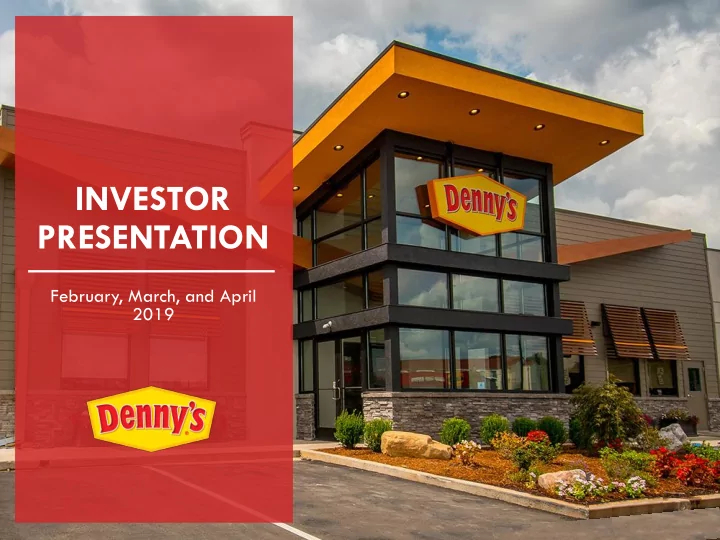
INVESTOR PRESENTATION February, March, and April 2019 - - PowerPoint PPT Presentation
INVESTOR PRESENTATION February, March, and April 2019 FORWARD-LOOKING STATEMENTS AND NON-GAAP FINANCIAL MEASURES Dennys Corporation urges caution in considering its current trends and any outlook on earnings disclosed in this presentatio n.
February, March, and April 2019
INVESTOR PRESENTATION 2
Denny’s Corporation urges caution in considering its current trends and any outlook on earnings disclosed in this presentation. In addition, certain matters discussed may constitute forward-looking statements. These forward-looking statements, which reflect the Company’s best judgment based on factors currently known, are intended to speak only as of the date such statements are made and involve risks, uncertainties, and other factors that may cause the actual performance of Denny’s Corporation, its subsidiaries and underlying restaurants to be materially different from the performance indicated or implied by such statements. Words such as “expects”, “anticipates”, “believes”, “intends”, “plans”, “hopes”, and variations of such words and similar expressions are intended to identify such forward-looking
statements to reflect events or circumstances after the date of this presentation or to reflect the occurrence of unanticipated events. Factors that could cause actual performance to differ materially from the performance indicated by these forward-looking statements include, among others: the competitive pressures from within the restaurant industry; the level of success of the Company’s operating initiatives, advertising and promotional efforts; adverse publicity; health concerns arising from food-related pandemics, outbreaks of flu viruses, such as avian flu, or other diseases; changes in business strategy or development plans; terms and availability of capital; regional weather conditions; overall changes in the general economy, particularly at the retail level; political environment (including acts of war and terrorism); and other factors from time to time set forth in the Company’s SEC reports, including but not limited to the discussion in Management’s Discussion and Analysis and the risks identified in Item 1A. Risk Factors contained in the Company’s Annual Report on Form 10-K for the year ended December 26, 2018 (and in the Company’s subsequent quarterly reports on Form 10-Q). The presentation includes references to the Company’s non-GAAP financials measures. All such measures are designated by an asterisk (*). The Company believes that, in addition to other financial measures, Adjusted Income Before Taxes, Adjusted EBITDA, Adjusted Free Cash Flow, Adjusted Net Income and Adjusted Net Income Per Share are appropriate indicators to assist in the evaluation of its operating performance on a period-to-period basis. The Company also uses Adjusted Income Before Taxes, Adjusted EBITDA and Adjusted Free Cash Flow internally as performance measures for planning purposes, including the preparation of annual operating budgets, and for compensation purposes, including bonuses for certain employees. Adjusted EBITDA is also used to evaluate its ability to service debt because the excluded charges do not have an impact on its prospective debt servicing capability and these adjustments are contemplated in its credit facility for the computation of its debt covenant ratios. Adjusted Free Cash Flow, defined as Adjusted EBITDA less cash portion
regarding the allocation of resources. However, Adjusted Income Before Taxes, Adjusted EBITDA, Adjusted Free Cash Flow, Adjusted Net Income and Adjusted Net Income Per Share should be considered as a supplement to, not a substitute for, operating income, net income or
GAAP reconciliations.
INVESTOR PRESENTATION 3
* See Appendix for reconciliation of Net Income to Adjusted EBITDA, Adjusted Net Income, Adjusted Net Income per Share (also called Adjusted Earnings per Share), and Adjusted Free Cash Flow.
revenue is limited to company restaurant sales and royalties, fees and occupancy revenue from franchised and licensed restaurants. Accordingly, domestic franchise same-store sales and domestic system-wide same-store sales should be considered as a supplement to, not a substitute for, our results as reported under GAAP.
Consistently Growing Same-Store Sales2
Eight consecutive years of system-wide same-store sales1 growth Strong same-store sales1 performance relative to peers
Global Development
Nearly 350 new restaurants opened since 2011 (~20% of the system)2 60 international locations opened since 2011 (5 new countries)2 Enhanced international development agreements
Refranchising and Real Estate Strategy
Transitioning to a lower risk business model expected to have accretive impacts
Upgrading the quality of real estate portfolio through a series of like-kind exchanges
Strong Adjusted Free Cash Flow* and Shareholder Return
Generated nearly $390M in Adjusted Free Cash Flow* over the last 8 years Approximately $424M allocated to share repurchase program since November 20102
INVESTOR PRESENTATION 4
Drive Profitable Growth for All Stakeholders Grow the Global Franchise Consistently Operate Great Restaurants Deliver a Differentiated and Relevant Brand
Enabled Through Technology and Training + Close Collaboration with Franchise Partners
Food Service Atmosphere
INVESTOR PRESENTATION 5
FOCUS ON BETTER QUALITY, MORE CRAVEABLE PRODUCTS Nearly 80% of Core Menu Entrées Changed or Improved Since Our Revitalization Began Leading to Significant Improvement in Taste and Quality Scores and Sales Growth
INVESTOR PRESENTATION 6
FEATURED PRODUCTS INCLUDE OMELETTES AND HEARTY COMFORT DINNER ENTREES
INVESTOR PRESENTATION 7
INVESTOR PRESENTATION 8
High awareness as 1 in 5 guests say they visit Denny’s because of $2468 Value Menu Utilize local and national media targeting popular products like $4 Everyday Value Slam 19% average incidence rate of $2468 Value Menu since national launch in April 2010, ranging from approximately 15% to 23% Positive guest response to new LTO value entrée
INVESTOR PRESENTATION 9
30% 25% 23% 22% 27% 38% 21% 14%
0% 10% 20% 30% 40% Breakfast Lunch Dinner Late Night
Share of Transactions by Daypart1
Off-Premise Transactions Dine-In Transactions
12% 43% 25% 12% 8%
0% 10% 20% 30% 40% 50% 18 - 24 25 - 34 35 - 44 45 - 54 55+
Online Transactions by Age1
86% 76% 77% 82% 70% 71%
0% 20% 40% 60% 80% 100% Company Domestic Franchise Total Domestic
Delivery Status2
Eligible for Delivery Active with Delivery
1. Data for the Fiscal Fourth Quarter 2018. 2. Data as of December 26, 2018, the end of Fiscal Fourth Quarter 2018.
89% 89% 7% 8% 4% 3%
60% 70% 80% 90% 100% Company Franchise
Sales by Channel1
Dine In Pick Up Delivery
INVESTOR PRESENTATION 10
Who they are:
Largely identify as part of the Millennial generation Have a family-first focus and are increasingly becoming multi-generational (especially amongst Hispanics) Mobile-centric and constantly have access to multiple screens
How we are connecting with them:
Digital Video TV Content Digital & Social Data & Tech Search
INVESTOR PRESENTATION 11
1. Data as of December 26, 2018, the end of Fiscal Fourth Quarter 2018. Includes new openings and international restaurants.
Q4 20181 Estimated Year End 2019
INVESTOR PRESENTATION 12
Legacy Denny’s New Denny’s
INVESTOR PRESENTATION 13
strategies driving improvements in service scores
evaluate and share best practices
executing remodels, improving speed of service, and growing margins
Growth Initiatives Enabled Nearly 350 New Restaurant Openings Since 2011 With 95% Opened by Franchisees1
INVESTOR PRESENTATION 14
56 34 41 32 37 36 32 21 5 6 5 6 8 14 7 9 61 40 46 38 45 50 39 30
10 20 30 40 50 60 70 2011 2012 2013 2014 2015 2016 2017 2018 Domestic Openings International Openings System Openings
1. Data as of December 26, 2018, the end of Fiscal Fourth Quarter 2018.
TOP OP 10 10 U.S. MARKETS1
DMA MA UNI UNITS TS Los Angeles 179 Phoenix 66 Houston 61 Dallas/Ft. Worth 53 Sacramento/Stockton 51 San Francisco/Oakland 44 Orlando/Daytona 41 San Diego 40 Chicago 38 Miami/Ft. Lauderdale 35
Approximately 1,600 Restaurants in the U.S.1 with Strongest Presence in West Coast, Southwest, Texas, and Florida
1. Data as of December 26, 2018, the end of Fiscal Fourth Quarter 2018.
INVESTOR PRESENTATION 15
6 5 11 8 1 25 2 6
International Presence of 131 Restaurants in 12 Countries and U.S. Territories has grown by over 50% Since Year End 20101
INVESTOR PRESENTATION 16
United States 1,578 Canada 74 Puerto Rico 14 Mexico 11 New Zealand 7 Philippines 7 Honduras 6 Costa Rica 3 United Arab Emirates 3 Guam 2 United Kingdom 2 El Salvador 1 Guatemala 1
Hon
Dub ubai Gua Guatemala la Ci City ty Phi hilip ippines
1. Data as of December 26, 2018, the end of Fiscal Fourth Quarter 2018.
INVESTOR PRESENTATION 17
1. Data as of December 26, 2018, the end of Fiscal Fourth Quarter 2018.
Well Diversified, Experienced, and Energetic Group of 246 Franchisees
restaurants each collectively comprise
Denny’s Franchisee Association Convention is evidence of our growing momentum and brand relevance
Ownership of 1,536 Franchisee Restaurants1
Number of Franchise Units Number of Franchisees Total Franchise Units Total Franchise Units as % of Total 1 84 84 5% 2 – 5 92 255 17% 6 – 10 35 268 17% 11 – 15 12 149 10% 16 – 30 13 277 18% > 30 10 503 33% Total 246 1,536 100%
INVESTOR PRESENTATION 18
Marketing Brand Advisory Council Operations Brand Advisory Council Supply Chain Oversight Committee Development Brand Advisory Council Denny’s Franchisee Association Technology Brand Advisory Council
Training Initiatives PRIDE Reviews Operations Support Purchase product for system Outperformed PPI by avg of ~1ppt each year over the last decade Successful Heritage Remodels Prototype Development Lease & Asset Management Menu Innovation Media Support Product Testing Annual Convention Steering Committee Meetings Joint Board Meetings Customer Facing Technology Denny’s On Demand Common POS Platform
INVESTOR PRESENTATION 19
INVESTOR PRESENTATION 20
Sell 90 to 125 Company operated restaurants Stimulate growth through attached development commitments Generate over $100 million in pre-tax proceeds
INVESTOR PRESENTATION 21
Estimated Refranchising Impact
Restaurants to be refranchised 90 - 125 Estimated Adjusted EBITDA* Impact ($20M - $27M) + Incremental Royalties (@4.5%) $8M - $11M + Incremental Rent $2M - $3M + Cost Savings $10M - $12M Net Adjusted EBITDA* Impact ~$0 + Benefit of lower maintenance Cash CapEx $7M - $10M Adjusted Free Cash Flow* Impact $7M - $10M
* See Appendix for reconciliation of Net Income to Adjusted EBITDA, Adjusted Net Income, Adjusted Net Income per Share (also called Adjusted Earnings per Share), and Adjusted Free Cash Flow.
INVESTOR PRESENTATION 22
1,536 1,624 1,659 173 91 56
1,400 1,450 1,500 1,550 1,600 1,650 1,700 1,750 1,800
Current Refranchise 90 Refranchise 125
Restaurant Store Count
Franchise Restaurants Company Restaurants
Current Post Refranchising States with Company Restaurants 21 ~8 DMAs with Company Restaurants 48 ~14
40 - 50 60 - 70
1. Data as of December 26, 2018, the end of Fiscal Fourth Quarter 2018. Includes the sale of 8 restaurants that occurred in Fiscal Fourth Quarter 2018.
1
$2.3
15.3%
0% 5% 10% 15% 20% 25% $0.0 $0.5 $1.0 $1.5 $2.0 $2.5 $3.0 $3.5 $4.0
What We Are Selling Current Company Portfolio What We Are Keeping Restaurant Operating Margin (non-GAAP) Average Unit Volume ($ in millions)
AUV’s & Margins
AUV Company Restaurant Operating Margin (Non-GAAP)
INVESTOR PRESENTATION 23 10% - 12% 19% - 21%
$2.7 - $2.9 $1.9 - $2.1
Estimated Refranchising Proceeds
Restaurants to be refranchised 90 - 125 AUV of restaurants we are selling $1.9M - $2.1M Company Restaurant Operating Margin (Non-GAAP) 10% - 12% Estimated Multiple 4.0x - 5.0x Pre-tax Refranchising Proceeds >$100M
1. Data as of December 26, 2018, the end of Fiscal Fourth Quarter 2018.
1 1
INVESTOR PRESENTATION 24
G&A % of LTM System-Wide Sales1
2.3% 2.1% 2.3% 2.1% 2.0% 2.0% 1.8% 1.9% 2.0% 2.1% 2.2% 2.3% 2.4%
1. Source: Company filings as of 9/7/2018.
Post Refranchising Pre Refranchising
25% 50% 25%
Total Savings $10M - $12M
Field Support (Operating Margins) Corporate Support (G&A) Franchise Support Cost Sharing (G&A)
2 4 6 8
Total Debt to LTM EBITDA Benchmarking1
INVESTOR PRESENTATION 25 Denny’s Current Target Range2
2.5x 3.5x
Current Credit Facility Limitation 2.94x
Q3 2018
2.79x
Q4 2017 Q4 2016
2.45x
3.1x
4.1x 6.6x 6.8x 7.3x
1. Source: FactSet based on most recent company filings as of 12/31/2018. 2. Denny’s target leverage guidance (Total Debt / LTM Adjusted EBITDA*) provided in conjunction with credit facility refinance announced October 31, 2017.
INVESTOR PRESENTATION 26
Upgrade quality of real estate portfolio through a series of like-kind exchanges Sell between 25% and 30% of the 951 properties currently owned Generate proceeds of approximately $30 million Redeploy proceeds to acquire higher quality real estate Cash proceeds from the sale of property are not captured in Cash Capital Expenditures while purchases of property are included
1. Data as of December 26, 2018, the end of Fiscal Fourth Quarter 2018.
INVESTOR PRESENTATION 27
INVESTOR PRESENTATION 28
Total System Sales Have Grown by Approximately $500 Million Since 2011 Adjusted EBITDA* Growth of 29% Over Last 7 Years
all Denny’s locations worldwide, including franchise and licensed restaurants which are non-consolidated entities. Total operating revenue is limited to company restaurant sales and royalties, fees and occupancy revenue from franchised and licensed restaurants. Accordingly, total system sales should be considered as a supplement to, not a substitute for, our results as reported under GAAP. * See Appendix for reconciliation of Net Income to Adjusted EBITDA, Adjusted Net Income, Adjusted Net Income per Share (also called Adjusted Earnings per Share), and Adjusted Free Cash Flow.
$81.7 $78.6 $78.0 $83.1 $88.8 $100.2 $103.3 $105.3 $65.0 $70.0 $75.0 $80.0 $85.0 $90.0 $95.0 $100.0 $105.0 $110.0 2011 2012 2013 2014 2015 2016 2017 2018 $Ms
Adjusted EBITDA*
$2.4 $2.5 $2.5 $2.6 $2.7 $2.8 $2.9 $2.9 $2.2 $2.3 $2.4 $2.5 $2.6 $2.7 $2.8 $2.9 $3.0 2011 2012 2013 2014 2015 2016 2017 2018
Total System Sales1
$Bs
INVESTOR PRESENTATION 29
Steady Growth in Company Restaurant Average Unit Volumes Company Margins grew over 17% from 2011
$53.8 $51.5 $44.8 $45.9 $58.7 $65.2 $65.6 $63.2 $35.0 $40.0 $45.0 $50.0 $55.0 $60.0 $65.0 $70.0
2011 2012 2013 2014 2015 2016 2017 2018
$Ms
Company Restaurant Operating Margin (Non-GAAP)
$1.8 $1.9 $2.0 $2.1 $2.2 $2.3 $2.3 $2.3 $1.45 $1.60 $1.75 $1.90 $2.05 $2.20 $2.35 $2.50 2011 2012 2013 2014 2015 2016 2017 2018
Company Restaurant AUVs
$Ms
INVESTOR PRESENTATION 30
Steady Growth in Franchise Restaurant Average Unit Volumes Franchise Operating Margins grew by ~26% Over the Last 7 Years1
$82.6 $88.0 $88.2 $92.9 $94.9 $98.8 $99.5 $104.0 $70.0 $75.0 $80.0 $85.0 $90.0 $95.0 $100.0 $105.0 $110.0 2011 2012 2013 2014 2015 2016 2017 2018 $Ms
Franchise Operating Margin (Non-GAAP)1
growth, over the last 7 years. See appendix for further details.
$1.4 $1.4 $1.4 $1.5 $1.6 $1.6 $1.6 $1.6 $1.25 $1.30 $1.35 $1.40 $1.45 $1.50 $1.55 $1.60 $1.65 $1.70 2011 2012 2013 2014 2015 2016 2017 2018
Franchise Restaurant AUVs
$Ms
INVESTOR PRESENTATION 31
0.7% 1.3% 0.5% 2.8% 5.8% 0.9% 1.1% 0.8% 1.5% (0.7%) 1.0% 1.4% (2.0%) (1.0%) 0.0% 1.0% 2.0% 3.0% 4.0% 5.0% 6.0% 7.0% 2011 2012 2013 2014 2015 2016 2017 2018 Q1 '18 Q2 '18 Q3 '18 Q4 '18
Domestic System-Wide Same-Store Sales1
same-store sales and domestic system-wide same-store sales should be considered as a supplement to, not a substitute for, our results as reported under GAAP.
Eighth Consecutive Year of Positive Domestic System-Wide Same-Store Sales1 Growth
INVESTOR PRESENTATION 32
Highly Franchised Business Provides Lower Risk with Additional Upside from Operating Higher Volume Company Restaurants
$19.5 $25.2 $29.3 $32.9 $36.7 $42.3 $40.7 $44.6
$0.20 $0.26 $0.31 $0.37 $0.43 $0.55 $0.58 $0.68 $0 $10 $20 $30 $40 $50 $0.00 $0.10 $0.20 $0.30 $0.40 $0.50 $0.60 $0.70 2011 2012 2013 2014 2015 2016 2017 2018 Adjusted Net Income* ($ Millions) Adjusted Net Income* per Share Adjusted Net Income* Adjusted Net Income per Share*
* See Appendix for reconciliation of Net Income to Adjusted EBITDA, Adjusted Net Income, Adjusted Net Income per Share (also called Adjusted Earnings per Share), and Adjusted Free Cash Flow.
INVESTOR PRESENTATION 33
* See Appendix for reconciliation of Net Income to Adjusted EBITDA, Adjusted Net Income, Adjusted Net Income per Share (also called Adjusted Earnings per Share), and Adjusted Free Cash Flow. ** Full Year Guidance provided in Fourth Quarter 2018 Earnings Release dated February 12, 2019.
Nearly $390 Million in Adjusted Free Cash Flow* Generated Over Last 8 Years 2019 Guidance anticipates $20 - $25 million of cash capital expenditures for real estate acquisitions through like-kind exchanges (see slide 26)
$13 - $16 ~$21 $35 - $40
$23 - $26 $95 - $100
$17 $12 $9 $8 $8 $11 $15 $20
$1 $2 $3 $4 $5 $3 $6 $3 $16 $16 $21 $22 $33 $34 $31 $32
$82 $79 $78 $83 $89 $100 $103 $105 $48 $49 $45 $49 $42 $52 $51 $50 $0 $20 $40 $60 $80 $100 $120
2011 2012 2013 2014 2015 2016 2017 2018 2019 Guidance**
$ Millions
Cash Capital Cash Taxes Cash Interest Adjusted EBITDA* Adjusted Free Cash Flow*
INVESTOR PRESENTATION 34
Growing Adjusted EBITDA* Enables Higher Leverage while Maintaining Financial Flexibility to Make Investments and Return Capital to Shareholders
0.0x 0.5x 1.0x 1.5x 2.0x 2.5x 3.0x 3.5x 2010 2011 2012 2013 2014 2015 2016 2017 2018 $0 $100 $200 $300 $400 $500 $600 Total Debt / Adjusted EBITDA* Total Debt* ($ Millions) Total Debt* Total Debt / Adjusted EBITDA*
* See Appendix for reconciliation of Net Income to Adjusted EBITDA, Adjusted Net Income, Adjusted Net Income per Share (also called Adjusted Earnings per Share), and Adjusted Free Cash Flow. Total Debt is Gross Debt including Capital Lease Obligations.
$3.9 $21.6 $22.2 $24.7 $36.0 $105.8 $58.7 $82.9 $68.0 Q4 2010 2011 2012 2013 2014 2015 2016 2017 2018
INVESTOR PRESENTATION 35
to repurchase shares in 2018
remaining in existing share repurchase authorization program1
share repurchase program on November 16, 2018
SHARE REPURCHASES ($ Millions) Approximately $424 Million Allocated Towards Share Repurchases Since We Started to Return Excess Capital to Shareholders in Late 20101
1. Data as of December 26, 2018, the end of Fiscal Fourth Quarter 2018.
INVESTOR PRESENTATION 36
Between 2010 and February 22, 2019, Denny’s Stock Price Rose 412%, or 3.0X the S&P Small Cap 600 Index and 1.6X the S&P Small Cap 600 Restaurants Index
(50%) 0% 50% 100% 150% 200% 250% 300% 350% 400% 450%
Dec-10 Feb-11 Apr-11 Jun-11 Aug-11 Oct-11 Dec-11 Feb-12 Apr-12 Jun-12 Aug-12 Oct-12 Dec-12 Feb-13 Apr-13 Jun-13 Aug-13 Oct-13 Dec-13 Feb-14 Apr-14 Jun-14 Aug-14 Oct-14 Dec-14 Feb-15 Apr-15 Jun-15 Aug-15 Oct-15 Dec-15 Feb-16 Apr-16 Jun-16 Aug-16 Oct-16 Dec-16 Feb-17 Apr-17 Jun-17 Aug-17 Oct-17 Dec-17 Feb-18 Apr-18 Jun-18 Aug-18 Oct-18 Dec-18 Feb-19
DENN Up 412% S&P Small Cap 600 Restaurants Index Up 259% S&P Small Cap 600 Index Up 138%
2011 The Beginning of Denny’s Brand Revitalization
INVESTOR PRESENTATION 37
* See Appendix for reconciliation of Net Income to Adjusted EBITDA, Adjusted Net Income, Adjusted Net Income per Share (also called Adjusted Earnings per Share), and Adjusted Free Cash Flow.
INVESTOR PRESENTATION 38
INVESTOR PRESENTATION 39
John C. Miller, President and CEO since 2011 with over 30 years experience in restaurant operations and management. Prior to joining Denny’s, served as President of Taco Bueno and spent 17 years with Brinker International where positions held included President of Romano’s Macaroni Grill and President of Brinker’s Mexican Concepts.
Officer of Danka Business Systems and senior financial positions with Hollywood Entertainment, Metromedia Restaurant Group (operators of Bennigans, Ponderosa Steakhouse, and Steak & Ale), and the Grand Metropolitan. Christopher D. Bode, Senior Vice President, Chief Operating Officer. Prior to joining Denny’s in 2011, served as Chief Operating Officer of QSR Management, LLC (a franchisee of Dunkin’ Donuts) and Vice President of Development & Construction of Dunkin’ Brands, Inc. Before joining the restaurant industry, served as a United States Navy Communications Specialist. John W. Dillon, Senior Vice President, Chief Brand Officer. Prior to joining Denny’s in 2007, held multiple marketing leadership positions with various
Rockets. Stephen C. Dunn, Senior Vice President, Chief Global Development Officer. Prior to joining Denny’s in 2004, held executive-level positions with Church's Chicken, El Pollo Loco, Mr. Gatti's, and TCBY. Earned the distinction of Certified Franchise Executive by the International Franchise Association Educational Foundation. Timothy E. Flemming, Senior Vice President, General Counsel and Chief Legal Officer. Joined the Company in 1993 and has served as General Counsel since 2008 after having served in the same capacity for the primary subsidiaries since 2005. Additional food service experience includes serving as Assistant General Counsel of Compass Group, North America. Jill A. Van Pelt, Senior Vice President, Chief People Officer. Joined Denny's in 2006 as Senior Director of Total Rewards and named Vice President of Human Resources in 2008. Prior experience includes various positions in Accounting, Human Resources Systems, and Human Resources for Maytag, Coastal Corporation, and Dynegy. Robert P. Verostek, Senior Vice President, Finance. Joined Denny’s in 1999 and served in numerous leadership positions across the Finance and Accounting teams. Named Vice President of Financial Planning and Analysis in 2012. Prior experience includes various accounting roles for Insignia Financial Group. Michael L. Furlow, Senior Vice President, Chief Information Officer. Prior to joining Denny’s in 2017, served as Chief Information Officer and Senior Vice President of IT at Red Robin Gourmet Burgers and CEC Entertainment, Inc. (an operator and franchisor of Chuck E. Cheese’s and Peter Piper Pizza).
INVESTOR PRESENTATION 40
Lauderback)
(José Gutiérrez)
Brenda Lauderback, and Laysha Ward)
Haywood, and Laysha Ward)
Franchisee)
INVESTOR PRESENTATION 41
($ in millions) 2017 2017 (Actual) (Pro Forma) Franchise and license revenue $138.8 $221.8 Advertising and other fees 83 Advertising and other costs (83) Costs of franchise and license revenue (39.3) (122.3) Franchise Operating Margin (Non-GAAP) $99.5 $99.5 Franchise Operating Margin Rate (Non-GAAP) 71.7% 44.9%
Advertising and Other Fees & Costs Will now be separately reflected in revenue and expense Initial Franchise Fees Will now be recognized ratably
($ in 000’S)
EXAMPLE Initial Fee $40 Year 1 Year 2 Year 3 . . . . Year 20
Previous Standard
Cash Receipt $40 Revenue $40
New Standard
Cash Receipt $40 Revenue $2 $2 $2 $2
Note: We recorded deferred revenue of approximately $21 million as of the first day of fiscal 2018 related to previously recognized initial franchise fees. The deferred revenue will be amortized over the remaining term of the related franchise agreements.
Revenue recognition changes will not impact any other components of franchise and license revenue, costs of franchise and license revenue, overall business cash flows, or cash taxes and effective tax rates.
INVESTOR PRESENTATION 42
$ Millions (except per share amounts) 2006 2007 20081 2009 2010 2011 2012 2013 20141 2015 2016 2017 2018 Net Income (loss) $28.7 $29.5 $12.7 $41.6 $22.7 $112.3 $22.3 $24.6 $32.7 $36.0 $19.4 $39.6 $43.7 Provision for Income Taxes2 16.3 6.7 3.5 1.4 1.4 (84.0) 12.8 11.5 16.0 17.8 16.5 17.2 8.6 Operating (Gains) Losses and Other Charges, Net (47.9) (31.1) (6.4) (14.5) (4.9) 2.1 0.5 7.1 1.3 2.4 26.9 4.3 2.6 Other Non-Operating (Income) Expense, Net 8.0 0.7 9.2 (3.1) 5.3 2.6 7.9 1.1 (0.6) 0.1 (1.1) (1.7) 0.6 Share‐Based Compensation 7.6 4.8 4.1 4.7 2.8 4.2 3.5 4.9 5.8 6.6 7.6 8.5 6.0 Deferred Compensation Plan Valuation Adjustments5 0.5 0.5 (1.8) 1.0 0.5 (0.1) 0.7 1.1 0.5 0.0 0.9 1.6 (1.0) Interest Expense, Net 57.7 43.0 35.5 32.6 25.8 20.0 13.4 10.3 9.2 9.3 12.2 15.6 20.7 Depreciation and Amortization 55.3 49.3 39.8 32.3 29.6 28.0 22.3 21.5 21.2 21.5 22.2 23.7 27.0 Cash Payments for Restructuring Charges & Exit Costs (5.1) (9.1) (9.1) (7.5) (7.0) (2.7) (3.8) (2.8) (2.0) (1.5) (1.8) (1.7) (1.1) Cash Payments for Share‐Based Compensation (0.9) (0.9) (1.0) (2.4) (1.9) (0.8) (1.0) (1.2) (1.1) (3.4) (2.5) (3.9) (1.9) Adjusted EBITDA5 120.3 93.3 86.6 86.0 74.3 81.7 78.6 78.0 83.1 88.8 100.2 103.3 105.3 Adjusted EBITDA Margin % 12.1% 9.9% 11.4% 14.1% 13.6% 15.2% 16.1% 16.9% 17.6% 18.1% 19.8% 19.5% 16.7% Cash Interest Expense (50.9) (38.5) (31.6) (29.3) (23.1) (17.0) (11.6) (9.1) (8.1) (8.3) (11.2) (14.6) (19.6) Cash Taxes (1.3) (2.3) (1.1) (0.6) (0.9) (1.1) (2.0) (2.8) (3.8) (5.4) (3.0) (6.4) (3.3) Capital Expenditures (33.1) (33.1) (27.9) (18.4) (27.4) (16.1) (15.6) (20.8) (22.1) (32.8) (34.0) (31.2) (32.4) Adjusted Free Cash Flow5 35.1 19.5 26.1 37.7 23.0 47.5 49.4 45.3 49.1 42.3 51.9 51.2 50.0 Net Income (loss) $112.3 $22.3 $24.6 $32.7 $36.0 $19.4 $39.6 $43.7 Pension Settlement Loss 0.0 0.0 0.0 0.0 0.0 24.3 0.0 0.0 Losses (Gains) on Sales of Assets and Other, Net (3.2) (7.1) (0.1) (0.1) (0.1) 0.0 3.5 (0.5) Impairment Charges 4.1 3.7 5.7 0.4 0.9 1.1 0.3 1.6 Early Extinguishment of Debt 1.4 7.9 1.2 0.0 0.3 0.0 0.0 0.0 Tax Reform 0.0 0.0 0.0 0.0 0.0 0.0 (1.6) 0.0 Tax Effect of Adjustments3 (0.8) (1.6) (2.2) (0.1) (0.4) (2.5) (1.2) (0.2) Adjusted Provision for Income Taxes4 (94.3) 0.0 0.0 0.0 0.0 0.0 0.0 0.0 Adjusted Net Income $19.5 $25.2 $29.3 $32.9 $36.7 $42.3 $40.7 $44.6 Diluted Net Income Per Share $1.15 $0.23 $0.26 $0.37 $0.42 $0.25 $0.56 $0.67 Adjustments Per Share ($0.95) $0.03 $0.05 $0.0 $0.01 $0.30 $0.02 $0.01 Adjusted Net Income Per Share $0.20 $0.26 $0.31 $0.37 $0.43 $0.55 $0.58 $0.68 Diluted Weighted Average Shares Outstanding (000’s) 99,588 96,754 92,903 88,355 84,729 77,206 70,403 65,562
1. Includes 53 operating weeks. 2. In the fourth quarter of 2011, we recorded an $89 million net deferred tax benefit from the release of a substantial portion of the valuation allowance on certain deferred tax assets. This release was primarily based on our improved historical and projected pre-tax income. 3. Tax adjustments for full year 2011 and 2012 are calculated using the Company's full year 2012 effective tax rate of 36.4%. Tax adjustments for full year 2013, 2014, 2015, 2017 and 2018 use full year effective tax rates of 31.9%, 32.9%, 33.0%, 30.3% and 16.4%, respectively. Tax adjustment for the loss on pension termination for the year ended December 28, 2016 is calculated using an effective tax rate of 8.8%. The remaining tax adjustments for the year ended December 28, 2016 are calculated using the Company's effective tax rate of 30.9%. 4. Adjusted provision for income taxes based on effective income tax rate of 36.4% for full year ended Dec. 27, 2012 and excludes impact of net deferred tax benefit. 5. Beginning in 2018, historical presentations of Adjusted EBITDA and Adjusted Free Cash Flow have been restated to exclude the impact of market valuation changes in our non-qualified deferred compensation plan liabilities.