Investment Policies and Strategies Tuesday, October 16 1:50-3:05 - - PDF document

investment policies and strategies
SMART_READER_LITE
LIVE PREVIEW

Investment Policies and Strategies Tuesday, October 16 1:50-3:05 - - PDF document

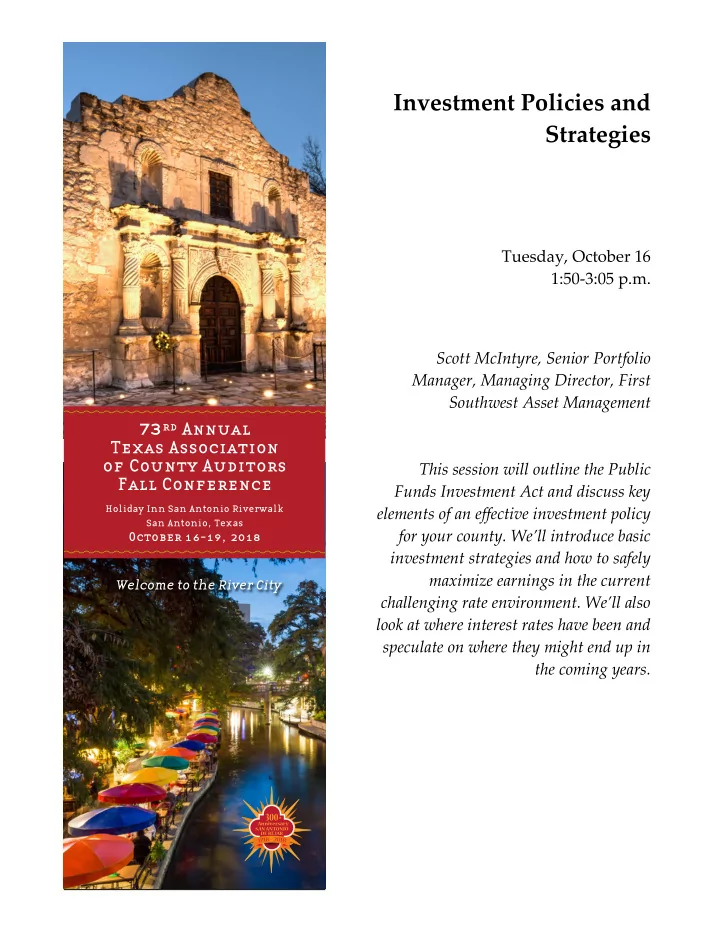
Investment Policies and Strategies Tuesday, October 16 1:50-3:05 p.m. Scott McIntyre, Senior Portfolio Manager, Managing Director, First Southwest Asset Management 73 rd Annual Texas Association of County Auditors This session will outline


slide-1
SLIDE 1

73rd Annual

Texas Association

  • f County Auditors

Fall Conference

Holiday Inn San Antonio Riverwalk San Antonio, Texas

October 16-19, 2018

Anniversary SAN ANTONIO

300

DE BÉJAR

th

Welcome to the River City

Investment Policies and Strategies

Tuesday, October 16 1:50-3:05 p.m. Scott McIntyre, Senior Portfolio Manager, Managing Director, First Southwest Asset Management This session will outline the Public Funds Investment Act and discuss key

elements of an effective investment policy

for your county. We’ll introduce basic investment strategies and how to safely maximize earnings in the current challenging rate environment. We’ll also look at where interest rates have been and speculate on where they might end up in the coming years.

slide-2
SLIDE 2

Scott McIntyre, Senior Portfolio Manager, Managing Director, First Southwest Asset Management, San Antonio McIntyre is a managing director and senior portfolio manager with First Southwest Asset Management, where he provides investment advice and consulting, as well as portfolio management to local governments throughout the nation. McIntyre is also responsible for reviewing investment policies, assisting in overall strategy formulation, evaluating account performance and overseeing the day-to- day operations of the investment management division. Prior to joining First Southwest in June 1998, McIntyre spent four years as a partner in an Austin-based investment advisory firm specializing in the management of public funds, and five years as an Investment

  • fficer for the Texas State Treasury.
slide-3
SLIDE 3

Section 8 – Investment Policies & Strategies 8 - 1

Investment Policies and Strategies

Texas Association of County Auditors 2018 Fall Conference, San Antonio Tuesday, October 16, 2018

Scott McIntyre, CFA Managing Director 300 West Sixth Street, Suite 1940 Austin, Texas 78701 512.481.2009 Tel scott.mcintyre@hilltopsecurities.com

Why Adopt an Investment Policy?

  • It’s a primary investment control
  • It’s the law
  • It prioritizes investment goals
  • It establishes risk tolerance
slide-4
SLIDE 4

Section 8 – Investment Policies & Strategies 8 - 2

Governing Statutes

  • Investments
  • Government Code, Title 10, Chapter 2256 (Public Funds Investment Act)
  • Local Government Code, Chapter 116.112
  • Collateral
  • Government Code, Title 10, Chapter 2257 (Public Funds Collateral Act)
  • Local Government Code, Chapter 116.051-060

Investment Policy

  • Review other policies (There’s no plagiarism in policy-making)
  • Refer to PFIA (Take language directly from the Act)
  • Consult your attorney for compliance
  • Approach Commissioners for feedback
  • Balance your need for flexibility with your need for control
  • Make sure policy is not too restrictive ...or too liberal
slide-5
SLIDE 5

Section 8 – Investment Policies & Strategies 8 - 3

Overview

  • An effective policy

should provide more than just the basic PFIA requirements.

  • An effective policy

provides the foundation for all investment decisions and establishes critical

  • controls. The policy

should clearly define:

 Portfolio Objectives  Acceptable Risk  Permitted Investments

EFFECTIVE INVESTMENT POLICY

Policy Requirements of the Act

  • Each governing body must adopt a

written investment policy and fund strategies.

  • The policy must emphasize safety

and liquidity

  • Address diversification, yield,

maturity and capability of management.

  • Include: a list of authorized

investments, maximum allowable maturity for individual securities and the maximum WAM for pooled fund groups.  Safety  Yield  Liquidly

EFFECTIVE INVESTMENT POLICY

slide-6
SLIDE 6

Section 8 – Investment Policies & Strategies 8 - 4

Policy Requirements of the Act

  • The governing body must review policy and strategies at least

annually and adopt written proof of the review.

  • A compliance audit of management controls on investments and

policy compliance must be performed annually.

Elements of the Policy

Scope

Objectives Delegation of Responsibility Training Prudence Authorized Investments Investment Limitations

EFFECTIVE INVESTMENT POLICY

slide-7
SLIDE 7

Section 8 – Investment Policies & Strategies 8 - 5

Elements of the Policy (cont.)

Authorized Brokers and Financial Institutions Safekeeping Collateralization Reporting Ethics and Conflict of Interest

EFFECTIVE INVESTMENT POLICY

Strategy

Scope

  • State the funds or pooled fund group to which the policy applies.
  • Does not apply to retirement funds.
slide-8
SLIDE 8

Section 8 – Investment Policies & Strategies 8 - 6

Objectives

  • Clearly sets the tone of the policy
  • Investment of Funds shall be governed by the following priorities:

 Safety of principal (detail)

 Liquidity  Yield

Delegation of Responsibility

  • Designate one or more persons as investment officer(s) to be

responsible for investment of its funds.

  • A person may not deposit, withdraw, transfer or manage funds without

express written authority consistent with the policy.

slide-9
SLIDE 9

Section 8 – Investment Policies & Strategies 8 - 7

Training

  • The Treasurer, CFO (if not the Treasurer) and the investment officer(s) shall:

 Attend 10 hours training from an independent source within 12 months after taking office  Ongoing 10 hours training not less than once every 2 years  Receive instruction in investment controls, security risks, strategy risks, market risks, diversification and compliance with the Act

Year 5 Appointed to Office 10 Hours of Training 10 Hours of Training Year 1 Year 3 10 Hours of Training

Prudence

  • Competitive bidding requirement
  • Prudent Person statement
  • In determining whether investment officer has exercised prudence, consider:

 investment of the total portfolio and not the performance of any individual security  whether the investment decision was consistent with written policy

slide-10
SLIDE 10

Section 8 – Investment Policies & Strategies 8 - 8

Authorized Investments

  • Obligations of, or guaranteed by the U.S. Government (2256.009) to include:

 Direct obligations of the U.S. and its agencies and instrumentalities, including letters of credit.  Direct Obligations of the state of Texas  Collateralized Mortgage Obligations (CMOs)  Other obligations of Texas, the U.S., or their agencies.  Obligations of U.S. states, cities, counties, school districts or other political subdivisions rated A or better.  State of Israel Bonds

Authorized Investments

  • Certificates of Deposit (2256.010)

 May be secured by obligations described in 2256.009 or in any other manner provided by law  Includes “shared certificates” or CDARS CDs.

  • Repurchase Agreements (2256.011)

 Must be secured by obligations in 2256.009

  • Securities Lending (2256.0115)
  • Bankers Acceptances (2256.012)
  • Commercial Paper (2256.013)
slide-11
SLIDE 11

Section 8 – Investment Policies & Strategies 8 - 9

Authorized Investments

  • Mutual Funds (2256.014)

– Money Market Mutual Funds are appropriate

  • Guaranteed Investment Contracts (2256.015)

– Includes Flex Repos within this section – Very Specific IRS Bidding Requirements (Be careful!)

  • Investment Pools (2256.016)

– Specific pools must be approved by resolution

  • Additional investments options for specified entities:

– Higher Education (2256.020); Municipal Utility (2256.0201); Funds from mineral rights (2256.0202); Ports and Navigation Districts (2256.0203); Qualified Independent School Districts (2256.0204)

New Authorized Investments

  • Section 2256.009(a) was modified to allow interest bearing bank deposits

insured by the FDIC or National Credit Union Share Insurance Fund. In addition, specific language was added authorizing the shared deposit programs in a manner very similar to the shared certificates of deposit.

  • 2256.014(b) was amended to allow so‐called ultra‐short bond funds that

have a duration of less than one year and whose investments are limited to investment grade securities, excluding asset‐backed securities.

  • Section 2256.0206 authorizes certain entities (generally those with at

least $250 million of outstanding debt) to enter into hedging agreements in order to “protect against economic loss due to price fluctuation of a commodity or related investment…” Eligible entities would be allowed to lock in costs of fuel, energy, construction expenses and similar.
slide-12
SLIDE 12

Section 8 – Investment Policies & Strategies 8 - 10

Unauthorized Investments

  • These are expressly prohibited:

 Principal-Only CMOs or “POs”  Interest-Only CMOs or “IOs”  Inverse floating rate CMOs  Any CMO with a stated final maturity longer than 10 years

Investment Limitations

  • The maximum allowable percentage of each security type should be clearly

stated.

  • Specific limits are not defined by PFIA.
  • Minimum % only for liquidity purposes.
  • Example: At no time shall (the entity) exceed the stated percentage of each

investment type

  • Treasuries 100%
  • Agencies 75%
  • Authorized Pools 50%
  • Commercial Paper 10%
  • Specific issuer limitations may be added as well
  • CP issuers 5%
  • Agencies issuers 25%
slide-13
SLIDE 13

Section 8 – Investment Policies & Strategies 8 - 11

Suggested Further Qualifications

  • Governmental obligations:
  • Be specific in your policy
  • Are all agency names acceptable?
  • Callable limits
  • Investments not authorized (2256.009b)
  • Repurchase Agreements
  • Limited to Primary Dealers?
  • Are Reverses authorized? Limits?

Suggested Further Qualifications

  • Commercial Paper and Bankers Acceptances
  • Authorized list of issuers
  • Domestic names only(?)
  • Mutual Funds
  • Does the fund invest in securities not authorized in your

policy?

  • Are non-MM mutual funds authorized?
  • Pools
  • AAA and AAAm only
slide-14
SLIDE 14

Section 8 – Investment Policies & Strategies 8 - 12

Inter-local Agreements

  • The Commissioners Court has to execute inter-local agreements to participate in Local

Government Investment Pools.

  • Listing LGIPs in the policy isn’t enough to allow you to invest in a pool.

Authorized Brokers and other Financial Institutions

  • A copy of the policy shall be presented to any person seeking to sell

an investment to the entity. The Registered Principal shall certify in writing that:

The RP has read the policy and Has reasonable procedures and controls in place to preclude investment transactions not authorized by policy.

  • Prohibited from buying securities from any person not providing this

document in substantially the same form

  • The governing body shall annually review and adopt a list of qualified

brokers authorized to transact business (2256.025)

slide-15
SLIDE 15

Section 8 – Investment Policies & Strategies 8 - 13

Suggested Broker Due Diligence

  • In addition, any broker seeking to transact business with the entity

should:  Provide updated financial statements  Complete a broker/dealer questionnaire  Provide a recent resume for the account rep  Provide references in the public sector  Use FINRA’s Broker Check to review regulatory filings and employment history: (http://www.finra.org/Investors/ToolsCalculators/BrokerCheck/ )

Safekeeping

  • All securities shall be held by a third-party custodian in the entity’s name.
  • A monthly safekeeping statement must be provided by the custodian and reconciled monthly

by the investment officer

  • All securities shall settle on a “delivery-versus-payment” basis.
slide-16
SLIDE 16

Section 8 – Investment Policies & Strategies 8 - 14

Collateralization

  • Repurchase Agreements and CDs

 State required collateral percentages  List acceptable securities  State a “mark-to-market” requirement

Reporting

  • The Act requires that specific data be reported.
  • A quarterly written report, jointly prepared and signed by each

investment officer, must be presented to the governing body and CEO.

  • State compliance of the portfolio with the policy, strategy and Act

provisions.

  • Portfolio pricing frequency and source
  • Reviewed by auditors if securities are purchased
slide-17
SLIDE 17

Section 8 – Investment Policies & Strategies 8 - 15

Reporting (cont.)

  • The following must appear in quarterly reports:

 Detail of the investment position on reporting date  Summary statement for each fund group stating: – beginning market value – ending market value – fully accrued interest for the period  Book value, market value and maturity of each separate asset by type of security and fund

Ethics and Conflict of Interest

  • Language: Investment officers shall refrain from personal business activity that could be

interpreted as a conflict of interest or which could impair their ability to make unbiased decisions.

  • Disclose personal business relationships with any firm or individual seeking to sell

investments.

  • A statement must be filed with the Texas Ethics Commission and the Governing Body if

present.

slide-18
SLIDE 18

Section 8 – Investment Policies & Strategies 8 - 16

Internal Controls

  • The investment officer is responsible for establishing and maintaining a set of written controls

designed to ensure that financial assets are protected from theft, loss or misuse.  Detailed Procedures  Examples  Back-ups  Phone numbers

Other Key Points

  • The policy should be expected to govern future investment officers

who may have less experience than current officers.

  • Understand all investments that are authorized by policy.
  • Take the time to review your policy on a regular basis.
slide-19
SLIDE 19

Section 8 – Investment Policies & Strategies 8 - 17

Investment Strategies for Texas Counties

Strategy Basics

  • The Public Funds Investment Act
  • Individual Investment Policy
  • Dynamic Investment Strategies
slide-20
SLIDE 20

Section 8 – Investment Policies & Strategies 8 - 18

BE A SLY INVESTOR

  • PFIA requires that investment strategies address the following
  • bjectives in order of importance:

– Suitability – Is the investment suitable for the entity – Safety – preservation and safety of principal – Liquidity – does the investment meet the entities need for funds – Marketability – in case the investment must be sold – Diversification – strategies should address diversification – Yield – dead last in order of priorities

  • SLY = Safety, Liquidity, Yield

Common Strategies

  • 100% Cash (pools, bank deposits,

money markets)

  • “Ladder”
  • “Barbell”
  • Buy and Hold
  • Active Management
slide-21
SLIDE 21

Section 8 – Investment Policies & Strategies 8 - 19

100% Pools or Full Liquidity

  • All funds held in fully liquid cash instruments – bank deposits, local government

investment pools, money market funds This strategy is beneficial when:

  • Interest rates are rising quickly
  • The yield curve is flat or inverted
  • No clear understanding of cash flow

Drawbacks:

  • Very low yields
  • Lacks diversification
  • Can be a problem when the market shifts directions and yields drop.

The Laddered Portfolio

  • The idea behind a laddered

portfolio is that securities are positioned so that maturities occur in regular intervals, providing a known stream of cash.

  • Cash Flow Matching – The

laddered portfolio may, or may not, correspond with expected future expenditures.

  • Regardless of the direction

interest rates move, you will be reinvesting at the prevailing market yield.

$0 $5 $10 $15

Laddered Portfolio

slide-22
SLIDE 22

Section 8 – Investment Policies & Strategies 8 - 20

The Barbell Portfolio

  • The idea behind a barbell is to

maintain some of the portfolio in pools or bank deposits and a portion in higher yielding securities with longer maturities – usually 18 to 36 months.

  • Pool rates will gradually rise as

the Fed increases the funds

  • target. The longer portfolio

securities will earn higher yields immediately.

$0 $5 $10 $15

Barbell Portfolio

Buy and Hold

  • Works well with a laddered portfolio
  • Effective when used in conjunction with a formal cash flow.
  • Keeps transaction costs down

 Has been proven to outperform “active management” on a total cost basis.

slide-23
SLIDE 23

Section 8 – Investment Policies & Strategies 8 - 21

Active Investment

  • r Active Management?

Active Management

  • Duration Management
  • Market Timing
  • Security Swaps
slide-24
SLIDE 24

Section 8 – Investment Policies & Strategies 8 - 22

Duration Management

  • Duration is a measure of portfolio risk
  • It tells us how much the portfolio’s value will change for a

given change in interest rates

  • Duration is closely tied to weighted average maturity
  • Duration management involves lengthening or shortening a

portfolios duration (or average maturity) depending on the

  • utlook for future interest rates
  • Difficult and marginally effective

Market Timing

  • The use of economic factors, such as strength of the economy and

interest rates, as well as technical factors, such as the direction of security prices and trading volume, in the decision-making process

  • ver what and when to buy or sell.
  • Difficult to implement, requires extensive analysis and time
  • Historically not effective
slide-25
SLIDE 25

Section 8 – Investment Policies & Strategies 8 - 23

Security Swaps

  • Selling existing securities that have become expensive in the market

and replacing them with comparable but cheaper securities.

  • Profit may be taken on the trade and a higher yield booked.
  • Typically shorter Treasury or agency issues are sold and replaced

with longer government securities, municipal securities or CP.

Investing in Different Security Types

slide-26
SLIDE 26

Section 8 – Investment Policies & Strategies 8 - 24

Defining “Spread”

The yield difference between two individual securities

  • Example:

A 2-year T-note yields 2.00% A 2-year agency yields 2.05% – The spread between these two securities is 5 basis points, 0.05% or 1/20 of 1%. – The agency is said to trade at +5 to the 2-yr

“Spread Product”

Agencies, CP and other security types provide higher yields by paying a “spread” over comparable Treasury issues.  First Rule of Thumb: Spread increases with the level of risk. Higher risk = higher spread. The more risk you are willing to take, the more you will get paid.  Second Rule of Thumb: Longer maturities mean more market risk and higher yields.

slide-27
SLIDE 27

Section 8 – Investment Policies & Strategies 8 - 25

Relative Value Within Security Types

  • If a brokerage firm owns a particular security, they should be able to offer it at a cheaper price

than one who doesn’t.

  • Quoted yields differ by offering size.
  • There are typically large differences in offering yields from CP issuers.
  • Being particular about dates can be costly.

Spread to Overnight Rates

  • The most common investment decision for public investors is whether the security beats

available pool or bank deposit rates.

  • In a “bear” market (yields rising) you must be compensated for future rate increases.
  • In a “bull” market (yields expected to fall), you may lock in yields below liquid rates.
slide-28
SLIDE 28

Section 8 – Investment Policies & Strategies 8 - 26

Historical Spreads

  • History determines an average spread between different security

types.

  • When that spread widens, it encourages investors to place more in

the higher yielding securities.

  • Keeping tabs on spreads helps pinpoint relative value, as well as

perceived risk.

Risk Spreads

  • Reasons why security spreads differ:
  • Credit risk (specific security risk)
  • Maturity length
  • Call risk
  • Liquidity
  • Risk/Return

– Key: Are you being adequately paid for the risk you are assuming?

slide-29
SLIDE 29

Section 8 – Investment Policies & Strategies 8 - 27

Diversification Strategies

…or not putting all of the eggs in a single basket

Diversification Basics

Variable Rate vs. Fixed Rate

  • Pools, money market funds, and floaters pay variable rates that rise

and fall with the market.

  • …so, as the Fed cuts rates, variable earnings fall.
  • Fixed rate securities “lock in” yields to a determined maturity date.
  • …so, as the Fed cuts rates, fixed rate security yields are

unaffected. – Be careful with callable securities. Although they have a fixed rate, if interest rates fall, they will be called.

slide-30
SLIDE 30

Section 8 – Investment Policies & Strategies 8 - 28

Diversification Basics

Variable Rate vs. Fixed Rate

  • Even “experts” cannot predict future interest rates.
  • Variable securities (alone) cannot diversify!

Objective 1 : Strive to achieve a mix of fixed and variable rate investments.

  • Remember- Pools and money market funds are variable rate.

Diversification Basics

Diversification by Security Type

  • All securities are subject to event risk and many securities are subject to default risk.
  • An unforeseen event may force a sale at unfavorable times at below market prices.
  • Investors cannot avoid the risk, but they can minimize the potential negative effect.

Objective 2: Limit overall exposure to CP issuers, municipals, and agency issues.

slide-31
SLIDE 31

Section 8 – Investment Policies & Strategies 8 - 29

Diversification with Commercial Paper

General Safety Rules: 1. PFIA requires a minimum A1 / P1 rating 2. Research/document before buying 3. Create an authorized issuer list 4. Immediately liquidate downgraded issues 5. Review CP placed on Credit Watch (negative)

Diversification Basics

Diversification by Maturity Date

  • Again, even experts can’t predict interest rates.
  • In the future, yields may be higher or lower than they are today.
  • Don’t “lock in” high % of funds on the long end.
  • Don’t maintain high % of funds in the short end.

Objective 3: By spreading out maturities, or laddering the portfolio, investors can continually invest funds into the current market.

slide-32
SLIDE 32

Section 8 – Investment Policies & Strategies 8 - 30

Discipline and Patience

  • Long-term advantage of a good strategy
  • Timing risk

General Investing in Actual Rate Environments

slide-33
SLIDE 33

Section 8 – Investment Policies & Strategies 8 - 31

Fed Funds History

Yield Curves

  • Positive
  • Flat
  • Inverse

5.00% 5.50% 6.00% 6.50% 7.00% 7.50% Pool rate 91 day discos 180 day discos 270 day discos 1 yr. agency 2 yr. agency 5.00% 5.50% 6.00% 6.50% 7.00% Pool rate 91 day discos 180 day discos 270 day discos 1 yr. agency 2 yr. agency 3.00% 4.00% 5.00% 6.00% 7.00% Pool rate 91 day discos 180 day discos 270 day discos 1 yr. agency 2 yr. agency

slide-34
SLIDE 34

Section 8 – Investment Policies & Strategies 8 - 32

Market Trends Indicative Yield Comparison 2/17/00

5.77% 5.97% 6.30% 6.37% 6.62% 6.98% 5.00% 5.50% 6.00% 6.50% 7.00% Pool rate 91 day discos 180 day discos 270 day discos 1 yr. agency 2 yr. agency

slide-35
SLIDE 35

Section 8 – Investment Policies & Strategies 8 - 33

Market Trends

Flat yield curve …with no clear market direction

Indicative Yield Comparison 8/31/00

6.58% 6.51% 6.60% 6.70% 6.66% 6.75% 5.00% 5.50% 6.00% 6.50% 7.00% Pool rate 91 day discos 180 day discos 270 day discos 1 yr. agency 2 yr. agency

slide-36
SLIDE 36

Section 8 – Investment Policies & Strategies 8 - 34

Market Trends

Falling yields (Rising prices)

Indicative Yield Comparison 2/28/01

5.59% 4.90% 4.82% 4.80% 4.75% 4.87% 3.50% 4.00% 4.50% 5.00% 5.50% Pool rate 91 day discos 180 day discos 270 day discos 1 yr. agency 2 yr. agency

slide-37
SLIDE 37

Section 8 – Investment Policies & Strategies 8 - 35

Market Trends

Rising rates (Falling prices) What do we do?

Indicative Yield Comparison 2/3/2017

0.00% 0.50% 1.00% 1.50% 2.00% Pool rate 91 day discos 180 day discos 270 day discos 1 yr. agency 2 yr. agency

0.54% 0.55% 0.65% 0.75% 0.88% 1.25%

slide-38
SLIDE 38

Section 8 – Investment Policies & Strategies 8 - 36

Indicative Yield Comparison 8/7/2018

0.00% 0.50% 1.00% 1.50% 2.00% 2.50% 3.00%

Pool rate 91 day discos 180 day discos 270 day discos 1 yr. agency 2 yr. agency

1.92% 2.00% 2.20% 2.35% 2.50% 2.75%

  • Many investment strategies may appear counter-intuitive
  • Diversification is always the right answer
  • Sometimes the least obvious way to lose money is being too

conservative

  • NEVER invest in securities that you don’t understand
slide-39
SLIDE 39

Section 8 – Investment Policies & Strategies 8 - 37

QUESTIONS?

slide-40
SLIDE 40
slide-41
SLIDE 41

Free Lined Graph Paper from http://incompetech.com/graphpaper/lined/

slide-42
SLIDE 42

Free Lined Graph Paper from http://incompetech.com/graphpaper/lined/