Investment Advisers Under Heightened Scrutiny: Lessons from Recent - - PowerPoint PPT Presentation

investment advisers under heightened scrutiny lessons
SMART_READER_LITE
LIVE PREVIEW

Investment Advisers Under Heightened Scrutiny: Lessons from Recent - - PowerPoint PPT Presentation

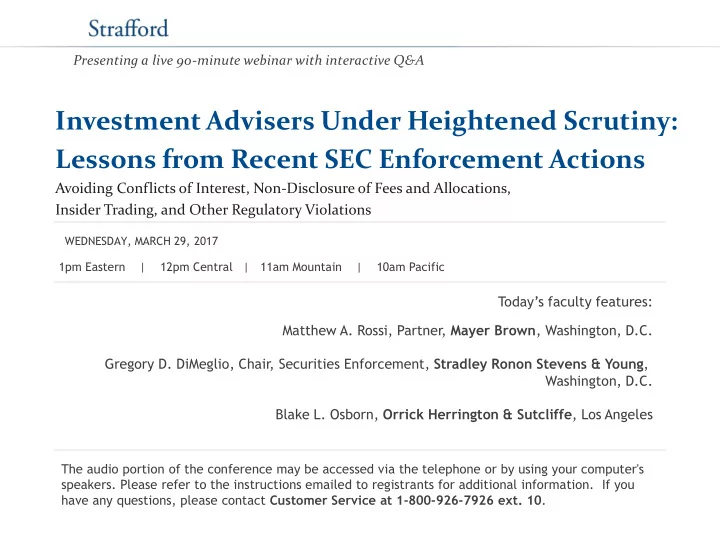
Presenting a live 90-minute webinar with interactive Q&A Investment Advisers Under Heightened Scrutiny: Lessons from Recent SEC Enforcement Actions Avoiding Conflicts of Interest, Non-Disclosure of Fees and Allocations, Insider Trading, and


slide-1
SLIDE 1

The audio portion of the conference may be accessed via the telephone or by using your computer's

  • speakers. Please refer to the instructions emailed to registrants for additional information. If you

have any questions, please contact Customer Service at 1-800-926-7926 ext. 10.

Presenting a live 90-minute webinar with interactive Q&A

Investment Advisers Under Heightened Scrutiny: Lessons from Recent SEC Enforcement Actions

Avoiding Conflicts of Interest, Non-Disclosure of Fees and Allocations, Insider Trading, and Other Regulatory Violations

Today’s faculty features:

1pm Eastern | 12pm Central | 11am Mountain | 10am Pacific WEDNESDAY, MARCH 29, 2017

Matthew A. Rossi, Partner, Mayer Brown, Washington, D.C. Gregory D. DiMeglio, Chair , Securities Enforcement, Stradley Ronon Stevens & Young, Washington, D.C. Blake L. Osborn, Orrick Herrington & Sutcliffe, Los Angeles

slide-2
SLIDE 2

Tips for Optimal Quality

Sound Quality If you are listening via your computer speakers, please note that the quality

  • f your sound will vary depending on the speed and quality of your internet

connection. If the sound quality is not satisfactory, you may listen via the phone: dial 1-888-450-9970 and enter your PIN when prompted. Otherwise, please send us a chat or e-mail sound@straffordpub.com immediately so we can address the problem. If you dialed in and have any difficulties during the call, press *0 for assistance. Viewing Quality To maximize your screen, press the F11 key on your keyboard. To exit full screen, press the F11 key again.

FOR LIVE EVENT ONLY

slide-3
SLIDE 3

Continuing Education Credits

In order for us to process your continuing education credit, you must confirm your participation in this webinar by completing and submitting the Attendance Affirmation/Evaluation after the webinar. A link to the Attendance Affirmation/Evaluation will be in the thank you email that you will receive immediately following the program. For additional information about continuing education, call us at 1-800-926-7926

  • ext. 35.

FOR LIVE EVENT ONLY

slide-4
SLIDE 4

Program Materials

If you have not printed the conference materials for this program, please complete the following steps:

  • Click on the ^ symbol next to “Conference Materials” in the middle of the left-

hand column on your screen.

  • Click on the tab labeled “Handouts” that appears, and there you will see a

PDF of the slides for today's program.

  • Double click on the PDF and a separate page will open.
  • Print the slides by clicking on the printer icon.

FOR LIVE EVENT ONLY

slide-5
SLIDE 5

5

Investmen Investment Adv t Advisers isers Under Under Heightened Heightened Scrutiny: Lessons Scrutiny: Lessons from from Rec Recent SEC Enfor ent SEC Enforcemen cement t Actions Actions

March 29, 2017

Gregory D. DiMeglio, Chair, Securities Enforcement

Stradley Ronon Stevens & Young, LLP

Blake L. Osborn, Managing Associate

Orrick Herrington & Sutcliffe

Matthew A. Rossi, Co-Leader, Securities Litigation & Enforcement Group

Mayer Brown

This presentation is for educational purposes only. It should not be construed as legal advice

  • r opinion or as a substitute for the advice of counsel.
slide-6
SLIDE 6

6

Agenda

  • FY2016 Enforcement Results
  • Coordination with OCIE
  • Whistleblowers
  • Other Priorities and Trends
  • Mutual Fund Advisers
  • Private Fund Advisers
  • Other Investment Advisers
  • Gatekeepers
  • Questions
slide-7
SLIDE 7

7

FY2016 Enforcement Results

  • Overall
  • “SEC Announces Enforcement Results for FY 2016” (Oct. 11,

2016 Press Release)

  • In the SEC’s most recent fiscal year, ended September 2016,

the agency:

  • Filed 868 enforcement actions (7.56% more than in fiscal year

2015)

  • Of these 807 actions, 548 were independent enforcement actions

(8% more than in fiscal year 2015 and a record for the agency)

  • Obtained orders for more than $4 billion in disgorgement and

penalties

slide-8
SLIDE 8

8

FY2016 Enforcement Results

  • Investment Advisers
  • “Increase in Actions Involving Investment Advisers”

(Oct. 11, 2016 press release)

  • “The new single year high for SEC enforcement

actions for the fiscal year that ended September 30 included the most ever cases involving investment advisers or investment companies (160) and the most ever independent or standalone cases involving investment advisers or investment companies (98).”

slide-9
SLIDE 9

9

Coordination with OCIE

  • Examination Results
  • Of the exams conducted by OCIE in the SEC’s 2015

fiscal year:

  • 77% of exams identified deficiencies
  • 31% of exams identified deficiencies deemed

significant by examiners

  • 11% of exams were referred to Enforcement
  • According to former Director Marc Wyatt, OCIE

views “the SEC’s policy and enforcement divisions… as customers of our examinations.”

  • Enforcement actions routinely credit the

examination staff

slide-10
SLIDE 10

10

Coordination with OCIE

  • Increased Staffing
  • OCIE examined just 10% of registered investment

advisers in the SEC’s 2015 fiscal year

  • By comparison, the SEC and SROs (such as FINRA)

examined 51% of broker-dealers in fiscal 2015

  • OCIE has bolstered staffing for the IA/IC program by

20%

slide-11
SLIDE 11

11

Coordination with OCIE

  • Examination Priorities
  • In January, OCIE issued its priorities for 2017, which include:
  • Electronic Investment Advice (“Robo-advisers”) – examinations will focus
  • n registrants’ compliance programs, marketing, formulation of investment

recommendations, data protection and disclosures relating to conflicts of interest as well as a review of firms’ compliance practices for overseeing algorithms that generate recommendations

  • Wrap Fee Programs – review of account suitability, effectiveness of

disclosures, conflicts of interest, and brokerage practices, to determine whether investment advisers are acting in a manner consistent with their fiduciary duty and whether they are meeting their contractual obligations to clients

  • Exchange-Traded Funds – examinations for compliance with applicable

exemptive relief granted under the Securities Exchange Act of 1934 (“1934 Act”) and the 1940 Act and with other regulatory requirements, as well as review ETFs’ unit creation and redemption processes

  • Never-Before Examined Investment Advisers – focused, risk-based

examinations of newly registered advisers and selected advisers registered for a longer period who have never been examined by OCIE

slide-12
SLIDE 12

12

Coordination with OCIE

  • Examination Priorities (continued)
  • Recidivist Representatives and their Employers – the deployment of

analytics to identify individuals with a track record of misconduct and the examination of their employers’ compliance oversight and controls

  • Multi-Branch Advisers – examinations with particular attention to the

compliance programs and oversight of advisory services for registered investment advisers which use a branch office model

  • The ReTIRE Initiative – examinations will focus on registrants’

recommendations and sales of variable insurance products and the sales and the sales and management of target date funds, along with an assessment of controls surrounding cross-transactions

  • Senior Investors – an evaluation of how firms manage their interactions

with senior advisers, including registrants’ supervisory programs and controls relating to products and services directed at senior investors

slide-13
SLIDE 13

13

Coordination with OCIE

  • Examination Priorities (continued)
  • Money Market Funds – examinations for compliance with the 2014 rule

amendments, which became effective in October 2016, which will likely include assessments of board oversight of fund compliance with these new amendments as well as a review of compliance policies and procedures relating to stress testing and periodic fund reporting of information to the SEC

  • Cybersecurity – examination for cybersecurity compliance procedures

and controls, including testing the implementation of those procedures and controls

  • Municipal Advisors – examination of municipal advisors to evaluate

their compliance with SEC and Municipal Securities Rulemaking Board rules

  • Transfer Agents – examination of transfer agents’ timely turn around of

transfers, recordkeeping and record retention, and safeguarding of funds and securities, with particular attention to transfer agents servicing microcap issues

slide-14
SLIDE 14

14

Coordination with OCIE

  • OCIE February 7, 2017 Risk Alert
  • In a recent risk alert, OCIE noted the five compliance

topics most frequently identified in deficiency letters sent to SEC-registered investment advisers were:

  • The Compliance Rule
  • Regulatory filings
  • The Custody Rule
  • The Code of Ethics Rule
  • The Books and Records Rule
slide-15
SLIDE 15

15

Whistleblowers

  • “Most Ever Whistleblower Money Distributed in a

Single Year” (Oct. 11, 2016 Press Release)

  • Including 6 of the 10 highest awards
  • Awards to whistleblowers
  • In FY2016, the Whistleblower program issued awards

totaling over $57 million, exceeding the sum of all award amounts issued in previous years.

  • Total awards have since surpassed the $130 million mark.
  • Whistleblower awards can range from 10-30% of the money

collected when monetary sanctions exceed $1 million.

slide-16
SLIDE 16

16

Whistleblowers

  • SEC mainly looks for assistance in 3 primary areas:
  • Issuer Reporting and Disclosure
  • Offering Frauds and Ponzi Schemes
  • Foreign Corrupt Practices Act (“FCPA”)
  • In the SEC’s 2016 fiscal year, the Office of the

Whistleblower received over 4,218 tips

  • Cases
  • In May 2016, the SEC paid more than $3.5 million to a

company employee whose tip bolstered an on-going SEC investigation by allowing the SEC to focus on specific conduct that “significantly contributed” to the success of the enforcement action

slide-17
SLIDE 17

17

Whistleblowers

  • Cases (continued)
  • In August 2016, the SEC made its second largest award to

date, paying more than $22 million to a company insider whose detailed tip and extensive assistance helped the agency halt a well-hidden fraud at the employee’s company

  • In November 2016, the SEC made its third largest award ,

paying more than $20 million to a whistleblower that led to a near total recovery of investor funds.

  • In January 2017, the SEC paid more than $7 million split

among three whistleblowers who helped the SEC prosecute an investment scheme. One whistleblower provided information that was a primary impetus for the start of the SEC’s investigation, and the other two whistleblowers jointly provided new information during the SEC’s investigation.

slide-18
SLIDE 18

18

Whistleblowers

  • The SEC also made protecting its whistleblowers a

point of emphasis in FY2016, bringing 2 settled actions under the anti-retaliation provisions of the Dodd-Frank Act and no less than 8 settled actions against companies for violating Rule 21F-17, which prohibits anyone from taking any action to impede communications with the SEC about possible securities law violations

  • Identifying facts patterns of retaliation will continue to

be a focus in the upcoming fiscal year.

slide-19
SLIDE 19

19

Whistleblowers

  • Anti-Retaliation
  • The Commission brought a first-of-its kind stand-alone retaliation

case against a company (International Game Technology) in September 2016 (resulted in $500k penalty).

  • The SEC followed this matter up with another first, when it settled

with another company (SandRidge Energy Inc.) for retaliating against an internal whistleblower.

  • Severance Agreements
  • On two separate occasions, asset managers (Health Net Inc. &

BlackRock Inc.) agreed to pay $340,000 civil monetary penalties to settle charges that they improperly used separation agreements in which existing employees were forced to waive their ability to

  • btain whistleblower awards.
  • A technology company (NeuStar Inc.) agreed to pay a $180,000

civil monetary penalty for routinely entering into severance agreements that contained a broad non-disparagement clause forbidding former employees from engaging with the SEC and

  • ther regulators “in any communication that disparages,

denigrates, maligns or impugns” the company.

slide-20
SLIDE 20

20

Other Priorities and Trends

  • Process
  • Chair White’s “Broken Windows” Approach to

Enforcement

  • Suing companies and individuals for minor infractions to

try to prevent larger misdeeds.

  • This philosophy raised concerns from the industry and

SEC Commissioners themselves

  • SEC had a record number of enforcement actions in the

last fiscal year (868), but many did not involve allegations of investor harm and settled without a fine or penalty.

slide-21
SLIDE 21

21

Other Priorities and Trends

  • Process (continued)
  • SEC Chair Nominee Jay Clayton
  • Likely to get away from the “Broken Windows” Approach, but what

does that mean?

  • The current administration indicates that it wants to de-regulate, but often

fraud pops up in deregulatory environments. The current Chair will likely try to balance deregulation efforts by still ensuring that that there is still a presence (albeit smaller) across all waterfronts.

  • Rollback of Dodd-Frank
  • Difficult process to actually accomplish due to the law’s

complexities, but cutbacks could include conflict minerals and executive pay ratio

  • Current Acting Chairman Michael Piwowar suggested such at SEC

Speaks because it ultimately burden the “forgotten investor.”

slide-22
SLIDE 22

22

Other Priorities and Trends

  • Process (continued)
  • Cooperation and Self-Reporting
  • Deferred prosecution agreements
  • Admissions
  • As of November 2016, the SEC has obtained admissions from

77 defendants and respondents – 30 individuals and 47 entities

  • 6 of these admissions involved investment advisers
slide-23
SLIDE 23

23

Other Priorities and Trends

  • Process (continued)
  • SEC In-House Courts
  • New Amendments to Rules of Practice governing

administrative proceedings adopted July 2016.

  • Prehearing period expanded from 4 months to maximum of 10

months

  • Right to notice 3/5 depositions
  • Clarifying rules on dispositive motions, admissibility of certain

types of evidence, expert disclosures and appellate procedures

  • Challenges to the Constitutionality of These Courts
  • Bandimere (10th Circuit) and Lucia (D.C. Circuit)
slide-24
SLIDE 24

24

Other Priorities and Trends

  • Substance
  • Conflicts of Interest: Investment advisers are

fiduciaries and must disclose conflicts of interest to their clients. SEC v. Capital Gains Research Bureau, Inc., 375 U.S. 180 (1963).

  • Conflicts of interest are always included in OCIE’s

annual examination priorities.

  • The former co-chief of the SEC’s Asset Management

Unit stated in 2015 that the AUM aggressively pursues enforcement cases involving conflicts because “disinterested investment advice – or alternatively, clients’ knowledge of any conflicts that might render their adviser’s advice not disinterested – is at the heart of advisers’ fiduciary relationship with clients.”

slide-25
SLIDE 25

25

Other Priorities and Trends

  • Conflicts of interest that resulted in recent

enforcement actions include:

  • Principal transactions without the required disclosure &

consent

  • Placing clients in inappropriate share classes
  • Undisclosed sources of compensation and referral fees
  • Undisclosed allocations of fees and expenses, use of

affiliated service providers, and outside business activities

  • Advisers negotiating discounts for themselves based on

work performed for fund clients

  • Disclosure of conflicts must be adequate and

timely.

slide-26
SLIDE 26

26

Other Priorities and Trends

  • Substance (continued)
  • Insider Trading
  • In FY2016, the SEC charged 78 parties in cases

involving trading on the basis of inside information.

  • The Enforcement Division is using data and analytics to

identify suspicious trading.

  • Recent federal court decisions sought to clarify the

personal benefit test for tipper-tippee insider trading liability originally set forth in Dirks v. SEC, 463 U.S. 646 (1983).

  • U.S. v. Newman, 773 F.3d 438 (2d Cir. 2014)
  • Salman v. U.S., 137 S.Ct. 420 (Dec. 6, 2016)
slide-27
SLIDE 27

27

Other Priorities and Trends

  • Substance (continued)
  • Pay to Play
  • Rule 206(4)-5: Subjects investment advisers to a 2-year

timeout from providing compensatory advisory services to a government client after making political contributions to a candidate who could influence the investment adviser selection process for a public pension fund or who could appointment someone with such influence.

  • In January 2017, after a multi-year sweep investigation,

the SEC brought enforcement actions against 10 advisers for violating Rule 206(4)-5.

  • Actions against CCOs and compliance

professionals

slide-28
SLIDE 28

28

Other Priorities and Trends

  • Substance (continued)
  • Cybersecurity: It remains an SEC priority for

investment advisers. OCIE has been conducting cybersecurity sweeps for the past 2 years. The Division of Investment Management issued guidance recommending that investment advisers and funds conduct periodic assessments of cybersecurity threats and controls. The Enforcement Division has brought two enforcement actions against investment advisers for inadequate cybersecurity.

slide-29
SLIDE 29

29

Mutual Fund Advisers

  • Improper Fair Valuation, Misleading Disclosures

Regarding Remediation and Improper Affiliated Transaction

  • Oct. 2016 settlement with Calvert Investment Management Group
  • ver its misvaluation of bonds, which caused funds to be priced at

an incorrect net asset value (NAV), inaccurate performance figures and inflated asset-based fees

  • Upon discovering the error, the Fund attempted remediation but

did not conform to its error correction procedures and failed to “ensure that the policies and procedures were reasonably designed to establish appropriate controls related to its reliance

  • n a third-party analytical tool in fair valuing securities”
slide-30
SLIDE 30

30

Mutual Fund Advisers

  • Improper Fair Valuation, Misleading Disclosures

Regarding Remediation and Improper Affiliated Transaction (continued)

  • The Fund never disclosed to investors and prospective investors

that it did not conform to its error correction procedures nor that the process compensated shareholders differently, depending on whether they invested directly or through an intermediary

  • The fund agreed to further remediation for the affected

shareholders and a civil monetary penalty of $3.9 million

slide-31
SLIDE 31

31

Mutual Fund Advisers

  • Fair Valuation Practices for Mutual Fund Holdings of Pre-

IPO Securities

  • Beginning in late 2015 and continuing through at least the late

summer of 2016, the SEC reportedly expanded the scope of a previously ongoing investigation of mutual funds’ fair valuation practices related to pre-IPO securities

  • Former Chair White discussed the motive for this investigation in a

speech in 2016, noting that inflated or ethereal valuations harm not only venture capital and private equity funds, “but also smaller retail investors and the next Stanford student whose great idea needs funding, but investors are unwilling to take a bet on her because they were burned last time”

  • Chair White also indicated companies known as unicorns (private

startup firms with valuations exceeding $1 billion) were an area of special concern as “one must wonder whether the publicity and pressure to achieve the unicorn benchmark is analogous to that felt by public companies to meet projections they make to the market with the attendant risk of financial reporting problems”

slide-32
SLIDE 32

32

Mutual Fund Advisers

  • Misleading Performance and Inadequate Fair

Valuation

  • In December 2016, the SEC brought and settled an

administrative proceeding that PIMCO misled investors about the performance of one of its first actively managed ETFs and failed to accurately value certain fund securities

  • The firm engaged in a strategy intended to help bolster its

performance but provided other, misleading reasons for the ETF’s early success and failed to disclose the resulting performance from the strategy was not sustainable as the fund grew in size

  • The strategy also caused the ETF to overvalue its portfolio

and consequently fail to accurately price a subset of the fund shares

  • The firm agreed to pay an $18.3 civil monetary penalty as

well as $1.5 million in disgorgement and prejudgment interest and to employ an Independent Compliance Consultant

slide-33
SLIDE 33

33

Mutual Fund Advisers

  • Policies and Procedures on Outside Consultants’ Use
  • f MNPI
  • In May 2016, the SEC brought and settled an administrative

proceeding against an investment adviser (FGIMC) for mutual funds for failure to establish, maintain and enforce written policies and procedures reasonably designed to prevent the misuse of material, nonpublic information (MNPI) in connection with the adviser’s use of outside consultants as part of its securities research and analysis services provided to the funds

  • The investment adviser had written policies and procedures

regarding MNPI, as well as addressing the personal trading activities of individuals who had access to confidential information regarding its funds, but it did not establish or maintain written policies or procedures for identifying

  • utside consultants who should be subject to oversight and

controls carried on by its compliance department

  • The investment adviser agreed to a $1.5 million civil money

penalty

slide-34
SLIDE 34

34

Mutual Fund Advisers

  • Failure to Disclose Key Terms in Exemptive Order

Application

  • In August 2016, the SEC brought and settled an administrative

proceeding against an investment adviser (Orinda Asset Management, LLC) for omissions of material fact relating to a side agreement with its lead subadvisor in an application for exemptive relief and other disclosures filed with the SEC

  • The investment adviser agreed to a $75,000 civil monetary

penalty

  • Inadequate Safeguards and Supervision at a

Transfer Agent

  • In February 2017, the SEC brought and settled an administrative

proceeding against a transfer agent for failing to implement adequate safeguards and procedures to protect customer funds and securities, and for failing to supervise an employee who stole approximately $1.2 million worth of mutual funds from investors

  • The transfer agent agreed to a $250,000 civil monetary penalty
slide-35
SLIDE 35

35

Private Fund Advisers

  • Insider Trading Policies and Procedures
  • Oct. 2016 settlement with Artis Capital Management and a

supervisor for failure to maintain adequate policies and procedures to prevent insider trading

  • Trade Allocation
  • Jun. 2016 settlement with James Caird Asset Management

and its CIO for operating two private funds in a manner inconsistent with prior disclosures about nature and extent to which they allocated IPOs and other securities offerings between the funds

  • Foreign Corrupt Practices Act (FCPA)
  • Sep. 2016 SEC and DOJ settlements with Och-Ziff Capital

Management Group, its CEO and CFO, as well as its subsidiary OZ Management, for violations of the FCPA’s bribery, internal controls and books and records provisions and violations of the Investment Advisers Act of 1940

slide-36
SLIDE 36

36

Private Fund Advisers

  • Fees, Expenses, and other Conflicts
  • In August 2016, the SEC charged a private equity fund adviser for failing to:

(a) adequately disclose the acceleration of monitoring fees; (b) properly disclose the allocation of interest paid on a related party loan; (c) reasonably supervise a partner; and (d) adopt & implement certain written compliance policies and procedures.

  • The adviser entered into monitoring agreements with portfolio companies

which provided for the acceleration of future monitoring fees paid to the adviser when the companies were sold. According to the SEC, the adviser failed to adequately disclose to the funds and to the funds’ investors (prior to their capital commitment) that future monitoring fees could be accelerated.

  • Client funds made a loan to a general partner (“GP”) and disclosed interest

accruing on a loan as an asset of the lending funds even though all interest accrued on the loan was allocated solely to the GP’s capital account. A senior partner also improperly submitted personal expenses for reimbursement by the funds over a 2.5 year period. The adviser initially failed to curtail his activity after discovering it and issued only a verbal reprimand. The adviser eventually terminated the partner and self-reported to the SEC.

  • The adviser paid a $12.5 million penalty and $40 million in disgorgement &

prejudgment interest.

slide-37
SLIDE 37

37

Private Fund Advisers

  • Fees, Expenses, and other Conflicts (continued)
  • On February 7, 2017, the SEC charged SLRA Inc. and its

principal with breaching their fiduciary duties to fund clients.

  • The adviser and its principal charged fund clients

approximately $20.3 million for services allegedly provided by an affiliate of the adviser. The principal claimed that he negotiated an oral agreement between the funds and the affiliated service provider.

  • The adviser and its principal did not disclose the conflicts of

interest and service fees to fund clients. They also failed to inform the fund’s limited partners of the fees.

  • The principal was barred from industry and assessed a

$1.25 million penalty .

slide-38
SLIDE 38

38

Private Fund Advisers

  • Fees, Expenses, and other Conflicts (continued)
  • SEC settled action against First Reserve Management, L.P.

(Sept. 2016) alleging that FR:

  • Formed 2 entities to serve as investment managers of a

portfolio company, and caused the company to reimburse those new entities for start-up costs from investments made by FR fund clients, without approval from the funds’ advisory board;

  • Caused its funds to bear 100% of the cost of First Reserve’s

premiums for its liability insurance; and

  • Negotiated discounts for legal work for itself based on the

large volume of work a law firm did for the funds, without negotiating a similar discount for the funds.

  • FR paid $3.5 million penalty and reimbursed fund clients

$7.5 million

slide-39
SLIDE 39

39

Private Fund Advisers

  • Offset of Management Fees: In re WL Ross & Co.

LLC (Aug. 2016)

  • LPA indicated that the adviser would offset its management fee

against a certain percentage of other transaction fees it received .

  • When a fund client co-invested with other funds or co-investors, the

adviser only offset its management fee in proportion to the interest

  • f the portfolio company held by the relevant fund, rather than the

full amount of the transaction fee.

  • Conduct occurred between 2001 and 2011, and was discovered by

the adviser in 2014 in the course of producing information to the SEC during an exam.

  • The SEC imposed a $2.3 million fine and adviser refunded $12

million to client funds.

slide-40
SLIDE 40

40

Private Fund Advisers

  • Undisclosed Use of Affiliated Service Providers: In re

Centre Partners Management, LLC (Jan. 2017)

  • CPM’s principals owned an interest in an IT services company, and

served on the company’s board of directors (the wife of one of the principals was also the sister of the CEO and majority owner of the company).

  • Over a period of over 13 years, CPM engaged the IT services

company to perform due diligence services for portfolio companies, without disclosing the affiliation to fund investors.

  • Neither the adviser nor its principals financially profited from the

use of the IT service provider, but the mere lack of disclosure regarding the relationship was a breach of fiduciary duty.

slide-41
SLIDE 41

41

Private Fund Advisers

  • Unregistered Broker-Dealer (and more conflicts) : In

re Blackstreet Capital Management (June 2016)

  • PE fund manager acted as unregistered broker in connection

with the receipt of acquisition and disposition fees related to the purchase and sale of portfolio companies.

  • Improper imposition of “operating partner oversight” fees on

portfolio companies without authorization in the fund LPAs and without disclosure to investors

  • Conflicted purchase by adviser of portfolio company

interests held by departing employees

  • Improper purchase by adviser of LP interests from defaulting

LPs in contravention of LPA terms

slide-42
SLIDE 42

42

Other Themes in Investment Adviser Cases

  • Performance Advertising
  • August 2016 – SEC announced settlements with 13

investment advisory firms found to have violated securities laws by spreading false claims made by an investment management firm about its flagship product

  • Found that these 13 firms accepted and negligently relied upon

claims by F-Squared Investments that its AlphaSector strategy for investing in ETFs had outperformed the S&P Index for several years.

  • In particular, SEC found that these firms repeated these claims to

their clients without obtaining sufficient documentation to substantiate the information being advertised.

  • Former Director of Enforcement Ceresney stated “when an

investment adviser echoes another firm’s performance claims in its own advertisements, it must verify the information first rather than merely accept it as fact.”

  • Penalties ranged from $100,000 to $500,000 based upon the fees

each firm earned.

slide-43
SLIDE 43

43

Other Themes in Investment Adviser Cases

  • Performance Advertising (continued)
  • August 2016 D.C. Circuit opinion in Raymond J. Lucia
  • v. SEC found that substantial evidence existed to

support Commission’s finding that former registered investment adviser and its owner violated the antifraud provisions of the Investment Advisers Act of 1940 as well as the Advertising Rule by presenting back-tested figures as evidence of strategy’s success.

  • July 2016 – SEC brought action for firm’s false

representations regarding assets under management and touting highly profitable returns that placed the firm in the top 1% of firms worldwide.

slide-44
SLIDE 44

44

Other Themes in Investment Adviser Cases

  • Wrap Fees
  • Clients pay an annual fee that is intended to cover the

cost of multiple services “wrapped” together, such as portfolio management, trade execution and custody.

  • SEC brought several cases in 2016 against advisers

that did not accurately disclose how the wrap fees would be calculated:

  • June 2016 – adviser represented to clients that commission

and advisory fee would not both be charged; resulted in reimbursing $35k in overcharges and $100k penalty.

  • July 2016 – settled action against adviser that often placed

trades with brokers not covered by the wrap fees; even with cooperation, imposed $300k penalty.

  • 2 additional actions that focused on the investment advisers

firm’s failure to adopt sufficient compliance policies and procedures to collect information on the costs and how frequently subadvisers “traded away.”

slide-45
SLIDE 45

45

Other Themes in Investment Adviser Cases

  • Custody Compliance
  • Investment advisers are expected to protect client

assets over which they have custody.

  • Cases:
  • Apr. 2016 settlement with owner of formerly registered

investment adviser for violations of Custody and Compliance rules, where owner required to admit wrongdoing in addition to an industry bar and civil monetary penalty

  • Aug. 2016 settlement against investment adviser for failing to

comply with the custody rule because it did not engage an independent public accountant to conduct a surprise examination.

slide-46
SLIDE 46

46

Gatekeepers

  • Fund Administrators
  • June 2016 settlement with Apex Fund Services which

provided administrative services to private funds to settle charges it failed to heed red flags and correct faulty accounting by two clients

  • Auditors
  • Oct. 2016 announcement of administrative proceedings

against engagement partner responsible for the independent audits of venture capital fund managed by Burrill Capital Management for his alleged failure to scrutinize advanced management fees taken from the fund in related party transactions

  • Lawyers
  • Several recent actions against attorneys involved in shell

company schemes where they allegedly created false business plans and financial records for penny stocks

slide-47
SLIDE 47

47

Questions?

  • Thank You -
slide-48
SLIDE 48

48

Presenter

Greg DiMeglio represents public companies, investment companies, investment advisers, broker-dealers, boards of directors, board committees, auditors, other entities and individuals in connection with examinations, investigations and enforcement actions by the U.S. Securities and Exchange Commission (SEC), Department of Justice, other federal and state regulators, and industry self-regulatory

  • rganizations. He also conducts internal investigations

designed to assist clients in preventing or limiting the scope

  • f potential enforcement action.

Prior to joining Stradley Ronon, Greg was a senior counsel in the SEC’s Division of Enforcement in Washington, D.C. During nearly eight years with the SEC, Greg was responsible for a number of significant enforcement investigations and actions and received a Division of Enforcement Director’s Award. While at Stradley, he has been named to the Best Lawyers in America.

Gregory D. DiMeglio

Partner and Chair, Securities Enforcement Practice Group gdimeglio@stradley.com (202) 419-8401

slide-49
SLIDE 49

49

Presenter

Blake Osborn represents clients in complex civil litigation in state and federal courts, including SEC enforcement actions, securities fraud claims, class actions, business disputes, and shareholder derivative suits. Blake has successfully represented these companies, directors and

  • fficers in various arenas and markets, including matters

involving emerging tech companies, software, securities and accounting fraud, and insider trading. He has also counseled clients on compliance matters and conducted internal investigations regarding a myriad of issues including accounting and securities fraud, insider trading, and whistleblower/retaliation claims. Prior to joining Orrick, Blake worked as a Deputy Public Defender in Orange County, California.

Blake L. Osborn

Managing Associate, White Collar, Securities Litigation and Compliance Group Orrick, Herrington & Sutcliffe LLP bosborn@orrick.com (213) 612-2497

slide-50
SLIDE 50

50

Presenter

Matthew A. Rossi Partner and Co-Leader, Securities Litigation & Enforcement Group mrossi@mayerbrown.com (202) 263-3374

Matthew Rossi is a partner in Mayer Brown's Washington DC office and co-leader of the firm’s Securities Litigation & Enforcement practice. His practice focuses on all aspects

  • f securities regulatory enforcement defense with

particular emphasis on representing investment advisers, private funds, registered investment companies and their affiliates in SEC and state securities inspections, investigations and enforcement actions. He also routinely counsels clients on compliance matters. Before joining Mayer Brown, Matthew worked in the United States Securities and Exchange Commission’s (SEC) Enforcement Division, where he served most recently in the position of Assistant Chief Litigation Counsel. He also served as Senior Counsel in the SEC’s Asset Management Unit , a specialized unit within the SEC’s Enforcement Division that investigates misconduct by investment advisers, private funds and registered investment companies.