Investigation and Presentation of the Valuation Type Graphs and - - PDF document

investigation and presentation of the valuation type
SMART_READER_LITE
LIVE PREVIEW

Investigation and Presentation of the Valuation Type Graphs and - - PDF document

Journal of Environmental Treatment Techniques 2015, Volume 3, Issue 2, Pages: 113-117 J. Environ. Treat. Tech. ISSN: 2309-1185


slide-1
SLIDE 1

Journal of Environmental Treatment Techniques 2015, Volume 3, Issue 2, Pages: 113-117

113

Investigation and Presentation of the Valuation Type Graphs and Plans to Design Protection System of Soldier Pile Excavation Wall

Mojtaba Askari1, Babak Mansouri2* 1- Department of Civil Engineering, Firoozabad Branch, Islamic Azad University, Firoozabad, Iran 2- Department of Civil Engineering, Meymand Center, Islamic Azad University, Meymand, Iran Received: 08/04/2015 Accepted: 08/06/2015 Published: 30/06/2015

Abstract

In recent years with regard to development of our country different towns and thereby the necessity of special and deep excavations, many wall collapses were observed. The stability of excavation walls can be supplied by various methods depending

  • n the conditions of land, depth and wall surrounding live loads. One of these methods is to use Soldier Pile system along with

anchor bolt. The important advantages of this system is the significant reduction of occupied space by soldier structure and the reduction of time and running cost in big projects. Components design of this system depends on various parameters such as soil physical properties, including soil cohesion (C), angle of internal friction (φ), soil bulk density (ϒ) and excavation conditions including excavation height (H), fixed length (D), the amount of live load (ω) and anchor situations. This paper presents wide parametric studies by changing aforementioned parameters and uses Support IT software to analyze different states, type valuations graphs and running plans as the charts used by engineers in rapid designing of this system to stabilize excavation. Key words: Protection system, soldier pile, design protection system

1 Introducing Soldier Pile System1

Soldier pile consists of different materials and profiles and mostly is applied in connection with timbers as ground support system like a continuous wall. In soldier pile elements, H or IPB profiles or shield profiles are used. The materials which are applied between profiles are wooden timbers with metal plates or concrete sections. A part of soil force by timbers and another part by arc phenomena are transported to soldier pile profiles [3]. The method is to excavate speculations in the intended ground margins in certain distances while the depth of these speculations is equal to excavation depth plus fixed length. After excavating these speculations profiles are installed within them then the fixed length which is obtained with calculation is concreted. After running above steps, the excavation operation is ran in steps which in this step anchor bolts are used to control soil if necessary which the necessity of using anchor bolts is specified in calculations. Then wooden timbers or prefabricated concrete panels are installed between the vertical profiles and control them to profiles and anchor-bolts. All of mentioned operations are implemented from top to bottom [2]. Corresponding author: Babak Mansouri, Department of Civil Engineering, Meymand Center, Islamic Azad University, Meymand, Iran.

2 The Advantages of Soldier Pile System

Soldier structure is not in fixed excavation and doesn’t

  • ccupy excavation space. 2- The time and cost of running
  • peration decreases in big projects. 3- The amount of soil

drift decreases using anchor-bolts. 4- The existing soil is used to control excavation wall. 5- Grouting injection results in the reinforcement of soil physical properties [1].

3 The Methods of System Designing and the Effect of Various Variables:

  • 3. A Effective width and proximity factor

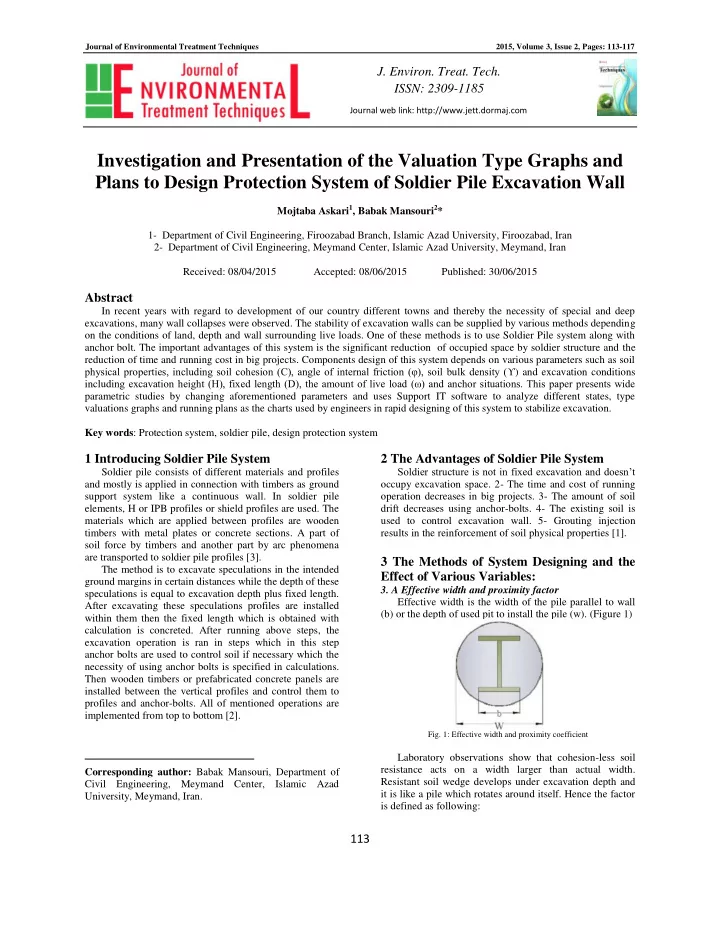
Effective width is the width of the pile parallel to wall (b) or the depth of used pit to install the pile (w). (Figure 1)

  • Fig. 1: Effective width and proximity coefficient

Laboratory observations show that cohesion-less soil resistance acts on a width larger than actual width. Resistant soil wedge develops under excavation depth and it is like a pile which rotates around itself. Hence the factor is defined as following:

Journal web link: http://www.jett.dormaj.com

  • J. Environ. Treat. Tech.

ISSN: 2309-1185

slide-2
SLIDE 2

Journal of Environmental Treatment Techniques 2015, Volume 3, Issue 2, Pages: 113-117

114

The final proximity width must not exceed from piles distance. Method 1: proximity factor is applied only for resistant

  • area. In this method, the factor affects only in resistant part.

Method 2: proximity factor is applied for resistant and active area. Figure (2) Soldier piles can be analyzed like shields, if we assume the width of active loading area is equal to the width of resistant loading part. In this case, we define Arching factor which is as following: All of the equations under the depth of excavation are multiplied by this factor and the final response is multiplied to the distance between the profiles (S). The fixed depth achieved in this method is larger than the first method [3].

  • Fig. 2: The forces diagram

4 The Effective Variables and Factors in Designing

Design and the panels between them depend on different parameters such as soil physical properties including soil cohesion (C), angle of internal friction (φ), soil bulk density (ϒ) and excavation conditions including excavation height (H), fixed length (D), the amount of live load (ω) and anchors situations h1, h2. Figure (3)

  • Fig. 3: Effective width and proximity coefficient

5 Introducing Support IT software

This is a type of designing and analyzing software to modeling the anchored excavations by shields and soldier

  • piles. The computational methods are based on US

BRITISH STEEL PILING, STEEL SHEET PILING DESIGN handbook.

5-A Software outputs

SupportIT software has many abilities to design soldier pile which a number of them are indicated in following. 1- The modeled full graphical shape 2- the calculation

  • f pressure, moment, displacement and shear force

maximum 3- the entire output calculation of soldier piles and timbers 4- Drawing pressure, moment, displacement and shear force plots 5- the table of pressure, moment, displacement and shear force

  • utput in different depths 6- Drawing excavations and

anchors plots. Figure (4)

b- The amount of force in anchor bolts a- Pressure distribution behind retaining walls

  • Fig. 4: An example of software output a- pressure distribution behind

retaining walls b- the amount of force in anchor-bolts

6 The Designing Procedure of Soldier Pile System Components

6-A Section designing for soldier pile To design the proper section for soldier pile, the existing profile in Iran market was used in the aim of simplicity in implementation. To design the pile, the regulation of steel building national rules (section 10), allowable stress method has been used. The basic of required section for soldier pile is calculated using the following formula. where, Sre is the basic of required section and M max is flexural moment maximum of the design, Fb is steel allowed flexural stress which is 0.6fy and fy is the yield stress of steel St37 which is equal to 2400 kN/m2. 6-B Anchors designing (anchor bolts) Anchors (anchor bolts) are the stretching oblique steel

  • members. Usually, steel bars are used to reduce the flexural

moment created in soldier pile. Anchor-bolts have three main components according figure 5. The system of the connection to soldier pile (Anchorage), stress-less part or unbound length and bond length [3].

slide-3
SLIDE 3

Journal of Environmental Treatment Techniques 2015, Volume 3, Issue 2, Pages: 113-117

115

  • Fig. 5: Anchor bolt components

6-C Bond strength The transferred force between anchor and soil depends

  • n various factors including method and pressure of

concrete injection, excavating type, excavated hole’s diameter, bond length and soil type which is called bond

  • strength. This strength is defined based on laboratory

results [3].

6-D Anchor diameter calculation

To design anchors, the steel bars, type A3 with characteristic strength of Fy=4000 kg/cm2 are used. Based

  • n Iran concrete regulations, for designing tensile bars,

reduction coefficient of steel strength is considered equal to 0/85. Hence the required diameter is calculated for anchor.

6-E lagging designing

The designing of laggings thickness in soldier pile system is performed based on empirical relations. The suggested amounts of wooden timber thickness (lagging) are offered depending on the type of soil, excavation depth and the distance between soldier piles [3].

6-F The computation of axial capacity required for a soldier pile

The axial capacity required to a soldier pile is computed using relation 5. In this relation, the first term is relevant to pile friction strength with confidence coefficient

  • f 2 and the second term is the strength of pile’s tip with

the confidence coefficient of 2/5 [3]. Qa is pile axial capacity, fs wall strength, As pile wall area, qt tip strength and At the area of pile tip.

6-G Computation of total axial load

Total axial load is the result of summing vertical forces

  • f anchors and the weight of soldier pile, concrete and

wooden timbers, which is compared to pile axial capacity [3].

7 Parametric Studies

Some of the parameters that influence the behavior of this system are soil type, excavation depth and the amount

  • f live load. In this paper, a wide parametric study has been

performed to determine the effect of these parameters. To include different soils the range of C values of soil cohesion is considered from to 100 kN/m2 (0,20,40,60,80,100) and φ the internal friction angle of soil from 0 to 40 degrees (0,5,10,15,20,25,30,35,40) and ϒ soil bulk density with the amounts of 17, 18, 19 and 20 KN/M3. Also, modeling for excavation depths are 3, 6, 9 and 12

  • meters. Also to apply excavation surrounding live load, the

neighbor building loads is considered from 0 to 10 floors for each floor the love load is 10 kN/m2. Excavation conditions with respect to soil type, excavation depth and different live loads are modeled in SupportIT

  • software. In this software, available flexural moment in pile

is picked and the section correspond to that moment is

  • designed. If the existing flexural moment in piles lead to

designing non-economical section, using steel anchors (anchor bolts) in different heights of excavation, the moment is diminished and the proper section is designed. Anchor bolts in different situations are modeled in software and the existing force is taken from them, then their diameter and length is designed. Wooden timbers (Lagging) which locate between profiles to protect soil are also modeled in this model and then the required designing is performed. According the multiplicity of modeling, the results are presented as executive charts in terms of C (soil cohesion), φ (the internal friction angle of soil), depths, different live loads and also soil different bulk densities and then these charts are classified in valuation types [1].

8 Study of Different Parameter Effect in Designing Soldier Pile System

8-A Effect of excavation side live load (ω) on the amount

  • f moments in soldier pile

To show the effect of live load changes on the amount

  • f moments in the different intervals C, φ, a model with

fixed characteristics has been taken into account. And the anchors situation and ω are considered as variable. With investigating results, it can be said that live load changes with other conditions being constant in poor soils (with low C and φ) are very impressive on united moments. But the live load changes in high shear strength soils (with high C and φ) are not impressive on created moments. Figure (6) [1].

  • Fig. 6: Chart of live load effect on the amount of moments

8-B Investigation of soil bulk density (ϒ) effect on flexural moment To show the effect of soil bulk density on flexural moment, a model with constant live load and variable

slide-4
SLIDE 4

Journal of Environmental Treatment Techniques 2015, Volume 3, Issue 2, Pages: 113-117

116

conditions of C, φ was considered for different bulk

  • densities. Seeing the results, it can be said that bulk density

changes has not remarkable impact in the amount of different areas moment except the areas that have low C and φ. Figure (7) [1].

  • Fig. 7: Chart of bulk density impact on the amount of moments

8-c Investigation of soil cohesion impact on the amount of moment in soldier pile To indicate soil cohesion effect, the model is considered with live load and friction angle in terms of the changes in parameter C and the results of moment changes was

  • registered. Investigating the results, it can be concluded that

with increase of soil cohesion (C), the amount of moment increases at first then decreases and finally it remains

  • constant. Figure (8) [1].
  • Fig. 8: Graph of cohesion impact on the amount of moments

8-5 Effect of internal friction angle on the amount of moment in soldier pile To investigate soil internal friction angle, a model is investigated with considering constant cohesion and the changes of parameter φ. From the results of moment changes, it can be understood that with increasing φ, the amount of moment decreases at first and finally it remains

  • constant. Figure (9) [1].
  • Fig. 9: Diagram of internal friction angle effect on the amount of moments

8-6 Effect of number, situation and angle of anchors on the amount of moment in soldier pile and the created force in anchors To observe the effect of number and locations of anchors

  • n the amount of moment in soldier pile, a model

considering φ and C as constants is investigated for different states of anchor’s laying. We find that at one- anchor state with moving the anchor from top to down, the amount of moment decreases at first and then it increases. In two-anchor state with increasing anchor’s number to a certain number in soldier pile system, the moment is decreased significantly but there will be no effects with more number than that and also the location and situation

  • f anchors affects the amount of created moment in soldier
  • pile. With increasing anchors number, the existing force is

decreased in them and the situation of anchors is impressive in the created force in them. To investigate the effect of moment inclination angle on the created force in models, it is considered in one-anchor state under different angles. Investigating these changes, we understand that with increasing anchor inclination angle, the existing force in them increases and the anchor vertical component which causes increasing axial force in pile, increases. Also, the changes of anchor inclination angle are not impressive in the created moment in pile [1].

9 Basis of Chart Drawings and the Valuation Type of Plans and How to Use Them

After analyzing all the models, the results registered in tables (bending moment and the location and number of anchor). After the result investigation, the moments having close values and having the equal situation and number of anchors are introduced as a type and their relevant charts are drawn; with regard to high volume of charts and running plans, one chart and two plans are shown in figures (10), (11) and (12). Observing the graph of figure 10 we see that having soil cohesion (C) and internal friction angle (φ) and the perpendicular drawn from them, it is possible to specify the structure type and then observing its relevant designing plan. Observing the plans figures 11 and 12, it is easy to obtain all of structure designing information including soldier pile characteristics (profile, the distance between piles and fixed length) and anchors characteristics (bond and un-bond length, their distance, anchors diameter, angle and …). There is an area in the graph called as zero type and this area is relevant to data that have high moment values and using this system in this area needs more investigation and this area is introduced zero type. In this research, we tried to supply and present graphs and plans for simplicity in calculating and determining the system component of soldier pile. These graphs and plans make easier the possibility of designing for engineers. The complete set of plans could be observed in the reference number 1. With regard to the performed work load and the limitation of presentable contents, a part of the performed work is presented here and the interested readers can refer to author’s master thesis.

slide-5
SLIDE 5

Journal of Environmental Treatment Techniques 2015, Volume 3, Issue 2, Pages: 113-117

117

  • Fig. 10: A sample of soldier pile valuation type graph (depth of 6 meter for

live load 20 KN/M2)

  • Fig. 11: An example of soldier pile valuation type plan (depth of 6 meters

type 4)

  • Fig. 12: An example of soldier pile valuation type plan (depth of 6 meter,

type 5)

10 Conclusions

1- The changes in soil bulk density has no effect on the form of valuation type graphs and also has not significant impact in the amount of moment in the different areas of valuation types except zero type area. 2- The changes of live load is very impressive in poor soils or low shear strength (with low C and φ) but the changes in live load has not sensible impact on strong soils with high shear strength. 3- With increasing soil cohesion in soldier pile system, the amount of moment is reduced at first and then it remains constant and thereby the pile profile section becomes smaller with increasing soil cohesion. 4- With increasing internal friction angle of soil, the amount of created moment in soldier pile reduces at first and then this moment remains constant.

References

1- M. Asqari, 2011, Investigation and valuation type of excavation protection method by Soldier Pile system, a master thesis, Islamic Azad University, Bushehr branch 2- A. Sarmad Nahri, 2008, principles of excavation and soldier systems, Simaye Danesh publications. 3- Sabatini, june 1999, Ground anchors and anchored system, Us department of-transportation 4-Vermeer, Pieter, 2000, Arching effects behind a soldier pile wall, Computers and Geotechnics 28 (2001).