
SLIDE 1
Invasive alien plant management
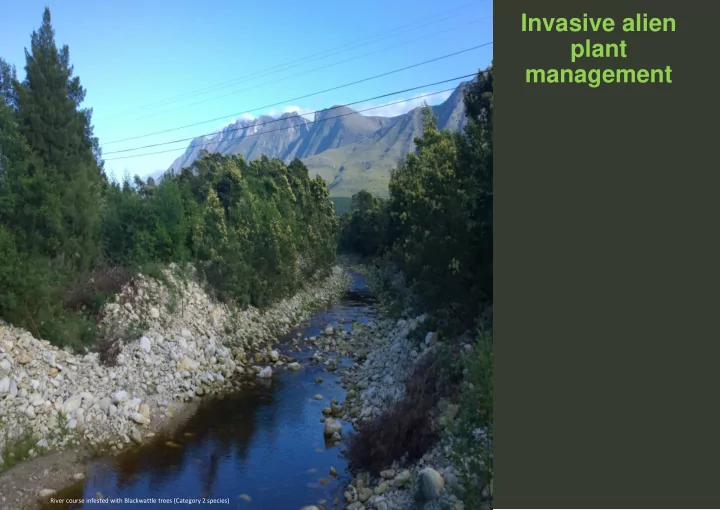
River course infested with Blackwattle trees (Category 2 species)
Invasive alien plant management River course infested with - - PowerPoint PPT Presentation
Invasive alien plant management River course infested with Blackwattle trees (Category 2 species) Invasive alien plant management Invasive alien plants infest approximately 200 000 km of South Africa. The impacts of these infestations are
River course infested with Blackwattle trees (Category 2 species)
Large fire burning in invasive alien vegetation (Argus, 2000)
Invasive alien plants have a negative impact on the ecological integrity of our natural systems, the productive potential of land, the intensity of fires, flooding, erosion, the health of estuaries, water quality and quantity and the livelihoods of communities who depend on these life-support systems. One of the most substantial impacts of invasive alien plants in South Africa is their impact on water availability and increased fire risk. It is estimated that they create a loss of nearly 695 million m³ in water yield each year and fires in invasive flora can burn up to 10 times hotter than indigenous vegetation The removal of invasive alien plants in riparian zones and the restoration of indigenous riparian vegetation to reduce the impact
risk reduction The National Environmental Management Biodiversity Act 10 of 2004 (NEMBA) Alien and Invasive Species (AIS) Regulations and Lists came into effect in October 2014. The new legislation requires all landowners in South Africa to undertake the following:
invasive alien plants for properties bigger than 1 ha
prevent them from spreading
invasive alien plants and the environment. The regulations also require all organs of state, in all spheres of government, to prepare invasive alien plant control plans for land under their control. Control plans for municipalities must be part of their integrated development plans (IDPs) and be reviewed every five years. Regulation 29 of the AIS Regulations state that no property may be sold without the seller notifying the buyer of listed invasive alien plants present on the property. The NEMBA AIS Regulations divide invasive alien plants into four categories:
Should landowners not comply, a directive will be issued. Non- compliance can result in a criminal offence punishable by a fine
Investing in projects that clear invasive alien plants from natural areas can pay huge dividends in terms social development, economic prosperity and biodiversity management. 1. Clearing invasive alien plants creates job
2. Investing in invasive alien plant management contributes to diversifying rural livelihood options by creating direct jobs, improving the productive potential
3. Removing invasive alien plants from river banks reduces the risk of damage to infrastructure during flooding events 4. The effective control of invasive alien plants reduces the impact of vegetation fires on community infrastructure and livelihoods. 5. Clearing invasive alien plants from important water supply areas can improve water supply.
Legal compliance requirements Compilation of monitoring, control and eradication plans ▪ The National Environmental Management Biodiversity Act 10 of 2004 (NEMBA) Alien and Invasive Species (AIS) Regulations and Lists came into effect in October 2014 ▪ The Regulations requires all landowners in South Africa who have listed invasive alien plants on their properties to undertake the following:
invasive alien plants and prevent them from spreading
harm to the environment
are appropriate for the listed invasive alien plants and the environment ▪ The Regulations require all spheres
alien plant control plans for land under their control ▪ Section 28 (1) of the National Environmental Management Act imposes Duty of Care on every person who causes , has caused or may cause significant pollution or degradation of the environment to take reasonable measures to prevent such pollution or degradation from occurring, continuing or recurring
the environment Category 2 invasive alien plants ▪ All landowners must determine if they have any listed invasive alien plants on their property ▪ If a property has listed invasive alien plants a detailed list and distribution map of all listed invasive alien plants must be compiled:
plants present on a property must be identified and described
plant infestations located on a property must be mapped
that are infested with listed invasive alien plants must be described ▪ All landowners who have listed invasive alien plants on their properties must control them with appropriate methods that cause as little harm to the natural environment ▪ The Regulations require that all landowners who have a property larger than 1 hectare compile a prioritised monitoring, control and eradication plan for the identified invasive alien plants on the property ▪ The plan must ensure compliance with the National Environmental Management Act (No. 107 of 1998) and include the following key components:
alien plant control methods that cause as little harm as possible to the natural environment
address offspring, propagating material and re-growth, in
establishment of invasive alien plants
clear project implementation timescales
control budget must be included
aspects must be included
requirements must be identified
invasive alien plant biomass generated by control
▪ Any landowner who would like to commercially grow a Category 2 invasive alien plants such as Pine trees requires a permit to carry out a restricted activity. ▪ A restricted activity includes the importing, growing and selling of these plants. Before a restricted activity can commence a risk assessment must be undertaken ▪ A risk assessment will evaluate the threat or potential threat to ecosystems, habitats, other species, the economy, the environment or human health or well-being posed by a restricted activity involving a listed invasive alien plant ▪ The Regulations require that the implementation of invasive alien plant control projects must be monitored to ensure the success of the project. ▪ Measurable indicators of invasive alien plant control project implementation progress and success must be included in invasive alien plant control plans ▪ Invasive alien plants have a range
infrastructure ▪ Ecological infrastructure refers to naturally functioning ecosystems such as rivers that deliver valuable services to people, such as water ▪ Active and passive restoration strategies should be implemented in areas where invasive alien plants have been removed to aid the recovery of indigenous vegetation and prevent the re- growth of invasive alien plants
Step 1
Environmental restoration Project implementation monitoring Pine trees (Category 1b species) in catchment area Hakea plant (Category 1b species) Dense infestations of Blackwattle (Category 2 species) trees surrounding water bodies Species identification and mapping
Invasive alien plant management and compliance lifecycle
Step 2 Step 3 Step 4 Step 5 Step 6