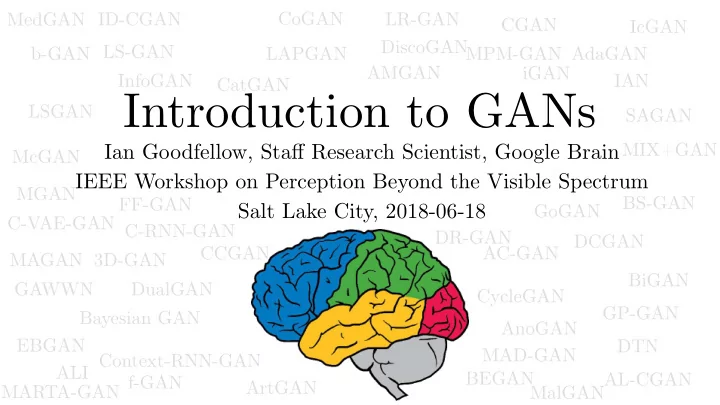
Introduction to GANs LSGAN SAGAN MIX+GAN Ian Goodfellow, Sta ff - - PowerPoint PPT Presentation

introduction to gans
SMART_READER_LITE
LIVE PREVIEW

Introduction to GANs LSGAN SAGAN MIX+GAN Ian Goodfellow, Sta ff - - PowerPoint PPT Presentation

CoGAN ID-CGAN LR-GAN MedGAN CGAN IcGAN DiscoGAN LS-GAN b-GAN LAPGAN MPM-GAN AdaGAN AMGAN iGAN InfoGAN IAN CatGAN Introduction to GANs LSGAN SAGAN MIX+GAN Ian Goodfellow, Sta ff Research Scientist, Google Brain McGAN IEEE


slide-1
SLIDE 1

Ian Goodfellow, Staff Research Scientist, Google Brain IEEE Workshop on Perception Beyond the Visible Spectrum Salt Lake City, 2018-06-18

Introduction to GANs

3D-GAN AC-GAN AdaGAN SAGAN AL-CGAN ALI AMGAN AnoGAN ArtGAN b-GAN Bayesian GAN BEGAN BiGAN BS-GAN CGAN CCGAN CatGAN CoGAN Context-RNN-GAN C-RNN-GAN C-VAE-GAN CycleGAN DTN DCGAN DiscoGAN DR-GAN DualGAN EBGAN f-GAN FF-GAN GAWWN GoGAN GP-GAN IAN iGAN IcGAN ID-CGAN InfoGAN LAPGAN LR-GAN LS-GAN LSGAN MGAN MAGAN MAD-GAN MalGAN MARTA-GAN McGAN MedGAN MIX+GAN MPM-GAN

slide-2
SLIDE 2

(Goodfellow 2018)

Generative Modeling: Density Estimation

Training Data Density Function

slide-3
SLIDE 3

(Goodfellow 2018)

Generative Modeling: Sample Generation

Training Data Sample Generator (CelebA) (Karras et al, 2017)

slide-4
SLIDE 4

(Goodfellow 2018)

Adversarial Nets Framework

x sampled from data Differentiable function D D(x) tries to be near 1 Input noise z Differentiable function G x sampled from model D D tries to make D(G(z)) near 0, G tries to make D(G(z)) near 1

(Goodfellow et al., 2014)

slide-5
SLIDE 5

(Goodfellow 2018)

Self-Attention GAN

State of the art FID on ImageNet: 1000 categories, 128x128 pixels (Zhang et al., 2018) Indigo Bunting Goldfish Redshank Saint Bernard Tiger Cat Stone Wall Broccoli Geyser

slide-6
SLIDE 6

(Goodfellow 2018)

Self-Play

1959: Arthur Samuel’s checkers agent (Silver et al, 2017) (Bansal et al, 2017) (OpenAI, 2017)

slide-7
SLIDE 7

(Goodfellow 2018)

What can you do with GANs?

  • Simulated environments and training data
  • Missing data
  • Semi-supervised learning
  • Multiple correct answers
  • Realistic generation tasks
  • Model-based optimization
  • Automated customization
  • Domain adaptation
slide-8
SLIDE 8

(Goodfellow 2018)

Autonomous Driving Data

(Wang et al., 2017)

slide-9
SLIDE 9

(Goodfellow 2018)

GANs for simulated training data

(Shrivastava et al., 2016)

slide-10
SLIDE 10

(Goodfellow 2018)

What can you do with GANs?

  • Simulated environments and training data
  • Missing data
  • Semi-supervised learning
  • Multiple correct answers
  • Realistic generation tasks
  • Automated customization
  • Domain adaptation
slide-11
SLIDE 11

(Goodfellow 2018)

What is in this image?

(Yeh et al., 2016)

slide-12
SLIDE 12

(Goodfellow 2018)

Generative modeling reveals a face

(Yeh et al., 2016)

slide-13
SLIDE 13

(Goodfellow 2018)

What can you do with GANs?

  • Simulated environments and training data
  • Missing data
  • Semi-supervised learning
  • Multiple correct answers
  • Realistic generation tasks
  • Model-based optimization
  • Automated customization
  • Domain adaptation
slide-14
SLIDE 14

(Goodfellow 2018)

Supervised Discriminator for Semi-Supervised Learning

Input Real Hidden units Fake Input Real dog Hidden units Fake Real cat

(Odena 2016, Salimans et al 2016) Learn to read with 100 labels rather than 60,000

slide-15
SLIDE 15

(Goodfellow 2018)

Semi-Supervised Classification

MNIST: 100 training labels -> 80 test mistakes SVHN: 1,000 training labels -> 4.3% test error CIFAR-10: 4,000 labels -> 14.4% test error (Dai et al 2017)

slide-16
SLIDE 16

(Goodfellow 2018)

What can you do with GANs?

  • Simulated environments and training data
  • Missing data
  • Semi-supervised learning
  • Multiple correct answers
  • Realistic generation tasks
  • Model-based optimization
  • Automated customization
  • Domain adaptation
slide-17
SLIDE 17

(Goodfellow 2018)

Next Video Frame Prediction

Ground Truth MSE Adversarial

(Lotter et al 2016) What happens next?

slide-18
SLIDE 18

(Goodfellow 2018)

Ground Truth MSE Adversarial

Next Video Frame Prediction

(Lotter et al 2016)

slide-19
SLIDE 19

(Goodfellow 2018)

Next Video Frame(s) Prediction

(Mathieu et al. 2015) Mean Squared Error Mean Absolute Error Adversarial

slide-20
SLIDE 20

(Goodfellow 2018)

What can you do with GANs?

  • Simulated environments and training data
  • Missing data
  • Semi-supervised learning
  • Multiple correct answers
  • Realistic generation tasks
  • Model-based optimization
  • Automated customization
  • Domain adaptation
slide-21
SLIDE 21

(Goodfellow 2018)

iGAN

youtube (Zhu et al., 2016)

slide-22
SLIDE 22

(Goodfellow 2018)

Image to Image Translation

Input Ground truth Output

(Isola et al., 2016)

Aerial to Map Labels to Street Scene

input

  • utput

input

  • utput
slide-23
SLIDE 23

(Goodfellow 2018)

Unsupervised Image-to-Image Translation

(Liu et al., 2017) Day to night

slide-24
SLIDE 24

(Goodfellow 2018)

CycleGAN

(Zhu et al., 2017)

slide-25
SLIDE 25

(Goodfellow 2018)

Text-to-Image Synthesis

(Zhang et al., 2016)

This bird has a yellow belly and tarsus, grey back, wings, and brown throat, nape with a black face

slide-26
SLIDE 26

(Goodfellow 2018)

What can you do with GANs?

  • Simulated environments and training data
  • Missing data
  • Semi-supervised learning
  • Multiple correct answers
  • Realistic generation tasks
  • Model-based optimization
  • Automated customization
  • Domain adaptation
slide-27
SLIDE 27

(Goodfellow 2018)

Designing DNA to optimize protein binding

(Killoran et al, 2017)

slide-28
SLIDE 28

(Goodfellow 2018)

What can you do with GANs?

  • Simulated environments and training data
  • Missing data
  • Semi-supervised learning
  • Multiple correct answers
  • Realistic generation tasks
  • Automated Customization
  • Domain Adaptation
slide-29
SLIDE 29

(Goodfellow 2018)

Personalized GANufacturing

(Hwang et al 2018)

slide-30
SLIDE 30

(Goodfellow 2018)

What can you do with GANs?

  • Simulated environments and training data
  • Missing data
  • Semi-supervised learning
  • Multiple correct answers
  • Realistic generation tasks
  • Automated Customization
  • Domain Adaptation
slide-31
SLIDE 31

(Goodfellow 2018)

Domain Adaptation

  • Domain Adversarial Networks (Ganin et al, 2015)
  • Professor forcing (Lamb et al, 2016): Domain-

Adversarial learning in RNN hidden state

slide-32
SLIDE 32

(Goodfellow 2018)

GANs for domain adaptation

(Bousmalis et al., 2016)

slide-33
SLIDE 33

(Goodfellow 2018)

Tips and Tricks

  • Spectral normalization (Miyato et al 2017) in both

discriminator and generator (Zhang et al 2018)

  • Different learning rate for generator and discriminator (Heusel

et al 2017)

  • No need to run discriminator more often than generator

(Zhang et al 2018)

  • Many different loss functions all work well (Lucic et al 2017);

spend more time tuning hyperparameters than trying different losses

slide-34
SLIDE 34

(Goodfellow 2018)

Track updates at the GAN Zoo

https://github.com/hindupuravinash/the-gan-zoo

slide-35
SLIDE 35

(Goodfellow 2018)

Questions