Introduction Eigenmodes Convolution and Response ODEs and Linear - - PowerPoint PPT Presentation

introduction
SMART_READER_LITE
LIVE PREVIEW

Introduction Eigenmodes Convolution and Response ODEs and Linear - - PowerPoint PPT Presentation

BENG 221 Lecture 1 Introduction BENG 221 Mathematical Methods in Bioengineering Overview Ordinary Differential Equations Lecture 1 Linear Time-Invariant Systems Introduction Eigenmodes Convolution and Response ODEs and Linear


slide-1
SLIDE 1

BENG 221 Lecture 1 Introduction Overview Ordinary Differential Equations Linear Time-Invariant Systems Eigenmodes Convolution and Response Functions Further Reading 1.1
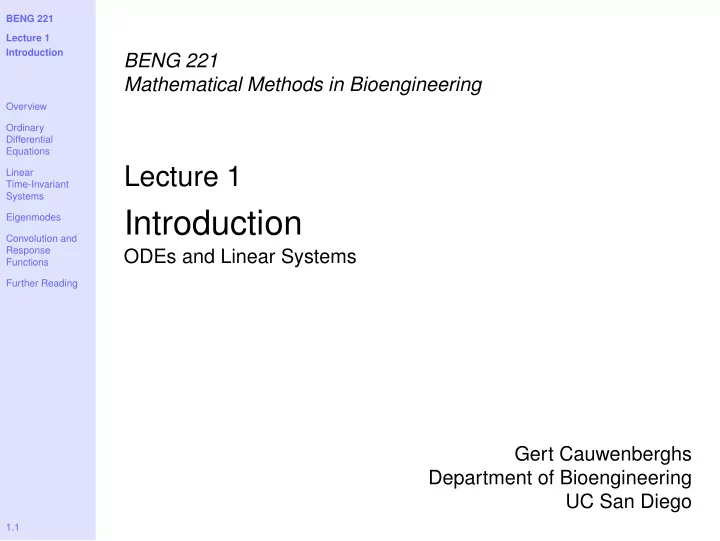
BENG 221 Mathematical Methods in Bioengineering

Lecture 1

Introduction

ODEs and Linear Systems Gert Cauwenberghs Department of Bioengineering UC San Diego

slide-2
SLIDE 2

BENG 221 Lecture 1 Introduction Overview Ordinary Differential Equations Linear Time-Invariant Systems Eigenmodes Convolution and Response Functions Further Reading 1.2

Course Objectives

  • 1. Acquire methods for quantitative analysis and prediction of

biophysical processes involving spatial and temporal dynamics:

◮ Derive partial differential equations from physical principles; ◮ Formulate boundary conditions from physical and operational

constraints;

◮ Use engineering mathematical tools of linear systems

analysis to find a solution or a class of solutions;

  • 2. Learn to apply these methods to solve engineering problems

in medicine and biology:

◮ Formulate a bioengineering problem in quantitative terms; ◮ Simplify (linearize) the problem where warranted; ◮ Solve the problem, interpret the results, and draw conclusions

to guide further design.

  • 3. Enjoy!
slide-3
SLIDE 3

BENG 221 Lecture 1 Introduction Overview Ordinary Differential Equations Linear Time-Invariant Systems Eigenmodes Convolution and Response Functions Further Reading 1.3

Today’s Coverage: Ordinary Differential Equations Linear Time-Invariant Systems Eigenmodes Convolution and Response Functions

slide-4
SLIDE 4

BENG 221 Lecture 1 Introduction Overview Ordinary Differential Equations Linear Time-Invariant Systems Eigenmodes Convolution and Response Functions Further Reading 1.4

ODE Problem Formulation Solve for the dynamics of n variables x1(t), x2(t), . . . xn(t) in time (or other ordinate) t described by m differential equations:

ODE

Fi

  • x1, dx1

dt , . . . dkx1 dtk , . . . x2, dx2 dt , . . . dkx2 dtk , . . . (1) xn, dxn dt , . . . dkxn dtk

  • =

for i = 1, . . . m, where m ≤ n and k ≤ n. Solutions are generally not unique. A unique solution, or a reduced set of solutions, is determined by specifying initial or boundary conditions on the variables.

slide-5
SLIDE 5

BENG 221 Lecture 1 Introduction Overview Ordinary Differential Equations Linear Time-Invariant Systems Eigenmodes Convolution and Response Functions Further Reading 1.5

ODE Examples Kinetics of mass m with potential V(x): 1 2m dx dt 2 + V(x) = 0 (2) Two masses with coupled potential V(x): 1 2m1 dx1 dt 2 + 1 2m2 dx2 dt 2 + V(x1, x2) = 0 (3) Second order nonlinear ODE: x d2x dt2 = 1 2 dx dt 2 (4)

slide-6
SLIDE 6

BENG 221 Lecture 1 Introduction Overview Ordinary Differential Equations Linear Time-Invariant Systems Eigenmodes Convolution and Response Functions Further Reading 1.6

ODE in Canonical Form In canonical form, a set of n ODEs specify the first order derivatives of each of n single variables in the other variables, without coupling between derivatives or to higher order derivatives:

Canonical ODE

dx1 dt = f1(x1, x2, . . . xn) dx2 dt = f2(x1, x2, . . . xn) (5) . . . dxn dt = fn(x1, x2, . . . xn). Not every system of ODEs can be formulated in canonical form. An important class of ODEs that can be formulated in canonical form are linear ODEs.

slide-7
SLIDE 7

BENG 221 Lecture 1 Introduction Overview Ordinary Differential Equations Linear Time-Invariant Systems Eigenmodes Convolution and Response Functions Further Reading 1.7

Canonical ODE Examples Amplitude stabilized quadrature oscillator:

  • dx

dt

= −y − (x2 + y2 − 1) x

dy dt

= x − (x2 + y2 − 1) y (6) Any first-order canonical ODE without explicit time dependence can be solved by separation of variables, e.g., dx dt = (1 + x2)/x (7)

slide-8
SLIDE 8

BENG 221 Lecture 1 Introduction Overview Ordinary Differential Equations Linear Time-Invariant Systems Eigenmodes Convolution and Response Functions Further Reading 1.8

Initial and Boundary Conditions Initial conditions are values for the variables, and some of their derivatives of various order, specified at one initial point in time t0, e.g., t = 0:

IC

dixj dti (0) = cij, i = 0, . . . m, j = 1, . . . n. (8) Boundary conditions are more general conditions linking the variables, and/or their first and higher derivatives, at one or several points in time tk:

BC

gl(. . . , dixj dti (tk), . . .) = 0. (9)

slide-9
SLIDE 9

BENG 221 Lecture 1 Introduction Overview Ordinary Differential Equations Linear Time-Invariant Systems Eigenmodes Convolution and Response Functions Further Reading 1.9

ICs in Canonical Form For ODEs in canonical form, initial conditions for each of the variables are specified at initial time t0, e.g., t = 0:

Canonical IC

x1(0) = c1 x2(0) = c2 (10) . . . xn(0) = cn ICs for first or higher order derivatives are not required for canonical ODEs.

slide-10
SLIDE 10

BENG 221 Lecture 1 Introduction Overview Ordinary Differential Equations Linear Time-Invariant Systems Eigenmodes Convolution and Response Functions Further Reading 1.10

Linear Canonical ODEs Linear time-invariant (LTI) systems can be described by linear canonical ODEs with constant coefficients:

LTI ODE

dx dt = A x + b (11) with x = (x1, . . . xn)T, and with linear initial conditions:

LTI IC

x(0) = e (12)

  • r linear boundary conditions at two, or more generally several,

time points:

LTI BC

C x(0) + D x(T) = e (13)

slide-11
SLIDE 11

BENG 221 Lecture 1 Introduction Overview Ordinary Differential Equations Linear Time-Invariant Systems Eigenmodes Convolution and Response Functions Further Reading 1.11

LTI Systems ODE Examples Examples abound in biomechanical and electromechanical systems (including cardiovascular system, and MEMS biosensors), and more recently bioinformatics and systems biology. A classic example is the harmonic oscillator (k = 0), and more generally the damped oscillator or resonator:

  • du

dt

= v m dv

dt

= −k u − γ v + fext (14) where u represents some physical form of deflection, and v its

  • velocity. Typical parameters include mass/inertia m, stiffness k,

and friction γ. The inhomogeneous term fext represents an external force acting on the resonator.

slide-12
SLIDE 12

BENG 221 Lecture 1 Introduction Overview Ordinary Differential Equations Linear Time-Invariant Systems Eigenmodes Convolution and Response Functions Further Reading 1.12

LTI Homogeneous ODEs In general, LTI ODEs are inhomogeneous. Homogeneous LTI ODEs are those for which x ≡ 0 is a valid solution. This is the case for LTI ODEs with zero driving force b = 0 and zero IC/BC:

LTI Homogeneous ODE

dx dt = A x (15)

LTI Homogeneous IC

C x(0) = 0 (16)

LTI Homogeneous BC

C x(0) + D x(T) = 0. (17) Eigenmodes, arbitrarily scaled non-trivial solutions x = 0, exist for under-determined IC/BC (rank-deficient C and D).

slide-13
SLIDE 13

BENG 221 Lecture 1 Introduction Overview Ordinary Differential Equations Linear Time-Invariant Systems Eigenmodes Convolution and Response Functions Further Reading 1.13

Eigenmode Analysis Eigenvalue-eigenvector decomposition of the matrix A yields the eigenmodes of LTI homogeneous ODEs. Let: A xi = λi xi (18) with eigenvectors xi and corresponding eigenvalues λi. Then

Eigenmodes

x(t) = ci xi eλit (19) are eigenmode solutions to the LTI homogeneous ODEs (15) for any scalars ci. There are n such eigenmodes, where n is the rank of A (typically, the number of LTI homogeneous ODEs).

slide-14
SLIDE 14

BENG 221 Lecture 1 Introduction Overview Ordinary Differential Equations Linear Time-Invariant Systems Eigenmodes Convolution and Response Functions Further Reading 1.14

Orthonormality and Inhomogeneous IC/BCs The general solution is expressed as a linear combination of eigenmodes: x(t) =

n

  • i=1

ci xi eλit (20) For symmetric matrix A (Aij = Aji) the set of eigenvectors xi is

  • rthonormal:

xT

i xj = δij

(21) so that the solution to the homogeneous ODEs (15) with inhomogeneous ICs (12) reduces to ci = xT

i x(0), or:

LTI inhomogenous IC solution (symmetric A)

x(t) =

n

  • i=1

xT

i x(0) xi eλit

(22)

slide-15
SLIDE 15

BENG 221 Lecture 1 Introduction Overview Ordinary Differential Equations Linear Time-Invariant Systems Eigenmodes Convolution and Response Functions Further Reading 1.15

Superposition and Time-Invariance Linear time-invariant (LTI) homogeneous ODE systems satisfy the following useful properties:

LTI ODE

  • 1. Superposition: If x(t) and y(t) are solutions, then

A x(t) + B y(t) must also be solutions for any constant A and B.

  • 2. Time Invariance: If x(t) is a solution, then so is x(t + ∆t) for

any time displacement ∆t. An important consequence is that solutions to LTI inhomogeneous ODEs are readily obtained from solutions to the homogeneous problem through convolution. This observation is the basis for extensive use of the Laplace and Fourier transforms to study and solve LTI problems in engineering.

slide-16
SLIDE 16

BENG 221 Lecture 1 Introduction Overview Ordinary Differential Equations Linear Time-Invariant Systems Eigenmodes Convolution and Response Functions Further Reading 1.16

Impulse Response and Convolution Let h(t) the impulse response of a LTI system to a delta Dirac function at time zero: dh dt = L(h) + δ(t) (23) then, owing to the principle of superposition and time invariance, the response u(t) to an arbitrary stimulus over time f(t) du dt = L(u) + f(t) (24) is given by:

Convolution

u(t) = +∞

−∞

f(θ) h(t − θ) dθ. (25)

slide-17
SLIDE 17

BENG 221 Lecture 1 Introduction Overview Ordinary Differential Equations Linear Time-Invariant Systems Eigenmodes Convolution and Response Functions Further Reading 1.17

Fourier Transfer Function Linear convolution in the time domain (25) u(t) = +∞

−∞

f(θ) h(t − θ) dθ transforms to a linear product in the Fourier domain: U(jω) = F(jω) H(jω) (26) where U(jω) = F(u(t)) = +∞

−∞

u(θ) e−jωθ dθ (27) is the Fourier transform of u. The transfer function H(jω) is the Fourier transform of the impulse response h(t).

slide-18
SLIDE 18

BENG 221 Lecture 1 Introduction Overview Ordinary Differential Equations Linear Time-Invariant Systems Eigenmodes Convolution and Response Functions Further Reading 1.18

Laplace Transfer Function For causal systems h(t) ≡ 0 for t < 0 (28) the identical product form (26) U(s) = F(s) H(s) (29) holds also for the Laplace transform U(s) = L(u(t)) = +∞ u(θ) e−sθ dθ (30) where s = jω.

slide-19
SLIDE 19

BENG 221 Lecture 1 Introduction Overview Ordinary Differential Equations Linear Time-Invariant Systems Eigenmodes Convolution and Response Functions Further Reading 1.19

Bibliography Wikipedia, Ordinary Differential Equation, http://en.wikipedia.org/wiki/Ordinary_differential_equation. Wikipedia, LTI System Theory, http://en.wikipedia.org/wiki/LTI_system_theory. Wikipedia, Convolution, https://en.wikipedia.org/wiki/Convolution.