Introduction the literature and research strategy Scott Bates 1 , - - PowerPoint PPT Presentation

introduction
SMART_READER_LITE
LIVE PREVIEW

Introduction the literature and research strategy Scott Bates 1 , - - PowerPoint PPT Presentation

Plants as countermeasures in long- duration space missions: A review of Introduction the literature and research strategy Scott Bates 1 , Vadim Gushin 2 , Joshua Marquit 1 , Gail Bingham 3 & Last week I got to photograph the Vladimir


slide-1
SLIDE 1

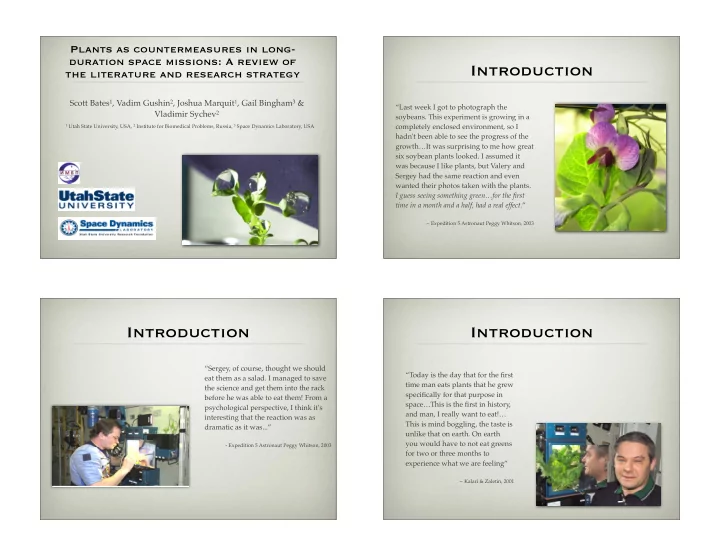
Plants as countermeasures in long- duration space missions: A review of the literature and research strategy

Scott Bates1, Vadim Gushin2, Joshua Marquit1, Gail Bingham3 & Vladimir Sychev2

1 Utah State University, USA, 2 Institute for Biomedical Problems, Russia, 3 Space Dynamics Laboratory, USA

Introduction

“Last week I got to photograph the

  • soybeans. This experiment is growing in a

completely enclosed environment, so I hadn't been able to see the progress of the growth…It was surprising to me how great six soybean plants looked. I assumed it was because I like plants, but Valery and Sergey had the same reaction and even wanted their photos taken with the plants. I guess seeing something green…for the first time in a month and a half, had a real effect.”

  • - Expedition 5 Astronaut Peggy Whitson, 2003

Introduction

“Sergey, of course, thought we should eat them as a salad. I managed to save the science and get them into the rack before he was able to eat them! From a psychological perspective, I think it's interesting that the reaction was as dramatic as it was...”

  • Expedition 5 Astronaut Peggy Whitson, 2003

Introduction

“Today is the day that for the first time man eats plants that he grew specifically for that purpose in space…This is the first in history, and man, I really want to eat!… This is mind boggling, the taste is unlike that on earth. On earth you would have to not eat greens for two or three months to experience what we are feeling”

  • - Kalari & Zaletin, 2001
slide-2
SLIDE 2

Introduction

  • Ryumin (1980) describes the pleasure that he derived

from tending the experimental garden onboard the Soviet Salyut 6 space station; Lebedev ([1983] 1988) reports similar experiences during a later mission.

  • Anatoli Berezovoy told a reporter that Lebedev had never

before grown plants, but on Salyut, he would rush to their "Oaziz" installation every morning as soon as he awakened to tend the peas and oats growing there.

  • The agricultural activities apparently transcended the

experimental requirements, and the cosmonauts found themselves devoting much of their leisure time to gardening.

The Lada VPU Intensity of Interaction Benefit Domains

slide-3
SLIDE 3

Structure / Organization

  • Benefit Domains
  • Social
  • Psychological
  • Physiological
  • Intensity of Interaction
  • Low / Passive
  • High / Active

Psychological Benefits

  • Passive
  • Wellbeing
  • Ulrich, 1979; Wells & Evans, 2003
  • Mood/Affect
  • Shibata and Suzuki, 2002, 2004; Hietanen & Korpela,

2004; Korpela, Klemettila, & Hietanen, 2002; Cackowski & Nasar, 2003; Larsen, et al, 1998; Shoemaker, Relf & Bryant, 1992

  • Cognitive Function / Attention
  • Fabor Taylor, Kuo & Sullivan, 2001; Wells, (2000)
  • Mental Fatigue
  • Kuo, 2001

Research Example

  • Fabor Taylor, A., Kuo F. E., & Sullivan, W. C.,

(2004). Coping with ADD. The surprising connection to green play settings. Environment and Behavior, 33(1), 54-77.

  • The parents of 96 children diagnosed with ADD were
  • surveyed. Parents were asked about weekend and

after-school activities that assisted functioning, and general surroundings.

  • Findings:
  • “Green” activities were identified as ‘best’ for symptom

management; better post-activity attentional functioning.

  • Children with more green-exposed play settings were

rated as higher functioning

Psychological Benefits

  • Active
  • Rehabilitation / Therapy
  • Langer & Rodin, 1976; Rodin & Langer, 1977
  • Sderback, Sderstrme & Schlander, 2004
  • Sandel, 2004
  • Smith, 1998
  • Well Being
  • Kaplan, R., 1973
slide-4
SLIDE 4

Research Example

  • Langer & Rodin, 1976; Rodin & Langer, 1977
  • Elderly nursing home residents were assigned to

experimental and control conditions (Langer & Rodin, 1976): high-control and low-control.

  • Findings
  • Behavior and self-report measured showed

alertness, active participation and well-being (1976)

  • Benefits seemed to sustain over time as nurses

ratings and medical and mortality show (Rodin & Langer, 1977).

Physiological Benefits

  • Passive
  • Stress Recovery
  • Ulrich et al 1991; Lohr, Pearson-Mims, & Goodwin, 1996
  • Health / Health Recovery
  • Ulrich, 1984; Fjeld, 2001; Moore, 1981
  • Reaction Time / Performance
  • Larsen, et al, 1998; Lohr, Pearson-Mims, & Goodwin 1996;

Shibata and Suzuki, 2002, 2004; Wise & Rosenberg, 1988

Research Example

  • Ulrich, R. S. (1985). View through a window

may influence recovery from surgery. Science, 224, 420-421.

  • Method: 46 surgical patients who were recovering

from gall-bladder surgery were exposed to one of two room-conditions: a window view with tress, and a window view of another building.

  • Outcome: Patients exposed to the natural scene

were found to have shorter post-op hospital stays, used less pain medication and had fewer negative comments in nurses’ notes.

Physiological Benefits

  • Active
  • Exercise
  • Fliegel Lewis & Mattson, 1988; Magnus, Matroos, &

Stackee, 1979

slide-5
SLIDE 5

Social Benefits

  • Passive
  • Frustration Tolerance / aggression
  • Cackowski & Nasar, 2003
  • Kuo & Sullivan, 2001
  • Communication
  • Shoemaker, Relf & Bryant, 1992
  • Residential Satisfaction
  • Kaplan, 1985

Research Example

  • Cackowski, J. M, & Nasar, J. L., (2003). The

restorative effects of roadside vegetation. Implications for automobile driver anger and

  • frustration. Environment and Behavior, 35(6),

736-751.

  • Method: participants were randomly assigned to one of

three videotaped highway drives that varied in their level

  • f vegetation. State/trait anger was assessed, as was

frustration tolerance (time spent on unsolvable anagrams).

  • Findings: State/Trait anger did not differ across the
  • conditions. Frustration tolerance did: higher levels of

present vegetation was met with more frustration tolerance.

Social Benefits

  • Active
  • Community Building
  • Bonham, 1992
  • Interracial Interaction
  • Shinew, Glover & Parry, 2004
  • Aggression
  • Sandel, 2004

Research Example

  • Shinew, K. J., Glover, T.D., & Parry, D. C. (2004).

Leisure spaces at potential sites for interracial interaction: community gardens in Urban areas. Journal of Leisure Research, 36(3), 336-355.

  • Method: community gardeners were selected

randomly and interviewed.

  • Findings:
  • Community gardens were somewhat supportive of

interracial contact.

  • Community gardeners believed that the setting was

supportive of interracial contact.

slide-6
SLIDE 6

Implications

  • The nature of long-duration space-flight,

including increased crew autonomy, and isolation from standard models of psychological support, necessitates new models for support.

  • One counter to these distinct conditions may

be what R. Kaplan (2001) referred to as “enhancing micro-restorative opportunities.”

  • Plants may provide these opportunities.

Research Strategy

  • Survey of Space Explorers
  • Proposals for Chamber Studies
  • Potential for Future Flight Studies

Survey Project

  • A survey will be conducted in the summer/fall of 2007.

The ground survey serves two key functions:

  • Collection of self-report data regarding experiences

with plants on mission and expectations and thought concerning the potential role having/tending plants could serve on longer missions.

  • Pilot testing and development of strategies for testing

the primary hypothesis in subsequent research project (s) including (potentially) additional ground studies (e.g. chamber studies), and/or potential flight studies.

Flown Missions Without Plants Flown Missions With Plants

Survey Project

  • Participants.
  • Surveys will be distributed to all active US

Astronauts, all active Russian Cosmonauts and all members of the Association of Space Explorers.

  • Respondents will be classified into three groups:

Rookie Astronauts & Cosmonauts Veteran Astronauts & Cosmonauts Veteran Astronauts & Cosmonauts

slide-7
SLIDE 7

Survey Project

  • Survey Instrument
  • Web-based survey with reactive skip-patterns.
  • The survey will assess:
  • Perceptions of having plants on missions, or

perceptions of having had plants on missions;

  • Perception of any mood, social or individual

psychological impact that having plants on missions could/did result, and;

  • Demographic / background characteristics which

may impact respondents’ reports of these experiences

Chamber Proposals

  • In order to further address this potential efficacy
  • f plants as a countermeasure, proposals will be

submitted for studies to be included in the Mars/ 500-day Chamber Study and the preparatory chamber studies.

Chamber Proposals

  • Several outcomes will be targeted, including mood,

preference, effort / time-spent, and social function. Key predictor variables include presentation of the plants and greenhouse, how the effort impacts

  • utcomes, and how background characteristics impact
  • utcome. As outlined below.

How do “background characteristics” impact

  • utcomes?

How does “effort” impact

  • utcomes?

How does “presentation” impact outcomes?

  • Experience with plants
  • Training / Education
  • Role
  • Personality
  • Type/style of effort
  • Intensity of effort
  • Function of the effort
  • Type of plants
  • Degree of access
  • Style of access
  • Structure of access

Potential for Flight Studies

  • All of the data that are collected in the

context of the survey and chamber studies will be used to support the creation of a focused, ecologically valid, flight study.

slide-8
SLIDE 8

Implications

  • The nature of long-duration space-flight,

including increased crew autonomy, and isolation from standard models of psychological support, necessitates new models for support.

  • One counter to these distinct conditions may

be what R. Kaplan (2001) referred to as “enhancing micro-restorative opportunities.”

  • Plants may provide these opportunities.

Conclusion