
SLIDE 1
Peter Dalgaard First UseR! Conference Vienna, May 2004
Language interfaces .Call and .External Introduction
- The .C and .Fortran functions are commonly used for
interfacing to numerical routines
- However, they have shortcomings for advanced use: Only
certain data types can be passed, and quite a bit of storage allocation and data conversion happens in interpreted code
- .Call and .External allow R objects to be passed to
and returned from compiled C code This is an elementary introduction, but I shall assume that you have a fairly good working knowledge of the C language.
1
Plan
- Differences between .C, .Call, and .External
- Basic usage
- Things to do in C code
– R object internals – Accessing R vectors and creating new ones – Dealing with internal list structures, expressions, etc. – The garbage collector and how to keep things out of its way – The write barrier – Parsing and evaluating R code
2
Synopsis of the interfaces
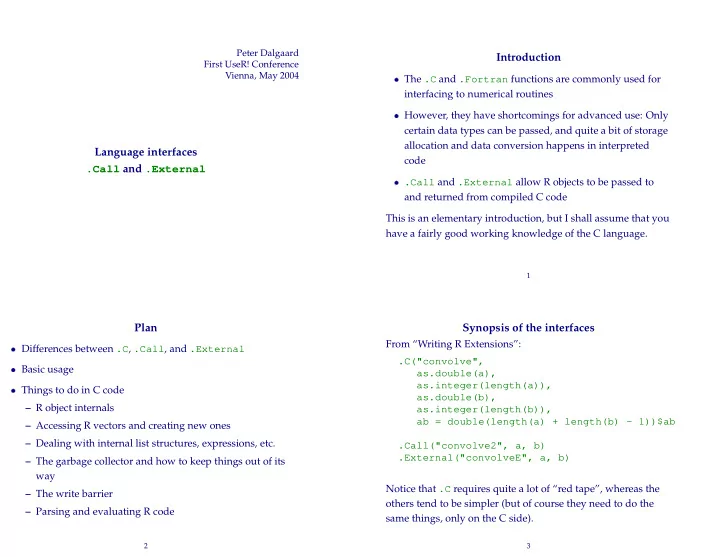
From “Writing R Extensions”: .C("convolve", as.double(a), as.integer(length(a)), as.double(b), as.integer(length(b)), ab = double(length(a) + length(b) - 1))$ab .Call("convolve2", a, b) .External("convolveE", a, b) Notice that .C requires quite a lot of “red tape”, whereas the
- thers tend to be simpler (but of course they need to do the