Introduction Traditional Birth Attendants Traditional birth - - PDF document

introduction
SMART_READER_LITE
LIVE PREVIEW

Introduction Traditional Birth Attendants Traditional birth - - PDF document

Introduction Traditional Birth Attendants Traditional birth attendants (TBA) play a major role in and Their Role in the the delivery of healthcare services to women Their practice has continued to exist despite the Delivery of Healthcare


slide-1
SLIDE 1

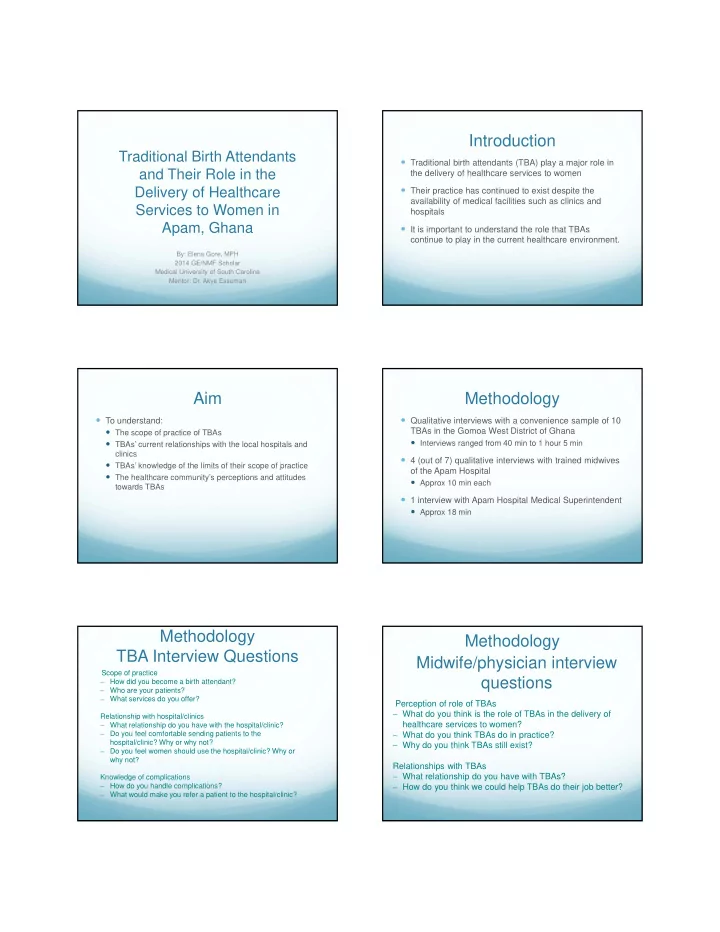
Traditional Birth Attendants and Their Role in the Delivery of Healthcare Services to Women in Apam, Ghana

By: Elena Gore, MPH 2014 GE/NMF Scholar Medical University of South Carolina Mentor: Dr. Akye Essuman

Introduction

 Traditional birth attendants (TBA) play a major role in

the delivery of healthcare services to women

 Their practice has continued to exist despite the

availability of medical facilities such as clinics and hospitals

 It is important to understand the role that TBAs

continue to play in the current healthcare environment.

Aim

 To understand:

 The scope of practice of TBAs  TBAs’ current relationships with the local hospitals and

clinics

 TBAs’ knowledge of the limits of their scope of practice  The healthcare community’s perceptions and attitudes

towards TBAs

Methodology

 Qualitative interviews with a convenience sample of 10

TBAs in the Gomoa West District of Ghana  Interviews ranged from 40 min to 1 hour 5 min

 4 (out of 7) qualitative interviews with trained midwives

  • f the Apam Hospital

 Approx 10 min each

 1 interview with Apam Hospital Medical Superintendent

 Approx 18 min

Methodology TBA Interview Questions

Scope of practice  How did you become a birth attendant?  Who are your patients?  What services do you offer? Relationship with hospital/clinics  What relationship do you have with the hospital/clinic?  Do you feel comfortable sending patients to the hospital/clinic? Why or why not?  Do you feel women should use the hospital/clinic? Why or why not? Knowledge of complications  How do you handle complications?  What would make you refer a patient to the hospital/clinic?

Methodology Midwife/physician interview questions

Perception of role of TBAs  What do you think is the role of TBAs in the delivery of healthcare services to women?  What do you think TBAs do in practice?  Why do you think TBAs still exist? Relationships with TBAs  What relationship do you have with TBAs?  How do you think we could help TBAs do their job better?

slide-2
SLIDE 2

Methodology

 Data analyzed using inductive thematic analysis

approach  The experiences, meanings, and reality of participants

are reported

 Themes are chosen based on their relativity to the

research question and consequently linked to the data

Scope of Practice

 I had a dream when I was living in Accra. [In the dream] I

saw a woman who was a nurse; she appeared. Then a bed with a pregnant woman appeared. Then the nurse taught me how to do the delivery. After the dream, other people called on me to do their deliveries.

 I learned from my mother; then my mother died. My mother

taught me everything.

 When I completed school, Form 4, my father sent me to

Swedru to a midwife to train me to become a TBA. And I went for training for 3 years. The person was a trained midwife but was on pension and was performing the duty at home.

Scope of Practice

 They all come from the Mumford area, which is walking

distance.

 My patients are people from around here and afar.

Some even [come] from Accra and Takoradi.

 It’s the people that comes to me that spread the

information about my good works. And there are others also that comes to me for prayers and through the prayers if they conceive, I see to the delivery.

Scope of practice

 Deliveries; during pregnancy I can turn the baby if its

breeched by massaging the mother’s stomach to turn the baby. Prenatal, post-natal and neonatal care; also I can manage fever [in the baby] from cord infection.

 Not only deliveries. I also have those with infertility

  • issues. I can give herbals to help them to become

pregnant, herbals to sustain the pregnancy, and deliveries, and afterwards I take care of them also.

 My major service is prayers. And after prayers, based

  • n what the Spirit says, I do likewise. Herbal

preparation is also based on the direction of the Spirit.

Relationships

 For the hospital, I don’t have any problems with them.

What I do is, when a client comes and there is a need for them to go to the hospital I will refer them and the hospital was calling on us for workshops too. That is what was going on then [in the past].

 What I do is that we are seeking for the welfare of the

  • patient. I send patients there [hospital] and I feel happy.

At the end of the day, the patient is fine and they have everything to be ok.

Relationships

 I agree very well because when you go to the

hospital you will have well-being of child and well-being of mother and that helps make our work easy.

 For the hospital, its very very important for

them to go. That’s why I send them for scans.

 Yes, the reason is that not all issues are

spiritual so the doctors should do their part. And the spiritual aspect, we also carry it out.

slide-3
SLIDE 3

Knowledge of Complications

 If there are complications [I] don’t waste time, try my best to

mobilize and bring the woman to the hospital. If the baby is breeched, I bring her to the hospital.

 By God’s grace, because we are doing everything under the

influence of God, I have not encountered any complications.

 What I do is that when I face complications such as retain

[retention] of the placenta, you wait for about 30 minutes to about 1 hour and pray and massage the uterus. But if still to no avail, we will cut the cord and tie it by the thigh of the mother and transport her to the hospital. If I face a condition like PPH, there is a medicine we give, a herbal medicine I

  • give. If for some time the bleeding still persists, I also will

transport the person to the hospital.

Knowledge of Complications

 If the mother has any complaints – heart problems, dizzy,

poor well-being.

 Because we are under the influence of the Spirit, we are told

by the Spirit who should deliver here and who should go to the hospital and we obey likewise. We have not encountered any bad outcomes.

 What I do is that women who have delivered more than 7 or

8 pregnancies, I refer them to the hospital. Women who are edematous and if I check the conjunctiva and see they are suffering from anemia I will refer them to the hospital. And based on scan, if you realize the baby is coming with breech presentation I also tell them to go to the hospital for delivery so then is what makes us refer.

Perceptions of TBAs

 They help with delivery of the baby. Also, assist

with family planning and at times refer to the hospital.

 They compliment the job of the hospitals and

work in places where there are no health facilities.

 Bad things. Give them herbs when they go

  • there. They use cloths whether clean or dirty.

Perceptions of TBAs

 Because local people in villages still patronize

them.

 Because of mothers not having money and not

having health insurance.

 In some areas there’s no hospital so their

assistance is needed.

 Some because they learned from their

mothers.

Relationships with TBAs

 The trained ones we know them. We advise them to

bring their patients if complications occur.

 Cordial relationships. We encourage them to bring

cases that are beyond them. They accompany their clients to the hospital.

 We used to have a relationship but now I don’t have.

Whenever we get a chance, we tell them to refer cases. It’s a good idea to restart a program [with them].

Ways to Help TBAs

 By training them, giving them more skills and

education.

 Workshops. And we have to follow-up also to

see where they do their deliveries, the things they use to deliver.

 Train them in most important things to prevent

  • infections. Workshops to train them to do things

to decrease infection, complications, and maternal mortality.

slide-4
SLIDE 4

Conclusions

 Scope of Practice

 The minimal level of training is alarming  TBAs report patients from near and far  TBAs offer a wide range of services

 Relationships

 Both midwives and TBAs acknowledge a good working

relationship with the other party

 Knowledge

 TBAs are reluctant to admit to being involved in complications  There are common conditions recognized among TBAs as

potentially dangerous

Conclusions

 Perceptions of role of TBAs

 As relevant in rural areas without access to the

healthcare system

 Some see them as complimentary to their work while

  • thers think their work is detrimental

 Tradition

 Ways to help

 Work with them to provide training and workshops

Community Births

2585 1575 928 579 195 233 166 1663 1715 1945 2002 1960 2007 2008 2009 2010 2011 2012 2013 # of TBA Births # of Hospital births

Recommendations

 Create more formal working relationship between TBAs

and the hospital

 Work to reinstate trainings and workshops for TBAs  Encourage TBAs to organize amongst themselves

Limitations Thank you!

 Special thanks to:

GE/NMF, GHS

 Academic Mentor, Dr. Akye Essuman  Site Mentors and their staff

 Dr. Amekah  Dr. Hagan

 Fellow NMFers

slide-5
SLIDE 5