Introduction File System Design for an NFS File In general, - - PowerPoint PPT Presentation

introduction file system design for an nfs file
SMART_READER_LITE
LIVE PREVIEW

Introduction File System Design for an NFS File In general, - - PowerPoint PPT Presentation

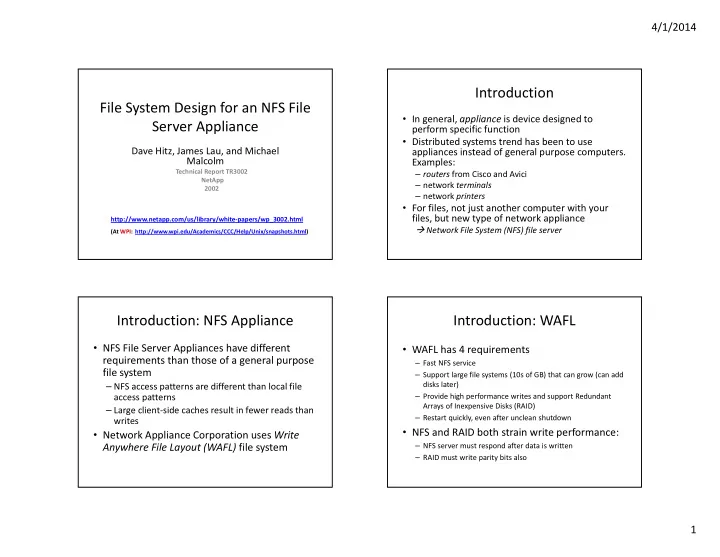
4/1/2014 Introduction File System Design for an NFS File In general, appliance is device designed to Server Appliance perform specific function Distributed systems trend has been to use Dave Hitz, James Lau, and Michael appliances instead


slide-1
SLIDE 1

4/1/2014 1

File System Design for an NFS File Server Appliance

Dave Hitz, James Lau, and Michael Malcolm

Technical Report TR3002 NetApp 2002 http://www.netapp.com/us/library/white‐papers/wp_3002.html

(At WPI: http://www.wpi.edu/Academics/CCC/Help/Unix/snapshots.html)

Introduction

  • In general, appliance is device designed to

perform specific function

  • Distributed systems trend has been to use

appliances instead of general purpose computers. Examples:

– routers from Cisco and Avici – network terminals – network printers

  • For files, not just another computer with your

files, but new type of network appliance

Network File System (NFS) file server

Introduction: NFS Appliance

  • NFS File Server Appliances have different

requirements than those of a general purpose file system

– NFS access patterns are different than local file access patterns – Large client‐side caches result in fewer reads than writes

  • Network Appliance Corporation uses Write

Anywhere File Layout (WAFL) file system

Introduction: WAFL

  • WAFL has 4 requirements

– Fast NFS service – Support large file systems (10s of GB) that can grow (can add disks later) – Provide high performance writes and support Redundant Arrays of Inexpensive Disks (RAID) – Restart quickly, even after unclean shutdown

  • NFS and RAID both strain write performance:

– NFS server must respond after data is written – RAID must write parity bits also

slide-2
SLIDE 2

4/1/2014 2

WPI File System

  • CCC machines have central, Network File System

(NSF)

– Have same home directory for cccwork1, cccwork2… – /home has 9055 directories!

  • Previously, Network File System support from

NetApp WAFL

  • Switched to EMC Celera NS‐120

similar features and protocol support

  • Provide notion of “snapshot” of file system (next)

Outline

  • Introduction

(done)

  • Snapshots : User Level

(next)

  • WAFL Implementation
  • Snapshots: System Level
  • Performance
  • Conclusions

Introduction to Snapshots

  • Snapshots are copy of file system at given point in time
  • WAFL creates and deletes snapshots automatically at preset

times

– Up to 255 snapshots stored at once

  • Uses copy‐on‐write to avoid duplicating blocks in the active

file system

  • Snapshot uses:

– Users can recover accidentally deleted files – Sys admins can create backups from running system – System can restart quickly after unclean shutdown

  • Roll back to previous snapshot

User Access to Snapshots

  • Note! Paper uses .snapshot, but is.ckpt
  • Example, suppose accidentally removed file named “todo”:

CCCWORK1% ls -lut .ckpt/*/todo

  • rw-rw---- 1 claypool claypool 4319 Oct 24 18:42

.ckpt/2011_10_26_18.15.29_America_New_York/todo

  • rw-rw---- 1 claypool claypool 4319 Oct 24 18:42

.ckpt/2011_10_26_19.27.40_America_New_York/todo

  • rw-rw---- 1 claypool claypool 4319 Oct 24 18:42

.ckpt/2011_10_26_19.37.10_America_New_York/todo

  • Can then recover most recent version:

CCCWORK1% cp .ckpt/2011_10_26_19.37.10_America_New_York/todo todo

  • Note, snapshot directories (.ckpt) are hidden in that they don’t

show up with ls unless specifically requested

slide-3
SLIDE 3

4/1/2014 3

Snapshot Administration

  • WAFL server allows sys admins to create and delete

snapshots, but usually automatic

  • At WPI, snapshots of /home:

– 3am, 6am, 9am, noon, 3pm, 6pm, 9pm, midnight – Nightly snapshot at midnight every day – Weekly snapshot is made on Saturday at midnight every week

  • Thus, always have:

– 6 hourly – 7 daily snapshots – 7 weekly snapshots

Snapshots at WPI (Linux)

  • 24? Not sure of times …

claypool 32 CCCWORK1% pwd /home/claypool/.ckpt claypool 33 CCCWORK1% ls 2010_08_21_12.15.30_America_New_York/ 2014_03_23_00.39.23_America_New_York/ 2014_02_01_00.34.45_America_New_York/ 2014_03_24_00.39.45_America_New_York/ 2014_02_08_00.34.29_America_New_York/ 2014_03_24_09.39.26_America_New_York/ 2014_02_15_00.35.58_America_New_York/ 2014_03_24_12.39.24_America_New_York/ 2014_02_22_00.35.50_America_New_York/ 2014_03_24_15.39.33_America_New_York/ 2014_03_01_00.37.14_America_New_York/ 2014_03_24_18.39.25_America_New_York/ 2014_03_08_00.38.25_America_New_York/ 2014_03_24_21.39.35_America_New_York/ 2014_03_15_00.38.11_America_New_York/ 2014_03_25_00.39.53_America_New_York/ 2014_03_19_00.38.23_America_New_York/ 2014_03_25_03.39.11_America_New_York/ 2014_03_20_00.38.47_America_New_York/ 2014_03_25_06.28.53_America_New_York/ 2014_03_21_00.39.06_America_New_York/ 2014_03_25_06.38.33_America_New_York/ 2014_03_22_00.39.45_America_New_York/ 2014_03_25_06.39.19_America_New_York/

ckpt = “checkpoint”

Snapshots at WPI (Windows)

  • Mount UNIX space, add .ckpt to end
  • Can also right‐click on file and choose “restore previous version”

Outline

  • Introduction

(done)

  • Snapshots : User Level

(done)

  • WAFL Implementation

(next)

  • Snapshots: System Level
  • Performance
  • Conclusions
slide-4
SLIDE 4

4/1/2014 4

WAFL File Descriptors

  • I‐node based system with 4 KB blocks
  • I‐node has 16 pointers, which vary in type depending upon

file size

– For files smaller than 64 KB:

  • Each pointer points to data block

– For files larger than 64 KB:

  • Each pointer points to indirect block

– For really large files:

  • Each pointer points to doubly‐indirect block
  • For very small files (less than 64 bytes), data kept in i‐node

instead of pointers

WAFL Meta‐Data

  • Meta‐data stored in files

– I‐node file – stores i‐nodes – Block‐map file – stores free blocks – I‐node‐map file – identifies free i‐nodes

Zoom of WAFL Meta‐Data (Tree of Blocks)

  • Root i‐node must be in fixed location
  • Other blocks can be written anywhere

Snapshots (1 of 2)

  • Copy root i‐node only, copy on write for changed data blocks
  • Over time, old snapshot references more and more data blocks

that are not used

  • Rate of file change determines how many snapshots can be stored
  • n system
slide-5
SLIDE 5

4/1/2014 5

Snapshots (2 of 2)

  • When disk block modified, must modify

meta‐data (indirect pointers) as well

  • Batch, to improve I/O performance

Consistency Points (1 of 2)

  • In order to avoid consistency checks after

unclean shutdown, WAFL creates special snapshot called consistency point every few seconds

– Not accessible via NFS

  • Batched operations are written to disk each

consistency point

  • In between consistency points, data only

written to RAM

Consistency Points (2 of 2)

  • WAFL uses NVRAM (NV = Non‐Volatile):

– (NVRAM is DRAM with batteries to avoid losing during unexpected poweroff, some servers now just solid‐state or hybrid) – NFS requests are logged to NVRAM – Upon unclean shutdown, re‐apply NFS requests to last consistency point – Upon clean shutdown, create consistency point and turnoff NVRAM until needed (to save power/batteries)

  • Note, typical FS uses NVRAM for metadata write cache

instead of just logs

– Uses more NVRAM space (WAFL logs are smaller)

  • Ex: “rename” needs 32 KB, WAFL needs 150 bytes
  • Ex: write 8 KB needs 3 blocks (data, i‐node, indirect pointer), WAFL

needs 1 block (data) plus 120 bytes for log

– Slower response time for typical FS than for WAFL (although WAFL may be a bit slower upon restart)

Write Allocation

  • Write times dominate NFS performance

– Read caches at client are large – Up to 5x as many write operations as read operations at server

  • WAFL batches write requests (e.g., at consistency

points)

  • WAFL allows “write anywhere”, enabling i‐node next to

data for better perf

– Typical FS has i‐node information and free blocks at fixed location

  • WAFL allows writes in any order since uses consistency

points

– Typical FS writes in fixed order to allow fsck to work if unclean shutdown

slide-6
SLIDE 6

4/1/2014 6

Outline

  • Introduction

(done)

  • Snapshots : User Level

(done)

  • WAFL Implementation

(done)

  • Snapshots: System Level

(next)

  • Performance
  • Conclusions

The Block‐Map File

  • Typical FS uses bit for each free block, 1 is allocated and 0 is free

– Ineffective for WAFL since may be other snapshots that point to block

  • WAFL uses 32 bits for each block

– For each block, copy “active” bit over to snapshot bit

Creating Snapshots

  • Could suspend NFS, create snapshot, resume NFS

– But can take up to 1 second

  • Challenge: avoid locking out NFS requests
  • WAFL marks all dirty cache data as IN_SNAPSHOT.

Then:

– NFS requests can read system data, write data not IN_SNAPSHOT – Data not IN_SNAPSHOT not flushed to disk

  • Must flush IN_SNAPSHOT data as quickly as

possible

IN_SNAPSHOT Can be used

new flush

Flushing IN_SNAPSHOT Data

  • Flush i‐node data first

– Keeps two caches for i‐node data, so can copy system cache to i‐ node data file, unblocking most NFS requests

  • Quick, since requires no I/O since i‐node file flushed later
  • Update block‐map file

– Copy active bit to snapshot bit

  • Write all IN_SNAPSHOT data

– Restart any blocked requests as soon as particular buffer flushed (don’t wait for all to be flushed)

  • Duplicate root i‐node and turn off IN_SNAPSHOT bit
  • All done in less than 1 second, first step done in 100s of ms
slide-7
SLIDE 7

4/1/2014 7

Outline

  • Introduction

(done)

  • Snapshots : User Level

(done)

  • WAFL Implementation

(done)

  • Snapshots: System Level

(done)

  • Performance

(next)

  • Conclusions

Performance (1 of 2)

  • Compare against other NFS systems
  • How to measure NFS performance?

– Best is SPEC NFS

  • LADDIS: Legato, Auspex, Digital, Data General, Interphase

and Sun

  • Measure response times versus throughput

– Typically, servers quick at low throughput then response time increases as throughput requests increase

  • (Me: System Specifications?!)

Performance (2 of 2)

(Typically, look for “knee” in curve)

Notes: + FAS has only 8 file systems, and others have dozens ‐ FAS tuned to NFS, others are general purpose

best response time best through‐ put

NFS vs. Newer File Systems

2 4 6 8 10 12 14 1000 2000 3000 4000 5000 Response Time (Msec/Op) Generated Load (Ops/Sec) 10 MPFS Clients 5 MPFS Clients & 5 NFS Clients 10 NFS Clients

  • Remove NFS server as bottleneck
  • Clients write directly to device

MPFS = multi‐path file system Used by EMC Celerra

slide-8
SLIDE 8

4/1/2014 8

Conclusion

  • NetApp (with WAFL) works and is stable

– Consistency points simple, reducing bugs in code – Easier to develop stable code for network appliance than for general system

  • Few NFS client implementations and limited set of
  • perations so can test thoroughly
  • WPI bought one ☺