International regulatory convergence strategic reflections from the - - PowerPoint PPT Presentation

international regulatory convergence strategic
SMART_READER_LITE
LIVE PREVIEW

International regulatory convergence strategic reflections from the - - PowerPoint PPT Presentation

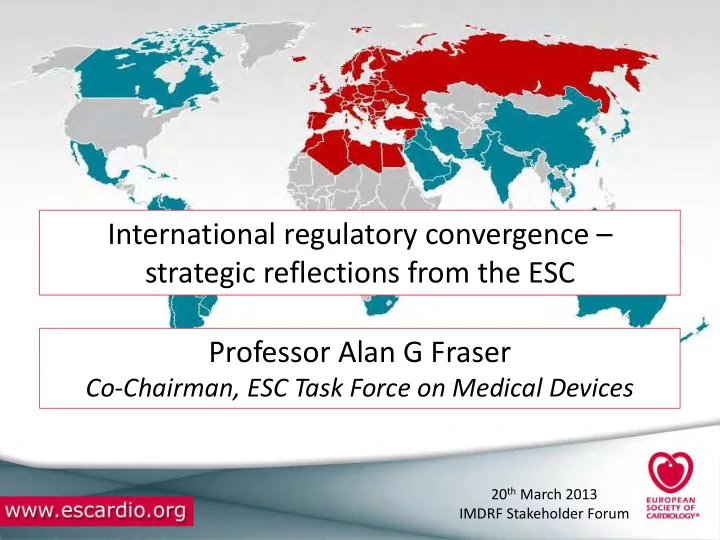
International regulatory convergence strategic reflections from the ESC Professor Alan G Fraser Co-Chairman, ESC Task Force on Medical Devices 20 th March 2013 IMDRF Stakeholder Forum Governance of medical devices REGULATORS PHYSICIANS


slide-1
SLIDE 1

International regulatory convergence – strategic reflections from the ESC Professor Alan G Fraser

Co-Chairman, ESC Task Force on Medical Devices

20th March 2013 IMDRF Stakeholder Forum
slide-2
SLIDE 2

REGULATORS INDUSTRY PHYSICIANS Governance of medical devices

20th March 2013 IMDRF Stakeholder Forum

slide-3
SLIDE 3

ESC Policy Conference 28-29th January 2011

Eur Heart J 2011; 32: 1673-86

slide-4
SLIDE 4

27.2.13 – European Office The European Heart Agency

slide-5
SLIDE 5

http://ec.europa.eu/health/medical-devices/files/revision_docs/proposal_2012_542_en.pdf

  • Review of proposals by Rapporteur, Dagmar Roth-Behrendt
  • Committee on Environment, Public Health & Food Safety 20.4.2013
  • Draft report from Rapporteur for Committee 24.4.2013
  • Deadline for amendments 3.5.2013
  • Votes in European Parliament, and in European Council 2013
  • Legislation to take effect about 2019
slide-6
SLIDE 6

The Human Mortality Database – 20th Century Trends 2010 1900

37 OECD countries www.fis.org / from www.mortality.org

slide-7
SLIDE 7
  • Stethoscope
  • Sphygmomanometer
  • Electrocardiography
  • Echocardiography
  • Isotope scintigraphy
  • Computed

tomography

  • Magnetic resonance

imaging

  • Invasive arteriography

Cardiological and cardiac surgical devices …

  • Coronary stents
  • Vascular grafts
  • Prosthetic heart valves
  • Pacemakers
  • Defibrillators
  • Artificial hearts
  • Cardiopulmonary bypass
  • Ventilator

20th March 2013 IMDRF Stakeholder Forum

slide-8
SLIDE 8

Drugs Devices

Access Communications for ACC; Laslett LJ et al, J Am Coll Cardiol 2012; 60 Supp S: S1-S49

Cardiovascular Drugs and Devices in Development

slide-9
SLIDE 9

Cutler EC and Beck CS, Arch Surg 1929; 18: 402-16

slide-10
SLIDE 10

Anterior-posterior Lateral Jean-Claude Daubert

slide-11
SLIDE 11

Cardiac Resynchronisation Therapy in Heart Failure

  • 1989: Concept, atrial resynchronisation, biatrial pacing JC Daubert
  • 1993: Concept of ventricular resynchronisation by BiV pacing

LBBB and HF: S Cazeau

  • 1993-1999: Acute hemodynamic studies with temporary pacing

S Cazeau, JJ Blanc, C Leclercq, A Auricchio, D Kass

  • 1993-1996: Early implantations in man with existing technology

Epicardial (P Bakker, S Cazeau) or CS leads (JC Daubert)

  • 1997: Dedicated triple-chamber devices (integrated Y adaptor)
  • 1998-2000: Observational studies of chronic CRT pacing
  • 2000-2001: Animal models (Christophe Leclercq, David Kass)
  • 2001: 1st randomised study for proof of concept MUSTIC

With the ESC as promotor

slide-12
SLIDE 12

Some Reasons for Success Story

  • Original and simple (or simplistic) concept based
  • n clinical observation
  • Easy to validate in acute studies with temporary

pacing

  • Initial development with existing

implantable technology, even suboptimal

  • Limited dependence from the industry in the

early phase

  • Limited regulatory issues
  • Support of a well-recognised professional

association (ESC) to promote the first trial

slide-13
SLIDE 13

“ The doctor is directly accountable to the patient and is expected to have the competency and motivation to select appropriate devices and drugs ”

slide-14
SLIDE 14
slide-15
SLIDE 15

Clinical product standards

(for all Class II and Class III devices)

  • Bench testing, hydrodynamics, simulations
  • Appropriate biological and animal models
  • Requirements for clinical evaluation
  • Need for randomised clinical trials, design,

duration, number of patients

  • Define when equivalence acceptable
  • Give limits to iterative changes
  • Conditional approval
  • Post-market surveillance

Policy conference, 28 January 2011 Clinical evaluation of cardiovascular devices

slide-16
SLIDE 16

EURObservational Research Programme

  • Representative of Europe
  • Conducted by ESC Constituent Bodies

(Associations and Working Groups, National Cardiac Societies)

  • Management centralised at EHH

(EORP Department)

  • In cooperation with, but independent

from Industry (database management and ownership, data analysis and publication by ESC)

slide-17
SLIDE 17

The EORP Registries 2010 – 2015

2010 2011 2012 2013 2014 2015 Acute Coronary Syndromes (ACS) Pilot ACS Long-Term PULMONARY HYPERTENSION IN ADULTS with Congenital H Disease EUROASPIRE IV EUROASPIRE IV (EACPR)* ATRIAL FIBRILLATION GENERAL Pilot ATRIAL FIBRILLATION GENERAL Long-Term CARDIOMYOPATHIES Pilot CARDIOMYOPATHIES Long-Term CHRONIC ISCHEMIC CVD Pilot CHRONIC ISCHEMIC CVD Long-Term PERIPARTUM CARDIOMYOPATIES (PPCM) TransCatheter Valve Treatment (TCVT) Pilot TCVT Long-Term ATRIAL FIBRILLATION ABLATION Pilot ATRIAL FIBRILLATION ABLATION Long-Term PREGNANCY & HEART DISEASE PREGNANCY AND CARDIAC DISEASE (ROPAC) HEART FAILURE Pilot HEART FAILURE Long-Term + PPCM 2010 2011 2012 2013 2014 2015 EUROPEAN LEAD EXTRACTION CONTROLLED (ELECTRa) Sponsored by EHRA

SENTINEL PREVENTION GENERAL SPECIAL

slide-18
SLIDE 18

64 Countries, >1000 centres, participating in at least one EORP Registry, >50,000 patients

EURObservational Research Programme

slide-19
SLIDE 19
slide-20
SLIDE 20

Hospitals No Patients Annual No Thoracic surgery 100 % 8 100 % 7,000 SCAAR (Coronary angiography and PCI) 100 % 30 100 % 40,000 RIKS-HIA (Coronary intensive care registry) 100 % 73 60 % 50,000 SEPHIA (Secondary Prevention After Myocardial Infarction, <75 yrs) 85 % 65 55 % 5,500 TAVI (Trans-catheter aortic valve implantation) 100 % 7 100 % 150

slide-21
SLIDE 21

The Swedeheart registry (SCAAR)

Bondesson P et al, Eurointervention 2012; 8: 444-9

Comparison of paclitaxel drug-eluting balloons

De-novo restenosis and in-stent restenosis of bare metal stent Contrast agent as drug-carrier 3.4% 12.5%

slide-22
SLIDE 22

SWEDE HEART SCAAR

Patients with suspected STEMI referred to primary PCI N = 5000 STEMI diagnosis confirmed at coronary angiography. Informed consent obtained Online 1:1 randomization in SCAAR, guidewire advancement, i.c. nitroglycerin Thrombus aspiration and PCI PCI alone

Immediately after PCI: TIMI flow grade 30 days: all-cause death 1, 2, 5 and 10 years: all-cause death and additional secondary endpoints

TASTE TASTE trial flow chart

Fröbert et al, AHJ 2009

Thrombus Aspiration in ST-Elevation MI in Scandinavia

slide-23
SLIDE 23

SWEDE HEART SCAAR

Inclusion rate

Randomized All primary PCIs

slide-24
SLIDE 24

Iglehart JK, NEJM 2009; 360; 1030-37

The growth of diagnostic imaging and tests

slide-25
SLIDE 25

Epidemiological studies of coronary disease Higgins IT, Cochrane AL, Thomas AJ Br J Prev Soc Med 1963; 17: 153-65 Percentage of ECGs with concordant positive diagnosis Number of observers

Diagnosis of coronary artery disease

537 ECGs from ex-miners in the Rhondda Fach aged 55-64 years

slide-26
SLIDE 26

“Raw” velocity field (initial estimate) “Filtered” velocity field (after post-processing)

Image processing – velocity vector imaging

Courtesy of Dr MS Feinberg

slide-27
SLIDE 27

60 patients studied on 4 echocardiography machines

Blood pool Doppler R = 0.85-0.93 Myocardial strain R = 0.02-0.35

D C B A D C B A

0.87 0.15

GE, Aloka, Toshiba, Acuson Andrew Williams et al

slide-28
SLIDE 28

Inter-operability of deformation by speckle tracking Joint EACVI and ASE initiative with major vendors Vendor A Vendor B Vendor C

  • Nomenclature and diagnostic targets
  • Simulated data-sets
  • Software revisions

Courtesy J D’hooge

slide-29
SLIDE 29
  • Physicians need to understand medical device evaluation

and practice evidence-based medicine

  • Professional associations should engage in clinical product

standards for medical devices, and in quality

  • Convergence of evidence (systematic reviews and

guidelines) and standards (safe and effective practice) but not of regulatory governance

  • Flexibility for clinical need in rare or life-threatening

diseases

  • Independent post-market surveillance and registries
  • Joint initiatives with industry for unmet needs

Strategic reflections from ESC for IMDRF

20th March 2013 IMDRF Stakeholder Forum