
SLIDE 1
Researcher: Omar Aboul-Enein Supervisor: Roger Bostelman
Inter-System Communication for Multi-Robot Control Researcher: Omar - - PowerPoint PPT Presentation
Inter-System Communication for Multi-Robot Control Researcher: Omar Aboul-Enein Supervisor: Roger Bostelman NIST SURF Program National Institute of Standards and Technology A non-regulatory federal agency within the Department of Commerce
Researcher: Omar Aboul-Enein Supervisor: Roger Bostelman
National Institute of Standards and Technology
A non-regulatory federal agency within the
Department of Commerce
Founded in 1901
Summer Undergraduate Research Fellowship
Engineering Laboratory Intelligent Systems Division
Laboratory Goal: Develop simple, accurate, and cost effective test methods
for Mobile Manipulators
AGVs and robots arms from different manufacturers currently lack
mechanisms for collaboration.
Performance tests consist of multiple cases regarding AGV and robot arm
Mobile Manipulators currently lack standardized test methods.
Development of test methods would typically use costly and complex ground
truth systems.
Project Goal: Develop AGV and robot arm communications to allow
NIST to develop standardized test methods for Mobile Manipulators.
[1]Bostelman, R., Hong, T., Marvel, J. (n.d.). Performance measurement of mobile manipulators.
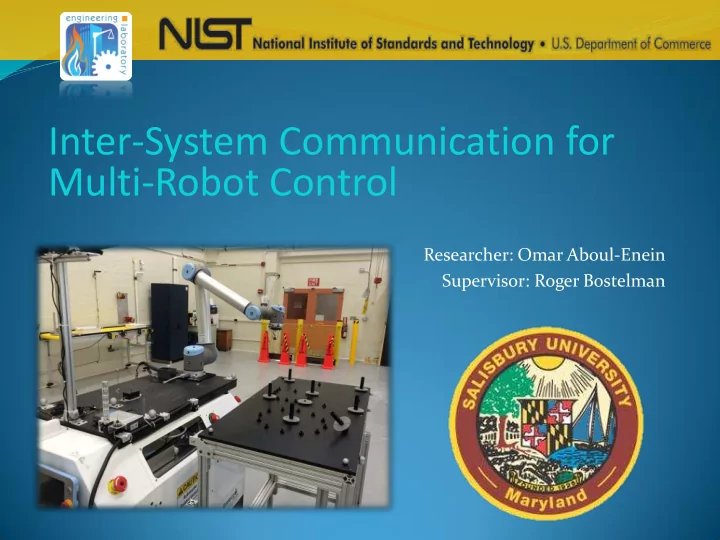
Reconfigurable Mobile Manipulator Artifact (RMMA) Retroreflective Laser Emitter & Sensor Universal Robot Arm (UR10) Automated Guided Vehicle (AGV) Reflector Target
Industrial PC and ARToolkit Camera Sensor Integration
System
Communications Manager” Software
Case
Computer Science Education at Salisbury University
enabled:
Rapid understanding and utilization of algorithms and data
structures.
Excellence in code conventions and documentation Ability to interpret pre-written software packages Ability to analyze learning resources for quick
comprehension of new topics.
Client Thread
Data
Feedback Transformation Functions
Server Threads
Received Data Queue Transformed Data Queue Transmission Data Queue Queues Shared Between Threads
Dynamic nature of research
Required ability to shift focus Analyze the practicality of pursuing certain challenges.
Learning about Quaternions and 3D rotations
New abstract concept Required extensive self-study and assistance from mentors.
Learning experimental procedure for calibration tests
Design performance experiements to suit needed analysis.
Quaternion Conversion
ARToolkit computes the
marker orientation in the quaternion number system.
Quaternion number system consists of
Imaginary components i, j, k A real component w. Quaternion representations of angles avoid computational problems such as gimbal
lock.
The Robot arm controller uses Euler angles (roll, pitch, yaw) to understand the
arm’s orientation.
Image courtesy of www.euclideanspace.com
NIST SURF Committee Roger Bostelman Dr. Roger Eastman Dr. Jeremy Marvel Dr. Tsai Hong
Lab Mates
Leila Ettehadieh Vivienne Shaw Justin Goh Robert Walsh
[1]Bostelman, R., Hong, T., Marvel, J., & Foufou, S. (n.d.). Performance measurement of mobile manipulators. [2] About ROS. (n.d.). Retrieved from ROS website: http://www.ros.org/about-ros/ [3] ARToolkit. (n.d.). Retrieved from http://www.hitl.washington.edu/artoolkit/ [4] Baker, M. (n.d.). Maths - Quaternions. Retrieved from Euclidean Space website: http://www.euclideanspace.com/maths/algebra/realNormedAlgebra