Integrating Molecular Genetics into Seed Management Programs 2017 - - PowerPoint PPT Presentation

integrating molecular genetics into seed management
SMART_READER_LITE
LIVE PREVIEW

Integrating Molecular Genetics into Seed Management Programs 2017 - - PowerPoint PPT Presentation

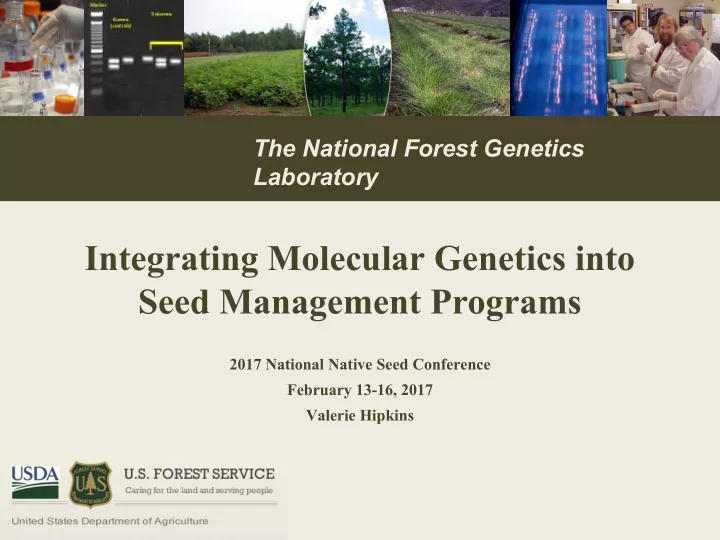
The National Forest Genetics Laboratory Integrating Molecular Genetics into Seed Management Programs 2017 National Native Seed Conference February 13-16, 2017 Valerie Hipkins Outline NFGEL Organization and Purpose Lab technology as

slide-1
SLIDE 1

Integrating Molecular Genetics into Seed Management Programs

2017 National Native Seed Conference February 13-16, 2017 Valerie Hipkins

The National Forest Genetics Laboratory

slide-2
SLIDE 2
  • NFGEL Organization and Purpose
  • Lab technology as applied tools
  • Examples

Outline

slide-3
SLIDE 3

Using genetic information to make informed management decisions.

177 Different Plant Species Studied

56 Different Conifers

Genetic Projects

Conservation Restoration Taxonomy Genetic Improvement Seed Collections Orchard, Nursery and Breeding Support Climate Change Implications Forensics – timber theft; poaching

The National Forest Genetics Lab (NFGEL)

slide-4
SLIDE 4
  • Can it address the management objective?
  • Can we answer the question/objective within

the management timeframe?

  • Availability of markers without additional

development.

  • Is the marker system reliable and

reproducible over time (data compatibility)?

  • Lowest cost marker.

What makes a molecular genetic technique a good management tool?

slide-5
SLIDE 5

Overview and Trends

Year Proportion of Technique Used

slide-6
SLIDE 6

Management Questions

  • Identify cultivars
  • Identify source or population
  • Assess levels of genetic variation
  • Determine individual relatedness
  • Determine taxonomy
  • Identify pollen and seed contamination
  • Verify crosses
  • Clone, ramet, and family identification
slide-7
SLIDE 7

Identification

(Species identification and cultivar detection in Fescue)

Objective 1: Are “wild” seed collections really Idaho Fescue,

  • r are they at least one of 5 ‘like’ species native to Montana.

Objective 2: Do the “wild” seed collections include some NRCS “cultivar” releases, or hybrids between the cultivars and wild-type Idaho Fescue.

[Mary Frances Mahalovich, Susan Rinehart]

slide-8
SLIDE 8

Taxonomy/Population Genetics Vaccinium parvifolium (huckleberry)

[Project Cooperators: Julie Nelson, Len Lindstrand]

slide-9
SLIDE 9

Golden Chinquapin (Chrysolepis chrysophylla)

Pete Veilleux, East Bay Wilds. USFS

  • What is the level and distribution of genetic

diversity within species

  • How different are the northern-most disjunct

populations from rest of range

  • Are there varietal level genetic differences among

the ‘shrub’ and ‘tree’ forms MARKER CHOICE

Allozymes: low variation obtained in tests Microsatellites (SSRs): pulled over from other Fagaceae (oaks, European chestnut) 16 loci, 716 trees, 23 stands (~$20,000; 1 yr) 2b-RAD: Next Generation Sequencing approach for genome-wide genotyping (restriction site-associated DNA (RAD), based on sequencing fragments produced by type IIB restriction endonucleases) 628 samples, 2021 SNPs with coverage > 20X (~$75,000; 2.5 yrs)

[Project cooperator: Andy Bower]

slide-10
SLIDE 10

2b-RAD: Population STRUCTURE SSR: Population STRUCTURE

K=2

slide-11
SLIDE 11

HYBRIDIZATION

Longleaf (Pinus palustris) and Shortleaf Pines (P. echinata) X Loblolly Pine (P. taeda) Whitebark Pine (P. albicaulis) X Limber Pine (P. flexilis) Butternut (Juglans cinerea) X Japanese Walnut (J. ailantifolia) Sisyrinchium sarmentosum X S. idahoense Oenothera wolfii (Wolf’s evening primrose) X O. glazioviana (garden escape)

slide-12
SLIDE 12

Management Needs by Collaborator Thank you to all NFGEL partners and collaborators

slide-13
SLIDE 13

Markers for Applied Purpose

Ability to address management objective drives all work and dictates to organization of the project:

  • What marker(s) will get run
  • Number of samples to collect
  • Location of samples
  • Tissue to collect
  • What kind of data will be obtained
  • When the data will be obtained
  • Cost/sample determination
slide-14
SLIDE 14

The preceding presentation was delivered at the This and additional presentations available at http://nativeseed.info

2017 National Native Seed Conference

Washington, D.C. February 13-16, 2017