Instructor Guide for Hand-off Workshop Resources: 1)Hand-off work - - PDF document

instructor guide for hand off workshop resources 1 hand
SMART_READER_LITE
LIVE PREVIEW

Instructor Guide for Hand-off Workshop Resources: 1)Hand-off work - - PDF document

Instructor Guide for Hand-off Workshop Resources: 1)Hand-off work script This provides a step-by-step guide for running the workshop. It described when and how to use the following materials, as well as references. 2)Hand-off Workshop Slides


slide-1
SLIDE 1

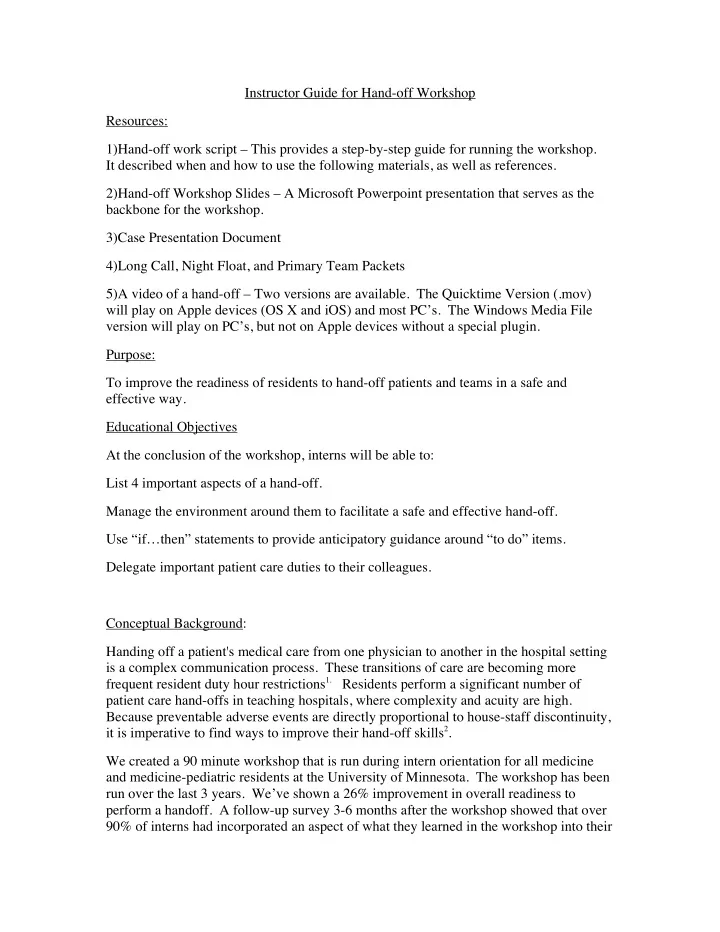
Instructor Guide for Hand-off Workshop Resources: 1)Hand-off work script – This provides a step-by-step guide for running the workshop. It described when and how to use the following materials, as well as references. 2)Hand-off Workshop Slides – A Microsoft Powerpoint presentation that serves as the backbone for the workshop. 3)Case Presentation Document 4)Long Call, Night Float, and Primary Team Packets 5)A video of a hand-off – Two versions are available. The Quicktime Version (.mov) will play on Apple devices (OS X and iOS) and most PC’s. The Windows Media File version will play on PC’s, but not on Apple devices without a special plugin. Purpose: To improve the readiness of residents to hand-off patients and teams in a safe and effective way. Educational Objectives At the conclusion of the workshop, interns will be able to: List 4 important aspects of a hand-off. Manage the environment around them to facilitate a safe and effective hand-off. Use “if…then” statements to provide anticipatory guidance around “to do” items. Delegate important patient care duties to their colleagues. Conceptual Background: Handing off a patient's medical care from one physician to another in the hospital setting is a complex communication process. These transitions of care are becoming more frequent resident duty hour restrictions1. Residents perform a significant number of patient care hand-offs in teaching hospitals, where complexity and acuity are high. Because preventable adverse events are directly proportional to house-staff discontinuity, it is imperative to find ways to improve their hand-off skills2. We created a 90 minute workshop that is run during intern orientation for all medicine and medicine-pediatric residents at the University of Minnesota. The workshop has been run over the last 3 years. We’ve shown a 26% improvement in overall readiness to perform a handoff. A follow-up survey 3-6 months after the workshop showed that over 90% of interns had incorporated an aspect of what they learned in the workshop into their

slide-2
SLIDE 2

hand-offs. Full results of the workshop have been published in the Journal of Graduate Medical Education3. The workshop is easy to run, is inexpensive, short, and can be easily deployed during resident orientation. Pitfalls/Tips for Success The workshop needs to be carefully facilitated to stay within the time limit. A “dress rehearsal” is probably helpful before deploying the workshop. The facilitator of the workshop should be facile with the hand-off literature, as the majority of the workshop is interactive and a discussion rather then a didactic session. The role-playing session at the end of the workshop is designed to mimic the need to rapidly assimilate and communicate information that happens during the natural hand-offs of a primary team to a call team to a night float team. Interns have some difficulty synthesizing the information and will tend to be overly verbose – they need to be moved along in the

  • process. The whole point is that the process is dynamic, rapid, and requires “thinking on

their feet.” Materials Required: Computer and Projector Marker Board/Flip chart Pre-printed packets Limitations The workshop so far has been done only for medicine and medicine/pediatric residents, and the facilitator has been a faculty member. It would be useful to train chief residents to run the workshop to provide more flexibility. The workshop provides a framework for thinking about hand-offs – as best practices are developed and accepted, they should be added to the workshop.

slide-3
SLIDE 3

References: 1)Horwitz LI, Krumholz HM, Green ML, Huot SJ. Transfers of patient care between house staff on internal medicine wards: a national survey. Archives of Internal Medicine. 2006;166(11):1173-1177. 2)Petersen LA, Brennan TA, O’Neil AC, Cook EF, Lee TH. Does housestaff discontinuity of care increase the risk for preventable adverse events? Annals of Internal

  • Medicine. 1994;121(11):866-872.

3)Aylward M, Vawter L, Roth C. An Interactive Handoff Workshop to Improve Intern Readiness in Patient Care Transitions. Journal of Graduate Medical Education: 2012:4 (1):68-71.