INSTITUTE FOR FOOD TECHNOLOGY Novi Sad - Serbia CENTER FOR F EED - - PDF document

institute for food technology
SMART_READER_LITE
LIVE PREVIEW

INSTITUTE FOR FOOD TECHNOLOGY Novi Sad - Serbia CENTER FOR F EED - - PDF document

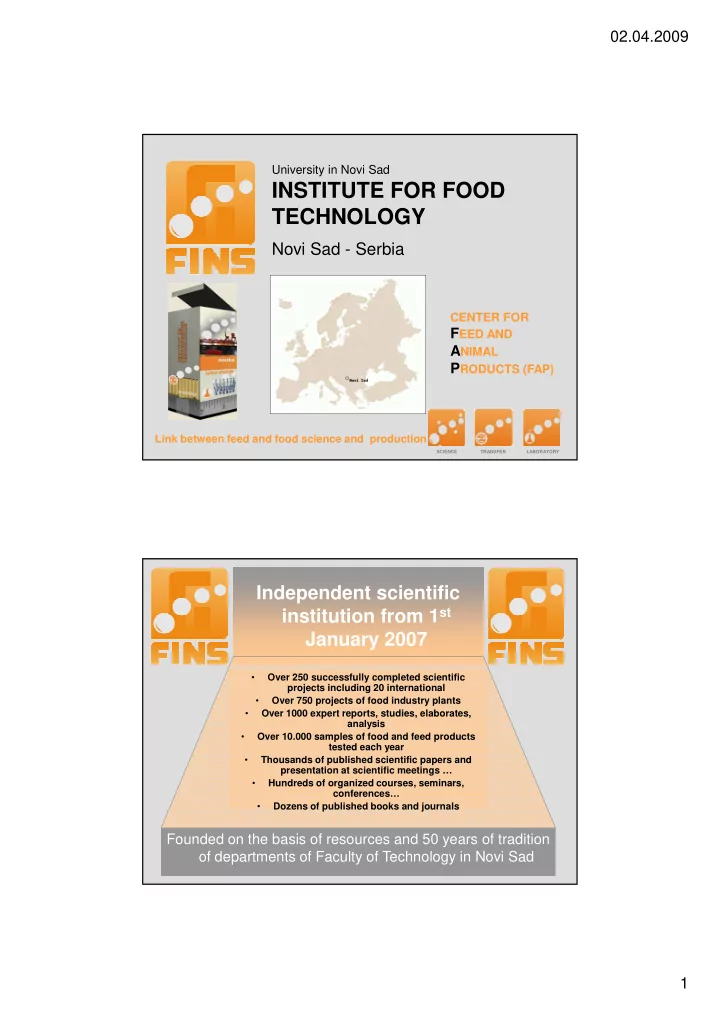
02.04.2009 University in Novi Sad INSTITUTE FOR FOOD TECHNOLOGY Novi Sad - Serbia CENTER FOR F EED AND A NIMAL P RODUCTS (FAP) Link between feed and food science and production SCIENCE TRANSFER LABORATORY Independent scientific


slide-1
SLIDE 1

02.04.2009 1

University in Novi Sad

INSTITUTE FOR FOOD TECHNOLOGY

Novi Sad - Serbia

SCIENCE TRANSFER LABORATORY

Link between feed and food science and production

CENTER FOR

FEED AND ANIMAL PRODUCTS (FAP)

Independent scientific institution from 1st January 2007

Founded on the basis of resources and 50 years of tradition

  • f departments of Faculty of Technology in Novi Sad
  • Over 250 successfully completed scientific

projects including 20 international

  • Over 750 projects of food industry plants
  • Over 1000 expert reports, studies, elaborates,

analysis

  • Over 10.000 samples of food and feed products

tested each year

  • Thousands of published scientific papers and

presentation at scientific meetings …

  • Hundreds of organized courses, seminars,

conferences…

  • Dozens of published books and journals
slide-2
SLIDE 2

02.04.2009 2

Building up of research potential Organization of dissemination activities Laboratory methods development and application P R O J E C T S Each project realized by the team with optimal structure of people from:

  • science
  • transfer
  • laboratory

University in Novi Sad

INSTITUTE FOR FOOD TECHNOLOGY ORGANIZATIONAL STRUCTURE ORGANIZATIONAL STRUCTURE matrix matrix

SCIENCE TRANSFER LABORATORY

DEPARTMENTS

  • Plant products

technology and biotechnology

  • Feed technology

and Animal products

  • Food quality and

safety

CENTRES:

  • Education
  • Project

documentation

  • Quality and safety

systems

  • Technological

support

LABORATORIES:

Laboratory for food technology, quality and safety:

  • Microanalytics
  • Microbiology
  • Chemistry
  • Physical
  • Sensory

Centre for proficiency testing

Corporate stuff:

  • finance
  • purchase
  • marketing
  • logistic
  • administration
  • human resources

University in Novi Sad

INSTITUTE FOR FOOD TECHNOLOGY HUMAN RESOURCES HUMAN RESOURCES

Technical and support stuff experts

  • Expertise:

– Technologies (cereal, feed, meat, fruit and vegetables, sugar…) – Food quality and safety (functional food - antioxidants, contaminants, market value, quality and safety systems, structural properties, …) – Food and feed testing methods – Raw materials for food and feed production – Energy, ecology, tradition, consumers ….

slide-3
SLIDE 3

02.04.2009 3

Laboratory

Laboratory for food and feed technology, quality and safety MICROANALYTICS: LC-MSMS; HPLC-DAD-FLD-ELSD HPLC-DAD-RI; GC-MS; GC-FID-ECD; AAS (3); ELISA PHYSICAL PROPERTIES: fundamental rheology – Hake MARS dough rheology - Brabender, Chopin particle size and food and feed structure CHEMICAL PROPERTIES: instruments for basic food and feed composition elemental analysis - HCNSO spectrophotometry MICROBIOLOGY: contamination, biotechnology SENSORY PROPERTIES: consumer tests, experts PILOT PLANTS

  • Bakery
  • Mill
  • Feed processing
  • Meat processing
  • Drying
  • Freezing
  • Pasta

FEED PROCESSING EQUIPMENT: Hamermill Screens Mixers Old pellet press Scales Testing equipment

PILOT PLANTS

slide-4
SLIDE 4

02.04.2009 4

TRANSFER OF KNOWLEDGE AND RESULTS

  • RECENT ACTIVITIES
  • educational courses
  • projects of technological

processes

  • business plans
  • support to quality and

safety assurance

  • GDO&GPI studies
  • advisory service
  • new products

development

  • food and feed quality and

safety testing

  • proficiency testing
  • production
  • Wheat quality determination
  • ISO 22000; ISO 18000
  • GDO&GPI system
  • HACCP for bakers, milers, pasta producers,

feed producers, meat processing

  • Pet food
  • Supermarket restaurants
  • Blood processing plant
  • Traditional meat products plant
  • Flakes production
  • ω3 reach snacks
  • Cakes with medicinal plants
  • Traditional sausage
  • Contracts for advisory support

with 200 companies

  • GDO&GPI studies for vine, spice,

brandy, bakery products, …

  • Over 10.000 tested food and

feed samples tested

  • Daily production of new high

quality baking products

RESEARCH PROJECTS

  • CURRENT

PROJECTS

  • One FP7 project

coordination

  • Two international

projects

  • Three regional

projects

  • Four national

projects coordination

  • Eight national project

participation

  • 1. FP7 REGPOT-3 FEED-TO-FOOD
  • 1. Strategic field crops regionalization
  • 2. Feed–safety for animals, people and environment

1. Animal waste treatment 2. Sugar beat varieties quality 3. Application of ionic radiation in food preservation 1. HACCP in wheat production and processing 2. Bakery and confectionary with medicinal plants 3. Application of amarathus spp. in functional food 4. Feed processes and products improvement 1. Improvement of frozen bakery products 2. Oil seed based bakery with functional properties

  • 3. Beef meat processing
  • 4. Fermented meat products development
  • 5. Pork meat processing
  • 6. Special bread with molasses
  • 7. New vegetable products
  • 8. Low energy confectionary products
slide-5
SLIDE 5

02.04.2009 5

Name of the coordinating person: Dr Jovanka Lević Proposal full title: REINFORCEMENT OF FEED TO FOOD RESEARCH CENTER AT INSTITUTE FOR FOOD TECHNOLOGY OF THE UNIVERSITY OF NOVI SAD Proposal Acronym: FEED-TO-FOOD Type of funding scheme: Coordination and support actions (Support) Work program topics addressed: FP7-REGPOT-2007-3 Centre for FEED AND ANIMAL PRODUCTS (FAP), as an

  • rganizational unit within the Institute for Food Technology

(FINS) at the University of Novi Sad (UNS), is the only scientific-research unit specialized for a wide range of issues related to the feed technology in Serbia and there is no similar organization in the former-Yugoslavia Republics,

  • ther Western Balkan countries (WBC) and Member States

(MS) in the region. We are well positioned in Serbia and in region, but we want to be recognized as the equal partner in developed Europe too. FAP is equipped with the laboratory equipments and scientific potentials and willing to take leading position in the region in research area in the production chain from feed to food

slide-6
SLIDE 6

02.04.2009 6

Now, when the doors of European research are wide

  • pen to Balkan countries, we want to developed our

research potentials and get the opportunity for full involvement to help us become a part of the EU and bring the excellent scientists and researchers from Serbia on board. We must prepare a long term sustainable development strategy for Serbia which will enable dynamic economic growth from which the entire population can benefit.

We want to reinforce FAP into the modern FEED-TO-FOOD Research Centre upgraded with Pilot Plant equipment capable for investigation in feed manufacturing technology. The project is also aimed to create a network for cooperation between research teams, with scientific interest concerned with the feed to food production

  • chain. Networking of research potentials and our cooperation will be a good

start point for integration in EU research area. Better communication and coordination is a bonus for all project partners – Serbia as WBC country will improve research skills, and European research gets better access to knowledge and expertise from new research regions. Trans-national two-way exchanges of research staff between project beneficiaries will improve our research capacities and filling the gap in experience in how to take part in complex and long term research EU projects.

Concept and project objectives

slide-7
SLIDE 7

02.04.2009 7

Under project FEED-TO-FOOD support can be provided to promote closer S&T cooperation between WBC (Serbia) Developed Europe (Germany and United Kingdom), and EU regions of convergence (Romania and Lithvania) Planned programmes forms a coherent set of coordination, training, dissemination, and development actions directly aimed at:

  • improving FAP research capacities (equipment and researchers)
  • increasing networking with EU research institutions and
  • making experience in how to take part in EU research projects.

CSAs

  • Within project,

from WBC Serbia WBC Serbia has coordinated:

Call: REGPOT-2007-3

Project “FEED-TO-FOOD”

Beneficiaries Beneficiaries

  • Research

Research Institute of Institute of Feed technology, IFF, Feed technology, IFF, Germany Germany

  • Institute

Institute of Food Research, IFR,

  • f Food Research, IFR, United Kingdom

United Kingdom

  • National Institute of Research and Development

National Institute of Research and Development in Animal Biology and Nutrition in Animal Biology and Nutrition,IBNA, ,IBNA, Romania Romania

  • Institute of Animal Science of the LVA,

Institute of Animal Science of the LVA, Lithuania Lithuania More then 30 researchers

WP-1 Project Management WP-2 Reinforcement of FEED-TO-FOOD Research Potentials WP-3 Developing and unlocking of Research Potentials WP-4 Knowledge Transfer WP-5 Dissemination and promotion activities

slide-8
SLIDE 8

02.04.2009 8

We want to reinforce FAP into the modern FEED-TO-FOOD Research Center upgraded with Pilot Plant complete technological lines for: to provide additional possibilites for development of new technological processes and products and for practical application. vacuum coating pressing expanding, and extruding Pelleting

Processing lines need to be completed with appropriate conditioner for steam and liquid component dosing, and with steam generator. As these lines are intended to be used for research purposes, they should be equipped with devices for material flow measurement, temperature meters placed at critical points (conditioner, dies..), devices for pressure and temperature measuring on the steam line and line for liquid components (flow, temperature..), and cooler, crusher and vibrating screen. Lines equipped in such a way could be used for production process testing or measuring feed supplement stabilty under different processing conditions, important operating factors for feed

  • perators.
slide-9
SLIDE 9

02.04.2009 9

FEED-TO-FOOD Research Center will be enabled to meet the following requirements in the future:

  • Scientific researches in future EU projects
  • Applied researches for industry concerned
  • Training of staff in production facilities
  • PhD studies

Objectives of FEED-TO-FOOD Center may include:

  • Evaluation of product technological properties
  • Studying conditions for destruction of microorganisms
  • Studying conditions for destruction of hazardous ingredients
  • Studying process effects on supplements activity
  • Studying effects of individual processing lines and the whole process line
  • n the product quality
  • Production of smaller quantities of animal feed for experimental

purposes.......

Institute of Animal Science

  • f - Litvania (IAS)

National Institute of Research and Development in Animal Biology and Nutrition (IBNA), Romania Institute of Food Research, Norwich (IFR) -UK Research Institute of Feed Technology, (IFF) Braunschweig] - Germany

slide-10
SLIDE 10

02.04.2009 10

Selected Institutes, beneficiaries, with the similar research intheres have a massive need for research in the field of feed to food production, especially within new context derived from the recent EU integration, where issues related to feed production sustainability and assurance of quality and safety are very important. The scope and variety of the project partners research work have greatly contributed to the progress of new technologies, products and procedures of particular importance for the advancement of feed and animal production.

Research Institute of Feed Technology [IFF Braunschweig] - Germany The Research Institute of the IFF is the scientific centre of the feed industry and its

  • suppliers. For more than 45 years, the

Research Institute supports the whole feed industry by results of cooperative research projects and contract research as well as by manifold services and a large offer of training and upgrading courses. Institute primarily has to clarify any of the technological issues or problems encountered in industrial compound-feed production through basic research and transfer of findings to real systems. But it also has to advance developments in the processes used in feed compounding.

Team leader Team leader Dr.

  • Dr. Aleksander Feil

Aleksander Feil

slide-11
SLIDE 11

02.04.2009 11

The Institute of Food Research's vision is to be a world-leading contributor to harnessing food for health and controlling food-related disease. IFR is the UK’s only integrated basic science provider focused on food. Their scientific research collaboration stretches across the world through informal and formal partnerships. Outcomes feed into national and international strategies, delivering advice and solutions for UK Government, public sector bodies, regulatory authorities, industry and consumers IFR have a well developed International section which role is to:

  • best support local researchers,
  • promote the Institute's scientists and its science,
  • initiate contacts,
  • facilitate co-operations, and
  • optimise the delivery of trans-disciplinary, international research

projects.

The Institute of Food Research, IFR, UK

Team leader Team leader Dr.

  • Dr. Roger Fenwick

Roger Fenwick Established in 1970 as the Research Institute for Animal Nutrition 2006: reorganized as national institute, under the name of : National Institute of Research and Development in Animal Biology and Nutrition NATIONAL RESEARCH–DEVELOPMENT INSTITUTE FOR ANIMAL BIOLOGY AND NUTRITION-IBNA, RO Team leader Team leader Dr.

  • Dr. Catalin Dragomir

Catalin Dragomir

slide-12
SLIDE 12

02.04.2009 12

  • IBNA is one of the most important research unit in the Romanian agriculture
  • developer of a modern system of farm animal nutrition (feeding tables,

requirements, etc.)

  • Founder of the Centre of Excellence “Animal Nutrition and Feeding”
  • among the first agricultural units that implemented the System of Quality

Management according to SR EN ISO 9001:2001

  • it runs every year over 30 research projects and contracts

in its field of activity

  • research topics were redirected so as to approach European research subjects

(participation in FP6 projects) and as to support the forthcoming EU integration of the Romanian agriculture

  • intense national and international collaboration
  • organizer of symposia and other professional meetings with significant national

and international attendance

IBNA

LABORATORY OF NUTRITION PHYSIOLOGY with 2 collectives: # Physiology # Chemistry LABORATORY OF ANIMAL NUTRITION with 2 collectives: # Non-ruminant nutrition # Ruminant nutrition LABORATORY OF ANIMAL BIOLOGY LABORATORY OF BIOTECHNOLOGIES

ORGANIZATION - RESEARCH DEPARTMENT

Technical endowment single in Romania; the modern Romanian system of farm animals’ nutrition was developed in this laboratory Directed towards supplying farmers with applied solutions providing thus the technical transfer of international level scientific knowledge to animal production industry Directed towards recent priorities such as food safety, animal feeding and health, genetic biodiversity Approaches topics of current interest to farm animals nutrition: use of non-polluting technologies to preserve the health status of the animals and to boost animal performance

slide-13
SLIDE 13

02.04.2009 13

Collective of non-ruminant nutrition

  • Research directions:

Alternatives to animal feeds in non-ruminant nutrition and replacement of imported protein feeds by local resources, without hindering animal performance Diet formulations to increase the quality of animal products Fit the nutritional recommendations to express the genetic potential of the pig and poultry breeds, lines and hybrids Software to optimise pig and poultry diets Nutritional solutions by species and categories to increase the conversion of vegetal products into animal products with lower feed conversion ratios Solutions for ecological products (eggs, meat) Improved utilization of the local feed sources , insufficiently known by users, in poultry and pig feeding: new hybrids and varieties, by-products from the new branches of food industry Using feed additives (vitamins, oligoelements, enzymes, growth promoters) to render biologically available the nutrients from raw materials Nutritional solutions to alleviate the environmental impact of animal production units Animal houses fitted for nutrition experiments under farm conditions and for inter-disciplinary and integrated (soil-plant-animal) research populated according to the experimental needs) Facilities to prepare, dose & optimise experimental variants of compound feeds Experimental slaughterhouse for the meat quality experiments

Research equipment and facilities

slide-14
SLIDE 14

02.04.2009 14

THE INSTITUTE OF ANIMAL SCIENCE

  • f the LVA, LITHUANIA

Institute was founded in

  • 1952. as a state research

institution with a status of University scientific institute, established for the fundamental and applied research in zootechnics and biology on international level in the field of biomedical sciences

Team leader Team leader Dr.

  • Dr. Violeta

Violeta JUŠK JUŠKIENö IENö Determination of biological value of new feed additives and feeds prepared by new technologies, their suitability for animal nutrition, the influence of animal nutrition factors on the production of high quality and safe animal

  • products. Investigation of usage possibilities of home-made protein feeds

and by-products of food industry for complete animal feeding and search for more effective ways to use biotechnological products (enzymes, probiotics, etc.) for improvement of feed conversion.

Department

  • f Animal Feeding and Feedstuffs
slide-15
SLIDE 15

02.04.2009 15

Analyses of the chemical composition, quality and nutritive value of

  • feedstuffs. Analyses of amino acids, volatile- and great molecular weight

fatty acids are carried out. Research activity aimed to study the influence of feeding factors on the quality of milk and meat.

Analytical Laboratory

Reinforcement of equipment and development of partnership established between FAP and excellent research centres like as International Forschungsgemeinschaft Futtermitteltechnik, Braunschweig-Germany (IFF), Institute of Food Research, Norwich - UK (IFR) and most prominent Institutes from European convergence regions like as National Research-Development Institute for Animal Biology and Nutrition (IBNA)-Romania and Institute of Animal Science of Litvania (IAS) an already most promising scientific institution of WBC region focused on production chain from feed to food, will be developed to FEED-TO-FOOD Research Centre ready to participate in European RTD activities.

slide-16
SLIDE 16

02.04.2009 16

Under different type of activities through FP-7REGPOT- 2007-3 project FEED-TO-FOOD project, FAP, an already most promising scientific institution of WBC region focused on production chain from feed to food, will be developed to FEED-TO-FOOD Research Center ready to participate in European RTD activities. Our linked research teams could, thus, provide significant contribution in future researches, including the following FP7 thematic areas:

  • Health
  • Food, Agriculture and Biotechnology
  • Environment.....

FOOD CLUSTERS will help to all of us to be better in all project activities

UNIVERSITY OF NOVI SAD SERBIA

slide-17
SLIDE 17

02.04.2009 17

Dr Jovanka Levic Institute for Food Technology Bulevar cara Lazara 1 21000 Novi Sad Serbia email: jovanka.levic@fins.ns.ac.yu Phone: +381 21 450-781

We want to start with new EU Projects and Cooperation

slide-18
SLIDE 18

02.04.2009 18