Innovative Strategies for Innovative Strategies for Preventing and - - PowerPoint PPT Presentation

innovative strategies for innovative strategies for
SMART_READER_LITE
LIVE PREVIEW

Innovative Strategies for Innovative Strategies for Preventing and - - PowerPoint PPT Presentation

Innovative Strategies for Innovative Strategies for Preventing and Managing Wage & Hour Risks Wage & Hour Risks September 30, 2009 Jason Guerrettaz Francisco Ochoa General Counsel Mayer Brown LLP Seccion Amarilla USA, LLC Los


slide-1
SLIDE 1

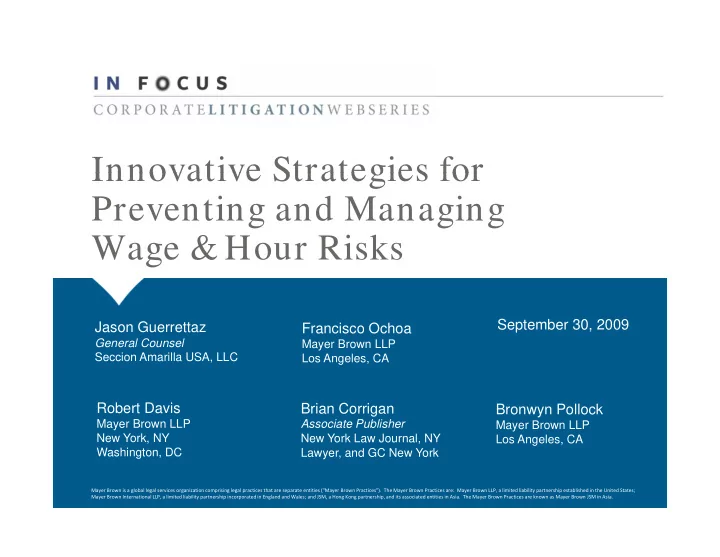
Innovative Strategies for Innovative Strategies for Preventing and Managing Wage & Hour Risks Wage & Hour Risks

Francisco Ochoa

Mayer Brown LLP Los Angeles, CA

Jason Guerrettaz

General Counsel Seccion Amarilla USA, LLC

September 30, 2009 Robert Davis

Mayer Brown LLP New York, NY Washington DC

Brian Corrigan

Associate Publisher New York Law Journal, NY Lawyer and GC New York

Bronwyn Pollock

Mayer Brown LLP Los Angeles, CA

Mayer Brown is a global legal services organization comprising legal practices that are separate entities ("Mayer Brown Practices"). The Mayer Brown Practices are: Mayer Brown LLP, a limited liability partnership established in the United States; Mayer Brown International LLP, a limited liability partnership incorporated in England and Wales; and JSM, a Hong Kong partnership, and its associated entities in Asia. The Mayer Brown Practices are known as Mayer Brown JSM in Asia.

Washington, DC Lawyer, and GC New York

slide-2
SLIDE 2

Overview of Presentation

  • Structuring compliance monitoring and follow‐up

programs from the in‐house perspective

  • Avoiding landmines in exempt‐status classifications
  • Challenging compliance issues re paying nonexempt

employees

  • Practical considerations once litigation is imminent or

filed

2

slide-3
SLIDE 3

STRUCTURING COMPLIANCE STRUCTURING COMPLIANCE MONITORING AND FOLLOW‐UP PROGRAMS FROM THE IN HOUSE PROGRAMS FROM THE IN‐HOUSE PERSPECTIVE

3

slide-4
SLIDE 4

Key Steps to Successful Wage & Hour Compliance Program Compliance Program

  • Identify risks based on compliance opportunities and

litigation trends

  • Understand needs and perspective of business unit in

designing compliance program

  • Develop compliance solutions that will work with

business unit

  • Use company culture and resources to implement

compliance program

4

slide-5
SLIDE 5

Identify Compliance Opportunities

  • Layoffs
  • Exempt‐status classification
  • Sales‐related
  • Independent contractors
  • Overtime pressures
  • Overtime pressures
  • Staffing levels
  • Employee complaints
  • Recent investigations

5

slide-6
SLIDE 6

Recent Wage & Hour Litigation Trends

  • Exempt‐status classification

– Financial services industry – Outside/inside sales

  • Pay compliance
  • Meal periods

Meal periods

  • Business expense reimbursement / wage deductions

id i f / hif ibili i

  • Unpaid time for pre/post shift responsibilities

6

slide-7
SLIDE 7

Examples of Wage & Hour Risks Resulting from Unique Compliance Opportunities Unique Compliance Opportunities

  • Layoffs that put exempt positions in “grey zone” and

result in pay‐equity issues result in pay equity issues

  • Sales culture that discourages expense reimbursement
  • Pressure to limit overtime that results in off‐the‐clock

work, not recording all hours worked

  • Understaffing that results in meal and rest period

compliance problems

  • Nonexempt employees emailing/texting off‐the‐clock
  • Spotting patterns in employee complaints

7

slide-8
SLIDE 8

Understand Your Audience: Assess Wage & Hour Risks from Perspective of Business Unit

  • In‐person visit; meet w/all levels of employees

Hour Risks from Perspective of Business Unit

  • Develop interview script re target areas identified

for wage and hour compliance

– “Smart interviews” – specific questions re how the job can be performed and still comply with the law – Use interviews as tool to review job descriptions

  • Use of counsel to conduct interviews
  • Consider terminology – e.g., review, not audit

8

slide-9
SLIDE 9

Increasing Awareness of Wage & Hour Risks in Business Unit Business Unit

  • Comprehensive training program for all employees

– Focus on specific issues impacting business unit

  • Consider impact of assigning employment costs as

Consider impact of assigning employment costs as business‐unit expense

  • Create a culture of compliance

Create a culture of compliance

  • Train HR/Help Desk to identify wage and hour

issues and escalate to legal issues and escalate to legal

  • Create central controls over hiring, promotion,

compensation and termination compensation, and termination

  • ADR

9

slide-10
SLIDE 10

Developing Compliance Solutions Targeted to Specific Wage & Hour Risks Specific Wage & Hour Risks

  • Example of compliance monitoring program

– Monitoring time entries of nonexempt employees to review compliance (e.g., meal periods) – Caller follows up with employee via telephone (with script) to ask about reason for noncompliance and reminder re policy reminder re policy – Manager‐related noncompliance reviewed for discipline against manager against manager – Discipline employee only after repeated noncompliance

10

slide-11
SLIDE 11

Developing Compliance Solutions Targeted to Specific Wage & Hour Risks Specific Wage & Hour Risks

  • Exempt‐status classification

– Analyze “grey area” positions

  • Middle managers; managers over paper, not people
  • Sales
  • IT

– Review duties and salary criteria – Require new positions and job descriptions to be q p j p approved by counsel – Consider impact of layoffs and part‐time work

11

slide-12
SLIDE 12

AVOIDING LANDMINES IN EXEMPT‐ AVOIDING LANDMINES IN EXEMPT STATUS CLASSIFICATIONS

12

slide-13
SLIDE 13

Exemption From Statutory Minimum Wage & Overtime Pay

  • FLSA: exemption for employees working in executive,

administrative, professional and outside sales positions, and certain computer‐related positions. (FLSA section 13(a)(1); 29 CFR Part 541) CFR Part 541)

  • To qualify for an exemption, employees must:

– Meet certain tests regarding their job duties; and – Meet certain tests regarding their job duties; and – Be paid on a salary basis at a rate not less than $455 per week

13

slide-14
SLIDE 14

Executive Exemption

  • To qualify for the executive exemption, all of the following

conditions must be met:

– Compensation must be on salary basis at a rate not less than $455 per week d b f h f – Primary duty must be management of the enterprise or of a customarily recognized department or subdivision – Employee must customarily and regularly direct the work of at least two or more full‐time employees or their equivalent – Employee must have the authority to hire or fire other employees, or his/her suggestions and recommendations re hiring firing his/her suggestions and recommendations re hiring, firing, advancement, promotion or other change of status of other employees must be given particular weight

14

slide-15
SLIDE 15

Administrative Exemption

  • To qualify for the administrative exemption, all of the following

conditions must be met:

– Compensation must be on salary or fee basis at a rate not less than $455 per week Primary duty must be the performance of office or non manual work – Primary duty must be the performance of office or non‐manual work directly related to the management or general business operations of the employer or its customers – Primary duty must include the exercise of discretion and independent judgment with respect to matters of significance

  • Note: In recent years substantial litigation re this exemption

Note: In recent years, substantial litigation re this exemption, particularly in the financial services and insurance industries

15

slide-16
SLIDE 16

Professional Exemption

  • Employees can be classified as creative or learned professional

l employees

  • To qualify for the creative professional exemption, all of the

following conditions must be met: following conditions must be met:

– Compensation must be on salary or fee basis at a rate not less than $455 per week – Primary duty must be the performance of work requiring invention, imagination, originality or talent in a recognized filed of artistic or creative endeavor creative endeavor

16

slide-17
SLIDE 17

Professional Exemption (cont.)

  • To qualify for the learned professional exemption, all of the

following conditions must be met: following conditions must be met:

– Compensation must be on salary or fee basis at a rate not less than $455 per week – Primary duty must be the performance of work requiring advanced knowledge, meaning work which predominantly intellectual in character and that requires the consistent exercise of discretion and q judgment – The advanced knowledge must be in a field of science or learning – The advanced knowledge must be customarily acquired through a prolonged course of specialized intellectual instruction

17

slide-18
SLIDE 18

Computer Employee Exemption

T lif f th t l ti ll f th

  • To qualify for the computer employee exemption, all of the

following conditions must be met:

– Compensation must be either on salary or fee basis at a rate not less Compensation must be either on salary or fee basis at a rate not less than $455 per week, or at an hourly rate of not less than $27.63 per hour Employee must be in the position of computer systems analyst – Employee must be in the position of computer systems analyst, computer programmer, software engineer or other similarly skilled position in the computer field

18

slide-19
SLIDE 19

Computer Employee Exemption (cont.)

– Primary duties must consist of:

  • Application of systems analysis techniques and procedures
  • Application of systems analysis techniques and procedures,

including consulting with users, to determine hardware, software or system functional specifications D i d l t d t ti l i ti t ti

  • Design, development, documentation, analysis creation, testing or

modification of computer systems or programs, including prototypes, based on or related to user or system design specifications specifications

  • Design, development, documentation, testing, creation or

modification of computer programs relating to machine operating systems, or

  • A combination of the above duties, requiring the same level of skills

19

slide-20
SLIDE 20

Outside Sales Exemption

  • To qualify for the outside sales employee exemption, all of the

following conditions must be met:

– Primary duty must be making sales, or obtaining orders or contracts for services or for the use of facilities for which a consideration will be paid by the client or customer – Employee must be customarily and regularly engaged away from the employer’s place or places of business, which includes an employee’s home office

  • The outside dales exemption does not require payment of a

minimum amount of compensation

  • Note: In recent years, significant litigation regarding this

exemption, including in the sales industry

20

slide-21
SLIDE 21

Highly Compensated Employee Exemption

  • To qualify for the highly compensated employee exemption, all

f th f ll i diti t b t

  • f the following conditions must be met:

– Annual compensation must be $100,000 or more, which must include at least $455 per week paid on a salary basis p p y – Employee must perform office or non‐manual work – Employee must customarily and regularly perform at least one of the duties of an exempt executive, administrative or professional employee

  • Note: Some states do not allow this exemption

21

slide-22
SLIDE 22

Key Definitions

  • “Primary duty” means the principal, main, major or most

i d h h l f D i i f important duty that the employee performs. Determination of an employee’s primary duty must be based on all of the facts in a particular case, with the major emphasis on the character of the employee’s job as a whole. In some circumstances, the primary duty may involve less than 50% of the employee’s work time.

  • “Customarily and regularly” means greater than occasional but

less than constant; it includes work normally done every workweek, but does not include isolated or one‐time tasks. ,

22

slide-23
SLIDE 23

Key Definitions (cont.)

  • The exercise of “discretion and independent judgment”

involves the comparison and evaluation of possible courses of involves the comparison and evaluation of possible courses of conduct, and acting or making a decision after the various possibilities have been considered

– Employee must have the authority to make an independent choice, free of immediate direction and supervision If l ’ d i i b i d d th t d t – If employee’s decisions can be revised or reversed, that does not mean the employee cannot exercise discretion and independent judgment – Exercise of discretion and independent judgment must be more than the use of skill in applying well‐established techniques, procedures or specific standards described in manuals or other sources

23

slide-24
SLIDE 24

Key Definitions (cont.)

  • Payment on a “salary basis” means that an employee receives a

predetermined amount of compensation each pay period on a weekly or less frequent basis weekly or less frequent basis

– This amount cannot be reduced because of variations in the quality or quantity of the employee’ work – Subject to a few exceptions, an exempt employee must receive the full salary for any week in which the employee performs any work, regardless of the number of days or hours worked

  • Payment on a “fee basis” means that an employee is paid an

agreed sum for a single job, regardless of the time required for l its completion

– A fee meets the compensation requirement for exemption if the payment for the job is at a rate that would amount to at least $455 per payment for the job is at a rate that would amount to at least $455 per week if the employee worked 40 hours on the job

24

slide-25
SLIDE 25

Relationship with State Laws

  • FLSA does not preempt state laws. Where state laws provide

stricter exemption rules, the state rules will govern.

  • California:

– No primary duty test; exempt employees must be primarily engaged in the performance of exempt duties spend more than 50% of their work time on performance of exempt duties = spend more than 50% of their work time on exempt duties – Executive, administrative and professional exempt employees must earn a monthly salary equivalent to no less than two times the state minimum wage monthly salary equivalent to no less than two times the state minimum wage (currently $8.00 per hour) for full‐time employment (defined as 40 hours per week) – Different definitions of duties for some exemptions including the professional – Different definitions of duties for some exemptions, including the professional,

  • utside sales and computer exemptions

– Does not permit a highly compensated employees exemption

25

slide-26
SLIDE 26

PAYING NONEXEMPT EMPLOYEES – PAYING NONEXEMPT EMPLOYEES THE THREE BASIC STEPS

26

slide-27
SLIDE 27

Step 1 – Determine Compensable Hours Worked Determine Compensable Hours Worked

  • Clearly document system which employees must

follow to record their compensable hours worked

  • Discipline supervisors who request or allow non‐

reporting of compensable hours worked

  • Farragher/Ellerth‐type reporting system for

employees who have complaints

27

slide-28
SLIDE 28

Step 1 – Determine Compensable Hours Worked Determine Compensable Hours Worked

  • Use of “default” schedules, dependent on “exception”

reporting, to capture compensable hours worked

  • “Bona fide” meal periods – length, and completely

relieved of duties

  • “Continuous workday” theory, preliminary time,

postliminary time

  • “Rounding” of time, and use of the de minimis rule

28

slide-29
SLIDE 29

Step 2 – Calculate the “regular rate” Calculate the regular rate

  • The “regular rate” is the hourly rate of pay on which
  • vertime is computed. The regular rate may differ

materially from the stated hourly rate of pay.

  • General principle: all pay for hours worked divided by

all hours worked

  • The regular rate calculation is unique to each work

week

29

slide-30
SLIDE 30

Step 2 – Calculate the “regular rate” Calculate the regular rate

  • Focus on inclusions – examples:

– Premiums for non‐overtime work – Non‐discretionary bonuses y

  • Focus on exclusions – examples:

“Gift ” d di ti b – “Gifts” and discretionary bonuses – Payments for work not performed – Premium rates: daily, weekly, weekends, holidays

  • Special calculations for salaried nonexempts and

commissioned employees

30

slide-31
SLIDE 31

Step 3 – Calculate the overtime premium Calculate the overtime premium

  • Basic rule: overtime hours are paid at “time and a

half” based on the regular rate

  • Fixed salary for fluctuating work week
  • “Half‐time” plans
  • Document the methods used
  • Document the methods used
  • Does your payroll vendor or payroll software

accurately implement these rules? accurately implement these rules?

31

slide-32
SLIDE 32

PRACTICAL CONSIDERATIONS ONCE PRACTICAL CONSIDERATIONS ONCE LITIGATION IS IMMINENT OR FILED

32

slide-33
SLIDE 33

Document & Data Retention Before Litigation

  • Develop litigation response team w/counsel, IT,

records HR administrators records, HR, administrators

  • Catalogue active and legacy ESI and location,

t di h d ESI (d t b b it ) custodians, shared ESI (databases, websites), retention schedule and auto‐delete function, plan for terminated employees p y

  • Develop template w/standard instruction on how to
  • verride automatic deletion, placeholders for

, p summary of dispute and individuals affected

33

slide-34
SLIDE 34

Litigation Holds

  • When reasonably anticipate litigation, must put a

litigation hold in place

  • Must preserve what you reasonably should know is

relevant to the dispute or action

  • Focus on key players who are expected to have relevant

information

  • Counsel must take affirmative steps to ensure relevant

information being retained g

– Periodic reminders re compliance; electronic acknowledgement

  • Reevaluate hold when matter ultimately concluded

34

slide-35
SLIDE 35

Communications

  • No punitive reaction to noncompliance, encourage

education and follow up re policies education and follow up re policies

– Negative jury reaction to punishment of line employees but not managers employees, but not managers

  • Avoid inflammatory and culpable language
  • Consider impact of all communications on jury
  • Careful communication w/current employees in a

class action to avoid dissuading participation or threat

  • f retaliation
  • Review by counsel

35

slide-36
SLIDE 36

Th k f j i i t d Thank you for joining us today.

California Specific Reference Materials to Follow Materials to Follow

slide-37
SLIDE 37

CALIFORNIA NONEXEMPT PAY ISSUES

37

slide-38
SLIDE 38

Timely Payment of Wages

  • Wages due

– Within 7 calendar days following the end of the payroll period Within 7 calendar days following the end of the payroll period – If using semi monthly payroll, may pay for work performed between the 1st and 15th of a month by the 26th of that month, and for work performed between the 16th and last day of a month by the 10th day of performed between the 16th and last day of a month by the 10th day of the following month

  • Note: Exempt employees must be paid for the entire month by the

h

26th of that month

  • Civil penalties may be sought by Labor Commissioner or employee for

late payment of wages late payment of wages

38

slide-39
SLIDE 39

Timely Payment of Terminating Employees

  • Wages due
  • Wages due

– On date of termination if employee is terminated by employer or voluntarily resigns with more than 72 hours of notice – Within 72 hours of termination if employee voluntarily resigns with less than 72 hours notice

  • Terminating employees who are not timely paid all of the wages
  • Terminating employees who are not timely paid all of the wages

earned at the time of termination are entitled to receive as a statutory penalty 8 hours of pay for each calendar day that such t i l t t i f 30 d payment is late, up to a maximum of 30 days

39

slide-40
SLIDE 40

Payment of Overtime Wages

  • Overtime

– Daily overtime at one and half times the regular rate for all hours worked in excess of 8 hours in a workday, and for the first 8 hours worked on the seventh consecutive day worked in a workweek – Daily overtime at double the regular rate for all hours worked in excess

  • f 12 hours in a workday, and for all hours worked in excess of 8 hours
  • n the seventh consecutive day worked in a workweek
  • Note: Employees remain entitled to weekly overtime at one and half times

the regular rate for all hours worked in excess of 40 hours in a workweek, as required by the FLSA. However, employees are not entitled to both weekly and daily overtime for the same hours worked

– Fluctuating workweek not permitted.

40

slide-41
SLIDE 41

California Meal Periods

  • Employers must “provide” one unpaid meal period for every five

hours worked

Mi i f 30 i d i – Minimum of 30 uninterrupted minutes – Must begin before start of 6th hour of work Must be duty free and permitted to leave the workplace – Must be duty free and permitted to leave the workplace – First meal period waiver by mutual consent permitted if workday does not exceed 6 hours; second meal period waiver by mutual consent d f kd d d h d f l d permitted if workday does not exceed 12 hours and first meal period was not waived – California Supreme Court currently reviewing whether an employer “provides” a meal period by making it available, or whether employer must ensure that employees take meal periods. Brinker v. Superior Court

41

slide-42
SLIDE 42

California Rest Periods

  • Employers must “authorize and permit” one paid rest period for each

p y p p p 4‐hour work period or major fraction thereof (i.e., over 2 hrs.)

– No rest period required if workday is less than 3 ½ hours – Minimum of 10 uninterrupted minutes – Rest period must be duty free, but employees may be required to remain at workplace remain at workplace – “Authorize and permit” construed to mean make available

42

slide-43
SLIDE 43

Payment for Failure to Provide Meal/Rest Periods Periods

  • Employees who are not provided a meal period, or who

h k are not authorized and permitted to take a rest period, as required by law are entitled to receive one hour of pay at their regular rate of pay g p y

– Note: Labor Commissioner’s current enforcement policy limits this payment requirement to a maximum of one hour of pay for each workday in which one or more violations have occurred. However, the y courts have not yet decided whether an employer can be liable for more than one payment per workday for multiple violations in a workday

43

slide-44
SLIDE 44

Other California Nonexempt Issues

  • Alternative workweeks (e g four 10‐hour days w/o OT)
  • Alternative workweeks (e.g., four 10 hour days w/o OT)

– Approval process strictly regulated. Requires written agreement, which must be approved by two‐thirds of affected employees, using secret b ll l i d d b l ballot election process mandated by law – Alternative workweek plan must be placed on file with Labor Commissioner

  • Compensatory time off in lieu of overtime not permitted
  • An employee may request in writing to make up time lost on a

An employee may request in writing to make up time lost on a workday due to a personal obligation of the employee on other workdays in the same workweek. The employer may not solicit or encourage such requests The employer may deny such requests encourage such requests. The employer may deny such requests.

– Make up time is not included toward computing the total number of hours worked for purposes of the overtime requirements, except for h k f h k h k hours worked in excess of 11 hours in a workday, or hours worked in excess of 40 hours in a workweek

44

slide-45
SLIDE 45

Other California Nonexempt Issues (cont.)

  • Reporting time pay

– Employees who are required to report and do report to work, but are not provided with their entire scheduled shift in a workday, must be paid at least half of their scheduled shift, with a minimum of two hours and a maximum of four hours – Narrow exceptions apply for certain instances where the failure to put employees to work is beyond the employer’s control

  • Days of rest
  • Days of rest

– Employees must receive one day’s rest in seven If it is not practicable for en employer to give one day off each – If it is not practicable for en employer to give one day off each workweek, employees may accumulate rest days as long as they are provided the equivalent of one day’s rest in seven in each calendar month month

45