
SLIDE 1
Innovative Airship Solutions from Guardian Flight Systems
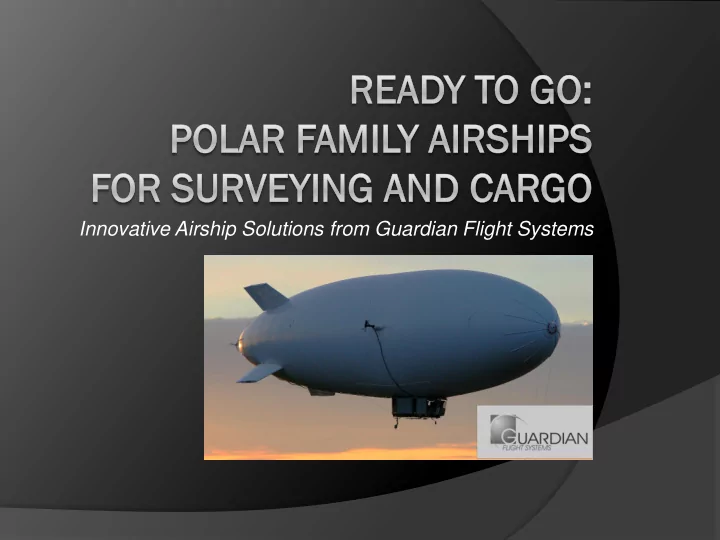
Innovative Airship Solutions from Guardian Flight Systems ITAR - - PowerPoint PPT Presentation
Innovative Airship Solutions from Guardian Flight Systems ITAR Disclaimer: This presentation does not contain Technical Data per 22 CFR 120.10 distribution unrestricted w/o 3282. Airships to the Arctic V Innovation begins with experience.
Innovative Airship Solutions from Guardian Flight Systems
Innovation begins with experience.
Airships to the Arctic V
Innovation begins with experience.
Airships to the Arctic V
About Guardian Flight Systems Polar 400 – Proof-of-concept for
Polar 600 – Near-term
Polar 3000 – Low-risk 10-ton
Ready to do business!
Innovation begins with experience…
Innovation begins with experience.
Airships to the Arctic V
Established in 2006 to build persistent
A division of Aviation Worldwide Services
○ Global provider of logistics and aviation
services with $300 million in annual revenue
○ Part 125 and 135 carrier for the US DoD ○ Operating in over two dozen countries with
○ Completion center for Sikorsky’s Blackhawk ○ Part 145 Modification and Repair Station
Established relationships with TCOM,
Innovation begins with experience.
Airships to the Arctic V
120 years combined airship experience
within our engineering group
Skyship 500HL, 600 Westinghouse Sentinel 1000, 5000 Cargolifter ATG SkyKitten, SkyCat, AT-10
Developed Polar Family Airship
architecture:
Fully maneuverable to zero airspeed VTOL/STOVL capable Can “taxi” in a manner similar to an airplane Demonstrated and validated reduced ground
crew requirements
Deliberate use of low-risk COTS technologies
The first member of Guardian’s Airship family.
Innovation begins with experience.
Airships to the Arctic V
Primary powerplant located in
The four hull-mounted propellers
Two side-mounted vectorable
Two stern-mounted propellers
Non-rigid design for simplicity, ease
Represents a “scalable” design
Innovation begins with experience.
Airships to the Arctic V
Innovation begins with experience.
Airships to the Arctic V
US OSD-sponsored and contracted launch/recovery/refueling exercise and technical evaluation of Polar 400 prototype vehicle results:
OSD: “Due to quick turn time (6 to 7 minutes including refueling) it’s clear a single crew could operate at least 2 or 3 different airships…”
OSD: “The manpower is 5 personnel (including the remote pilot) to attach and release the airship from the mast and 6 personnel… to fuel the vehicle.”
NAVAIR: “The 4 propellers permit vertical takeoff with pitch and lateral control at zero speeds. The impact is:
No runway needed
Lower operational costs
Less people on the ground”
Innovation begins with experience.
Airships to the Arctic V
Participated in Army RDECOM C4-ISR On-the-
Over 300 total flight test hours and >10
Innovation begins with experience.
Airships to the Arctic V
Innovation begins with experience.
Airships to the Arctic V
Providing a near-term solution for aerial surveying.
Innovation begins with experience.
Airships to the Arctic V
950 kg surveying payload capacity in addition to 2-pilot crew and fuel (3 kW available for payload)
Survey >20 hours at 20 knots, 100 nm from base (radius/speed/payload/endurance tradeoffs possible)
Type-certified design (derived from the proven Skyship 600: US Type Certificate AS1EU)
Powered by twin 300 hp vectorable direct-drive Lycoming IO-540 engines (STC SS05290AT)
Low-speed maneuverability enhanced by Polar- family hydraulic lateral thruster system which increases loiter stability and reduces ground crew requirements.
First flight in 6 months, deliverable in 12 months
We offer “parallel” payload integration using Polar 400 test-bed vehicle to shorten time into the field
Innovation begins with experience.
Airships to the Arctic V
Innovation begins with experience.
Airships to the Arctic V
On-station Loiter Endurance in Hours vs. Operating Radius*
*ISA conditions, 3,500 msl pressure height, 950 kg Payload, 200 kg crew, 40 KTAS cruise, 75 kg fuel reserve
A low-risk approach to delivering a 10-ton cargo ship.
Innovation begins with experience.
Airships to the Arctic V
Low-risk design
No fundamentally new technology or design work! Based on Polar 400 hull form, fins etc. Uses COTS powerplants and propellers Proven Polar-family architecture and low-speed maneuverability Derived from persistent surveillance platform variant being designed
for US military
Powered by 3 x 300 hp Ford Diesels and 2 x 1,000 hp
vectorable PT6 turboprops
10 metric ton cargo capacity, 100 nautical mile radius, VTOL 12 metric ton cargo capacity, 100 nautical mile radius, STOVL 1.6 metric ton VTOL drop-off capacity (no re-ballasting) 3.4 metric ton STOVL drop-off capacity 16 months to first flight, 36 months to certify, ~$20 million Drop-off capacity can be significantly expanded if desired
Innovation begins with experience.
Airships to the Arctic V
Innovation begins with experience.
Airships to the Arctic V
Cargo Capacity (metric tons) vs. Operating Radius*
*ISA conditions, 4,500 ft msl pressure height, 45 KTAS cruise @ 4,000 ft, no refueling, two hour cruise reserve, 300 kg crew.
Next steps to learn more about Guardian Flight Systems
Innovation begins with experience.
Airships to the Arctic V