
SLIDE 1
Innovation and Education M edical Use of Isotopes Patient - - PowerPoint PPT Presentation
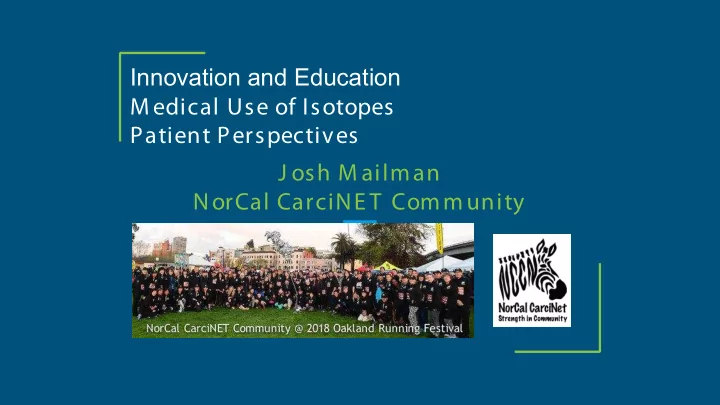
Innovation and Education M edical Use of Isotopes Patient Perspectives J osh M ailman NorCal CarciNET Community Disclosure NorCal CarciNET receives funding for educational and speaking events from AAA, Curium, IPSEN, Lexicon, Novartis, and
NorCal CarciNET receives funding for educational and speaking events from AAA, Curium, IPSEN, Lexicon, Novartis, and Progenics. Views expressed during this presentation are solely my own. Thank you on behalf of patients for this opportunity to participate in this forum
Diagnosed in 2007 with a Pancreatic Neuroendocrine Tumor
Selected current affiliations: President - NorCal CarciNET Community COO - World Association of Radiopharmaceutical and Molecular Therapy Inaugural president of Patient Advocate Advisory Board and Ga68 Working Group- SNMMI Treasure and Board Member - Neuroendocrine Tumor Research Foundation
○ Low incidence ~7/100k ~21,000 ○ Second highest prevalence for GI Cancer ~172k
(hormonal) and nervous systems.
○ They can occur all over the body
symptoms and imaging challenges (more on that later)
somatostatin receptors
Yao, JCO ‘08
J une 2016, NETSPOT - Ga68 Dotatate for Imaging J anuary 2018, Lutathera - Lu177 Dotatate for Treatment of GEPNETS J uly 2018, Azedra - I131 - Para/Pheo J une 2019, Ga68 Dotatoc for imaging
We concur with the SNMMI, EANM and WARMTH on the promising use of Alpha emitters and Copper 67 for several disease indications beyond NETS
approval date
limited to only those who could afford to travel overseas With Availability Comes New Opportunities for Education.
for patient, providers, and payers are magnified by the use of social media
○ DIffers by treatment facility ○ Fear of the unknown with Radiation ○ Some families (and pets) are separated from each other for weeks
○ Mis reads or mis understanding of imaging ○ Wanting to use an “experienced center”
All magnified in the lens of Facebook, and private patient support portals
Patient Release Criteria Maintaining Education Standards Managing Regulatory Challenges
NorCal CarciNET responded to Docket ID-NRC-2019-0154 Our response asked the NRC to consider adding isotope to tables 1 and 2 even if below threshold value with NA or “*” to indicate that the instructions do not apply as below threshold. Consider a patient friendly version of the Release Criteria so that patient can use this in discussion with their provider Confirm all values and best practice with stakeholders prior to final approvals
NorCal CarciNET Community responded to Docket ID NRC-2018-0230 in J anuary 2019. Our position was:
35.300.
access to procedures involving radiopharmaceuticals.
nuclear medicine.
We are reviewing proposed rulemaking that was issued on 1-17-2020
We want to again thank the NRC for updating giudice in 2017 and again in 2019 in the matter of germanium-68/gallium-68 (Ge-68/Ga-68) pharmaceutical-grade generators We were involved in at least 2 calls over 2015/16 in regards to Ge68 being left
have a decommissioning plan in place. While we can not predict the next regulatory challenge we know that one will