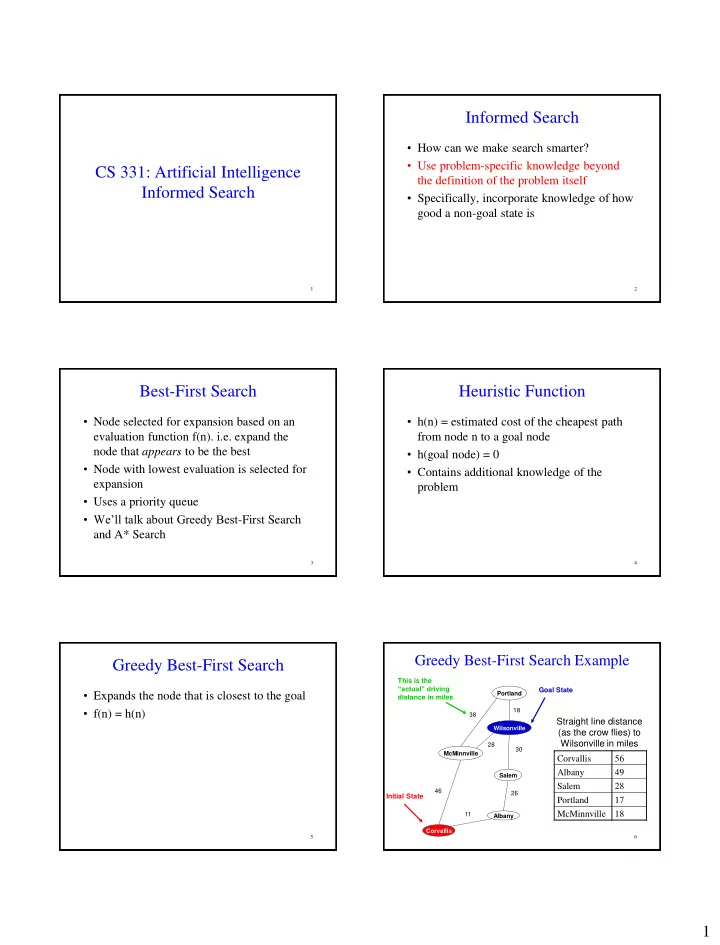
SLIDE 5 5
Consistency
- A heuristic is consistent if, for every node n and every
successor n’ of n generated by any action a: h(n) ≤ c(n,a,n’) + h(n’)
- A form of the triangle inequality – each side of the triangle
cannot be longer than the sum of the two sides
Step cost of going from n to n’ by doing action a n n’ G c(n,a,n’) h(n’) h(n) n n’ G c(n,a,n’)=2 h(n’)=1 h(n)=2 n n’ G c(n,a,n’)=2 h(n’)=1 h(n)=4
CONSISTENT INCONSISTENT
26
Consistency
- Every consistent heuristic is also admissible
- A* using GRAPH-SEARCH is optimal if
h(n) is consistent
- Most admissible heuristics are also
consistent
27
Consistency
- Claim: If h(n) is consistent, then the values of f(n) along
any path are nondecreasing
Suppose n’ is a successor of n. Want to show f(n’) ≥ f(n) Then g(n’) = g(n) + c(n,a,n’) for some a f(n’) = g(n’) + h(n’) = g(n) + c(n,a,n’) + h(n’) ≥ g(n) + h(n) = f(n)
- Thus, the sequence of nodes expanded by A* is in
nondecreasing order of f(n)
- First goal selected for expansion must be an optimal
solution since all later nodes will be at least as expensive
From defn of consistency: c(n,a,n’) + h(n’) ≥ h(n)
28
A* is Optimally Efficient
- Among optimal algorithms that expand search
paths from the root, A* is optimally efficient for any given heuristic function
- Optimally efficient: no other optimal algorithm is
guaranteed to expand fewer nodes than A*
– Fine print: except A* might possibly expand more nodes with f(n) = C* where C* is the cost of the optimal path – tie-breaking issues
- Any algorithm that does not expand all nodes with
f(n) < C* runs the risk of missing the optimal solution
29
Evaluating A* Search
With a consistent heuristic, A* is complete, optimal and
- ptimally efficient. Could this be the answer to our
searching problems?
30
Evaluating A* Search
With a consistent heuristic, A* is complete, optimal and
- ptimally efficient. Could this be the answer to our
searching problems? The Dark Side of A*…
Time complexity is exponential (although it can be reduced significantly with a good heuristic) The really bad news: space complexity is exponential (usually need to store all generated states). Typically runs out of space on large-scale problems.