
SLIDE 1
INDONESIA ECONOMIC QUARTERLY MARCH 2013
Jim Brumby, PREM Sector Manager & Lead Economist Paramadina Public Policy Institute, March 2013
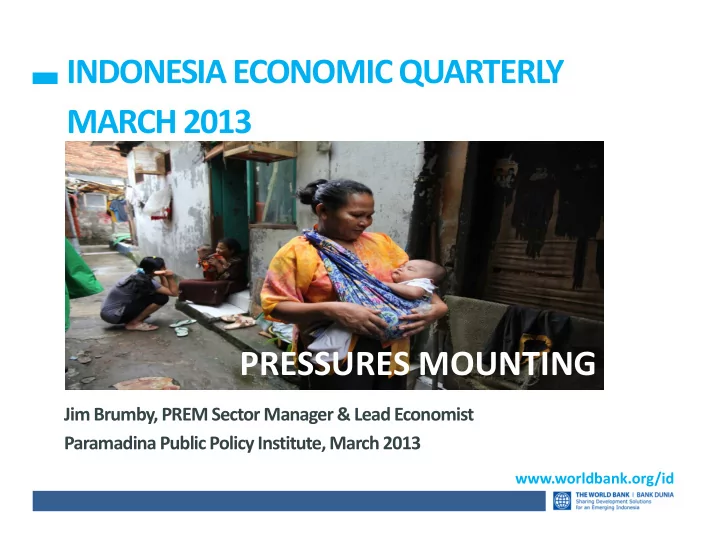
PRESSURES MOUNTING
www.worldbank.org/id
INDONESIA ECONOMIC QUARTERLY MARCH 2013 PRESSURES MOUNTING Jim - - PowerPoint PPT Presentation
INDONESIA ECONOMIC QUARTERLY MARCH 2013 PRESSURES MOUNTING Jim Brumby, PREM Sector Manager & Lead Economist Paramadina Public Policy Institute, March 2013 www.worldbank.org/id MARCH 2013 IEQ LAUNCH PRESENTATION Steady recent economic growth,
www.worldbank.org/id
3 6 9 12 15 3 6 9 12 15 Dec-2009 Dec-2010 Dec-2011 Dec-2012 Percent Percent China India Indonesia Malaysia Major Trading Partners USA
Source: CEIC; World Bank Global Economic Prospects, January 2013, and East Asia Update, December 2012
Real GDP growth, year-on-year
Source: CEIC; World Bank staff calculations
Year-on-year growth
2 4 6 8 10 12 14
20 40 60 80 Mar-09 Dec-09 Oct-10 Jul-11 Apr-12 Jan-13 Percent Percent Capital goods imports (3-month moving average) Real fixed investment
Source: CEIC; World Bank staff calculations
1 2 3 4 Jan-09 Jan-10 Jan-11 Jan-12 Jan-13 Non-oil and gas balance Oil and gas balance USD billion USD billion
6 12 18
6 12 18 Dec-09 Dec-10 Dec-11 Dec-12 Net direct investment Net portfolio Net other capital Current account Overall balance Basic balance USD billion USD billion
Source: CEIC; World Bank staff calculations
2 4 6 8 10 2 4 6 8 10 Dec-04 Dec-06 Dec-08 Dec-10 Dec-12 Real final sales Real final domestic sales Real GDP Percent Percent
Note: Real final (domestic) sales = Measured private consumption + government consumption + fixed investment + net exports (-net exports) Source: CEIC; World Bank staff calculations
Year-on-year growth
5 10 15 20 25 30 5 10 15 20 25 30 Dec-04 Dec-06 Dec-08 Dec-10 Dec-12 Real GDP Nominal GDP Percent Percent
Source: CEIC; World Bank staff calculations
Year-on-year growth
5 10 15 20 25 30 35 40 500 1,000 1,500 2,000 2,500 3,000 3,500 4,000 2000 2002 2004 2006 2008 2010 2012 GDP per capita (constant 2012 USD, LHS) GDP per capita (current price USD, LHS) GDP per capita (current price IDR, RHS) USD per capita IDR per capita (million)
Source: CEIC; World Bank staff calculations
Source: CEIC; World Bank staff calculations
2 4 6 8 20 40 60 80 Green Chili Red Chili Garlic Onion Food inflation excl items* Food inflation Change in CPI from Dec 2012 to Feb 2013 (LHS) Change in CPI from Dec 2012 to Feb 2013 (RHS) Percent Percent
0.0 0.5 1.0 1.5 2.0 2.5 2 4 6 8 10 12 14 16 18 20 2005 2006 2007 2008 2009 2010 2011 2012 2013 2014 Official Poverty (LHS) RPJM High Target RPJM Moderate Target Annual Change in Poverty Change in Poverty rate, percent Poverty rate, percent
50 100 150 200 250 300 350 50 100 150 200 250 300 350 Personnel Material Capital Int. Payments Energy subsidy Social 2011 Actual Audited 2012 Preliminary Actual 2013 Budget IDR trillion IDR trillion
Source: MoF; World Bank staff calculations
Note: CPI is annual average. Government figures for Budget deficit: 2012 is preliminary outturn, 2013 is approved Budget and 2014 is from the 2013 Draft Budget Financial Note Source: Ministry of Finance, BPS, Consensus Forecasts Inc., World Bank staff calculations
2011 2012 2013 2014 Gross domestic product 6.5 6.2 6.2 6.5 Consumer price index 5.2 4.3 5.5 5.2 Budget balance ‐1.2 ‐1.8 ‐1.7 ‐1.4 Major trading partner growth 3.6 3.4 3.7 4.0
certainty; making ongoing improvements in regulatory framework
challenge
restrictions
25 50 75 100
25 50 75 100 Agriculture Mining Food prod TCF Wood&paper Chemicals&mi… Basic metal Machinery Electric eq. Transport eq. Other Domestic goods Domestic services Foreign goods Foreign services Percent
Indonesia China Value-added in manufactured goods exports
Source: OECD and WTO Trade in Value-Added (TiVA) statistics
2 4 6 8 2 4 6 8 2002-2004 2005-2008 2010-2011 Percent Percent
Source: CEIC; World Bank staff calculations
Inbound FDI, percent of GDP
100 200 300 400 500 2 4 6 8 10 1995 1997 1999 2001 2003 2005 2007 2009 2011 Percent of GDP IDR trillion Real spending (2000 prices, RHS) Infrastructure investment to GDP (LHS)
Note: Real value calculated using investment GDP deflator Source: Infrastructure investment data as detailed in Box 5 of March 2013 IEQ and World Bank staff calculations
Source: Indonesia: The Rise of Metropolitan Regions. The World Bank (2012)
Agglomeration areas in Indonesia 15 25 35 45 55 15 25 35 45 55 5.5 6 6.5 7 7.5 8 8.5 9 9.5 Percent Ln GDP per capita (PPP, 2005 prices) Indonesia China India Philippines Thailand Vietnam Per capita GDP against urbanization rates
Indonesia
continue
are to the downside