Incorporating use of a mixed-media information tool into the work - - PowerPoint PPT Presentation

incorporating use of a mixed media information tool into
SMART_READER_LITE
LIVE PREVIEW

Incorporating use of a mixed-media information tool into the work - - PowerPoint PPT Presentation

Incorporating use of a mixed-media information tool into the work of actors involved in the development of livestock production in Tanzania; dissemination, user training, monitoring and evaluation, and impact Jane Frances Asaba (CABI), Gareth


slide-1
SLIDE 1

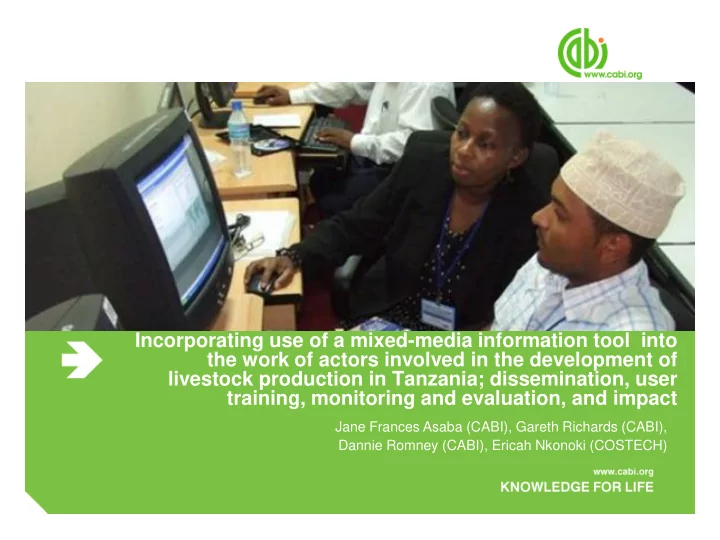
Incorporating use of a mixed-media information tool into the work of actors involved in the development of livestock production in Tanzania; dissemination, user training, monitoring and evaluation, and impact

Jane Frances Asaba (CABI), Gareth Richards (CABI), Dannie Romney (CABI), Ericah Nkonoki (COSTECH)

slide-2
SLIDE 2

Summary

  • The problem – limited access to timely, validated information
  • Introduction to the Animal Health and Production Compendium
  • Trainees and training
  • Monitoring and evaluation activities
  • Summary of results
  • Conclusions / Lessons learned
slide-3
SLIDE 3

The problem – limited access to timely, validated information

  • Lack of reference materials available to, in particular,

extension officers – “Only materials are out of date”

  • Individuals may have Internet access, but this, and computers,

are expensive

  • Dissemination of information is expensive; publishing leaflets,

etc.

  • In rural extension, information often passed by personal

contact based on personal experience or contacts - farmer is discouraged when information is not consistent or when it is not provided quickly

slide-4
SLIDE 4

An Anim imal al Hea ealt lth h an and d Pr Prod

  • duc

uctio tion n Com

  • mpe

pend ndiu ium

Mixed media knowledgebase on Internet and CD:

  • Datasheets; breeds, diseases, pathogens, food

products, disease vectors etc.

  • Library
  • Bibliography
  • Glossary
  • Pictures
  • Maps
  • Decision support tools
  • Navigation tools
slide-5
SLIDE 5

Example: Disease Datasheet Rift Valley Fever

Links to other datasheets or datasheet sections

slide-6
SLIDE 6

Library – wide range of Library documents…

slide-7
SLIDE 7
  • First AHPC Training Workshop (May 2008):
  • Monitoring and evaluation follow-up visits
  • Second and Third AHPC Training Workshops (June

2009). including the participation of previous year‟s trainees

  • Final Monitoring and evaluation workshop (July 2009).

Collection of Most Significant Change stories (MSCs)

Training programme in Tanzania

slide-8
SLIDE 8

Participants - 50

  • livestock field institute-based researchers and

scientists

  • university-based researchers
  • veterinarians (from central diagnostic laboratory,

extension, local government and private practice backgrounds)

  • public and private sector livestock

production/disease oriented extension workers

  • farmers‟ magazine journalist
  • farm managers
  • private sector farmer information service provider
  • veterinary/agricultural-input suppliers
  • trainers from agricultural colleges and industrial

farms

  • rural ICT trainers
slide-9
SLIDE 9
  • Actor Linkage Matrix; participants identify the

information flows and constraints in the fields in which they work

  • Training in using the Animal Health and

Production Compendium; demonstration and hands-on sessions

  • Planning sessions; participants set themselves

SMART objects and agree on reporting methods

AHPC Workshop Format

slide-10
SLIDE 10

AHPC Training Workshops

slide-11
SLIDE 11

Monitoring and evaluation

  • Visits
  • Telephone and email communication
  • „NING‟ website; www.ning.com

Final Monitoring and evaluation workshop (July 2009). Collection of Most Significant Change stories (MSCs):

  • impact on livestock development
  • dissemination and spreading awareness of the AHPC
  • changes in participants‟ way of working
  • unanticipated benefits
  • lessons learned
slide-12
SLIDE 12

Dissemination of information from the Compendium

  • Training materials prepared using the AHPC reached:
  • 7 field level training programmes
  • >3000 farmers/livestock keepers
  • Articles for farmers‟ magazines - tickborne diseases and

brucellosis:

  • 10,000 copies
  • 23 of Tanzania‟s 26 regions)
slide-13
SLIDE 13

Other benefits from the Compendium…

  • Catalysed plans to equip district council employees with

computers and other information resources

  • Used to produce training resources at Livestock Training

Institutes

  • Increasing quality of research proposals and research

papers

  • Led to better decision making by extension workers
slide-14
SLIDE 14

Awareness raising events initiated by participants

  • Tanzania Veterinary Association Conference, January 2009, in Arusha
  • 150 veterinary and paraveterinary delegates at pre-conference

workshop

  • >420 delegates at the main conference
  • At other events the AHPC was introduced to:
  • 200 extension workers
  • 40 farmers
  • 100 researchers and paraveterinarians
  • 8 milk processors and 5 veterinarians
  • Nane Nane Agricultural Show in August 2008 and 2009
  • AHPC demonstrated
  • Extension materials disseminated here.
  • COSTECH has taken on the role of distributor for the Compendium in

Tanzania, allowing the resource to be purchased with local currency.

slide-15
SLIDE 15

Most Significant Change Stories

Domain Title Why participant considers story a most significant change Ranking (Points) 3 Lugoba Cattle vaccinated against East Coast Fever (ECF) Better extension services (advice) were provided using knowledge from the AHPC. This has positively influenced farmers‟ decision-making. 2.8 3 Poultry keeping set to improve in Rufiji Awareness creation and extension activities led to improvement in farmers‟ knowledge and have empowered them to demand more information about poultry keeping 2.3 3 AHPC: Seeing is believing Successful demonstration of the AHPC as an easy to use and relevant source of information facilitated its use by researchers and trainers 2.2 3 AHPC on the move in Mkuranga The AHPC is contributing to improve the knowledge of extension staff (livestock/human health) 2 2 AHPC Awareness creation at Sokoine University of Agriculture (SUA) There has been increased use of the AHPC (0-15 users) over a 2-month period 2 4 Pleasant surprise for researcher as he secures 30 million Tanzania shillings for research on tsetse and trypanosomosis Throughout his career, the scientist had never won research funds and he attributes this success to the information from the Compendium, which he used to develop his proposal. 2 2 Promoting the AHPC as a reference tool for trainers and students The Compendium is a reliable source of information and helps to fill the gap in training resources (inadequate resources) 1.8 2 AHPC a resource for developing training materials at the Open University of Tanzania (OUT) The Compendium provides concise, up-to-date information 1.2

slide-16
SLIDE 16

The importance of images

  • Use in the field-level extension environment, diagnostic photographs

used for conflict resolution as well as confirmation of diagnoses

  • Use of illustrations and information to produce extension materials to

increase the rate of vaccination against East Coast fever

slide-17
SLIDE 17

Conclusions / Lessons learned

  • Main uses of AHPC were for reference and production of

teaching/demonstration materials

  • Compendium catalyzed activities strengthening IT/information

capacity

  • Impact greater at field – extension – level
  • Images proved to be a very useful component
  • Assistance of previous participants in later workshops

addressed issues of variable language skills and ICT capabilities of participants

  • Communication channels for monitoring and mentoring should

be simple, affordable and sustainable

  • For national ownership of the programme it is important to use

local intermediaries and facilitators

  • Train influential individuals at policy level
slide-18
SLIDE 18

These activities were part of, Combating Hunger and Rural Poverty through Increasing Access to Knowledge: Participation of IFAD in the Global Compendium Programme Project Grant CABI 831 Gareth Richards g.richards@cabi.org