
SLIDE 1
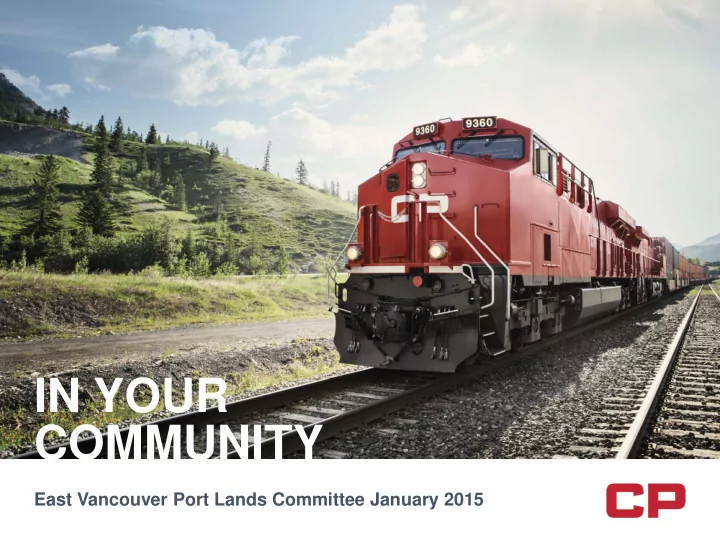
IN YOUR COMMUNITY
East Vancouver Port Lands Committee January 2015
IN YOUR COMMUNITY East Vancouver Port Lands Committee January 2015 - - PowerPoint PPT Presentation
IN YOUR COMMUNITY East Vancouver Port Lands Committee January 2015 OUR NETWORK WORKING WITH COMMUNITIES PLANNING AND RESPONSE Preparing: Phase 1: Overview Phase 2: Tabletop exercise with local first responders. Phase 3: Mock
East Vancouver Port Lands Committee January 2015
OUR NETWORK
WORKING WITH COMMUNITIES
PLANNING AND RESPONSE
– Phase 1: Overview – Phase 2: Tabletop exercise with local first responders. – Phase 3: Mock exercise – Railroad 101: Specific Fire/Police department training
3
SAFE TRANSPORTATION OF DANGEROUS GOODS
Who owns the tracks? CP owns our own tracks and Right of Way. Who owns the tank cars? Tank cars are owned by product producers or third party lessors. Who owns product in the cars? The product producer. Must CP move dangerous goods?
rail traffic. Who is liable for the movement of dangerous goods? The railway. In the event of an incident on CP tracks, CP is liable.
CONTEXT
5
SAFE TRANSPORTATION OF DANGEROUS GOODS
THE INSPECTION PROCESS
Determines basic description Inspects cars for compliance Loads car and applies proper placards/ markings Prepares shipping paper for shipment Receives shipping paper for shipment
Inspects cars before leaving shipper’s facility
Creates shipping paper for movement Switches car according to restrictions Properly positions car in train Transports car Inspects car periodically during transport
CUSTOMER RAILWAY
6
SAFE TRANSPORTATION OF DANGEROUS GOODS
INCIDENT RATES CONTINUE TO DROP
8
SAFE TRANSPORTATION OF DANGEROUS GOODS
SAFETY AND VOLUMES ARE INCREASING
the industry for seven years.
way to transport hazardous commodities
considered hazardous commodities reach their destination without a release caused by a train accident
are down 91 percent since 1980 and 38 percent since 2000.
downward trend even as volumes grow
8
REGULATORY CHANGE
Directions:
CP MEETS OR EXCEEDS ALL REGULATORY REQUIREMENTS
10
LAC MEGANTIC
Locomotive
Mechanical problems not remedied Non-standard engine repair failure Locomotive Engine Fire Safety device not wired to initiate braking
Tank Cars
Breached tank cars and highly volatile crude oil
Transport Canada
Inadequate
changes Limited follow- up on safety deficiencies
Ineffective SMS audit program
Derailment
Excessive train speed for track
Train Securement
Insufficient hand brakes Improper hand brake test Independent air brakes leaked off
MM&A Railway
Train left unattended on hill No additional safety defenses
Ineffective training &
train securement
Weak safety culture
SMS not fully implemented Not effectively managing risks
TSB IDENTIFIED 18 CONTRIBUTING FACTORS
Transportation Safety Board of Canada investigative findings, 2013
11
PROXIMITY GUIDELINES
WWW.PROXIMITYISSUES.CA
Canadian Municipalities and the Railway Association of Canada.
Vancouver
8
PROXIMITY GUIDELINES
to railway operations are:
SETBACKS
14
Mike LoVecchio Director Government Affairs 778 772-9636 mike_lovecchio@cpr.ca @mike_lovecchio Public Information CP Community Connect 24/7 toll free 800 766-7912 community_connect@cpr.ca www.cpr.ca @CanadianPacific Emergency Contact CP Police Service 24/7 Toll Free 800 716-9132