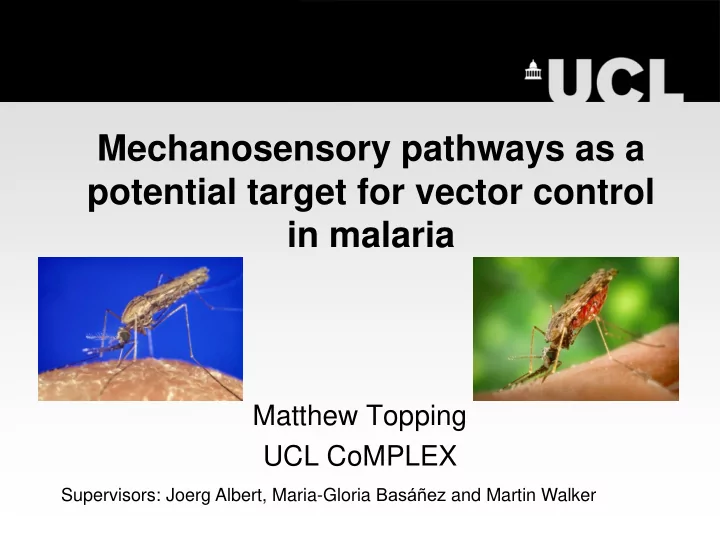
SLIDE 1 Mechanosensory pathways as a potential target for vector control in malaria
Matthew Topping UCL CoMPLEX
Supervisors: Joerg Albert, Maria-Gloria Basáñez and Martin Walker
SLIDE 2 Malaria
Plasmodium falciparum Plasmodium vivax
- Caused by Plasmodium protists
- P. vivax and falciparum are the most significant
for humans
- Spread by mosquitoes of the family Anopheles
SLIDE 3 Mosquito vector
Anopheles species act as vector in different locations
- Studies often use
- A. stephensi
because easiest to raise
Anopheles female feeding
SLIDE 4 Significance of malaria
- Symptoms include fever, convulsions and kidney
failure – severe cases can lead to death
- Estimated 219 million documented cases of malaria
in 2010 according to WHO
- Approximately 650,000 mortalities, the majority of
which were children
- Increased range of vector due to climate change
SLIDE 5
Current methods for eradication
3 different methods to combat malaria:
SLIDE 6
Current methods for eradication
3 different methods to combat malaria: Protect humans from infection using vaccines
SLIDE 7
Current methods for eradication
3 different methods to combat malaria: Protect humans from infection using vaccines Treat infected with antibiotics
SLIDE 8
Current methods for eradication
3 different methods to combat malaria: Protect humans from infection using vaccines Treat infected with antibiotics Target vectors with insecticides
SLIDE 9
Current methods for eradication
3 different methods to combat malaria: Protect humans from infection using vaccines Treat infected with antibiotics Target vectors with insecticides Many insecticides that lead to loss of mechanosensation are available but untested for application against malaria vectors
SLIDE 10 Mosquito chordotonal organs
- Male Johnston’s organ is largest chordotonal
- rgan in all insects – has over 7000 scolopidia
- Female has significantly smaller organ
(approximately 3000 scolopidia)
Scolopidia
SLIDE 11 Importance of mechanosensation
- Insertion of the proboscis whilst blood feeding is very
likely to require some sort of mechanosensory feedback
- Courtship takes place whilst mosquitoes are flying and
involves acoustic communication
- Therefore insecticides which are able to target
mechanosensation could be useful
SLIDE 12 Pymetrozine
- Significant efficacy against aphids and other insects at
concentrations as low as 1 part per ten million
- Leads to loss of all chordotonal organ function
- Mechanism of action is unknown
- Aphids cannot insert proboscis into plants after
exposure to pymetrozine
SLIDE 13 Pea aphid feeding on plant
SLIDE 14
Project aims
Study the mechanosensory basis of, and requirements for, i) blood-feeding ii) mating in mosquitoes and the effect on these important parts of the mosquitoes life cycle of insecticides that destroy chordotonal organ function
SLIDE 15 Current and proposed experiments
- Investigate using water as a solvent for pymetrozine
- Take high speed camera footage of biting by
mosquitoes injected with pymetrozine
- Investigate the impact, if any, of pymetrozine on the
ability to mate
SLIDE 16
mouth parts to investigate chordotonal organ distribution
SLIDE 17
Proposed mathematical modelling
Goal = Create a model that accounts for the effect of mechanosensory impairment on the mosquito to investigate the potential impact of using pymetrozine Tools = No completely suitable malaria models exist currently A model by Lynch et al. (2012) including fungal insecticide could be adapted for this purpose
SLIDE 18
SLIDE 19 Conclusions
- New insecticides are needed to combat malaria
- Insecticides that affect mechanosensation have a
number of promising advantages
- Greater understanding of the role of mechanosensation
for blood feeding and mating could be useful in many different respects
SLIDE 20 Acknowledgements
- Joerg Albert (who helped source all images used)
- Maria-Gloria Basáñez
- Martin Walker