
SLIDE 1
- In Indiana some
water flows North but most flows South
1
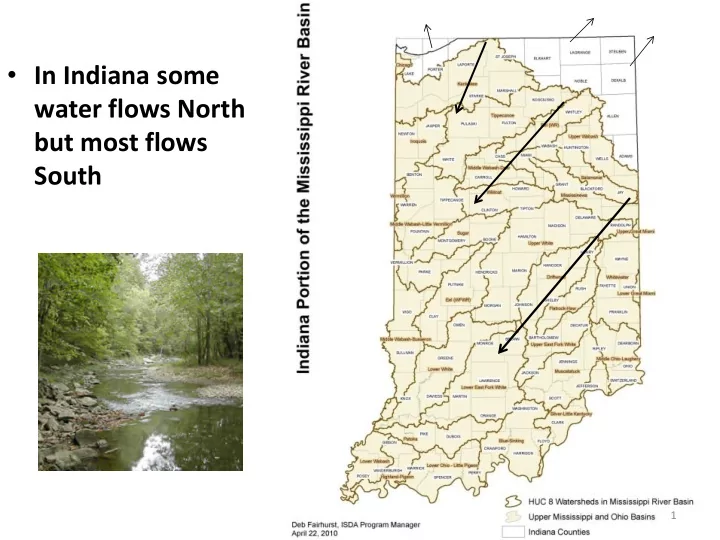
In Indiana some water flows North but most flows South 1 Toledo - - PowerPoint PPT Presentation
In Indiana some water flows North but most flows South 1 Toledo = Harmful Algal Bloom 3 Source: USGS SPARROW Model Source: USGS SPARROW Model Urgency: Gulf Restoration Network vs. EPA Des Moines Water Works vs. Counties Source:
1
Toledo = Harmful Algal Bloom
3
Source: USGS SPARROW Model
Source: USGS SPARROW Model
Source: Bloomberg Source: Iowa Farmer Today
Comprised of 92 smaller TMDLs within the Bay Watershed Based on 7 Watershed Implementation Plans
DE, VA) and Washington DC
$35 billion to $80 billion by 2025 Chesapeake Bay: The Largest Total Maximum Daily Load (TMDL) in history - 2010 TMDL = “Pollution Diet”
SWCD Generated Success Story Funding Break down/county
ISDA/SWCD DATA CREP & CWI
Indianapolis
DEB FAIRHURST
NRCS DATA FARM BILL*
Washington D.C.
CHRIS MORSE
IDEM DATA EPA – 319
Indianapolis
LOU RENSHAW
FSA DATA CRP SUSAN HOVERMAL E DNR DATA LARE
Indianapolis
DOUG NUSBAUM
DATA CONSOLIDATION & QUALITY CONTROL
DEB FAIRHURST ISDA
SPRING/FALL TILLAGE TRANSECT DATA*** http://www.in.gov/isda (Tillage Trends By County) (Separate Data Flow Process) ICP FINANCIAL REPORTS WEB APPLICATION*** http://www.in.gov/isda/icpreports/ (Total Funding By County) (Separate Data Flow Process) ANNUAL ICP CONSERVATION WORKLOAD REPORT*** (By County)
FSA DATA CRP
Kansas City
SUSAN HOVERMALE
QUARTERLY (CY) EPA REGION 5 LOAD REDUCTION MODELING** ISDA STAFF
ANNUAL REGION 5 MODEL LOAD REDUCTION MAPS*** (By Watershed)
REGION 5 MODEL DATA CONSOLIDATION & QUALITY CONTROL DEB FAIRHURST ISDA
PUBLISHED TO ISDA & ICP WEBSITES http://www.in.gov/isda http://iaswcd.org/icp/ PUBLISHED TO ISDA & ICP WEBSITES http://www.in.gov/isda http://iaswcd.org/icp/
*Data Sharing Privacy Agreements are in place ** http://it.tetratech-ffx.com/steplweb/models$docs.htm ***Incorporated into the Indiana Nutrient Reduction Strategy Last updated 9/25/14
Indiana Conservation Partnership Annual (CY) Workload Accountability Data Flow
Original Data Source
Data Server Location
AGENCY POINT OF CONTACT
Load reduction modeling accounting for before and after conditions conducted. Estimates pounds
waterways.
Thoughts For Further Consideration