Implicit Memory Alloca6on: Garbage Collec6on Garbage - - PowerPoint PPT Presentation

implicit memory alloca6on garbage collec6on
SMART_READER_LITE
LIVE PREVIEW

Implicit Memory Alloca6on: Garbage Collec6on Garbage - - PowerPoint PPT Presentation

University of Washington University of Washington Implicit Memory Alloca6on: Garbage Collec6on Garbage collec+on: automa6c reclama6on of heap-allocated The


slide-1
SLIDE 1

University ¡of ¡Washington ¡

Memory ¡Alloca6on ¡III ¡

The ¡Hardware/So>ware ¡Interface ¡

CSE351 ¡Winter ¡2013 ¡

University ¡of ¡Washington ¡

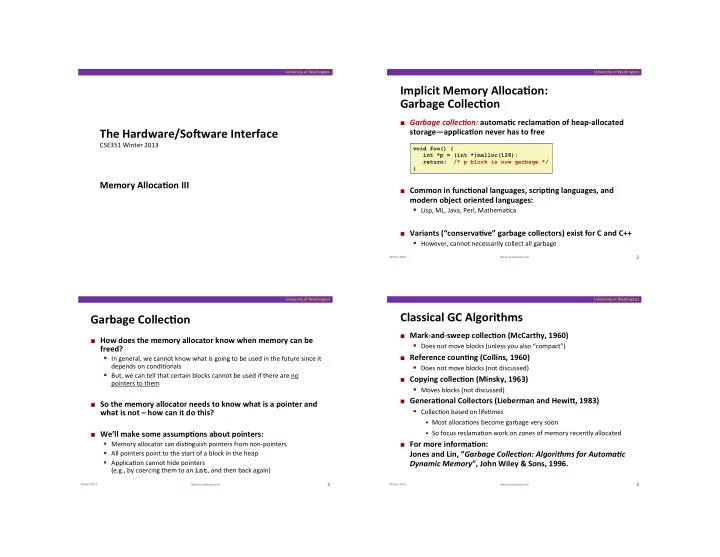
Implicit ¡Memory ¡Alloca6on: ¡ Garbage ¡Collec6on ¡

 Garbage ¡collec+on: ¡automa6c ¡reclama6on ¡of ¡heap-­‑allocated ¡

storage—applica6on ¡never ¡has ¡to ¡free ¡

 Common ¡in ¡func6onal ¡languages, ¡scrip6ng ¡languages, ¡and ¡

modern ¡object ¡oriented ¡languages: ¡

  • Lisp, ¡ML, ¡Java, ¡Perl, ¡Mathema<ca ¡

 Variants ¡(“conserva6ve” ¡garbage ¡collectors) ¡exist ¡for ¡C ¡and ¡C++ ¡

  • However, ¡cannot ¡necessarily ¡collect ¡all ¡garbage ¡

¡

void foo() { int *p = (int *)malloc(128); return; /* p block is now garbage */ } 2 ¡

Winter ¡2013 ¡ Memory ¡Alloca6on ¡III ¡

University ¡of ¡Washington ¡

Garbage ¡Collec6on ¡

 How ¡does ¡the ¡memory ¡allocator ¡know ¡when ¡memory ¡can ¡be ¡

freed? ¡

  • In ¡general, ¡we ¡cannot ¡know ¡what ¡is ¡going ¡to ¡be ¡used ¡in ¡the ¡future ¡since ¡it ¡

depends ¡on ¡condi<onals ¡

  • But, ¡we ¡can ¡tell ¡that ¡certain ¡blocks ¡cannot ¡be ¡used ¡if ¡there ¡are ¡no ¡

pointers ¡to ¡them ¡

 So ¡the ¡memory ¡allocator ¡needs ¡to ¡know ¡what ¡is ¡a ¡pointer ¡and ¡

what ¡is ¡not ¡– ¡how ¡can ¡it ¡do ¡this? ¡ ¡

 We’ll ¡make ¡some ¡assump6ons ¡about ¡pointers: ¡

  • Memory ¡allocator ¡can ¡dis<nguish ¡pointers ¡from ¡non-­‑pointers ¡
  • All ¡pointers ¡point ¡to ¡the ¡start ¡of ¡a ¡block ¡in ¡the ¡heap ¡
  • Applica<on ¡cannot ¡hide ¡pointers ¡ ¡

(e.g., ¡by ¡coercing ¡them ¡to ¡an ¡int, ¡and ¡then ¡back ¡again) ¡

3 ¡

Winter ¡2013 ¡ Memory ¡Alloca6on ¡III ¡

University ¡of ¡Washington ¡

Classical ¡GC ¡Algorithms ¡

 Mark-­‑and-­‑sweep ¡collec6on ¡(McCarthy, ¡1960) ¡

  • Does ¡not ¡move ¡blocks ¡(unless ¡you ¡also ¡“compact”) ¡

 Reference ¡coun6ng ¡(Collins, ¡1960) ¡

  • Does ¡not ¡move ¡blocks ¡(not ¡discussed) ¡

 Copying ¡collec6on ¡(Minsky, ¡1963) ¡

  • Moves ¡blocks ¡(not ¡discussed) ¡

 Genera6onal ¡Collectors ¡(Lieberman ¡and ¡Hewi\, ¡1983) ¡

  • Collec<on ¡based ¡on ¡life<mes ¡
  • Most ¡alloca<ons ¡become ¡garbage ¡very ¡soon ¡
  • So ¡focus ¡reclama<on ¡work ¡on ¡zones ¡of ¡memory ¡recently ¡allocated ¡

 For ¡more ¡informa6on: ¡ ¡

Jones ¡and ¡Lin, ¡“Garbage ¡Collec+on: ¡Algorithms ¡for ¡Automa+c ¡ Dynamic ¡Memory”, ¡John ¡Wiley ¡& ¡Sons, ¡1996. ¡

4 ¡

Winter ¡2013 ¡ Memory ¡Alloca6on ¡III ¡

slide-2
SLIDE 2

University ¡of ¡Washington ¡

Memory ¡as ¡a ¡Graph ¡

 We ¡view ¡memory ¡as ¡a ¡directed ¡graph ¡

  • Each ¡allocated ¡heap ¡block ¡is ¡a ¡node ¡in ¡the ¡graph ¡ ¡
  • Each ¡pointer ¡is ¡an ¡edge ¡in ¡the ¡graph ¡
  • Loca<ons ¡not ¡in ¡the ¡heap ¡that ¡contain ¡pointers ¡into ¡the ¡heap ¡are ¡called ¡

root ¡nodes ¡(e.g. ¡registers, ¡loca<ons ¡on ¡the ¡stack, ¡global ¡variables) ¡

Root ¡nodes ¡ Heap ¡nodes ¡ Not-­‑reachable ¡ (garbage) ¡ reachable ¡

A ¡node ¡(block) ¡is ¡reachable ¡if ¡there ¡is ¡a ¡path ¡from ¡any ¡root ¡to ¡that ¡node ¡ Non-­‑reachable ¡nodes ¡are ¡garbage ¡(cannot ¡be ¡needed ¡by ¡the ¡applica6on) ¡

5 ¡

Winter ¡2013 ¡ Memory ¡Alloca6on ¡III ¡

University ¡of ¡Washington ¡

Mark ¡and ¡Sweep ¡Collec6ng ¡

 Can ¡build ¡on ¡top ¡of ¡malloc/free ¡package ¡

  • Allocate ¡using ¡malloc ¡un<l ¡you ¡“run ¡out ¡of ¡space” ¡

 When ¡out ¡of ¡space: ¡

  • Use ¡extra ¡mark ¡bit ¡in ¡the ¡head ¡of ¡each ¡block ¡
  • Mark: ¡Start ¡at ¡roots ¡and ¡set ¡mark ¡bit ¡on ¡each ¡reachable ¡block ¡
  • Sweep: ¡Scan ¡all ¡blocks ¡and ¡free ¡blocks ¡that ¡are ¡not ¡marked ¡

Before ¡mark ¡ root ¡ ABer ¡mark ¡

Mark ¡bit ¡set ¡

ABer ¡sweep ¡

free ¡ free ¡ 6 ¡

Winter ¡2013 ¡ Memory ¡Alloca6on ¡III ¡

University ¡of ¡Washington ¡

Assump6ons ¡For ¡a ¡Simple ¡Implementa6on ¡

 Applica6on ¡can ¡use ¡func6ons ¡such ¡as: ¡

  • new(n) ¡: ¡ ¡returns ¡pointer ¡to ¡new ¡block ¡with ¡all ¡loca<ons ¡cleared ¡
  • read(b,i): ¡read ¡loca<on ¡i ¡of ¡block ¡b ¡into ¡register ¡
  • b[i]
  • write(b,i,v): write ¡v ¡into ¡loca<on ¡i ¡of ¡block ¡b
  • b[i] = v ¡

 Each ¡block ¡will ¡have ¡a ¡header ¡word ¡

  • b[-1]

¡

 Func6ons ¡used ¡by ¡the ¡garbage ¡collector: ¡

  • is_ptr(p): ¡determines ¡whether ¡p ¡is ¡a ¡pointer ¡to ¡a ¡block ¡
  • length(p): ¡ ¡returns ¡length ¡of ¡block ¡pointed ¡to ¡by ¡p, ¡not ¡including ¡header ¡
  • get_roots(): ¡ ¡returns ¡all ¡the ¡roots ¡

7 ¡

Winter ¡2013 ¡ Memory ¡Alloca6on ¡III ¡

University ¡of ¡Washington ¡

Mark ¡and ¡Sweep ¡(cont.) ¡

ptr mark(ptr p) { if (!is_ptr(p)) return; // do nothing if not pointer if (markBitSet(p)) return; // check if already marked setMarkBit(p); // set the mark bit for (i=0; i < length(p); i++) // recursively call mark on mark(p[i]); // all words in the block return; }

Mark ¡using ¡depth-­‑first ¡traversal ¡of ¡the ¡memory ¡graph ¡ ¡ Sweep ¡using ¡lengths ¡to ¡find ¡next ¡block ¡

ptr sweep(ptr p, ptr end) { while (p < end) { // while not at end of heap if markBitSet(p) // check if block is marked clearMarkBit(); // if so, reset mark bit else if (allocateBitSet(p)) // if not marked, but allocated free(p); // free the block p += length(p); // adjust pointer to next block } 8 ¡

Winter ¡2013 ¡ Memory ¡Alloca6on ¡III ¡

slide-3
SLIDE 3

University ¡of ¡Washington ¡

Conserva6ve ¡Mark ¡& ¡Sweep ¡in ¡C ¡

 Would ¡mark ¡& ¡sweep ¡work ¡in ¡C? ¡

  • is_ptr() ¡(previous ¡slide) ¡determines ¡if ¡a ¡word ¡is ¡a ¡pointer ¡by ¡

checking ¡if ¡it ¡points ¡to ¡an ¡allocated ¡block ¡of ¡memory ¡

  • But ¡in ¡C, ¡pointers ¡can ¡point ¡into ¡the ¡middle ¡of ¡allocated ¡blocks ¡(not ¡so ¡

in ¡Java) ¡

  • Makes ¡it ¡tricky ¡to ¡find ¡all ¡allocated ¡blocks ¡in ¡mark ¡phase ¡
  • There ¡are ¡ways ¡to ¡solve/avoid ¡this ¡problem ¡in ¡C, ¡but ¡the ¡resul<ng ¡

garbage ¡collector ¡is ¡conserva-ve: ¡

  • Every ¡reachable ¡node ¡correctly ¡iden<fied ¡as ¡reachable, ¡but ¡some ¡

unreachable ¡nodes ¡might ¡be ¡incorrectly ¡marked ¡as ¡reachable ¡

header ¡ ptr ¡ 9 ¡

Winter ¡2013 ¡ Memory ¡Alloca6on ¡III ¡

University ¡of ¡Washington ¡

Memory-­‑Related ¡Perils ¡and ¡Piialls ¡

 Dereferencing ¡bad ¡pointers ¡  Reading ¡unini6alized ¡memory ¡  Overwri6ng ¡memory ¡  Referencing ¡nonexistent ¡variables ¡  Freeing ¡blocks ¡mul6ple ¡6mes ¡  Referencing ¡freed ¡blocks ¡  Failing ¡to ¡free ¡blocks ¡

10 ¡

Winter ¡2013 ¡ Memory ¡Alloca6on ¡III ¡

University ¡of ¡Washington ¡

Dereferencing ¡Bad ¡Pointers ¡

 The ¡classic ¡scanf ¡bug ¡  Will ¡cause ¡scanf ¡to ¡interpret ¡contents ¡of ¡val ¡as ¡an ¡

address! ¡

  • Best ¡case: ¡program ¡terminates ¡immediately ¡due ¡to ¡segmenta<on ¡fault ¡
  • Worst ¡case: ¡contents ¡of ¡val ¡correspond ¡to ¡some ¡valid ¡read/write ¡area ¡
  • f ¡virtual ¡memory, ¡causing ¡scanf ¡to ¡overwrite ¡that ¡memory, ¡with ¡

disastrous ¡and ¡baffling ¡consequences ¡much ¡later ¡in ¡program ¡execu<on ¡ int val; ... scanf(“%d”, val);

11 ¡

Winter ¡2013 ¡ Memory ¡Alloca6on ¡III ¡

University ¡of ¡Washington ¡

Reading ¡Unini6alized ¡Memory ¡

 Assuming ¡that ¡heap ¡data ¡is ¡ini6alized ¡to ¡zero ¡

/* return y = Ax */ int *matvec(int **A, int *x) { int *y = (int *)malloc( N * sizeof(int) ); int i, j; for (i=0; i<N; i++) { for (j=0; j<N; j++) { y[i] += A[i][j] * x[j]; } } return y; }

12 ¡

Winter ¡2013 ¡ Memory ¡Alloca6on ¡III ¡

slide-4
SLIDE 4

University ¡of ¡Washington ¡

Overwri6ng ¡Memory ¡

 Alloca6ng ¡the ¡(possibly) ¡wrong ¡sized ¡object ¡

int **p; p = (int **)malloc( N * sizeof(int) ); for (i=0; i<N; i++) { p[i] = (int *)malloc( M * sizeof(int) ); }

13 ¡

Winter ¡2013 ¡ Memory ¡Alloca6on ¡III ¡

University ¡of ¡Washington ¡

Overwri6ng ¡Memory ¡

 Off-­‑by-­‑one ¡error ¡

int **p; p = (int **)malloc( N * sizeof(int *) ); for (i=0; i<=N; i++) { p[i] = (int *)malloc( M * sizeof(int) ); }

14 ¡

Winter ¡2013 ¡ Memory ¡Alloca6on ¡III ¡

University ¡of ¡Washington ¡

Overwri6ng ¡Memory ¡

 Not ¡checking ¡the ¡max ¡string ¡size ¡  Basis ¡for ¡classic ¡buffer ¡overflow ¡a\acks ¡

  • Your ¡lab ¡assignment ¡#3 ¡

char s[8]; int i; gets(s); /* reads “123456789” from stdin */

15 ¡

Winter ¡2013 ¡ Memory ¡Alloca6on ¡III ¡

University ¡of ¡Washington ¡

Overwri6ng ¡Memory ¡

 Misunderstanding ¡pointer ¡arithme6c ¡

int *search(int *p, int val) { while (p && *p != val) p += sizeof(int); return p; }

16 ¡

Winter ¡2013 ¡ Memory ¡Alloca6on ¡III ¡

slide-5
SLIDE 5

University ¡of ¡Washington ¡

Overwri6ng ¡Memory ¡

 Referencing ¡a ¡pointer ¡instead ¡of ¡the ¡object ¡it ¡points ¡to ¡  ‘-­‑-­‑’ ¡and ¡‘*’ ¡operators ¡have ¡same ¡precedence ¡and ¡associate ¡

from ¡right-­‑to-­‑le>, ¡so ¡-­‑-­‑ ¡happens ¡first! ¡

int *getPacket(int **packets, int *size) { int *packet; packet = packets[0]; packets[0] = packets[*size - 1]; *size--; // what is happening here? reorderPackets(packets, *size); return(packet); }

17 ¡

Winter ¡2013 ¡ Memory ¡Alloca6on ¡III ¡

University ¡of ¡Washington ¡

Referencing ¡Nonexistent ¡Variables ¡

 Forgesng ¡that ¡local ¡variables ¡disappear ¡when ¡a ¡func6on ¡

returns ¡

int *foo () { int val; return &val; }

18 ¡

Winter ¡2013 ¡ Memory ¡Alloca6on ¡III ¡

University ¡of ¡Washington ¡

Freeing ¡Blocks ¡Mul6ple ¡Times ¡

 Nasty! ¡  What ¡does ¡the ¡free ¡list ¡look ¡like? ¡

x = (int *)malloc( N * sizeof(int) ); <manipulate x> free(x); ... y = (int *)malloc( M * sizeof(int) ); free(x); <manipulate y>

19 ¡

x = (int *)malloc( N * sizeof(int) ); <manipulate x> free(x); free(x);

Winter ¡2013 ¡ Memory ¡Alloca6on ¡III ¡

University ¡of ¡Washington ¡

Referencing ¡Freed ¡Blocks ¡

 Evil! ¡ ¡

x = (int *)malloc( N * sizeof(int) ); <manipulate x> free(x); ... y = (int *)malloc( M * sizeof(int) ); for (i=0; i<M; i++) y[i] = x[i]++;

20 ¡

Winter ¡2013 ¡ Memory ¡Alloca6on ¡III ¡

slide-6
SLIDE 6

University ¡of ¡Washington ¡

Failing ¡to ¡Free ¡Blocks ¡(Memory ¡Leaks) ¡

 Slow, ¡silent, ¡long-­‑term ¡killer! ¡ ¡

foo() { int *x = (int *)malloc(N*sizeof(int)); ... return; }

21 ¡

Winter ¡2013 ¡ Memory ¡Alloca6on ¡III ¡

University ¡of ¡Washington ¡

Failing ¡to ¡Free ¡Blocks ¡(Memory ¡Leaks) ¡

 Freeing ¡only ¡part ¡of ¡a ¡data ¡structure ¡

struct list { int val; struct list *next; }; foo() { struct list *head = (struct list *)malloc( sizeof(struct list) ); head->val = 0; head->next = NULL; <create and manipulate the rest of the list> ... free(head); return; }

22 ¡

Winter ¡2013 ¡ Memory ¡Alloca6on ¡III ¡

University ¡of ¡Washington ¡

Dealing ¡With ¡Memory ¡Bugs ¡

 Conven6onal ¡debugger ¡(gdb) ¡

  • Good ¡for ¡finding ¡bad ¡pointer ¡dereferences ¡
  • Hard ¡to ¡detect ¡the ¡other ¡memory ¡bugs ¡

 Debugging ¡malloc ¡(UToronto ¡CSRI ¡malloc) ¡

  • Wrapper ¡around ¡conven<onal ¡malloc
  • Detects ¡memory ¡bugs ¡at ¡malloc ¡and ¡free ¡boundaries ¡
  • Memory ¡overwrites ¡that ¡corrupt ¡heap ¡structures ¡
  • Some ¡instances ¡of ¡freeing ¡blocks ¡mul<ple ¡<mes ¡
  • Memory ¡leaks ¡
  • Cannot ¡detect ¡all ¡memory ¡bugs ¡
  • Overwrites ¡into ¡the ¡middle ¡of ¡allocated ¡blocks ¡
  • Freeing ¡block ¡twice ¡that ¡has ¡been ¡reallocated ¡in ¡the ¡interim ¡
  • Referencing ¡freed ¡blocks ¡

23 ¡

Winter ¡2013 ¡ Memory ¡Alloca6on ¡III ¡

University ¡of ¡Washington ¡

Dealing ¡With ¡Memory ¡Bugs ¡(cont.) ¡

 Some ¡malloc ¡implementa6ons ¡contain ¡checking ¡code ¡

  • Linux ¡glibc ¡malloc: ¡setenv MALLOC_CHECK_ 2 ¡ ¡
  • FreeBSD: ¡setenv MALLOC_OPTIONS AJR ¡ ¡

 Binary ¡translator: ¡valgrind ¡(Linux), ¡Purify ¡

  • Powerful ¡debugging ¡and ¡analysis ¡technique ¡
  • Rewrites ¡text ¡sec<on ¡of ¡executable ¡object ¡file ¡
  • Can ¡detect ¡all ¡errors ¡as ¡debugging ¡malloc
  • Can ¡also ¡check ¡each ¡individual ¡reference ¡at ¡run<me ¡
  • Bad ¡pointers ¡
  • Overwri<ng ¡
  • Referencing ¡outside ¡of ¡allocated ¡block ¡

Winter ¡2013 ¡ Memory ¡Alloca6on ¡III ¡

24 ¡