Implicit Graphs Implicit Graph: Only a subset, possibly only - - PDF document

implicit graphs
SMART_READER_LITE
LIVE PREVIEW

Implicit Graphs Implicit Graph: Only a subset, possibly only - - PDF document

2/23/2016 Explicit vs Implicit Graphs Explicit Graph: All vertices are identified individually and represented separately. CSE373: Data Structures and Algorithms All edges are identified individually and represented separately.


slide-1
SLIDE 1

2/23/2016 1

CSE373: Data Structures and Algorithms

Implicit Graphs

Steve Tanimoto Winter 2016

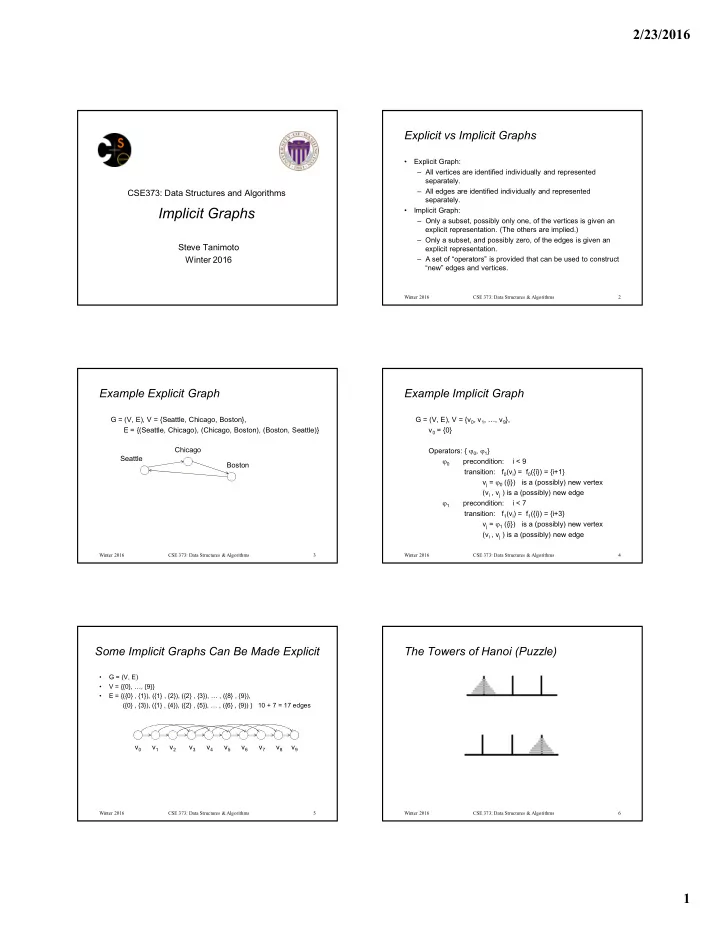
Explicit vs Implicit Graphs

  • Explicit Graph:

– All vertices are identified individually and represented separately. – All edges are identified individually and represented separately.

  • Implicit Graph:

– Only a subset, possibly only one, of the vertices is given an explicit representation. (The others are implied.) – Only a subset, and possibly zero, of the edges is given an explicit representation. – A set of “operators” is provided that can be used to construct “new” edges and vertices.

2 CSE 373: Data Structures & Algorithms Winter 2016

Example Explicit Graph

G = (V, E), V = {Seattle, Chicago, Boston}, E = {(Seattle, Chicago), (Chicago, Boston), (Boston, Seattle)}

3 CSE 373: Data Structures & Algorithms

Seattle Chicago Boston

Winter 2016

Example Implicit Graph

G = (V, E), V = {v0, v1, …, v9}, v0 = {0} Operators: { 0, 1} 0 precondition: i < 9 transition: f0(vi) = f0({i}) = {i+1} vj = 0 ({i}) is a (possibly) new vertex (vi , vj ) is a (possibly) new edge 1 precondition: i < 7 transition: f1(vi) = f1({i}) = {i+3} vj = 1 ({i}) is a (possibly) new vertex (vi , vj ) is a (possibly) new edge

4 CSE 373: Data Structures & Algorithms Winter 2016

Some Implicit Graphs Can Be Made Explicit

  • G = (V, E)
  • V = {{0}, …, {9}}
  • E = {({0} , {1}), ({1} , {2}), ({2} , {3}), … , ({8} , {9}),

({0} , {3}), ({1} , {4}), ({2} , {5}), … , ({6} , {9}) } 10 + 7 = 17 edges

5 CSE 373: Data Structures & Algorithms

v1 v0 v2 v3 v4 v5 v6 v7 v8 v9

Winter 2016

The Towers of Hanoi (Puzzle)

6 CSE 373: Data Structures & Algorithms Winter 2016

slide-2
SLIDE 2

2/23/2016 2

Example: TOH* Graph

7 CSE 373: Data Structures & Algorithms

G = (V, E) v0 = [[4321],[ ], [ ]] vk = [p0, p1, p2]; pm = [dm,0, dm,1, …, dm,nm] i, j precondition : pi != [] and if pj != [] then di,ni < dj,nj i, j transition : pi: [ ,di,ni], pj: [  ]  pi: [  ], pj: [ ,di,ni]

The precondition is that peg i must have at least one disk, and if peg j has any disks, the top (last) disk on peg i must be smaller than the last disk on peg j. The transition is that the top disk on peg i is removed from peg i and put on the top

  • f the pile on peg j.

* Towers of Hanoi

Winter 2016

TOH Graph – properties

8 CSE 373: Data Structures & Algorithms

Gn = TOH graph for an n-disk TOH puzzle. Gn = (Vn, En) What is | Vn | ? What is | En | ? Diameter of Gn ? Longest distance between two vertices of the graph.

Winter 2016

TOH Graph – properties

9 CSE 373: Data Structures & Algorithms

Gn = TOH graph for an n-disk TOH puzzle. Gn = (Vn, En) What is | Vn | ? What is | En | ? Diameter of Gn ? Longest distance between two vertices of the graph. n=1 3 3 1

Winter 2016

TOH Graph – properties

10 CSE 373: Data Structures & Algorithms

Gn = TOH graph for an n-disk TOH puzzle. Gn = (Vn, En) What is | Vn | ? What is | En | ? Diameter of Gn ? Longest distance between two vertices of the graph. n=1, n=2 3 9 3 12 1 3

Winter 2016

TOH Graph – properties

11 CSE 373: Data Structures & Algorithms

Gn = TOH graph for an n-disk TOH puzzle. Gn = (Vn, En) What is | Vn | ? What is | En | ? Diameter of Gn ? Longest distance between two vertices of the graph. n=1, n=2, n=3 3 9 27 3 12 39 1 3 7

Winter 2016

TOH Graph – properties

12 CSE 373: Data Structures & Algorithms

Gn = TOH graph for an n-disk TOH puzzle. Gn = (Vn, En) What is | Vn | ? What is | En | ? Diameter of Gn ? Longest distance between two vertices of the graph. n=1, n=2, n=3, n=4 3 9 27 81 3 12 39 120 1 3 7 15

Winter 2016

slide-3
SLIDE 3

2/23/2016 3

TOH Graph – properties

13 CSE 373: Data Structures & Algorithms

Gn = TOH graph for an n-disk TOH puzzle. Gn = (Vn, En) What is | Vn | ? | Vn | = 3  | Vn-1 | What is | En | ? Diameter of Gn ? Longest distance between two vertices of the graph. n=1, n=2, n=3, n=4 3 9 27 81 3 12 39 120 1 3 7 15

Winter 2016

TOH Graph – properties

14 CSE 373: Data Structures & Algorithms

Gn = TOH graph for an n-disk TOH puzzle. Gn = (Vn, En) What is | Vn | ? | Vn | = 3  | Vn-1 | What is | En | ? | En | = 3  | Vn | + 3 Diameter of Gn ? Longest distance between two vertices of the graph. n=1, n=2, n=3, n=4 3 9 27 81 3 12 39 120 1 3 7 15

Winter 2016

TOH Graph – properties

15 CSE 373: Data Structures & Algorithms

Gn = TOH graph for an n-disk TOH puzzle. Gn = (Vn, En) What is | Vn | ? | Vn | = 3  | Vn-1 | What is | En | ? | En | = 3  | Vn | + 3 Diameter of Gn ? D(Gn) = 2  D(Gn-1) + 1 Longest distance between two vertices of the graph. n=1, n=2, n=3, n=4 3 9 27 81 3 12 39 120 1 3 7 15

Winter 2016

TOH Graph – properties

16 CSE 373: Data Structures & Algorithms

Gn = TOH graph for an n-disk TOH puzzle. Gn = (Vn, En) What is | Vn | ? | Vn | = 3  | Vn-1 | What is | En | ? | En | = 3  | Vn | + 3 Diameter of Gn ? D(Gn) = 2  D(Gn-1) + 1 Longest distance between two vertices of the graph. n=1, n=2, n=3, n=4 3 9 27 81 3 12 39 120 1 3 7 15

Winter 2016

n_disks = 4

CSE 373: Data Structures & Algorithms 17 Winter 2016

n_disks = 3

With heuristic distances to landmarks. Solution path shown (the golden path)

CSE 373: Data Structures & Algorithms 18 Winter 2016

slide-4
SLIDE 4

2/23/2016 4

Creating Graph Layouts

  • Each vertex should be assigned a location on the “page” that

helps reflect the structure of the graph.

  • One method is based on “landmark vertices.”

Formulate a distance function d(v0, v1). Identify 3 or more “landmark” states in Sigma: {L1, L2, L3, . . . , Ln } and assign them (x,y) locations. For vertex v, use d to find barycentric coordinates (b1, b2, . . . , bn) in terms of L1, . . . , Ln , and plot v.

CSE 373: Data Structures & Algorithms 19 Winter 2016

Heuristic distance dh(v0, v1)

Natural method: weight larger disks more heavily. Then add up the absolute values of differences.

n - 1

dh(v0, v1) =  2k | qk(v0, v1) |

k = 0

Where qk(v0, v1) = 1 if disk k is on different pegs in v0 and v1, and 0

  • therwise.

Disk 0 is the smallest disk. (n is the number of disks.)

CSE 373: Data Structures & Algorithms 20 Winter 2016

Layout depends on distance function

Let dm(v0, v1) = minimum number of moves needed to reach v0 from v1. Then the solution path can be a straight line.

CSE 373: Data Structures & Algorithms 21 Winter 2016

TOH Graph Laid Out with dm and barycentric coordinates.

CSE 373: Data Structures & Algorithms 22

Note that the golden path is now a straight line.

Winter 2016

Summary

Graphs can be represented explicitly, implicitly, or with a combination of methods. Some graphs come in families that share properties. e.g., TOH graph G4  {Gn such that n > 0} Graph layout can reveal structural information. Problems and puzzles can be represented by graphs. Path-finding methods can be used to solve problems.

CSE 373: Data Structures & Algorithms 23 Winter 2016