
SLIDE 1
Implementing Graphs
Data Structures and Algorithms
CSE 373 SP 18 - KASEY CHAMPION 1
https://visualdatahub.wordpress.com/2013/04/02/a-web-of-thrones-character-relationships/
Implementing Graphs Data Structures and Algorithms CSE 373 SP 18 - - - PowerPoint PPT Presentation
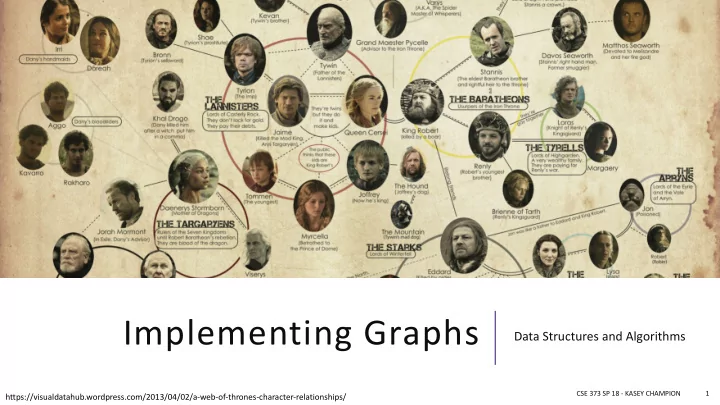
Implementing Graphs Data Structures and Algorithms CSE 373 SP 18 - KASEY CHAMPION 1 https://visualdatahub.wordpress.com/2013/04/02/a-web-of-thrones-character-relationships/ Warm Up Draw a graph that represents the following relationships:
Data Structures and Algorithms
CSE 373 SP 18 - KASEY CHAMPION 1
https://visualdatahub.wordpress.com/2013/04/02/a-web-of-thrones-character-relationships/
Draw a graph that represents the following relationships:
V = 13 E = 19
CSE 373 SP 18 - KASEY CHAMPION 2
Robert Catelyn
Sansa Robb Bran Arya
Rickon
Jon Ned
Cersei Jaime Tywin Tyrion
I’m not here next week Email me with grade questions
CSE 373 SP 18 - KASEY CHAMPION 3
Graph Direction
Degree of a Vertex
Drogo : 1, Danny : 1, Jon : 1
Petyr : 0, Catelyn : 2, Ned : 1
Petyr : 1, Catelyn : 1, Ned : 1
CSE 373 SP 18 - KASEY CHAMPION 4
Drogo
Dany
Jon V = { Dany, Drogo, Jon } E = { (Dany, Drogo), (Dany, Jon) } inferred (Drogo, Dany) and (Jon, Dany) V = { Petyr, Catelyn, Ned } E = { (Petyr, Catelyn), (Catelyn, Ned), (Ned, Catelyn) } Petyr
Catelyn
Ned Undirected Graph: Directed Graph:
Self loop – an edge that starts and ends at the same vertex Parallel edges – two edges with the same start and end vertices Simple graph – a graph with no self-loops and no parallel edges
CSE 373 SP 18 - KASEY CHAMPION 5
Dany Drogo Petyr
Margaery
Renly Loras
Brienne
Is a graph valid if there exists a vertex with a degree of 0?
CSE 373 SP 18 - KASEY CHAMPION 6
Petyr has an “in degree” of 0
Robert Lyanna
Rheagar
Lyanna has an “out degree” of 0
Cersei Jaime
Robert
Robert has both an “in degree” and an “out degree” of 0
Is this a valid graph?
Jon
Yes!
Robert Joffrey Tommen
Stark Lannister Tyrells Targaryens
Are these valid? Yup Sure Yes
Petyr
Catelyn
Ned
Cersei
Implement with nodes… Implementation gets super messy What if you wanted a vertex without an edge? How can we implement without requiring edges to access nodes? Implement using some of our existing data structures!
CSE 373 SP 18 - KASEY CHAMPION 7
A B C D A T T B C T T D T
CSE 373 SP 18 - KASEY CHAMPION 8
Assign each vertex a number from 0 to V – 1 Create a V x V array of Booleans If (x,y) ∈ E then arr[x][y] = true Runtime (in terms of V and E)
How much space is used? V2
A B C D
Dense Graph – a graph with a lot of edges E ∈ Θ(V2) Sparse Graph – a graph with “few” edges E ∈ Θ(V) An Adjacency Matrix seems a waste for a sparse graph…
CSE 373 SP 18 - KASEY CHAMPION 9
Stark Lannister Tyrells Targaryens Jon Sam Yoren Pyp Eddison
Create a Dictionary of size V from type V to Collection of E If (x,y) ∈ E then add y to the set associated with the key x Runtime (in terms of V and E)
How much space is used? V + E
CSE 373 SP 18 - KASEY CHAMPION 10
1 2 3 A B C D A B C D B C B D A
Walk – continuous set of edges leading from vertex to vertex A list of vertices where if I is some int where 0 < 1 < Vn every pair (Vi, Vi+1) in E is true Path – a walk that never visits the same vertex twice
CSE 373 SP 18 - KASEY CHAMPION 11
Winterfell Castle Black King’s Landing Casterly Rock Winterfell Castle Black King’s Landing Casterly Rock
Connected graph – a graph where every vertex is connected to every other vertex via some path. It is not required for every vertex to have an edge to every other vertex There exists some way to get from each vertex to every other vertex
CSE 373 SP 18 - KASEY CHAMPION 12
Sansa Robb Bran Arya Rickon Jon Dany
Connected Component – a subgraph in which any two vertices are connected via some path, but is connected to no additional vertices in the supergraph
within the connected component to every other vertex in the connected component
component
Viserys
CSE 373 SP 18 - KASEY CHAMPION 13
In all previous data structures:
For graphs – Where do we start? How do we decide where to go next? When do we end?
CSE 373 SP 18 - KASEY CHAMPION 14
1. Pick any vertex to start, mark it “visited” 2. Put all neighbors of first vertex in a “to be visited” collection 3. Move onto next vertex in “to be visited” collection 4. Mark vertex “visited” 5. Put all unvisited neighbors in “to be visited” 6. Move onto next vertex in “to be visited” collection 7. Repeat…
Current node: Queue: Visited:
CSE 373 SP 18 - KASEY CHAMPION 15
F B C D A E G H I J
A B A B E C D D F G B D E H E C C F F G G I G H H I I search(graph) toVisit.enqueue(first vertex) while(toVisit is not empty) current = toVisit.dequeue() for (V : current.neighbors()) if (V is not in queue) toVisit.enqueue(v) visited.add(current)
Visited:
CSE 373 SP 18 - KASEY CHAMPION 16
F B C D A E G H I J
A B D E C F G H I search(graph) toVisit.enqueue(first vertex) while(toVisit is not empty) current = toVisit.dequeue() for (V : current.neighbors()) toVisit.enqueue(v) visited.add(current) Runtime? O(V + 2E) = O(V + E) “graph linear” How many times do you visit each node? How many times do you traverse each edge? 1 time each Max 2 times each
BFS uses a queue to order which vertex we move to next Gives us a growing “frontier” movement across graph Can you move in a different pattern? Can you use a different data structure? What if you used a stack instead?
CSE 373 SP 18 - KASEY CHAMPION 17
bfs(graph) toVisit.enqueue(first vertex) while(toVisit is not empty) current = toVisit.dequeue() for (V : current.neighbors()) if (V is not in queue) toVisit.enqueue(v) visited.add(current) dfs(graph) toVisit.push(first vertex) while(toVisit is not empty) current = toVisit.pop() for (V : current.neighbors()) if (V is not in stack) toVisit.push(v) visited.add(current)
CSE 373 SP 18 - KASEY CHAMPION 18
F B C D A E G H I J
dfs(graph) toVisit.push(first vertex) while(toVisit is not empty) current = toVisit.pop() for (V : current.neighbors()) if (V is not in stack) toVisit.push(v) visited.add(current)
Current node: Stack: Visited: A
B A B E C D D F G B E H E C F G I H H I G F I C D Runtime? O(V + 2E) = O(V + E) “graph linear” How many times do you visit each node? How many times do you traverse each edge? 1 time each Max 2 times each