Implementing evidence into (BE WELL) practice to improve chronic - - PowerPoint PPT Presentation

implementing evidence into
SMART_READER_LITE
LIVE PREVIEW

Implementing evidence into (BE WELL) practice to improve chronic - - PowerPoint PPT Presentation

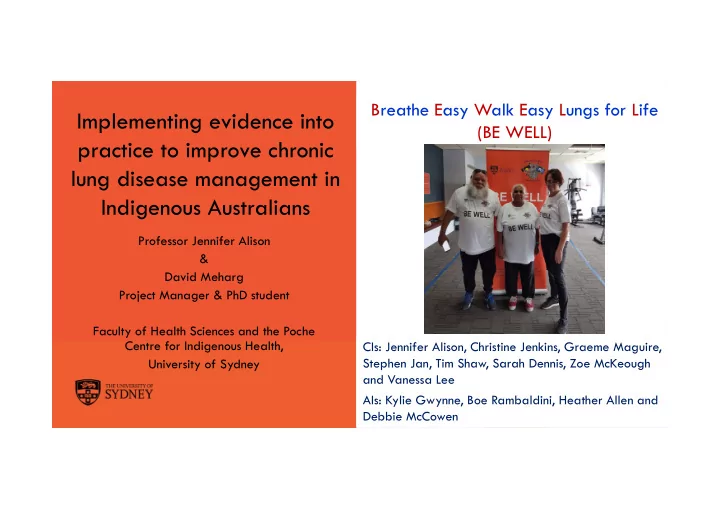
Breathe Easy Walk Easy Lungs for Life Implementing evidence into (BE WELL) practice to improve chronic lung disease management in Indigenous Australians Professor Jennifer Alison & David Meharg Project Manager & PhD student Faculty


slide-1
SLIDE 1

The University of Sydney Page 1

Implementing evidence into practice to improve chronic lung disease management in Indigenous Australians

Professor Jennifer Alison & David Meharg Project Manager & PhD student Faculty of Health Sciences and the Poche Centre for Indigenous Health, University of Sydney

Breathe Easy Walk Easy Lungs for Life (BE WELL)

AIs: Kylie Gwynne, Boe Rambaldini, Heather Allen and Debbie McCowen CIs: Jennifer Alison, Christine Jenkins, Graeme Maguire, Stephen Jan, Tim Shaw, Sarah Dennis, Zoe McKeough and Vanessa Lee

slide-2
SLIDE 2

The University of Sydney Page 2

BE WELL Overview

– Aim and research question – Study design, methods and outcome measures – Knowledge to Action Framework – BE WELL study flowchart – Project to date – Reflections

slide-3
SLIDE 3

The University of Sydney Page 3

Aim and Research Question

BE WELL aims to: – Build the capacity of Aboriginal Medical Services in New South Wales, Australia to provide effective management of Chronic Obstructive Pulmonary Disease (COPD), through pulmonary rehabilitation. Research Question – Can pulmonary rehabilitation be implemented in Aboriginal Medical Services and achieve improved health outcomes for Aboriginal people with chronic lung disease?

slide-4
SLIDE 4

The University of Sydney Page 4

Study Design – Implementation Science

Source: NIH, CTSA model Thanks to Dr Nicole Rankin

slide-5
SLIDE 5

The University of Sydney Page 5

Methods and outcome measures

– Research uses mixed methods – Participants:

  • 1. Aboriginal Health Workers trained as BE WELL program

leaders

  • 2. Aboriginal people with chronic lung disease completing

BE WELL

  • 3. Aboriginal Medical Services implementing BE WELL
slide-6
SLIDE 6

The University of Sydney Page 6

Participants What to measure How (Pre and Post BE WELL) 1. Aboriginal Health Workers

  • Knowledge and

confidence managing COPD

  • Questionnaire

2. People with chronic lung disease

  • Quality of Life
  • Exercise capacity
  • Experience of care
  • COPD hospital

admission and cost of care

  • Questionnaire
  • 6-minute walk test
  • Yarning circle
  • Compare COPD hospital

admissions 12 months before and after BE WELL program 3. Aboriginal Medical Service

  • Respiratory services

available for people with chronic lung disease

  • Questionnaire
slide-7
SLIDE 7

The University of Sydney Page 7 BEWE= Breathe Easy, Walk Easy

KNOWLEDGE

BEWE resources Level 1 evidence for Pulmonary Rehabilitation Guidelines Australia COPD-X & PR

ACTION CYCLE

The Problem - COPD

Indigenous communities:

  • High incidence COPD
  • High rates hospitalisation
  • Limited access to best-practice

management COPD Adapt knowledge to Local Context in 4 Distinct Aboriginal Medical Services Assess Barriers to Implementation:

  • Service Delivery Inventory
  • Focus Groups

Select Assessment tools Tailor Pulmonary rehabilitation Review Implementation strategy Ongoing mentoring Monitoring of pulmonary rehabilitation sessions Monitor Knowledge retention and use Evaluate:

  • Service delivery outcomes
  • Patient outcomes
  • Patient Experience
  • Implementation experience

Sustainability Policy impact Evaluate pre / post workshop: Health worker outcomes:

  • Knowledge, confidence, skills
slide-8
SLIDE 8

The University of Sydney Page 8

BE WELL flowchart

Complete Service Questionnaire Recruit Aboriginal Health Workers Start Cert IV Allied Health Assistant BE WELL Workshop Pre/Post Survey

Recruitment & Training & Baseline data collection

3 month follow up support Telehealth Support Recruit patients Support to establish a PR program on site

Develop & support the intervention (PR)

Data collection Economic and hospital admission data Qualitative interviews - all stakeholders

Collect outcome data for patients and services

Telehealth support

  • f program

Pre-study

Engage Communities Gain consent Community supports research protocol Ethics approval

slide-9
SLIDE 9

The University of Sydney Page 9

Project to date

 Commenced BE WELL at first site and delivering a second program and adapting to local context  Conducted a BE WELL Awareness Day  Completing a systematic literature review - Global Indigenous Pulmonary Rehabilitation  Reviewing 18 years of NSW COPD hospitalisation data  Identifying three additional NSW Aboriginal Medical Services to implement BE WELL

slide-10
SLIDE 10

BE WELL Program Pathway

  • 3. Health Worker
  • 4. Physiotherapist

GP referral letter to Health Worker

Referral to Physiotherapist

3 4 Clients Patient has a consultation with GP GP/Medical assessment

Suitable for BE WELL ‐ Referral Not suitable for BE WELL ‐ No Referral

New client registration New client assessment Client completes BE WELL 1 2 5 Follow‐up letter to GP BE WELL Program with Physio and Aboriginal Health Workers

slide-11
SLIDE 11

The University of Sydney Page 11

Walk 20 min Lower limb strength 10 mins Upper limb strength 10 mins Warm-up/Cool-down Flexibility and Stretches 5-10 mins Cycle 20 min

BE WELL Exercise Program – Session time ~ 1.5 hours

slide-12
SLIDE 12

The University of Sydney Page 12

– Welcome to Country by local Aboriginal Elder – Community BBQ – BE WELL show bags and T-shirt giveaways: program and lung disease information – Aboriginal community consultation: self reported knowledge of lung disease, service delivery preference, smoking status and spirometry completed – BE WELL exercise program showcased – Potential participants toured the gym and viewed the BE WELL exercise program

BE WELL Aboriginal Community Awareness Day

slide-13
SLIDE 13

The University of Sydney Page 13

BE WELL Community Awareness Day – October 2018

slide-14
SLIDE 14

The University of Sydney Page 14

Reflections

  • 1. Huge commitment of Aboriginal Medical Services and

Aboriginal Health Workers to implement a new program

  • 2. Aboriginal Medical Services strong commitment, accountability

and leadership with limited pulmonary rehabilitation funding

  • 3. Importance of incorporating Aboriginal Health Workers as

leaders in pulmonary rehabilitation service delivery

  • 4. Care needed when engaging Aboriginal community and

service partners to ensure real partnership

  • 5. Challenge of remote partnerships
slide-15
SLIDE 15

The University of Sydney Page 15

Acknowledgements

– Aboriginal communities and traditional nations implementing the BE WELL program – Aboriginal Medical Services, staff and BE WELL Ambassadors – Poche Centre for Indigenous Health and the Faculty of Health Sciences, University of Sydney, Australia – Lung Foundation Australia – BE WELL Investigators