Implementing action on climate change in the Australian Capital - - PowerPoint PPT Presentation

implementing action on climate change in the australian
SMART_READER_LITE
LIVE PREVIEW

Implementing action on climate change in the Australian Capital - - PowerPoint PPT Presentation

Implementing action on climate change in the Australian Capital Territory Barbara Norman (CURF- UC), Frank Jotzo (ANU) and Will Steffen (ANU) Canberra. January 2003 Managing risk IMPACTS SOCIOECONOMIC CLIMATE Vulnerability PROCESSES


slide-1
SLIDE 1

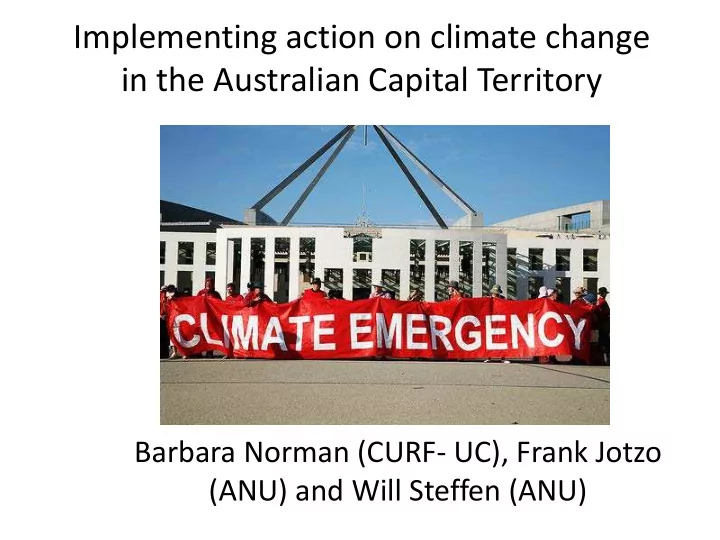
Barbara Norman (CURF- UC), Frank Jotzo (ANU) and Will Steffen (ANU)

Implementing action on climate change in the Australian Capital Territory

slide-2
SLIDE 2

Canberra…. January 2003

slide-3
SLIDE 3

SOCIOECONOMIC PROCESSES

Socioeconomic Pathways Adaptation and Mitigation Actions Governance

CLIMATE

Natural Variability Anthropogenic Climate Change

RISK

Hazards Exposure Vulnerability

IMPACTS EMISSIONS and Land-use Change

Managing risk

slide-4
SLIDE 4

ACT region climate risks and implications

Impacts

  • Warmer dryer future
  • More extreme weather events (storms,

flash flooding)

  • More frequent and intense bushfires,

drought and extreme heat Consequences

  • Loss of life and property
  • Reduced quality of life
  • Loss of biodiversity & ecosystem services
  • Changes in regional food production
  • Expensive responses
slide-5
SLIDE 5

Strong targets to cut emissions

The Climate Change and Greenhouse Gas Reduction Act 2010 mandates:

  • 40% below 1990 emission levels by 2020
  • 80% below 1990 emissions levels by 2050
  • Peaking emissions per capita by 2013
  • 90% renewable electricity supply by 2020

Most ambitious targets in Australia

slide-6
SLIDE 6

ACT Climate Change Council

Left to right: Maria Efkarpidis, Toby Roxburgh, Lynne Harwood, Barbara Norman (Chair), Minister Simon Corbell, Dorte Ekelund, Will Steffen and Frank Jotzo.

slide-7
SLIDE 7
  • Released October 2012.
  • AP2 pathway to 40% of ‘90 levels by 2020.
  • 18 Actions across key sectors:

– Residential, Non-residential, Transport, Waste, Energy supply, Adaptation, Monitoring and reporting.

  • Three supporting actions:

– Carbon Neutral Government Framework, Social Impacts and Cost of Living Review, ACT Greenhouse Gas Inventory Update.

  • Progress reports are released every six

months.

Action Plan 2 (AP2)

slide-8
SLIDE 8

Sustainable Transport

Capital Metro Light Rail project Capital Metro is the first stage

  • f light rail for Canberra:

 12.5 km link from Gungahlin Town Centre to the CBD  Developed along key north- south arterial route  $614 million capital project – commence 2016  City building project to bring forward urban consolidation and mixed use development  Light Rail Master Plan under development to analyse future route expansion

slide-9
SLIDE 9

Improving energy efficiency in commercial buildings

Up to 25% remission of lease variation charge where high standards of sustainable design and adaptable housing are nominated in the development application (March 2014 – March 2016).

Remissions available:

  • Commercial (using Green Star ratings)

5 Star = 10%, 6 Star = 25%

  • Residential (using NatHERS ratings)

6.5 or 7 stars = 10%, 7+ stars = 25%

  • Adaptable housing (complying with Australian standards)

50% adaptable = 15% ; 100% adaptable = 25%

slide-10
SLIDE 10

90% renewables target (490 MW)

  • Solar Auction

40 MW

  • Wind energy (1)

200 MW

  • Community solar 1 MW
  • Next generation solar 50 MW
  • Waste from Energy 23 MW
  • Wind energy (2)

~176 MW = 178,000 homes

slide-11
SLIDE 11

Solar Auction Outcomes

slide-12
SLIDE 12
  • Near term decisions can have

long term consequences

  • Implementation of the ACT

Climate Change Strategy across government

  • Engagement of the community

in the process

  • Uncertainty means ‘learning

by doing’ and managing risk

slide-13
SLIDE 13

Adapting to a changing climate: directions for the ACT

Priority sectors:

  • Community health and

wellbeing

  • Disaster and emergency

management

  • Settlements and

infrastructure

  • Water
  • Natural resources and

ecosystems

  • Agriculture
slide-14
SLIDE 14

Adapting to a changing climate: Directions for the ACT

  • Next steps
  • Identify knowledge gaps
  • Background papers
  • Community engagement to

identify priorities and pathways

  • Draft prepared in 2014
  • Final Adaptation Strategy end

2015.

www.environment.act.gov.au/climate_change/climate-change-adaptation

slide-15
SLIDE 15

Community Engagement Strategy

Renewed commitment to engage with the community about climate change matters to guide the ACT’s future responses on mitigation and adaptation. Builds on partnerships with households, community

  • rganisations, business,

knowledge brokers (e.g. Climate Change Council), regional councils and government agencies

slide-16
SLIDE 16

Canberra as a national leader

  • Adapting to change will

be both incremental and transformational

  • Investing in light rail and

renewable energy a major step forward

  • International interest in

the transformation of the national capital and a medium sized city

CT 16 July 2014 ABC 27 Feb 2014

slide-17
SLIDE 17
slide-18
SLIDE 18

Conclusions

  • Climate change is a present and evolving threat to ACT

natural systems, communities and our built environment

  • The ACT, while small, is looking to provide leadership
  • The ACT’s targets are ambitious but informed by science

and they are achievable

  • Renewable energy is at the heart of the strategy and the

solar auction process offers some hope of ensuring continued investment at the lowest cost

Storm cell rolls into North Canberra on Australia Day 2013 Source: ABC Online Acknowledge the contribution by the ACT Environment and Planning Directorate