IMOs mandate: Update on IMOs International Convention on Oil - - PDF document

imo s mandate
SMART_READER_LITE
LIVE PREVIEW

IMOs mandate: Update on IMOs International Convention on Oil - - PDF document

IMOs mandate: Update on IMOs International Convention on Oil Pollution Preparedness, Response and Safe, secure and efficient shipping Cooperation on cleaner oceans 10 March 2016 RINA Lloyds Register Colleen OHagan Sub-division


slide-1
SLIDE 1

1 Update on IMO’s International Convention on Oil Pollution Preparedness, Response and Cooperation 10 March 2016 RINA Lloyd’s Register Colleen O’Hagan

Sub-division of Implementation, Marine Environment Division

IMO’s mandate:

Safe, secure and efficient shipping

  • n cleaner oceans

Need for international regulation

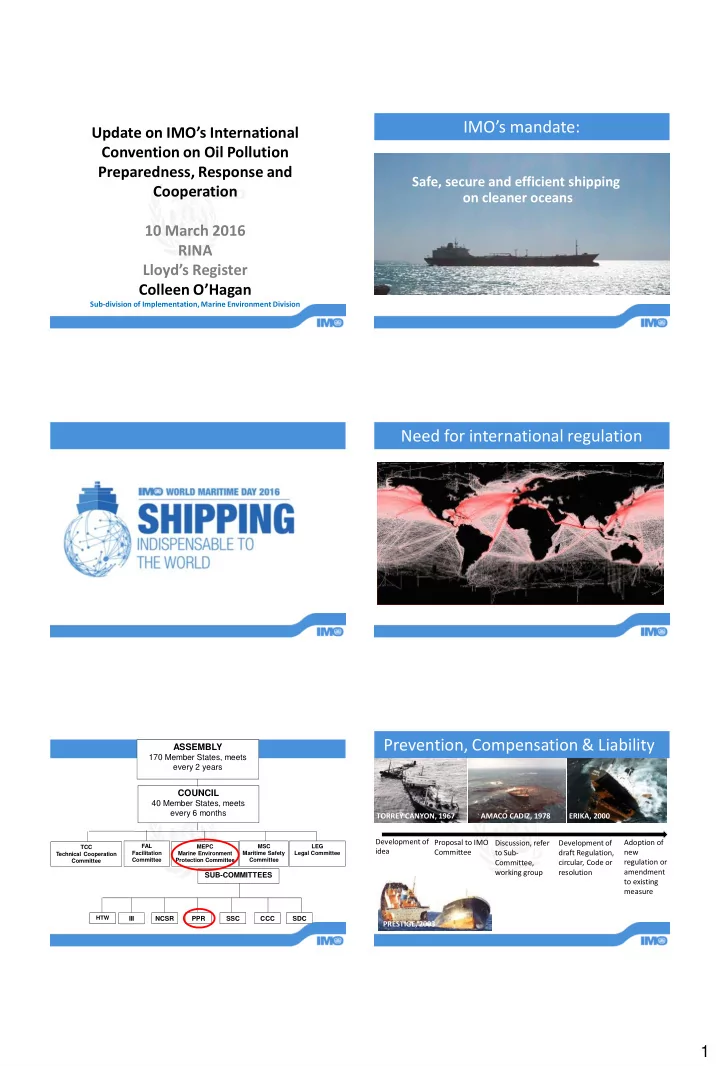
ASSEMBLY

170 Member States, meets every 2 years

COUNCIL

40 Member States, meets every 6 months

TCC Technical Cooperation Committee

SUB-COMMITTEES

HTW

SDC CCC SSC PPR NCSR III

FAL Facilitation Committee MSC Maritime Safety Committee LEG Legal Committee MEPC Marine Environment Protection Committee

Photo Credit: Maritime New Zealand

Prevention, Compensation & Liability

Development of idea Proposal to IMO Committee Discussion, refer to Sub- Committee, working group Development of draft Regulation, circular, Code or resolution Adoption of new regulation or amendment to existing measure TORREY CANYON, 1967 AMACO CADIZ, 1978 ERIKA, 2000 PRESTIGE, 2003

slide-2
SLIDE 2

2

Preparedness and Response

EXXON VALDEZ, Prince William Sound, Alaska – March 1989

  • Adoption of the International Convention on Oil Pollution,

Preparedness, Response and Cooperation (OPRC) – November 1990

  • Importance of effective preparation
  • Pollution emergency plans for ships, offshore units, sea ports

and oil handling facilities

  • Reporting requirements and development of adequate response

capacity

  • Need for mutual aid and international cooperation

OPRC Convention

International convention on oil pollution preparedness, response and co-operation, 1990 Protocol on preparedness, response and co-operation to pollution incidents by hazardous and noxious substances, 2000

OPRC Convention – Key Articles

Article Description 3 Oil pollution emergency plans 4 Oil pollution reporting procedures 5 Action on receiving an oil pollution report 6 National and Regional systems for preparedness and response 7 International co-operation in pollution response

Cooperation: A regional approach

Article 10 Promotion of bilateral and multilateral co-operation in preparedness and response. The importance of regional agreements for implementing the Convention

108 Member States >100 Workshops/training courses/seminars 25 Manuals/Guidelines/Guidance 15 Regional agreements / initiatives supported 3 Model Training courses

25 years of OPRC

slide-3
SLIDE 3

3 Incidents still happen and still challenge

HEBEI SPIRIT, 2007 MSC NAPOLI, 2007

Incidents still happen and still challenge

Photo Credit: Maritime New Zealand Photo Credit: AFP/Getty Photo Credit: MEMAC

DEEP WATER HORIZON, 2010 GODAFOSS, 2011 RENA, 2011 STOLT VALOR, 2012

Encouraging effective International cooperation

Pat Roque / AP file Korean Coastguard

HEBEI SPIRIT, Rep. of Korea 2007 SOLAR 1, Philippines 2006 SOUTHERN STAR 7, Bangladesh 2014

OPRC related developments

  • Guidelines on International offers of assistance in

response to a marine oil pollution incident Tool to assist in managing requests for spill response resources and offers of assistance from other countries and organizations when confronted with large, complex or significant oil spill incidents

  • Part III of the Guidelines for the use of dispersants for

combating oil pollution at sea (Operational and technical sheets for surface application of dispersants) Parts I (Basic information) and II (National policy) were approved by MEPC 65

Guidelines completed at PPR 2

OPRC related developments

Guidelines completed at PPR 3

  • Section II of the Manual on Oil Pollution –

Contingency planning Extensive use as reference material by countries developing or updating their National oil spill contingency planning for offshore units and more general advances in the field of contingency planning

  • Guide on oil spill response in ice and snow conditions

Used to identify and describe those aspects of planning and operations that are directly associated with a response to a marine oil spill in ice and snow conditions anywhere in the world, including a summary of the most up to date research and development in this field.

OPRC related developments

Photo Credit: Maritime New Zealand Photo Credit: BP/REUTERS

Guidelines and tools currently under development

  • Part IV of the IMO Dispersant Guidelines (Sub-sea

dispersant application) Work underway by a correspondence group who aim to submit at final draft to PPR 4 (Jan 2017)

  • Update of OPRC Model training course

Final review of materials underway with an aim to submit at final draft to PPR 4 (Jan 2017) Level 3 – Strategic – Administrators and Senior managers Level 2 – Tactical – Supervisors/On Scene Commanders Level 1 – Operational – First Responders Level 0 – Raising awareness – Basic introduction
slide-4
SLIDE 4

4

Current OPRC Regional Projects

  • Goal: Enhance oil spill response capability in West, Central,

and Southern Africa

  • Scope: Organise trainings, exercises and workshops
  • Key feature: Partnership between Industry/Government
  • Area: Covers 22 countries
  • Funding from IMO
  • Funding from IPIECA: 10 oil industries members

The GI WACAF project

22 countries of the GI WACAF Project

GI WACAF – Core Objectives

  • 1. Legislation
  • 2. Contingency planning
  • 3. Designation of authority
  • 4. Trans-boundary agreements
  • 5. Training and exercise
  • 6. National resources

What has been achieved?

23

What type of activities?

24

slide-5
SLIDE 5

5

Nigeria / Cameroon trans-boundary exercise (2015)

  • 150+ participants from both government and industry
  • Exercise scenario based on a tanker accident impacting the Nigeria and

Cameroon coastlines

  • Exercise was conducted in real time simultaneously in two locations
  • The purpose was to test lines of communication and promote agreements

between Cameroon and Nigeria on oil spill topics

25

Nigeria Cameroon

Summary of 2014 – 2015 Activities

Strengthen specific elements within National Contingency Plans Develop Trans-boundary response capability Continued support for core elements

  • f the OPRC 90 Convention

26

6 x national workshops 3 x sub-regional workshops 2 x trans- boundary communications exercises 4 x national workshops 1 x exercise 1 x sub-regional workshop

  • 1000+ participants
  • 13 hosting countries
  • 19 of 22 member countries engaged

Strengthening Elements within National Contingency Plans

Cote D’Ivoire Sub Regional Workshop on IMS Angola National workshop Dispersants South Africa National Workshop IMS Namibia National workshop Waste Management – The Gambia National workshop SCAT / Waste Management - Gabon Sub-regional workshop SCAT / Waste – Ghana Sub-regional workshop SCAT / Waste Management - Cote d’Ivoir National workshop Sensitivity Mapping Senegal National workshop Dispersants

2014 – 2015 Activities Strengthening elements with national contingency plans

Gabon Transboundary Exercise Congo Transboundary Exercise Nigeria Transboundary Exercise Cameroon Transboundary Exercise

2014 – 2015 Activities Developing trans-boundary response capability

29

Sao Tome and Principe National workshop NOSCP and sensitivity mapping Ghana National workshop NOSCP Guinea-Bissau National workshop NOSCP and sensitivity mapping Cameroon National Exercise and workshop NOSCP Gabon Sub-regional workshop Liability & compensation

2014 – 2015 Activities Supporting core elements of the OPRC 90 Convention

  • Maintaining preparedness with fewer resources
  • Ships increasing in size
  • Encouraging HNS preparedness and response

Current challenges for Pollution, Preparedness, Response and Cooperation

slide-6
SLIDE 6

6

Thank you

Photo Credit: Maritime New Zealand

Questions