IMC 2013 E XAMPLE : North of Divide Community Association is a - - PDF document

imc 2013
SMART_READER_LITE
LIVE PREVIEW

IMC 2013 E XAMPLE : North of Divide Community Association is a - - PDF document

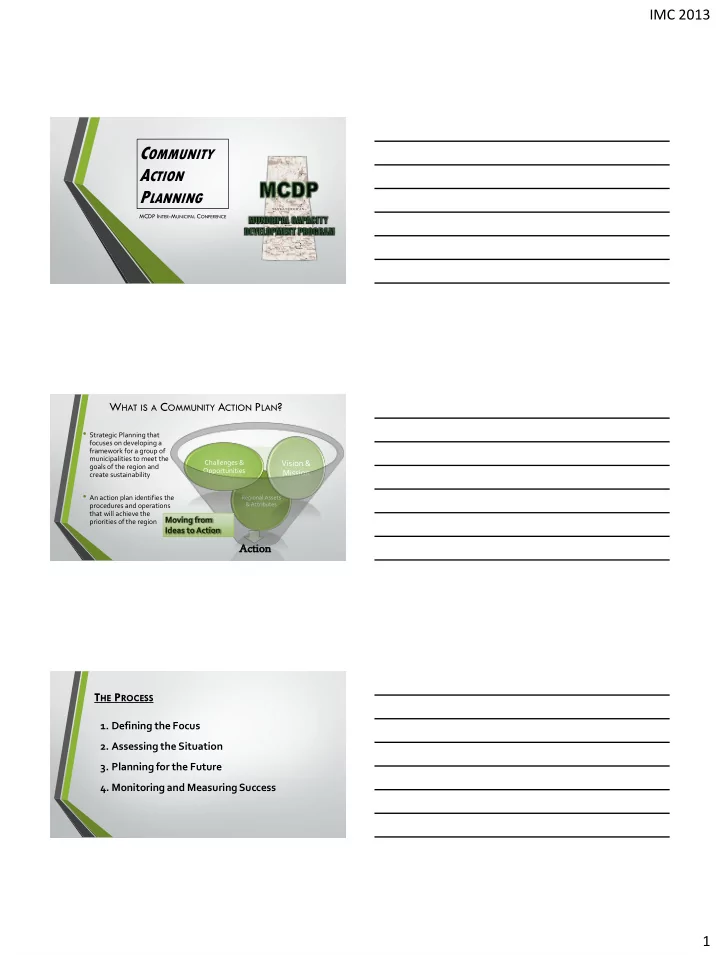
IMC 2013 C OMMUNITY A CTION P LANNING MCDP I NTER -M UNICIPAL C ONFERENCE W HAT IS A C OMMUNITY A CTION P LAN ? Strategic Planning that focuses on developing a framework for a group of municipalities to meet the Challenges & Vision


slide-1
SLIDE 1

IMC 2013 1

COMMUNITY ACTION PLANNING

MCDP INTER-MUNICIPAL CONFERENCE

WHAT IS A COMMUNITY ACTION PLAN?

  • Strategic Planning that

focuses on developing a framework for a group of municipalities to meet the goals of the region and create sustainability

  • An action plan identifies the

procedures and operations that will achieve the priorities of the region

Action

  • n

Regional Assets & Attributes

Challenges & Opportunities

Vision & Mission

THE PROCESS

  • 1. Defining the Focus
  • 2. Assessing the Situation
  • 3. Planning for the Future
  • 4. Monitoring and Measuring Success
slide-2
SLIDE 2

IMC 2013 2

DEFINING THE FOCUS DEVELOPING A VISION, MISSION AND VALUES

  • What are these?
  • Why are these Important?

WHAT’S YOUR VISION?

THE OVERARCHING PICTURE FOR YOUR REGION

  • Your organization operating at its most effective level
  • Your ideal purpose and outcome (s)
  • A future ideal to strive for
  • Provides a “big picture” view
  • What do you hope the region will look like in 10 years? 25 years?

50 years?

WRITING A VISION STATEMENT

One statement that sums up what the group is and why it exists

  • We are _________ that_____
  • Our vision is to be _________
  • Our vision is for a region where ______
slide-3
SLIDE 3

IMC 2013 3

EXAMPLE:

“North of Divide Community Association is a progressive and cooperative partnership of Rural, Urban and First Nations communities promoting positive growth and common goals for a thriving, safe, stable and sustainable region.”

WHAT’S YOUR MISSION?

Your Mission Statement answers:

  • “What are you doing as a group?”
  • “Why are you doing it?”
  • “Who benefits?”

HOW WILL YOU ACHIEVE YOUR VISION?

WRITING A MISSION STATEMENT

  • What are you doing to achieve your vision?
  • Why are you trying to achieve your vision?
  • Who are you trying to achieve your vision for?
slide-4
SLIDE 4

IMC 2013 4

EXAMPLE:

“The North Valley Inter-Municipal Organization is engaged in group initiatives for improving local services and opportunities. We do this through cost sharing and capacity building strategies in order to build regional efficiencies for the benefit of our collective residents.”

WHAT ARE YOUR VALUES?

  • Values reflect the core ideology of a group
  • Value statements ensure there is no disagreement or

question about the way people should act or how the work should be carried out

How will you carry out your mission?

WRITING VALUE STATEMENTS

  • Think of the golden rules set up in a classroom or on the

playground

  • How would you like to be treated? What values will guide
  • ur activities and intentions?
  • Value statements are more than single words, they are

meaningful sentences

slide-5
SLIDE 5

IMC 2013 5

EXAMPLE:

  • Be respectful of other member’s opinions, actions and needs
  • We listen well to each others’ concerns in order to develop a

shared understanding and to find solutions

  • Create

Transparency by conducting open, honest and respectful communication and listening to others shared ideas and goals

ASSESSING THE SITUATION

  • Envisioning Assets and Attributes
  • Identifying Challenges and Opportunities
  • Prioritization

ASSETS AND ATTRIBUTES

  • List any and all assets and attributes you wish to see remain in the

community over the next 15 to 20 years.

  • What brought you to the community?
  • Why do you stay?
  • What do you enjoy most about your community?
  • What would you miss?
  • What are the best features of your area?
slide-6
SLIDE 6

IMC 2013 6

CHALLENGES AND OPPORTUNITIES

Challenges

  • Roads and maintenance
  • Housing shortage and affordability
  • Bylaw Enforcement
  • Aging Population
  • Old or no planning documents
  • Lack of developers
  • Landfill non-compliant

Opportunities

  • Promote the region
  • Share equipment and services
  • Create consistency in planning
  • Share emergency measures
  • Potential to benefit from potash

development in the region

PRIORITIZATION

  • The goal is to take a long list of challenges and opportunities and channel

them into more focused priorities for the group

  • Priorities should be fairly broad and general
  • Start by clustering the challenges and opportunities into categories that

identify the issue

  • Helpful questions:
  • Is this issue within the scope of this group? How much time and resources can we

dedicate to the priorities being developed?

PLANNING FOR THE FUTURE

  • Goal Development
  • Objective Development
  • Action Plan Worksheets
slide-7
SLIDE 7

IMC 2013 7

GOAL DEVELOPMENT – TURNING PRIORITIES INTO GOALS

  • A goal is a focus on why a specific issue or
  • pportunity is a priority
  • Finding the basic reason for your priority gives it

purpose and directs you to your objective

DEVELOP A GOAL

Priority Area – Planning and Development Helpful question: Why do you need to focus on planning and development?

So then your goal could be: “Encourage consistent and regulated planning and development for continuity and predictability.”

The basic reason is to coordinate planning and development to limit confusion between municipalities and among citizens.

OBJECTIVE DEVELOPMENT – TURNING GOALS INTO OBJECTIVES

  • An objective identifies a solution to your goal
  • Objectives should suggest tangible actions that the

group is willing to commit to

  • Must be attainable for the group
  • Should be measureable
slide-8
SLIDE 8

IMC 2013 8

DEVELOP AN OBJECTIVE

Example Goal: Encourage consistent and regulated planning and development for continuity and predictability Objective: Harmonize municipal bylaws in the region

To Recap: Goal = Overall Reason for addressing priority Objective = the Solution to address the goal

ACTION PLAN WORKSHEETS – ACTING ON OBJECTIVES

Activity Resources Lead(s) Timeline

  • What needs to be

done?

  • Are there sub-

activities that need to be completed to do activity?

  • What other

activities are connected to this activity? Physical assets needed for completing the activity

  • Human?
  • Financial?
  • Who will monitor

the project/objective as a whole?

  • Who will be

responsible to complete the activity?

  • How long will it

take?

  • When will this

activity need to be completed?

EXAMPLE

Prio iorit ity: Planning and Development

Goal: Encourage consistent and regulated planning and development for continuity and predictability Objective 1 Actions Lead Resources Timeline Harmonize Municipal Bylaws in the region Each municipality submit bylaws Each Member Administrators July/2013 Group bylaws by type Bob & Jane Aug/2013 Review and amend bylaws for consistency Bob & Jane Jack Smith (lawyer) Oct/2013 Determine a standard for each type of bylaw Committee Oct/2013 Update Bylaws Bob Nov/2013 Approve bylaws at councils Each Council Jan/2014

slide-9
SLIDE 9

IMC 2013 9

ACTION PLAN OVERVIEW MEASURING SUCCESS AND PROGRESS

  • It may take months or years to see the effects that your actions

are having on the goal that has been set out.

  • Measures allow you to track the progress so that your plan is on

schedule.

  • Being able to see the progress helps to keep people motivated

and allows you to show your accountability to outside stakeholders

MEASURES

Indicators

  • The tangible measure of success or the physical thing you will keep

track of

  • The indicator has to be something that is measurable – often it is a

number or percentage

Baseline, Benchmarks, and targets

  • Baseline – the starting point or the current situation of the

indicator

  • Benchmarks – checkpoints in your timeline
  • Target – the end result you are aiming for; where you want the

indicator to be

slide-10
SLIDE 10

IMC 2013 10

PUTTING IT

ALL

TOGETHER

Prio iorit ity: Planning and Development

Goal: Encourage consistent and regulated planning and development for continuity and predictability Objective 1 Actions Lead Resources Timeline Harmonize Municipal Bylaws in the region

Each municipality submit bylaws Each Member Administrators July/2013 Group bylaws by type Bob & Jane Aug/2013 Review and amend bylaws for consistency Bob & Jane Jack Smith (lawyer) Oct/2013 Determine a standard for each type of bylaw Committee Oct/2013 Update Bylaws Bob Nov/2013 Approve bylaws at councils Each Council Jan/2014

Me Measu sures

Indicators

  • % of consistent bylaws

Benchmark

  • Have bylaws reviewed by September 2013, Bylaws updated by December 2013

Target

  • 100% of bylaws consistent and approved by January 2014

USING THE COMMUNITY ACTION PLAN

The CAP is a Living Document

Can be used to:

  • Maintain accountability
  • Set agendas
  • Monitor progress
  • Record additional actions