Image Smoothing ! Chicken-and-egg dilemma! " ! Edge preserving - - PowerPoint PPT Presentation

image smoothing
SMART_READER_LITE
LIVE PREVIEW

Image Smoothing ! Chicken-and-egg dilemma! " ! Edge preserving - - PowerPoint PPT Presentation

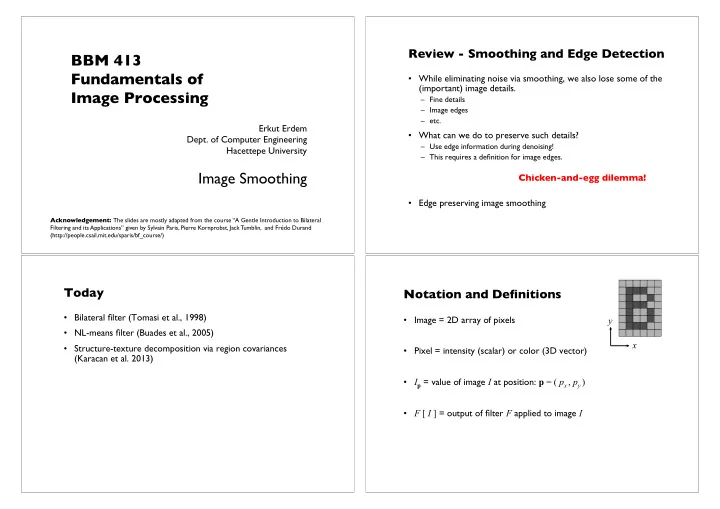
Review - Smoothing and Edge Detection " BBM 413 ! Fundamentals of ! While eliminating noise via smoothing, we also lose some of the (important) image details. ! Image Processing ! Fine details ! Image edges ! etc. ! Erkut Erdem


slide-1
SLIDE 1

BBM 413! Fundamentals of! Image Processing!

Erkut Erdem"

  • Dept. of Computer Engineering"

Hacettepe University" !

Image Smoothing!

Acknowledgement: The slides are mostly adapted from the course “A Gentle Introduction to Bilateral " Filtering and its Applications” given by Sylvain Paris, Pierre Kornprobst, Jack Tumblin, and Frédo Durand " (http://people.csail.mit.edu/sparis/bf_course/)!

Review - Smoothing and Edge Detection"

  • While eliminating noise via smoothing, we also lose some of the

(important) image details.!

– Fine details! – Image edges! – etc.!

  • What can we do to preserve such details?!

– Use edge information during denoising!! – This requires a definition for image edges. ! ! !

  • Edge preserving image smoothing!

Chicken-and-egg dilemma!"

Today"

  • Bilateral filter (Tomasi et al., 1998)!
  • NL-means filter (Buades et al., 2005)!
  • Structure-texture decomposition via region covariances

(Karacan et al. 2013)!

Notation and Definitions"

  • Image = 2D array of pixels!
  • Pixel = intensity (scalar) or color (3D vector)!
  • Ip = value of image I at position: p = ( px , py )
  • F [ I ] = output of filter F applied to image I

x y

slide-2
SLIDE 2

Strategy for Smoothing Images"

  • Images are not smooth because "

adjacent pixels are different.!

  • Smoothing = making adjacent pixels"

! ! !look more similar.!

  • Smoothing strategy"

!pixel as average of its neighbors!

Box Average"

average! input! square neighborhood!

  • utput!

sum over" all pixels q" normalized" box function! intensity at" pixel q" result at" pixel p"

Equation of Box Average"

− =

S

I B I BA

q q p

q p ) ( ] [

σ

0!

Square Box Generates Defects "

  • Axis-aligned streaks!
  • Blocky results!

input!

  • utput!
slide-3
SLIDE 3

Strategy to Solve these Problems"

  • Use an isotropic (i.e. circular) window.!
  • Use a window with a smooth falloff.!

box window! Gaussian window!

Gaussian Blur"

average! input! per-pixel multiplication!

  • utput!

*!

input" box average"

slide-4
SLIDE 4

Gaussian blur"

normalized" Gaussian function!

Equation of Gaussian Blur"

( )

− =

S

I G I GB

q q p

q p || || ] [

σ Same idea: weighted average of pixels.! 0! 1! size of the window!

Spatial Parameter"

( )

− =

S

I G I GB

q q p

q p || || ] [

σ small s! large s! input! limited smoothing! strong smoothing!

How to set s!

  • Depends on the application.!
  • Common strategy: proportional to image size!

– e.g. 2% of the image diagonal! – property: independent of image resolution!

slide-5
SLIDE 5

Properties of Gaussian Blur"

  • Weights independent of spatial location!

– linear convolution! – well-known operation! – efficient computation (recursive algorithm, FFT…)!

Properties of Gaussian Blur"

  • Does smooth images!
  • But smoothes too much:"

edges are blurred.!

– Only spatial distance matters! – No edge term!

input!

  • utput!

( )

− =

S

I G I GB

q q p

q p || || ] [

σ

space!

Blur Comes from ! Averaging across Edges"

*! *! *!

input!

  • utput!

Same Gaussian kernel everywhere.!

Bilateral Filter! No Averaging across Edges"

*! *! *!

input!

  • utput!

The kernel shape depends on the image content.!

[Aurich 95, Smith 97, Tomasi 98]!

slide-6
SLIDE 6

space weight!

not new!

range weight!

I! new!

normalization" factor!

new!

Bilateral Filter Definition:! an Additional Edge Term"

( )

( )

− − =

S

I I I G G W I BF

q q q p p p

q p | | || || 1 ] [

r s

σ σ

Same idea: weighted average of pixels.!

Illustration a 1D Image"

  • 1D image = line of pixels!
  • Better visualized as a plot!

pixel! intensity" pixel position" space!

Gaussian Blur and Bilateral Filter"

space! range! normalization!

Gaussian blur!

( )

( )

− − =

S

I I I G G W I BF

q q q p p p

q p | | || || 1 ] [

r s

σ σ

Bilateral filter" [Aurich 95, Smith 97, Tomasi 98]! space! space! range! p" p" q" q"

( )

− =

S

I G I GB

q q p

q p || || ] [

σ

q p

Bilateral Filter on a Height Field"

  • utput!

input!

( )

( )

− − =

S

I I I G G W I BF

q q q p p p

q p | | || || 1 ] [

r s

σ σ

p

reproduced! from [Durand 02]"

slide-7
SLIDE 7

Space and Range Parameters"

  • space ss : spatial extent of the kernel, size of the considered

neighborhood.!

  • range sr : “minimum” amplitude of an edge!

( )

( )

− − =

S

I I I G G W I BF

q q q p p p

q p | | || || 1 ] [

r s

σ σ

Influence of Pixels"

p"

Only pixels close in space and in range are considered.! space! range! ss = 2! ss = 6! ss = 18! sr = 0.1! sr = 0.25! sr = "

(Gaussian blur)!

input!

Exploring the Parameter Space"

ss = 2! ss = 6! ss = 18! sr = 0.1! sr = 0.25! sr = "

(Gaussian blur)!

input!

Varying the Range Parameter"

slide-8
SLIDE 8

input"

sr = 0.1" sr = 0.25" sr = !

(Gaussian blur)"

slide-9
SLIDE 9

ss = 2! ss = 6! ss = 18! sr = 0.1! sr = 0.25! sr = "

(Gaussian blur)!

input!

Varying the Space Parameter"

input"

ss = 2" ss = 6"

slide-10
SLIDE 10

ss = 18" How to Set the Parameters"

Depends on the application. For instance:!

!

  • space parameter: proportional to image size!

– e.g., 2% of image diagonal!

  • range parameter: proportional to edge amplitude!

– e.g., mean or median of image gradients!

  • independent of resolution and exposure!

Bilateral Filter Crosses Thin Lines"

  • Bilateral filter averages across "

!features thinner than ~2ss !

  • Desirable for smoothing: more pixels = more robust!
  • Different from diffusion that stops at thin lines!

close-up! kernel!

Iterating the Bilateral Filter"

  • Generate more piecewise-flat images!
  • Often not needed in computational photo.!

] [

) ( ) 1 ( n n

I BF I =

+

slide-11
SLIDE 11

input" 1 iteration" 2 iterations" 4 iterations"

slide-12
SLIDE 12

Bilateral Filtering Color Images"

( )

( )

− − =

S

I I I G G W I BF

q q q p p p

q p | | || || 1 ] [

r s

σ σ

( )

( )

− − =

S

G G W I BF

q q q p p p

C C C q p || || || || 1 ] [

r s

σ σ

For gray-level images ! For color images !

intensity difference! color difference! scalar! 3D vector " (RGB, Lab)!

input!

  • utput!

Hard to Compute"

  • Nonlinear!
  • Complex, spatially varying kernels!

– Cannot be precomputed, no FFT…!

  • Brute-force implementation is slow > 10min!

( )

( )

− − =

S

I I I G G W I BF

q q q p p p

q p | | || || 1 ] [

r s

σ σ

Basic denoising"

Noisy input! Bilateral filter 7x7 window! Bilateral filter!

Basic denoising"

Median 3x3!

slide-13
SLIDE 13

Bilateral filter!

Basic denoising"

Median 5x5!

Basic denoising"

Bilateral filter! Bilateral filter – lower sigma! Bilateral filter!

Basic denoising"

Bilateral filter – higher sigma!

Denoising"

  • Small spatial sigma (e.g. 7x7 window)!
  • Adapt range sigma to noise level !
  • Maybe not best denoising method, but best simplicity/quality

tradeoff!

– No need for acceleration (small kernel)! – But the denoising feature in e.g. Photoshop is better!

slide-14
SLIDE 14

Goal: Understand how does bilateral filter relates with other methods! Local mode! filtering! Robust! statistics! Partial! differential! equations! Bilateral! filter! more in BIL717 Image Processing graduate course..! New Idea:! NL-Means Filter (Buades 2005)"

  • Same goals: ‘Smooth within Similar Regions’!
  • KEY INSIGHT: Generalize, extend‘Similarity’!

– Bilateral: " !Averages neighbors with similar intensities;! – NL-Means: " Averages neighbors with similar neighborhoods!"

NL-Means Method:! Buades (2005)"

! !

  • For each and!

every pixel p: "

NL-Means Method:! Buades (2005)"

!

  • For each and!

every pixel p: ! " " "

– Define a small, simple fixed size neighborhood;!

slide-15
SLIDE 15

!

  • For each and!

every pixel p: ! "

– Define a small, simple fixed size neighborhood;!

– Define vector Vp: a list of neighboring pixel values.!

NL-Means Method:! Buades (2005)"

Vp = "

0.74! 0.32! 0.41! 0.55! …! …! …!

NL-Means Method:! Buades (2005)"

‘Similar’ pixels p, q" ! SMALL! vector distance;! ! ! !

|| Vp – Vq ||2 " p! q!

NL-Means Method:! Buades (2005)"

‘Dissimilar’ pixels p, q" ! LARGE! vector distance;! ! ! !

|| Vp – Vq ||2 " p! q! q!

NL-Means Method:! Buades (2005)"

‘Dissimilar’ pixels p, q" ! LARGE! vector distance;! ! ! Filter with this!" "

|| Vp – Vq ||2 " p! q!

slide-16
SLIDE 16

NL-Means Method:! Buades (2005)"

p, q neighbors define! a vector distance;! Filter with this:! " "

"

No spatial term!" "

|| Vp – Vq ||2 " p! q!

( )

( )

− − =

S

I V V G G W I NLMF

q q q p p p

q p

2

|| || || || 1 ] [

r s

 

σ σ

NL-Means Method:! Buades (2005)"

pixels p, q neighbors" Set a vector distance;! " "

"

Vector Distance to p sets ! weight for each pixel q"

|| Vp – Vq ||2 " p! q!

( )

− =

S

I V V G W I NLMF

q q q p p p 2

|| || 1 ] [

r

 

σ

NL-Means Filter (Buades 2005)" NL-Means Filter (Buades 2005)"

slide-17
SLIDE 17

NL-Means Filter (Buades 2005)"

  • Noisy"

source" image:!

NL-Means Filter (Buades 2005)"

  • Gaussian"

Filter! Low noise,! Low detail!

NL-Means Filter (Buades 2005)"

  • Anisotropic"

Diffusion! ! (Note " ‘stairsteps’:" ~ piecewise" constant)!

NL-Means Filter (Buades 2005)"

  • Bilateral"

Filter! ! (better, but" similar" ‘stairsteps’:" !

slide-18
SLIDE 18

NL-Means Filter (Buades 2005)"

  • NL-Means:!

! ! ! Sharp,! Low noise,! Few artifacts." !

NL-Means Filter (Buades 2005)" NL-Means Filter (Buades 2005)"

http://www.ipol.im/pub/algo/bcm_non_local_means_denoising/"

  • riginal!

NL-Means Filter (Buades 2005)"

http://www.ipol.im/pub/algo/bcm_non_local_means_denoising/"

slide-19
SLIDE 19

noisy!

NL-Means Filter (Buades 2005)"

http://www.ipol.im/pub/algo/bcm_non_local_means_denoising/"

denoised!

NL-Means Filter (Buades 2005)"

http://www.ipol.im/pub/algo/bcm_non_local_means_denoising/"

  • riginal!

NL-Means Filter (Buades 2005)"

http://www.ipol.im/pub/algo/bcm_non_local_means_denoising/"

noisy!

NL-Means Filter (Buades 2005)"

http://www.ipol.im/pub/algo/bcm_non_local_means_denoising/"

slide-20
SLIDE 20

denoised!

http://www.ipol.im/pub/algo/bcm_non_local_means_denoising/"

NL-Means Filter (Buades 2005)"

Input Image!

Structure-Texture Decomposition!

Karacan et al., SIGGRAPH Asia 2013" Structure Component

Structure-Texture Decomposition!

Karacan et al., SIGGRAPH Asia 2013" Texture Component

Structure-Texture Decomposition!

Karacan et al., SIGGRAPH Asia 2013"

slide-21
SLIDE 21

Structure Texture Input Image!

Structure-Texture Decomposition!

Karacan et al., SIGGRAPH Asia 2013"

Region Covariances as Region Descriptors!

Tuzel et al., ECCV 2006"

F(x, y) = φ(I, x, y)

F(x, y) = h I(x, y)

  • ∂I

∂x

  • ∂I

∂y

  • ∂2I

∂x2

  • ∂2I

∂y2

  • x

y iT (6)

CR = 1 n − 1

n

X

i=0

(zk − µ)(zk − µ)T

Main motivation"

  • Region covariances well capture

local structure and texture information.!

  • Similar regions have similar

statistics.!

Formulation"

  • Structure-texture decomposition "

via smoothing!

  • Smoothing as weighted averaging !
  • Different kernels (wpq) result in

different types of filters.!

  • Two novel patch-based kernels for

structure-texture decomposition! ! ! p q

S(p) = 1 Zp X

q∈N(p,r)

wpqI(q) I = S + T

slide-22
SLIDE 22
  • Covariance matrices do not live on Euclidean space.!
  • Hong et al.,CVPR’09 suggested a way to transform covariance

matrices into Euclidean Space.!

  • Every covariance matrix has a unique Cholesky decomposition!
  • First order statistics can be easily incorporated to the formulation.!

Model 1"

%={si}! &=''(! Cholesky Decomposition! Sigma Points! p! q!

{ } si = ⇢ α √ dLi if 1 ≤ i ≤ d −α √ dLi if d + 1 ≤ i ≤ 2d

Model 1"

Final representation! Resulting kernel! p! q!

Ψ(C) = (µ, s1, . . . , sd, sd+1, . . . , s2d)T wpq / exp ✓ kΨ(Cp) Ψ(Cq)k2 2σ2 ◆

Model 2"

  • An alternative way is to use statistical measures.!
  • A Mahalanobis-like distance measure to compare to image patches!

p! q! d(p, q) = p (µp µq)C−1(µp µq)T with C = Cp + Cq, covariances of features wpq / exp ✓ d(p, q)2 2σ2 ◆ Resulting kernel!

Input! Model1! Model2!

!=*.,-------"=. !=*./-------"=.

Illustrative Example"

slide-23
SLIDE 23

/home/levent/Dropbox/acmsiggraph_Date2April_Time1108/ barbara_original.png! Input

Illustrative Example"

Input

/home/levent/Dropbox/acmsiggraph_Date2April_Time1108/ barbara_original.png! Model2 Structure

Structure

Illustrative Example"

/home/levent/Dropbox/acmsiggraph_Date2April_Time1108/ barbara_original.png! Model2 Texture

Input Structure Texture

Illustrative Example"

Input 9 7!

Multiscale Decomposition"

I(p) =

n

X

i=0

Ti(p) + Sn(p)

slide-24
SLIDE 24

9 8!

Multiscale Decomposition"

S1(k (k-=-5) )

I(p) =

n

X

i=0

Ti(p) + Sn(p)

9 9!

Multiscale Decomposition"

S2(k (k-=-7) )

I(p) =

n

X

i=0

Ti(p) + Sn(p)

1

Multiscale Decomposition"

S3(k (k-=-9) )

I(p) =

n

X

i=0

Ti(p) + Sn(p)

Model 2 + Model 1"

Model2 Structure"

slide-25
SLIDE 25

Model 2 + Model 1"

Model2 Texture"

Model 2 + Model 1"

Model2+Model1"

Model 2 + Model 1"

Model2! Model2+Model1! Input!

Model 2 + Model 1"

Model2+Model1! Input! Model2 Texture!