SLIDE 1
SLIDE 2
SLIDE 3
SLIDE 4
SLIDE 5
SLIDE 6
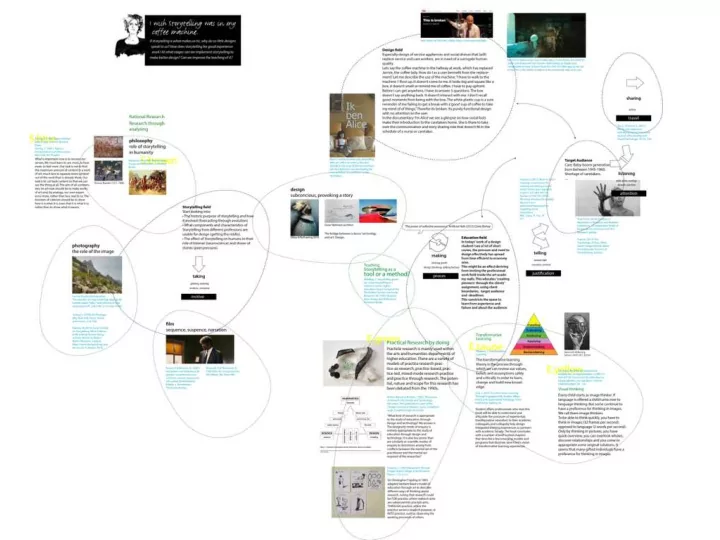
SLIDE 7 Ik ben Alice In the documentary ‘I’m Alice’ we see a glimpse on how social bots make their introduction to the caretakers home. She is there to take over the communication and story-sharing role of a caretaker
SLIDE 8
SLIDE 9
SLIDE 10
SLIDE 11
What differentiates the novel from all other forms of prose literature—the fairy tale, the legend, even the novella—is that it neither comes from oral tradition nor goes into it. This distinguishes it from storytelling in particular. The storyteller takes what he tells from experience—his own or that reported by others. And he in turn makes it the experience of those who are listening to his tale.
Benjamin W. (1999)
SLIDE 12
The first storyteller of the Greeks was Herodotus. In the fourteenth chapter of the third book of his Histories there is a story from which much can be learned. It deals with Psammenitus. From this story it may be seen what the nature of true storytelling is. The value of information does not survive the moment in which it was new. It lives only at that moment; it has to surrender to it completely and explain itself to it without losing any time. A story is different. It does not expend itself. It preserves and concentrates its strength and is capable of releasing it even after a long time.
Benjamin W. (1970) Illuminations. The Great Storyteller
Keep the time capsule of a story
SLIDE 13 What is important now is to recover our
- senses. We must learn to see more, to
hear more, to feel more. Our task is not to find the maximum amount of content in a work of art, much less to squeeze more content out of the work than is already
- there. Our task is to cut back content so
that we can see the thing at all. The aim
- f all commentary on art now should be to
make works of art-and, by analogy, our
- wn experience-more, rather than less, real
to us.
Susan Sontag (1961) Against Interpretation Anish Kapoor. Descent into Limbo 1992 fiberglass, acrylic medium and pigment
SLIDE 14
Turning a critical eye to the internet and its promise — rather, its threat — of crowdsourced storytelling: Literature tells stories. Television gives information. Literature involves. It is the re-creation of human solidarity. Television (with its illusion of immediacy) distances — immures us in our own indifference. The so-called stories that we are told on television satisfy our appetite for anecdote and offer us mutually canceling models of understanding. (This is reinforced by the practice of punctuating television narratives with advertising.) They implicitly affirm the idea that all information is potentially relevant (or “interesting”), that all stories are endless — or if they do stop, it is not because they have come to an end but, rather, because they have been upstaged by a fresher or more lurid or eccentric story. By presenting us with a limitless number of nonstopped stories, the narratives that the media relate — the consumption of which has so dramatically cut into the time the educated public once devoted to reading — offer a lesson in amorality and detachment that is antithetical to the one embodied by the enterprise of the novel.
Susan Sontag (2004)
How can I involve narrative and endlessness into short story span
SLIDE 15 Form as system. Artistic form is best thought of in relation to a perciever, the human being who watches the play, read the novel, listens to the piece of music, or views the film. Perception in all phases of life is an activity. Form versus content. Very often people assume that form as a concept is the
- pposite of something called content. This
assumption implies that a poem or a musical piece or a film is like a jug. Form and meaning. Like emotion, meaning is important to our experience of artworks. As an active perciever the spectator is constantly testing the work for larger significance, for what it says or suggests.
David Bordwell and Kristen Thompson (1997) Film Art an introduction. Yellow brick road stand for the desire to go home _we want Dorothy to succeed. The road is a stage for dance and songs. The road color yellow dictates the color sheme of the rest; red shoes, green city.
Help from form
SLIDE 16
Carl de Keyzer, photographer.
“De essentie van mijn beeld ligt altijd op de tweede plaats.” Kunstuur http://web.avrotros.nl/kunstuur/player/AT_2062184/
Krasnoyarsk, Siberia, Russia (2001) Camp 27. Holiday house. Inmates with good behaviour can spend some time here.
timecapsule
SLIDE 17
SLIDE 18
SLIDE 19