iJOBS Workshop: Drug Development in Biotechnology - Agenda 9:30 - - PowerPoint PPT Presentation

ijobs workshop drug development in biotechnology agenda
SMART_READER_LITE
LIVE PREVIEW

iJOBS Workshop: Drug Development in Biotechnology - Agenda 9:30 - - PowerPoint PPT Presentation

iJOBS Workshop: Drug Development in Biotechnology - Agenda 9:30 9:45AM Introduction and Purpose of the Symposium Janet Alder 9:45 10:15 Overview of the Pharmaceutical Industry Larry


slide-1
SLIDE 1

iJOBS Workshop: Drug Development in Biotechnology - Agenda

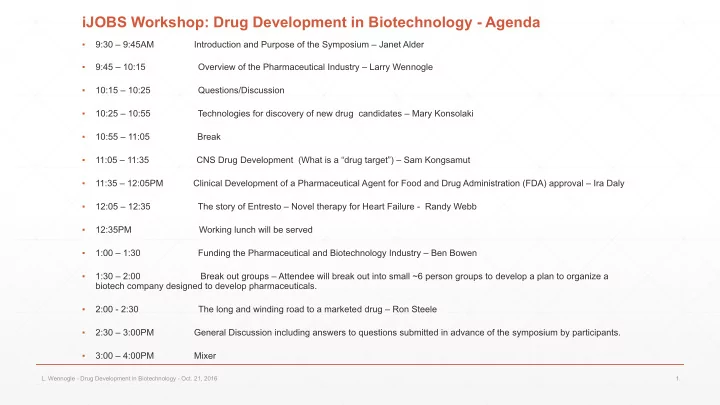
▪ 9:30 – 9:45AM Introduction and Purpose of the Symposium – Janet Alder ▪ 9:45 – 10:15 Overview of the Pharmaceutical Industry – Larry Wennogle ▪ 10:15 – 10:25 Questions/Discussion ▪ 10:25 – 10:55 Technologies for discovery of new drug candidates – Mary Konsolaki ▪ 10:55 – 11:05 Break ▪ 11:05 – 11:35 CNS Drug Development (What is a “drug target”) – Sam Kongsamut ▪ 11:35 – 12:05PM Clinical Development of a Pharmaceutical Agent for Food and Drug Administration (FDA) approval – Ira Daly ▪ 12:05 – 12:35 The story of Entresto – Novel therapy for Heart Failure - Randy Webb ▪ 12:35PM Working lunch will be served ▪ 1:00 – 1:30 Funding the Pharmaceutical and Biotechnology Industry – Ben Bowen ▪ 1:30 – 2:00 Break out groups – Attendee will break out into small ~6 person groups to develop a plan to organize a biotech company designed to develop pharmaceuticals. ▪ 2:00 - 2:30 The long and winding road to a marketed drug – Ron Steele ▪ 2:30 – 3:00PM General Discussion including answers to questions submitted in advance of the symposium by participants. ▪ 3:00 – 4:00PM Mixer

  • L. Wennogle - Drug Development in Biotechnology - Oct. 21, 2016

1

slide-2
SLIDE 2

Drug Development in Biotechnology

October 21, 2016 Rutgers University Piscataway, New Jersey

slide-3
SLIDE 3

The Challenge: Odds are against you!

▪ 11-15 years to develop and win Food and Drug Administration (FDA) approval of a novel pharmaceutical agent ▪ Estimated costs range … Average cost of $2.6 Billion (PhRMA report) for New Drug Approval (NDA)

▪ Central Nervous System drugs generally higher/longer/riskier

▪ Less than one in ten drugs that enter Phase I clinical development succeed to approval and marketing ▪ Less than one in two marketed drugs gain back the money used to win approval ▪ Estimates of how many small molecules are made/screened per novel pharmaceutical agent approved is difficult and depends on the field/prior art

  • L. Wennogle - Drug Development in Biotechnology - Oct. 21, 2016

3

slide-4
SLIDE 4
  • L. Wennogle - Drug Development in Biotechnology - Oct. 21, 2016

4

slide-5
SLIDE 5

Typical IND-enabling Pre-Clinical Toxicology and Safety Studies

  • In vitro
  • Assay development and validation
  • Dose formulation analyses
  • Rat Toxicity
  • Single dose
  • 7 day dose ranging
  • 14 and 28 day toxicity
  • Dog/Monkey
  • Maximum tolerated dose
  • 7 day dose ranging
  • No effective dose level
  • 14 and 28 day toxicity
  • Genotoxicity
  • Bacterial mutagenicity
  • Chromosome aberration
  • Rodent micronucleus
  • Safety Pharmacology
  • hERG inhibition
  • CNS rodent
  • Cardiovascular (telemetry)
  • Respiratory

Prior to studies in humans, an Investigational New Drug (IND) application must be filed with and approved by the FDA. The FDA has a specific set of in vivo/in vitro studies that must be conducted for IND approval.

  • L. Wennogle - Drug Development in Biotechnology - Oct. 21, 2016

5

slide-6
SLIDE 6

Larry Wennogle, Ph.D. Overview of the Pharmaceutical Industry

▪ Introductory statements and setting the stage for the symposium ▪ My career in brief ▪ 30,000 foot view of the Pharmaceutical Industry

▪ Markets/revenues/employees

▪ The challenges ▪ The changing landscape

▪ Historical perspective

▪ A few words about the legal aspects and patent law

  • L. Wennogle - Drug Development in Biotechnology - Oct. 21, 2016

6

slide-7
SLIDE 7

Data Sources

▪ Pharmaceutical Research and Manufacturing Association of America PRMA ▪ Center for Disease Control

▪ National Center for Health Statistics’ (NCHS) Office of Analysis and Epidemiology ▪ Package Inserts for approved drugs at Food and Drug Administration (FDA)

▪ State of New Jersey ▪ Taganpoint Consultants (Mark Lane) ▪ PubMed/PubChem ▪ Google ▪ WebMD ▪ Wikipedia

  • L. Wennogle - Drug Development in Biotechnology - Oct. 21, 2016

7

slide-8
SLIDE 8

Focus on Biopharmaceuticals

Including: ▪ Biopharmaceutical Industry

▪ Traditional “Big Pharma” ▪ Biotech Companies ▪ Generic Manufacturers ▪ Human clinical trials “industry”

Generally not including: ▪ Chemical Manufacturing ▪ Devices ▪ Clinical Diagnostics

  • L. Wennogle - Drug Development in Biotechnology - Oct. 21, 2016

8

slide-9
SLIDE 9

Industry Overview

▪ Biopharmaceutical sector

  • L. Wennogle - Drug Development in Biotechnology - Oct. 21, 2016

9

slide-10
SLIDE 10

Pharmaceutical Research and Development Association (PhRMA) member companies

▪ Abbott Eisai ▪ Amgen EMD Serono ▪ Astellas Endo Pharma ▪ AstraZenica GlaxoSmithKlyne ▪ Biogen Johnson & Johnson ▪ Bayer HealthCare LLC Eli Lilly ▪ Boehringer Ingelheim Lundbeck ▪ Bristol-Myers Squibb Merck & Co ▪ Celgene Novartis Pharma ▪ Cubist Pharma Novo Nordisk ▪ Daiichi Sankyo Otsuka ▪ Dainippon Sumitomo Pfizer ▪ Purdue Ikaria ▪ Sanofi Orexigen Pharma ▪ Sigma-Tau Shionogi Inc. ▪ Takeda Pharma Sucampo ▪ Alkermes Theravance Inc. ▪ Arena Pharma United Therapeutics ▪ BioMartin Pharma Vertex ▪ CSL Behring LLC Vifor ▪ Depomed Vivus Inc. ▪ Ferring Pharma Xoma Ltd. ▪ Helsin Therapeutics ▪ Horizon Pharma

Blue – headquartered in New Jersey, Purple – significant presence in New Jersey

  • L. Wennogle - Drug Development in Biotechnology - Oct. 21, 2016

10

slide-11
SLIDE 11

Total Sales by company Novartis top in total sales in 2014 with $47B

  • L. Wennogle - Drug Development in Biotechnology - Oct. 21, 2016

11

slide-12
SLIDE 12

Key Points: PhRMA companies

▪ In the year 2011

▪ spent $49B in R&D

▪ Roughly 78% - domestic ▪ Roughly 17% of Total Sales

  • L. Wennogle - Drug Development in Biotechnology - Oct. 21, 2016

12

slide-13
SLIDE 13
  • L. Wennogle - Drug Development in Biotechnology - Oct. 21, 2016

13

slide-14
SLIDE 14

Some Statistics

▪ In 2003 there were 6,199 Clinical trials in the US involving 1.1 million participants ▪ 17.5% of GDP goes to national health expenditures ▪ In 2014, $9,523 was spent on health care expenses per capita ▪ Roughly 9.8% of the medical expenses in the USA go to purchase prescription drugs (CDC in 2014)

▪ This expense offsets considerably higher costs for hospitalization

  • L. Wennogle - Drug Development in Biotechnology - Oct. 21, 2016

14

slide-15
SLIDE 15

17.5%

  • f GDP
  • L. Wennogle - Drug Development in Biotechnology - Oct. 21, 2016

15

slide-16
SLIDE 16

National Center for Health Statistics’ (NCHS) Office of Analysis and Epidemiology

  • L. Wennogle - Drug Development in Biotechnology - Oct. 21, 2016

16

slide-17
SLIDE 17

R&D Expenditures as a % of GDP US – 2.59%

  • L. Wennogle - Drug Development in Biotechnology - Oct. 21, 2016

17

slide-18
SLIDE 18

Highest Selling Pharmaceuticals in 2013

▪ Humira - $10.7B

▪ Enbrel and Remicade

▪ US 2013

▪ Abilify - $6.53B - Antipsychotic ▪ Nexium - $6B – Proton Pump Inhibitor - Ulcer ▪ Humira - $5.4B – TNF alpha antibody

▪ Lipitor (Pfizer HMG-CoA Reductase inhibitor – Statin – Cholesterol – Park Davis Pfizer acquizition)

▪ Averaged $13B annually (totaled $141B before patent expiration 2011

  • L. Wennogle - Drug Development in Biotechnology - Oct. 21, 2016

18

slide-19
SLIDE 19

2015 – WebMD: The top 10 medications by number of monthly prescriptions are: The top 10 medications by sales are:

  • 1. Synthroid (levothyroxine), 21.5

million

  • 1. Humira (adalimumab), $8.2

billion

  • 2. Crestor (rosuvastatin), 21.4

million

  • 2. Abilify (aripiprazole), $7.9 billion
  • 3. Ventolin HFA (albuterol), 18.2 million ¡
  • 3. Sovaldi (sofosbuvir), $6.9 billion ¡
  • 4. Nexium (esomeprazole), 15.2

million

  • 4. Crestor (rosuvastatin), $5.9

billion

  • 5. Advair Diskus (fluticasone), 13.7 million
  • 5. Enbrel (etanercept), $5.9 billion ¡
  • 6. Lantus Solostar (insulin glargine), 10.9

million ¡

  • 6. Harvoni (ledipasvir and sofosbuvir), $5.3 billion ¡
  • 7. Vyvanse (lisdexamfetamine), 10.4 million ¡
  • 7. Nexium (esomeprazole), $5.3

billion

  • 8. Lyrica (pregabalin), 10.0 million ¡
  • 8. Advair Diskus (fluticasone), $4.7 billion
  • 9. Spiriva Handihaler (tiotropium), 9.6 million ¡
  • 9. Lantus Solostar (insulin glargine), $4.7

billion

  • 10. Januvia (sitagliptin), 9.1 million ¡
  • 10. Remicade (infliximab), $4.6

billion ¡ ¡

  • L. Wennogle - Drug Development in Biotechnology - Oct. 21, 2016

19

slide-20
SLIDE 20
  • L. Wennogle - Drug Development in Biotechnology - Oct. 21, 2016

20

slide-21
SLIDE 21
  • L. Wennogle - Drug Development in Biotechnology - Oct. 21, 2016

21

slide-22
SLIDE 22
  • L. Wennogle - Drug Development in Biotechnology - Oct. 21, 2016

22

slide-23
SLIDE 23

Evolution of Therapeutic Approaches

400BC

Hippocrates describes us of salicylic tea to reduce fever

1899

Bayer begins selling “aspirin”

1914

Rabies vaccine licensed in US

1922

1st diabetic treated with insulin

1942

1st success tx

  • f septicemia

with penicillin

1958

1st implantable pacemaker

1986

1st antibody therapy approved for transplant rejection

2012

1st (only) stem cell therapy approved

2012

1st (only) gene therapy approved (outside of China)

2016

1st 3D printed pill approved

  • L. Wennogle - Drug Development in Biotechnology - Oct. 21, 2016

23

slide-24
SLIDE 24

Statins: Cholesterol Lowering

▪ In 1971, Akira Endo, a Japanese biochemist from Sankyo, identified mevastatin from a fungus as an inhibitor of HMG-CoA reductase, RDS for cholesterol biosynthesis ▪ In 1987, Roy Vagaeos (CEO of Merck) orchestrated first marketing of Mevacor ▪ Zocor causes 35% reduction in cholesterol and chances of dying of heart disease reduces 43% ▪ Sales of Zocor and Mevacor (Merck) over $1B in 1995

  • L. Wennogle - Drug Development in Biotechnology - Oct. 21, 2016

24

Example

slide-25
SLIDE 25

Historical Perspective

▪ Natural Products ▪ Antibiotics ▪ Anti-infectives ▪ Designer drugs such as specific kinase and receptor inhibitors ▪ Biologicals ▪ First direct-to-consumer advertisement: Merck, 1981 (Readers Digest for anti- pneumococcal vaccine) ▪ In 2003, $5B spent on direct-to-consumer marketing

  • L. Wennogle - Drug Development in Biotechnology - Oct. 21, 2016

25

slide-26
SLIDE 26

Pfizer: Legacy

▪ Warner-Lambert ▪ Agouron ▪ Pharmacia ▪ Wyeth ▪ American Home Products ▪ Parke-Davis ▪ American Cyanamid/Lederle Labs ▪ Recent failed attempts: Astra-Zeneca and Allergan

  • L. Wennogle - Drug Development in Biotechnology - Oct. 21, 2016

26

Example

slide-27
SLIDE 27
  • L. Wennogle - Drug Development in Biotechnology - Oct. 21, 2016

27

The World

slide-28
SLIDE 28

The World

  • L. Wennogle - Drug Development in Biotechnology - Oct. 21, 2016

28

slide-29
SLIDE 29
  • L. Wennogle - Drug Development in Biotechnology - Oct. 21, 2016

29

slide-30
SLIDE 30

State of New Jersey and Pharma

▪ GDP of New Jersey is 3.2% on the National GDP ▪ HealthCare Institute of New Jersey:

▪ 78,447 employed in the Biopharmaceutical industry in NJ

▪ 2014: New Jersey Department of Labor and Workforce Development/Office of Research and Information estimated 115,000 workers in the Biopharmaceutical Life Sciences Cluster (Medical device manufacturing included)

▪ 3.6% of the New Jersey private workforce; Nationally: 1.9% ▪ $15B in wages or 8.1% of total state wages

▪ In 2013, there were 1,234 clinical trials ongoing in the state of New Jersey with 25,126 participants

  • L. Wennogle - Drug Development in Biotechnology - Oct. 21, 2016

30

slide-31
SLIDE 31

Quick View on Patents in Pharma

▪ A patent (/ˈpætəӚnt/ or /ˈpeɪtəӚnt/) is a set of exclusive rights granted by a sovereign state to an inventor

  • r assignee for a limited period of time in exchange for detailed public disclosure of an invention. An

invention is a solution to a specific technological problem and is a product or a process.[1]:17 Patents are a form of intellectual property. ▪ The procedure for granting patents, requirements placed on the patentee, and the extent of the exclusive rights vary widely between countries according to national laws and international

  • agreements. Typically, however, a granted patent application must include one or more claims that

define the invention. A patent may include many claims, each of which defines a specific property

  • right. These claims must meet relevant patentability requirements, such as novelty, usefulness, and

non-obviousness. The exclusive right granted to a patentee in most countries is the right to prevent

  • thers, or at least to try to prevent others, from commercially making, using, selling, importing, or

distributing a patented invention without permission.[2][3] ▪ Under the World Trade Organization's (WTO) Agreement on Trade-Related Aspects of Intellectual Property Rights, patents should be available in WTO member states for any invention, in all fields of technology,[4] and the term of protection available should be a minimum of twenty years.[5] Nevertheless, there are variations on what is patentable subject matter from country to country

  • L. Wennogle - Drug Development in Biotechnology - Oct. 21, 2016

31

slide-32
SLIDE 32
  • L. Wennogle - Drug Development in Biotechnology - Oct. 21, 2016

32

slide-33
SLIDE 33

Typical Big Pharma Composition of Matter, Small Molecule Patent

▪ ~750 compounds with complicated structure relationships ▪ Compounds never before made ▪ Dozens to hundreds of claims ▪ Prosecuted in multiple countries ▪ Generally prosecuted for 5-10 years with generation of multiple continuations, divisional patent applications

▪ Ex. Over 3000 patents include the structure of Lovastatin

▪ Major approved drugs have composition of matter, crystals, method of preparation, therapeutic applications, formulations, etc.

  • L. Wennogle - Drug Development in Biotechnology - Oct. 21, 2016

33

slide-34
SLIDE 34

Summary and Conclusions

▪ Drug Development is risky ▪ Enormous investment with potential blockbuster payoffs ▪ Sizable fraction of personal/state/country/world economy ▪ Large workforce with multiple disciplines represented ▪ Incredible changes continue in the industry

  • L. Wennogle - Drug Development in Biotechnology - Oct. 21, 2016

34

slide-35
SLIDE 35

Thank you!

My nearly 37 years in the Pharmaceuticals has been a wonderful experience. Consider a career in Pharma!

slide-36
SLIDE 36

iJOBS Workshop: Drug Development in Biotechnology - Agenda

▪ 9:30 – 9:45AM Introduction and Purpose of the Symposium – Janet Alder ▪ 9:45 – 10:15 Overview of the Pharmaceutical Industry – Larry Wennogle ▪ 10:15 – 10:25 Questions/Discussion ▪ 10:25 – 10:55 Technologies for discovery of new drug candidates – Mary Konsolaki ▪ 10:55 – 11:05 Break ▪ 11:05 – 11:35 CNS Drug Development (What is a “drug target”) – Sam Kongsamut ▪ 11:35 – 12:05PM Clinical Development of a Pharmaceutical Agent for Food and Drug Administration (FDA) approval – Ira Daly ▪ 12:05 – 12:35 The story of Entresto – Novel therapy for Heart Failure - Randy Webb ▪ 12:35PM Working lunch will be served ▪ 1:00 – 1:30 Funding the Pharmaceutical and Biotechnology Industry – Ben Bowen ▪ 1:30 – 2:00 Break out groups – Attendee will break out into small ~6 person groups to develop a plan to organize a biotech company designed to develop pharmaceuticals. ▪ 2:00 - 2:30 The long and winding road to a marketed drug – Ron Steele ▪ 2:30 – 3:00PM General Discussion including answers to questions submitted in advance of the symposium by participants. ▪ 3:00 – 4:00PM Mixer

  • L. Wennogle - Drug Development in Biotechnology - Oct. 21, 2016

36

slide-37
SLIDE 37

Backup Slides

  • L. Wennogle - Drug Development in Biotechnology - Oct. 21, 2016

37

slide-38
SLIDE 38

The Pharmaceutical Industry Has Had A Significant Impact on Human Health

▪ Hepatitis C – a once incurable disease that now has cure rates above 90% ▪ HIV/AIDS – once a death sentence, it’s now a chronic manageable condition ▪ Cancer – 83% of children with cancer now survive, compared to 58% in 1970 ▪ Vaccines – more than 730,000 children’s lives have been saved in the last 20 years in the United States because of advances in vaccines.

https://youtu.be/-5X2kzIDroA

  • L. Wennogle - Drug Development in Biotechnology - Oct. 21, 2016

38

slide-39
SLIDE 39

Developing pharmaceuticals is a costly and risky business

  • L. Wennogle - Drug Development in Biotechnology - Oct. 21, 2016

39

slide-40
SLIDE 40

Comparing development of different product types

Attribute Small molecule (pill) Large Molecule (biologic) Medical Device Cycle time 10-15 yrs 10-12 yrs 3-7 yrs Cost to develop >$2.5B including capital and failures >$2.5B including capital and failures $31M Regulatory Pathway NDA (safe and efficacious) BLA Safe and efficacious) 510K (clinical benefit

  • r substantial

equivalence) Price ++ +++ + Superiority, cost effectiveness, health economic benefit

  • L. Wennogle - Drug Development in Biotechnology - Oct. 21, 2016

40

slide-41
SLIDE 41
  • L. Wennogle - Drug Development in Biotechnology - Oct. 21, 2016

41

slide-42
SLIDE 42

Lab to Patient Journey: Investigational New Drug (IND)

▪ Content of the IND

▪ Cover letter (various administrative information and commitments) ▪ General investigational plan ▪ Previous human experience ▪ Investigator Brochure ▪ Drug substance and formulation ▪ Summary of pharmacology and toxicology ▪ Summary of biologic disposition and pharmacokinetics ▪ Clinical protocol (study design, dose, etc) ▪ CMC (physical, chemical , biological characteristics)

▪ Quality, impurities, strength, stability, shelf life, manufacturing process, dose form

▪ Labeling ▪ Environmental impact ▪ Drug dependence and abuse potential

  • L. Wennogle - Drug Development in Biotechnology - Oct. 21, 2016

42

slide-43
SLIDE 43

Cost and Complexity

Lab to Patient Journey: Clinical Trials

  • L. Wennogle - Drug Development in Biotechnology - Oct. 21, 2016

43

slide-44
SLIDE 44

Discovery Pre- clinical Clinical Development Agency Review Post Approval Lifecycle

Research Chemistry CMC (incl. Regulatory) Clinical Development Regulatory Strategy Regulatory Operations Clinical Operations Data Management Strategic Marketing Commercial Manufacturing Packaging Quality Pharmacovigilance Medical Affairs Health Economics & Outcomes Pricing and Reimbursement Labeling and Promotion

Those functions in red often have separate organizations outside of the headquarters country and in various regions

  • L. Wennogle - Drug Development in Biotechnology - Oct. 21, 2016

44

slide-45
SLIDE 45

Regulatory Affairs Activities and Deliverables

▪ Strategy

▪ Assist with protocol and development plan creation ▪ Country and region-specific regulatory agency strategy ▪ Leads preparation and conduct of agency meetings ▪ Pediatric Investigation plan ▪ Point of contact for all Agency correspondence ▪ Draft labeling with clinical

▪ Operations

▪ Regulatory Information Management ▪ Submission planning ▪ Coordination of submission preparation ▪ Agency interactions ▪ Submission publication ▪ Document archiving

  • L. Wennogle - Drug Development in Biotechnology - Oct. 21, 2016

45

slide-46
SLIDE 46

Strategic Marketing Activities and Deliverables

▪ Target product profile (with team) ▪ Global Marketing Strategy (what markets, price, etc) ▪ Communication plans ▪ Global sales and product forecasts ▪ Label claims needed ▪ Global launch plan ▪ Label development

  • L. Wennogle - Drug Development in Biotechnology - Oct. 21, 2016

46

slide-47
SLIDE 47

Medical Affairs Activities and Deliverables

▪ Publication strategy (abstracts, presentations, papers) ▪ Investigator sponsored trials ▪ Medical Advisory Boards ▪ Medical Science Liaison (to physician; relatively new role) ▪ Patient, physician, payer education ▪ Phase IV clinical trials design, conduct, reporting and publication ▪ Key opinion leader and patient advocacy group education/interaction

  • L. Wennogle - Drug Development in Biotechnology - Oct. 21, 2016

47

slide-48
SLIDE 48

A number of challenges have led to declining (or steadily low) productivity while costs continue to increase

▪ Longer cycle times ▪ Higher efficacy and regulatory hurdles ▪ Increased competition ▪ Comparative effectiveness and value-based pricing and stricter reimbursement ▪ Despite large investment limited impact of personalized medicine ▪ Increased complexity of targets

  • L. Wennogle - Drug Development in Biotechnology - Oct. 21, 2016

48