
SLIDE 1
IIRP World Conference – November, 2013
Jackie Vazquez, Mary Beth Spinelli, Kathy Sweetland
IIRP World Conference November, 2013 Jackie Vazquez, Mary Beth - - PowerPoint PPT Presentation
IIRP World Conference November, 2013 Jackie Vazquez, Mary Beth Spinelli, Kathy Sweetland Partners in Restorative Initiatives is a nonprofit community-based organization in Rochester, NY. Our goal is to build a more peaceful community.
IIRP World Conference – November, 2013
Jackie Vazquez, Mary Beth Spinelli, Kathy Sweetland
» Our mission with the Drug Free Streets Initiative: make urban residential communities in the city of Rochester, NY safer by reducing open-air drug sales (sales on the street, parks, outside of businesses, etc). Our work developed through the Ibero-American Development Corporation. » Ibero-American Development Corporation (IADC) is a non-profit that does:
˃ Community Development: real-estate and property management with rental-to-
˃ In 2008: hired a group of community organizers (Project HOPE) who began to work in a challenged neighborhood. Residents identified Drugs as #1 issue that affects their health and the health of their neighbors through an asset mapping survey. ˃ In 2009: Residents began getting involved in creating solutions.
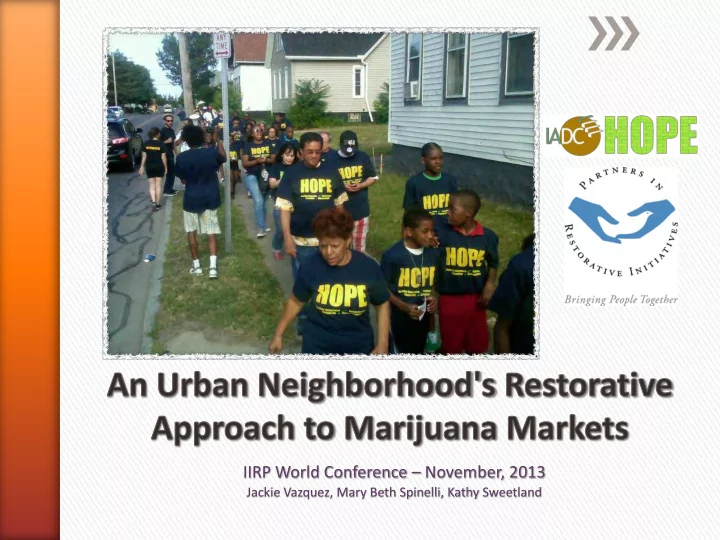
In 2009, residents decided to start taking action and began community walks, resident meetings, and planning around the issue.
Drug Walks: over 60 in the neighborhood in the last 5 years; Message delivered: “We love you but hate what you are doing to our neighborhood.”
Out with the Old
Improving the Neighborhood
Improvements include: Housing, Sofrioto Garden, El Camino trail, Conkey Corner Park. Community meetings, programs & events: block clubs, safety committee, youth & elder focused programs and events through Project HOPE. Still… plagued by drug sales on the streets, especially marijuana sales.
Decriminalization of laws pertaining to marijuana; possession of 25 grams or less is a violation – receives a fine but back on the corner selling the next day. A sale is a crime but not a priority in the courts due to harder drugs and other cases.
Crime lab tests for the city of Rochester, county and surrounding counties; marijuana isn’t a priority to test compared to other cases (homicides to arson, etc).
Corner of Clifford & Conkey Avenues – has been a drug market for over 30 years
What the community sees: same people on the corner/street day after day, arrest after arrest; Children, sisters, cousins, neighbors negatively influenced by their actions; Residents/Business owners feelings: frustrated with police officers, limitation on what they’re willing to do; threatened if constantly reporting on sellers; tired/weary from trying to do something about violence/drug issues Police: frustrated by recurrence; limitations on what they CAN do
The new park we built with residents: in the background here
Rochester Police Department: letter writing campaign to people buying in the area of that Conkey- Clifford corner to deter buyers.
The Roadmaps to Health Community Grants program (Community Grants) will support communities to implement policy or system changes to address one of the social or economic factors that, as defined by the County Health Rankings, most strongly influence health outcomes in their community.
RDFSI is one of two Roadmaps to Health grantees funded around Community Safety. We built a Coalition of
police, nonprofits, etc who are working to address the issue.
Civil: Working on a policy change to implement a Protective Order for the Community Voluntary: Restorative Community Circles
˃ Lower income; troubled with violence, drug sales, loitering, high unemployment; low social determinants of health; many renters ˃ Rich with neighbors who care; residents name “good neighbors” as one of the best parts of the neighborhood; people that own that have lived their for 20 or more years and a few year renters who don’t want to leave. ˃ Rich with community organizing, active resident participation, close libraries, schools, businesses and recreation centers.
˃ Male, between 16 and 28 years old, dropped out of school, some with records and some without convictions (this quadrant of Rochester has the
˃ Some addiction to street life while others very ready and interested in
training OR immediate employment .
» Community residents take action within their neighborhood » Individuals who are selling are held accountable for his/her actions » Achieve a sense of reconnection to the residents and the community
What supports do you need to achieve your goals? What caused you to begin selling marijuana? How has this choice affected you, your family, the community?
RCC = a hybrid of community conferencing, peace circles & restorative transition circles (Lauren Walker’s work with youth in HI); Purpose is intervention (before a conviction); Harm we’re focusing on is the impact of selling = BEHAVIOR); Victims are: resident (self, family, neighbors) and neighborhood; Restoration -- focused on supporting a change in behavior and a different way to get one’s needs met
Voluntary Outreach
individuals; includes building buy-in to the restorative process
Pre-circle
Restorative Community Circles
restorative language
the individual’s goals and needs
during break
Follow-up
celebrate successes
Sustainable
Engage Sellers Pre-circle Restorative Community Circles Post-Circle Support of Seller Follow-up Circle Changes in the Community
Seller
Supporters
Community Residents
Service Providers Individual Plan for Success
Roles: Facilitators (in start up they are staff & 2 in-training resident
facilitators; long-term all facilitators will be residents)
Staff members- 2 (our Outreach person is the most
consistent Supporter in the whole process; RP coordinator as a resource person in the circles)
Agenda Welcome Guidelines What’s Going
Strengths Individual Plan for Success Closing Components
˃ Individual Plan for Success (IP4S): + Respondent: share your goals and what type of support you need to help you reach them. + Everyone else: what they would like to see happen and offers of support they want to make. + All of the above is recorded on flip-chart paper on the wall. + Take a break (about 15 min) to create IP4S: – Respondent works with supporters , staff resource person and lead facilitator to draft a plan. – The focus is on taking 1- 2 of the goals written up on the flip-chart paper and drafting a couple of first-second action steps for reaching each goal. These go on an IP4S plan paper. Steps for other goals will be developed in the weekly to bi-weekly follow up between the RP coordinator and the Respondent. + Reconvene the circle: Respondent shares her/his plan with the Circle.
Seller Engagement Resident Engagement
» Resident engagement:
˃ Successes + Over 100 residents (in 2 focus neighborhoods) sign-uped to learn more and/or be involved + Active Resident Advisory Committee (10-12 people at monthly meetings) + Residents spoke at City Council about drug issues in their neighborhood + Engaging with RCCs : restorative practices training (more to come) with PiRI; role plays on RCCs; have 5 people in training as apprentice facilitators (2 are residents rest are staff); have about 15 in training for community resident role + By end of Nov -- enough residents to run the RCCs (2 apprentice facilitators, about 12 community residents) ˃ Challenges: intimidation, fear of retaliation, fear that nothing will change/burnout ˃ Learnings: + Nothing will change: Mock circles/role plays for education; gotten more people to buy-in; willing to try alternatives, something new + Community “education” through community forum + Intimidation: Name and outreach message changes: new Community friendly name – INSPIRE: Invested Neighbors Seeking Progress, Inspiration, Restoration, and Empowerment
» Street outreach with individuals selling:
˃ Connecting with youth on the streets selling – building a relationship ˃ Restorative: focus is on What’s going on? What’s your story? ˃ Successes: A number of the individuals selling are interested & willing to take part voluntarily ˃ Challenges: + Following up with interested individuals + Short amount of time: trying to get buy-in to talk to us and consider following up with us without much time to trust-build – it’s going to take longer and be an on-going process + One outreach worker on staff ˃ Learnings + Buy-in: getting introductions from community outreach staff (community organizers through Projects HOPE, Project Bridges To Wellness, and our city’s Gang Intervention outreach workers at Pathways to Peace) + Try engaging in a different place –at library/rec center, over a meal, etc
We’re seeking relief for the weary residents. We want to engage people in restorative practices but know it will not work for everyone. Protection for the community is the second tier of our model.
stop selling drugs.
subject to contempt of court order.
Protective Orders will be individually tailored. Exceptions will apply for work, family, school. This model will apply city wide.
mspinelli@iberodevelopment.org 585-467-6410 x32
jvazquez@iberodevelopment.org 585-467-6410 x34