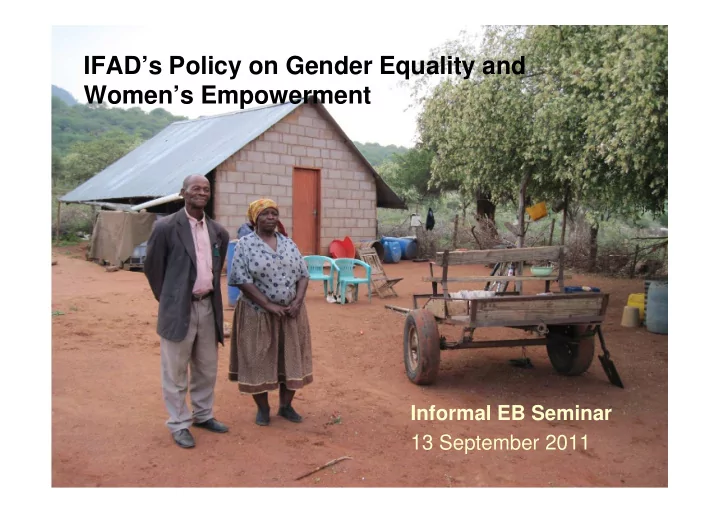
IFADs Policy on Gender Equality and Womens Empowerment Informal EB - - PowerPoint PPT Presentation
IFADs Policy on Gender Equality and Womens Empowerment Informal EB Seminar 13 September 2011 I. Relevance of addressing gender in ARD Role of rural women Challenges facing rural women Account for 43% of Limited access to
- I. Relevance of addressing gender in ARD
Challenges facing rural women
- Limited access to inputs,
services and rural infrastructure (technology, education, extension, health, finance, markets, water, energy)
- Represent fewer than 5% of all
agricultural land holders in NENA; SSA average of 15%
- Limited contribution to decision-
making in home, organizations and community Role of rural women
- Account for 43% of
agricultural labour force in developing countries; 50% in Eastern Asia and SSA
- Typically work 16 hours per
day
- Multi-tasking with mix of
productive and household responsibilities Yields gap between men- and women-run farms of 20-30%
Benefits of addressing gender in ADR
Closing persistent gender gaps would:
- Increase yields on women’s farms by 20-30%
- Increase total agricultural output by 2.5-4% in developing countries
- Reduce the number of global hungry by 12-17%
SOFA, FAO, 2011 By World Bank addressing needs of both men and women, projects increased long-lasting value of the benefits generated by 16% IFPRI, 2008
Relevance for IFAD
IFAD already recognizes significance of addressing gender issues:
- Gender equality is embedded in Strategic Framework: Principle of
Engagement 4 and the five objectives
- Scaling up, systematising and refining its approach to gender equality
and women’s empowerment are essential to achieve IFAD’s mandate
- Changing rural economies (population growth, globalization, emerging
new markets, climate change, feminization of poverty…) present new
- pportunities and risks for rural women
Closing gender gaps is central to achieving all the MDGs: critical for food security and economic growth UNDP 2010
- II. IFAD’s Experience
- Household Food Security and Gender
project design memory checks in 1999
- Gender Plan of Action (2003-2006),
approved by EB in April 2003
- Framework for Gender Mainstreaming as
part of new business model in 2008
- Gender and Agriculture Sourcebook IFAD-
WB-FAO in 2009
- President accepted MDG3 Champion Torch
in 2009 Gender milestones
Uganda: District Livelihoods Support Programme (DLSP)
2007-2014, IFAD:US$27.4 million, 100,000 benefitting HHs, 15,600
- farmers. Major focus on Gender Empowerment.
Processes
- Gender-sensitized technical
team, including gender specialist
- Work plans/budgets and
implementation guidelines address gender issues in programme sub-components
- Mechanisms for collecting,
analysing and disseminating gender-disaggregated data
Achievements
- Gender-related and social
benefits
- Household mentoring
methodology developed for gender empowerment and strengthening sustainability
Ghana: Upper East Region Land Conservation and Smallholder Rehabilitation PROJECT (LACOSREP)
1999-2006, IFAD: US$13.9 million, 34,400 benefitting HHs. A key focus 80 Water Users Associations. Processes
- Social equity and inclusive
targeting of rural poor mainstreamed into WUA activities and multiple types of users recognized
- Bottom-up approaches to WUA
drew on institutional frameworks and decentralization
- Upscaling WUAs to district, and
regional WUA councils:. Achievements
- Greater participation of
women in WUA decision- making processes
- WUAs to engage in
policy dialogue - attention brought to women’s needs
Guatemala: Rural Development Programme for Las Verapaces
2001-2011, IFAD:US$15 million, 16,000 benefitting HHs. Value chains for a variety of crops. Processes
- Discussions within farmers’
associations involve women as well as men
- Employment of a qualified full-time
gender adviser
- Capacity building
- literacy and training on accounting
- group management and technical
skills
- Integration of women into high-value
agricultural production and processing activities Achievements
- Work and resources fairly
distributed between women and men
- Increased control by women
- ver benefits:
- improved household
nutrition
- children’s education
- improvements to housing
Best practices
- Decision-making power to
women
- Role modelling, exchange visits
- Gradual approaches, using local
innovators and leaders
- Household-based approach to
extension
- Measures for positive
discrimination (eg quotas)
- Implementing partners
committed to gender equality
- Model gender equality in IFAD
and field
- III. Further strengthening IFAD’s gender
engagement
IOE’s Corporate evaluation of IFAD gender policy (2010):
- Performance of IFAD-financed operations with regards to gender
better than peers
BUT – existing guidance fragmented: need to develop an evidence and results-based corporate policy
- increased women’s capacity building, economic
empowerment and decision-making
- prominent advocacy role in bringing the contribution of rural
women to policymakers’ attention
- strong results orientation in project cycle - regularly tracked
performance indicators on gender
- High relevance and effectiveness of IFAD’s three gender objectives
- Recent operations have improved performance
A new Gender Policy would look to
Deepen impact (economic, institutions, well-being) of IFAD
- perations by systematic consideration of gender
Provide clear objectives and comprehensive policy guidance (including on HR) on gender Bridge design/implementation gaps and ensure more even performance Increase capacity of IFAD leadership, management, staff and partners on gender issues Systematic learning and reporting to serve management decision-making needs for improving IFAD performance
IFAD’s leadership role on rural gender issues
IFAD’s Role: empowering rural women and their organizations in
- rder to promote gender equality and rural development
effectiveness IFAD’s Mandate: focus on rural poverty reduction by promoting smallholder agriculture and rural development (ARD)
- Rural women play major role in smallholder ARD, especially
in poorer countries
- “Feminization of poverty” and gap widening
- Rural women have key functions in food security, natural
resource management, processing and off-farm employment:
- ften unrecognised
Process for IFAD’s gender policy
Process
- Leadership by IFAD senior
management
- IFAD-wide Policy Reference
Group
- Divisional consultations
- Intranet learning and sharing
platform
- Significant allocation of
resources at corporate and divisional levels Actions
- Revise business processes
related to project-programme cycle
- Improve knowledge
management and innovation
- Track expenditure
- Plan for more gender- and
diversity-inclusive
- rganization, including
management roles
- IV. Gender policy: Purpose and objectives
Economic empowerment Economic empowerment Representation and citizenship rights Representation and citizenship rights Workload reduction Workload reduction
Goal: enhance sustainability and deepen impact Purpose: improve gender equality and women’s empowerment
Strategic Framework Goal Enabling poor rural women and men to improve their food security and nutrition, raise their incomes and strengthen their resilience Strategic Framework Goal Enabling poor rural women and men to improve their food security and nutrition, raise their incomes and strengthen their resilience
Principles and approaches
- Gender equality as a value and guiding principle
- Gender equality as a matter of development effectiveness
- Gender equality as a matter of professional accountability
- Gender analysis and mainstreaming required in all country,
programme and project designs
- Gender specific programmes developed to address
institutional exclusion and special needs of women/men
- IFAD, government and local capacity built at the institutional
and project level for results-based gender development
- Partner investments leveraged for women in agriculture and
rural development
Field–level approaches
- Recognise differences among women and
that women’s and men’s roles change over time and space
- Build on complementarities between
women and men in agricultural production and the rural economy
- Focus efforts to benefit young rural women
- Engage men and leaders for gender
equality
- Use participatory approaches so voices of
different segments of population are valued
Objective 1: Economic empowerment
- Increase women’s access to
and control over resources
- Increase women’s
participation in profitable economic activities (farm,
- ff-farm, value chain actors,
employees)
- Increase women’s access to
and control over economic benefits
Objective 2: Representation and citizenship rights
- Increase women’s role in
household decision-making
- Increase women’s representation
among members and leaders of rural producer organisations
- Increase women’s participation in
and leadership of community decision-making bodies
Objective 3: Women’s workload reduction and balance
- Women’s access to basic
rural infrastructure and services
- Access to labour saving
technologies
- Equitable balance between
workloads and benefits/ remuneration
- V. Implementation: Operational action areas
- 1. Country
programmes and projects
- 2. Catalyst for
advocacy, learning and partnerships
- 3. Capacity-building
- f national and
international partners
Action areas
- RB-COSOPs
- Design (QE/QA)
Implementation
- Supervision/
implementation support
- Project completion
reports
- Learning and
innovation
- KM and
communications
- Advocacy
- Partnerships and
networking
- Training
- Skills development
- Toolkits and
materials
Operational action areas (continued)
- 4. Corporate approaches
and procedures
- 5. Resources, accountability
and monitoring
IFAD’s change and reform agenda:
- Staff capacity building
- HR rules and procedures
- Performance evaluation
- Gender and diversity
balance: HQ, missions
- Human and financial resources
- Corporate results framework
- Corporate M&E
- Institutional responsibilities
- EB oversight
Annexes to Gender Policy document (December EB)
- Results framework and implementation plan
- Best practice statements by thematic area
- Policy coherence: references to gender in
- ther IFAD policies
- Policies of other organisations: a