If you touch buildings, YOU can benefit from the Moisture - - PowerPoint PPT Presentation

if you touch buildings you can benefit from the moisture
SMART_READER_LITE
LIVE PREVIEW

If you touch buildings, YOU can benefit from the Moisture - - PowerPoint PPT Presentation

If you touch buildings, YOU can benefit from the Moisture Encounter Plus In our experience, whatever it is you are doing working on buildings, at some


slide-1
SLIDE 1

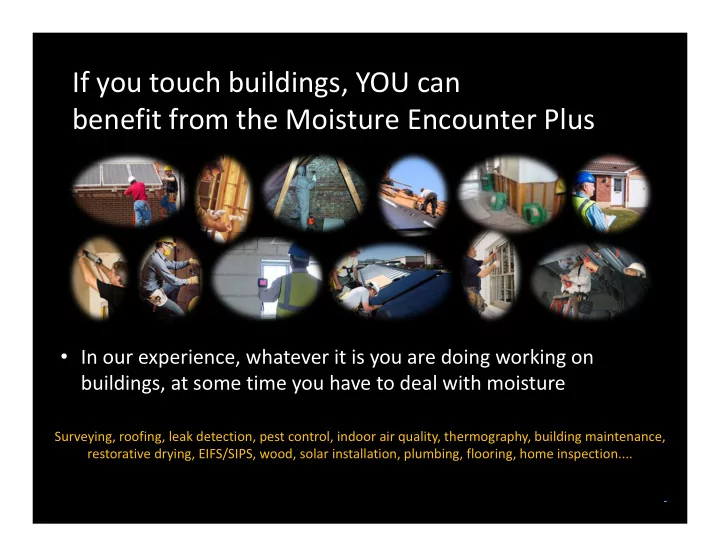
Ifyoutouchbuildings,YOUcan benefitfromtheMoisture Encounter Plus

  • Inourexperience,whateveritisyouaredoingworkingon

buildings,atsometimeyouhavetodealwithmoisture

Surveying,roofing,leakdetection,pestcontrol,indoorairquality,thermography,buildingmaintenance, restorativedrying,EIFS/SIPS,wood,solarinstallation,plumbing,flooring,homeinspection....

slide-2
SLIDE 2

GoalofMoistureDetection

  • Agoalofmoisturedetectionistoidentifyanddocument

abnormallywetareas/locationswhichcancausepotential damageofabuilding/structuresothattheenvironmentcan bereoccupiedorbroughtbacktothe(dry)conditionbefore theintrusion/occurrenceoccurred,anddoitinthemost economicalandefficientmeanspossible.

  • Theprocessbeginsbyidentifyingalloftheaffectedmaterials.

Watermustbetrackedfromitsinitialsourceanddiligently followedineverydirectionitmigratedtoestablishan accuratepictureoftheextentofthedamage.

slide-3
SLIDE 3

MoistureProblemsweEncounter

Systematicmeasurementofmoisturecontentcanprovidevitalcluesof hiddendampness– webelievetheMEPisthebestnondestructivetool forrevealingsuddenchangesinmoistureinalmostanymaterial

Condensation Rainpenetration Risingdamp Constructionmoisture Surfacewater Groundwater Leakingpipes Leakingroofs Spillage Visualdamage Structuraldamageintimbers andmetals Mould Poorindoorairquality Frostdamage Puddles

Thesesources... Causetheseissues!

slide-4
SLIDE 4

MoistureProblemsinBuildings

  • Evenwithoutanunwelcomeintrusionofwaterintoabuilding,manybuildingswillhave

moistureproblems.Moistureinbuildingshasbeenasourceofconcernforthe constructionandarchitecturalindustryforanumberofyears.

  • Inrecentyears,otherindustriessuchastherestorationindustryandindustriesthat

addressindoorairqualityhavebeguntostudythissciencetobetterunderstandhow moisturemoveswithinabuilding.

  • Understandingtheconceptsofmoisturemovementandsurroundingsinabuildingis

crucialtoincreasingthequalityofworkperformedbyrestorativedryingcontractors.

  • Withoutawaterdamagesituation,normalmoistureproblemscanrangefromsimple

nuisancestoseriousproblemsthatcanaffectthestructuralintegrityofabuildingand canseriouslythreatenhumancomfortandhealthiftheproblemgetsoutofcontrol.

  • TheMEPmoisturemeterallowsyoutorapidlyevaluatewheremoistureisaproblem

withoutpenetratingthematerial’ssurface.Nonpenetratingmetersareveryeffective forinitialtroubleshootingandinspection,becausetheygiveaquickindicationofwhere themoisturesourceislocated,orwherethematerialcontains“abnormal”moisture.

  • Inafewseconds,theycandetectmoisturenotvisiblefromthesurface,andtheyleave

notraceoftheiruse.

slide-5
SLIDE 5

Whichmaterialscanbemeasured?

  • ManytypicalbuildingandfinishingmaterialscanbemeasuredformoisturecontentwiththeMEP

including:

  • Wood– SolidandEngineered
  • Plywood/Particleboard/OSB/Engineered
  • Tile– Marble– PorcelainorCeramic
  • Vinyl/Lino/VCT
  • Drywall/Plaster/Gypsum
  • Roofingmaterial
  • Masonry
  • Cabinets
  • Subflooring
  • Concrete
  • StructuralInsulatingBoard
  • BlockWall
  • Ahygroscopicmaterialisonethatreadilytakesupandretainsmoistureuntilitattainsvaporequilibrium

withtheenvironment.Materialsthatarelabeledhygroscopic,absorbmoistureeasily,whetherfromdirect contactwithwaterorfromexposuretohighhumidity.Suchmaterialsgainandlosemoisturecontinuallyin anefforttoequalizewiththewatercontentinthesurroundingairmass.Mostmaterialsinbuildingsare hygroscopic,whichmeanstheynaturallytakeonandgivesoffwatertoachieveequilibriumwiththe surroundingenvironment.Themorehygroscopicthematerial,thefasteritwillcollectwatervapour.

slide-6
SLIDE 6

IdentifyingDamp

  • Visible– Initialinspectionproceduresbeginswithidentifyingandstoppingthesourceofwater

intrusion.Formsofvisualdamage,condensation,rainpenetration,risingdamp,frost,construction moisture,leakingpipesandbuildingenvelopleaks.Whilecondensationinitselfmaynotgiveriseto morethanatemporarynuisance,themouldgrowthwhichoftenaccompaniespersistent condensationismuchmorelikelytogiverisetoseriouscomplaint.

  • Hidden Isoftenthehardesttofind.Theprocessbeginsbyidentifyingalloftheaffectedmaterials.

Watermustbetrackedfromitsinitialsourceanddiligentlyfollowedineverydirectionitmigrated toestablishanaccuratepictureoftheextentofthedamage.Investigationisrequiredtoprovide recommendationandresolutionoftheproblem.Oftenthereareseveralreasonsforaproblem,and thereforeseveralremedies.Dampnesscanseriouslyaffectpartsofthebuildingthatarenot immediatelyvisible.Hiddendampnessmustbediscoveredbecauseitcanalsoleadtosevere deteriorationinbuildingproducts,andcanresultinstructuralproblems.

  • Knowledgeofwhat’swetandwhat'sdry,andtheextentisvitaltoRestorationandBuilding

Diagnostics.Wemustunderstandwhat“wet”isandwhat“dry”iswhencomparingtoa“Dry Standard”.Thisisestablishedbyobtainingamoisturereadingusingaknownunaffectedmaterial.

  • Inmanysituationstheprofessionalinvestigatingthedampnesswillneedanindicationoftheactual

levelofmoisturewithinthestructure,whichiswheretheMEPcomesin.
slide-7
SLIDE 7

Howdoesmoisturemove?

  • Itisimportanttounderstandhowmoisturemovestobeabletoproperlytracethesourceofthewater

leaks.Waterintrusionisthepassageofwaterthroughtheenvelopeofastructureresultinginleaks andeventuallywetrot,mould,dryrotanddeteriorationofbuildingcomponents.

  • Youmustidentifyandsolvethemoistureintrusionproblemsfirst.Sourcesofwaterintrusioncanvary

fromfailuresinfixturesandotherplumbing,weatherevents,flooding,andbuildingdefects.Identify thesourceandcorrectingtheprobleminordertopreventadditionalwaterintrusionorfuturedamage tothestructureanditscomponents.

  • LiquidFlow
  • Putsimply,wateralwaysgoeswhereveritwantstogoandgravityplaysasignificantroleinwhere

itgoes.

  • CapillaryAction
  • Thisistheabilityofliquidtoflowupwardsspontaneouslyrisinginanarrowspaceorinporous

materials.Thiseffectcancauseliquidstoflowagainsttheforceofgravityandoccursbecauseof intermolecularattractiveforcesbetweentheliquidandsolidsurroundingsurfaces.

  • AirMovement
  • Airmovementhasasignificantroleinthemovementofmoisture.Whenairismovedacrossthe

surfaceofamaterialthatcontainsmoisture,aslongastheambientconditionsaredrierthanthe airinthe“boundarylayer”,thisdrierairwillhelpaccommodateevaporation.Airmovement acrosswillalsocreatea“suction”effectthatwillhelppullliquidmoisturefromporousmaterials

  • racrossothersurfaces.
  • VaporDiffusion
  • Moisturevapourwillalwaysmovefromwettodryandwillmovethroughmaterials.Thisisa

functionofthepermeabilityofthematerialaswellasthevapourpressuredifferential.

slide-8
SLIDE 8

EstablishingExtentandSeverity

  • Investigate
  • Identifytheexistence,location,pathandsourceofthedampproblem,thismayrequireinternalandexternalnondestructive

measurementwiththeMEPalongwithotherdestructivetypesofinvestigations.

  • Document
  • Whenwaterintrusion/damageoccursthesinglemostcriticalfactorindefiningtheamountofpotentialdamageisbytheuseof

moisturedetectionandevaluation,moisturemappingcanhelpindocumentingtheextentandlocationsofthedamage. Moisturemeterswillquantifythemoisture,oneitherarelativeorabsolutescale.Thisnumericalvaluecanthenbedocumented andcommunicatedtointerestedpartiesinamucheasierway.

  • Damageassessment
  • Primary– Lookforwherethewaterhasenteredandlocatethesource
  • Secondary– Leaktracingallowsyoutoverifywheretheextentofthedamagehasspread
  • GYRratings– Isasystemformarkingareasthatarewetanddrybyacolourcodesystem
  • Green=Normally/Safe
  • Yellow=AbnormallyHighMoisturecontent
  • Red=ExtremelyHighMoisturecontent
  • Whattolookfor
  • Woodsurfacefungiistypicallynotsupportedonwoodwithamoisturecontentbelow16%
  • Moisturecontentgreaterthan20%cansupportthegrowthofdryrotfungus.Ifallowedtoremainabove20%moisturecontent,

woodcanlosestructuralintegrity

  • Fiber saturationpointformoststructuralwoodisabout30%
  • Manybasicbuildingmaterialsarenotuniforminquality,weightandflexibility
slide-9
SLIDE 9

Moisturemapping

  • Moisturemappingisausefulmethodforidentifyingthelocation

andactualsizeoftheaffectedarea,andprovidesareferencefor thelocationswheretheinstrumenthasbeen/willbeused.

  • Moisturemapsaredrawingsofaffectedroomsorareaswith

correspondingmoisturelevelsforthestructuralmaterialsineach locationorroom.

  • Usingmoisturemappingisaformattedwaytoincludethe

conditionsfromthefirstinspection,toanyfollowupinspectionsto documenttheamountofchangebetweeneach.

slide-10
SLIDE 10

HowtooperatetheMEP

  • TheMEPhastworubberelectrodeswhicharespacedaparttogivestablereadings

andadeeppenetratingsignalwhichcaneasilyreadthroughtiles,vinyl,roofing, woodsurfacesetc.

  • First,switchtheuniton.Iftheunitdoesnotcomeon,checkthebattery.
  • Then,youmustselectthescalerelevanttothematerialsbeingtested
  • #1 for Wood/Timber for a quantitative measurement using a percentage of

moisture content

  • #2 using a dry standard for comparative/qualitative moisture levels in

Drywall/Roofing

  • #3 again using a dry standard for comparative/qualitative moisture levels in

Plaster/Brick)

  • HoldtheMoistureEncounterdirectlyontothematerialbeingtestedensuringthe

softrubberpadsareinfirmcontactwiththesurface.Nocuttingorpenetratingof thematerialbeingtestedisnecessary.

  • Forwood,readthemoisturecontentofftheupperscaleinpercentagemoistureby

weight.

  • Fordrywall,plaster,brickandfeltroofingusetherelativescale.
  • Batterycheck.WhentheMoistureEncounterisswitchedon,theLEDwill

commencetoflash.Thisisaremindertoavoidstoringtheunitwhileitison therebydrainingthebattery.Ifthelightdoesnotflashwhenswitchedon,the batteryneedsreplacing.

slide-11
SLIDE 11

IBSCASESTUDY:WATERDAMAGE TORESIDENTIALBASEMENTWALL

slide-12
SLIDE 12

ObjectiveandBackground

  • IBSwereselectedtoassistin

resolutionofongoingwater intrusionintothefinished basementofahighend residence specificallythe exteriorbasementwallareas belowpatio.

  • Internalwatersourceshave

beendiscounted.

  • Someattemptsweremadeto

dryoutaswellasrepairthe exteriorareas.Noneofthese havebeensuccessful.

  • Constantinternalrepairand

redecorationrequired.

slide-13
SLIDE 13

ApproachUsedbyIBS

1. Establishbaselinemoisturelevel acrossproblemareasusingMEP anddocumentonamoisture map. 2. Watertestingtotheexterior. 3. Monitormoisturelevelsof internalsubjectwallovera24 hourperiod. 4. Identifylikelywateringress pointsbasedonMEPreadings andallotherinformation available

2. 4. 1. 3.

slide-14
SLIDE 14

PreparingtheGridforMapping

  • Decideonapracticalgridsizefor

specificproblem(e.g.15cm/6”or 60cm/2ft)andmarkouta“virtual grid”usingnonmarkingtapealong the2axes.

  • Onawall,tosavetime,sometimes

atapemeasurecanbelaidonfloor toprovidehorizontalaxis.

  • Markthegridonsquaredpaperto

replicatewallorfloorundersurvey.

  • Makeanoteofthelocationofany

visualinformationonthegrid(e.g. spalling,stainingorotherdefects)

  • rconstructiondetail(e.g.

apertures,joints,fixingsor features).

slide-15
SLIDE 15

TakingMeasurementswiththeMEP

  • Determinethesurfacematerialtobe

tested,whichinthiscasewasplaster, setthecorrectscaleto#3.

  • Pickasuspectlocationandputthe

MEPfirmlyonthesurfacetogetan elevatedmoisturereading,thenlook forareasthatarenonsuspectand takeafewreadingsinthose locations.Thiswillallowyoutoget comparative“wet”and“dry” baselinesreadings.

  • Usingthemarkerreferencepoints

alongthe2axes,placetheMEPon eachvirtualgridpointandnotethe comparative0100readingonthe appropriategridpointonthepaper.

  • MovetheMEPsystematicallyfrom

pointtopoint,liftingitfromrough surfacestoavoidpaddamage.

slide-16
SLIDE 16

BeforeandAfterWaterTest

  • Comparativemoisture

readingsweretakenbefore andafterwatertestingand documentedwithhigh readingsnotedasREDareas

  • nthegrid.
  • Thisapproachprovided:
  • Baseline
  • Comparison
  • Finding the extent of

damage

  • Leak tracing

information

  • Documentation
  • Communication –

process –progress- determination-results

35 30 30 30 30 35 30 30 35 35 35 8 30 30 30 30 30 30 25 30 30 30 30 6 30 30 30 30 30 30 25 30 35 30 30 4 30 30 30 75 75 30 30 35 35 55 35 2 Apparentseaminwall 35 75 90 95 90 80 90 90 80 80 80 80 90 38 Visiblestain 28 26 24 22 20 18 16 14 12 10 8 6 4 2 feet WestWallBaselineMeasurement17/11/2010(ComparativemeasurementusingMEP) Mirror 35 30 30 30 30 35 30 30 35 75 100 8 30 30 30 30 30 30 25 30 30 35 35 6 30 30 30 30 30 30 25 30 35 70 90 4 30 30 30 75 75 30 30 35 35 55 55 2 Apparentseaminwall 35 75 90 95 90 80 90 90 80 80 80 80 90 95 Visiblestain 28 26 24 22 20 18 16 14 12 10 8 6 4 2 feet WestWallMeasurement20hoursAfterFlooding18/11/2010(ComparativemeasurementusingMEP) Mirror

slide-17
SLIDE 17

1. Ongoingground waterintrusionto baseofbasement wallviadefective sealingofjunction withfloorslab 2. Rainwaterintrusion totopRHScorner

  • froomvia

defectivedriptray sealing 3. Nointrusionvia verticaljointsin wallslabs

MoisturemappingwiththeMEP helpedreachtheseconclusions:

1. 2.

slide-18
SLIDE 18

IBSTipstoAvoid“FalsePositives”

  • “Falsepositives”canalwaysbeaconcern.Typicaltriggersoffalsepositivesincludehiddenservices

andfeaturessuchas:

  • Steel studs
  • Nails/Screws
  • Corner beads
  • Lead or heavy metal paints
  • Foil backed Insulation and wall paper
  • HVAC Ducting
  • Plumbing
  • Electrical wiring, conduits and boxes
  • Inordertoavoidincorrectconclusions:
  • Like any instrument, you should not use the MEP blindly: always use your eyes (and ears) !
  • Try turning the MEP through 90˚ - metal objects across both pads will cause a high reading and

avoiding both pads will remove the problem

  • Step back and search for obvious clues (sockets, switches, fixings, visible features etc)
  • Use any other sources of information – drawings, other peoples knowledge of the building
  • If you suspect you are getting a false reading, move the meter around the location, look for

patterns, test in various areas for a better reading

slide-19
SLIDE 19

GeneralTipsandHints

  • Carryextrabatteries
  • Alwaystesttheequipmentbeforegoingtotheinspection
  • Makesurethatthesurfaceyouaretestingisdrywithno

liquidmoisture

  • Usesecondarymeansofverification
  • Useacameratodocumentfindings
slide-20
SLIDE 20

TypicalMoistureRelatedRoofing Issues

  • Leaksatroofingfeaturesandabutments: blockedvalleyguttersand

downpipescancauserainwatertopondandoverspilltheflashings. Parapetsandchimneyscanbecomeextremelywetand,inthe absenceofeffectivedampproofing,waterwilldraindownwardsto

  • therpartsofthebuilding,showingasdamppatchesinrooms

below.

  • Allbuildingcomponentshavealimitedlifespan.Elementswearout,

erode,becomewornordecayed,andgenerallyfailwithtime.They canbeconstructedincorrectly,byhavingwrongtheconstruction detailorthewrongcomponentsbeinginstalled.Allcancause constructionrelateddampproblems.Thesecanmanifest themselvesinabuildinginmanyways– Damptothe interior/exteriorofabuildingorwateringressorpenetration.

slide-21
SLIDE 21

TypicalRestorationIssues

  • Damageassessment– visualvs.hidden
  • InspectforPrimaryandsecondarydamage
  • Inrestorativedrying,moisturemonitoringanddocumentationfromstartto

finishisvitalandpartoftheIndustryStandard

  • Knowledgeofwhat’swetandtheextentisvitaltoRestorationandBuilding

Diagnostics

  • Decisionsmustbemadeonacasebycasebasis,foundedonproperdiagnosis

foreachstructureanditscomponents;thegoodnewsisthatmoisturemeters willprovideuswiththeabilitytomakethosedecisions

  • Understandwhatis“wet”andwhatis“dryiswhencomparingbuilding

materials.Thisisestablishedbyobtainingamoisturereadingusingan unaffectedmaterialasreferencedintheIndustryStandarddocumentsIICRCS 500&S520