SLIDE 1 1
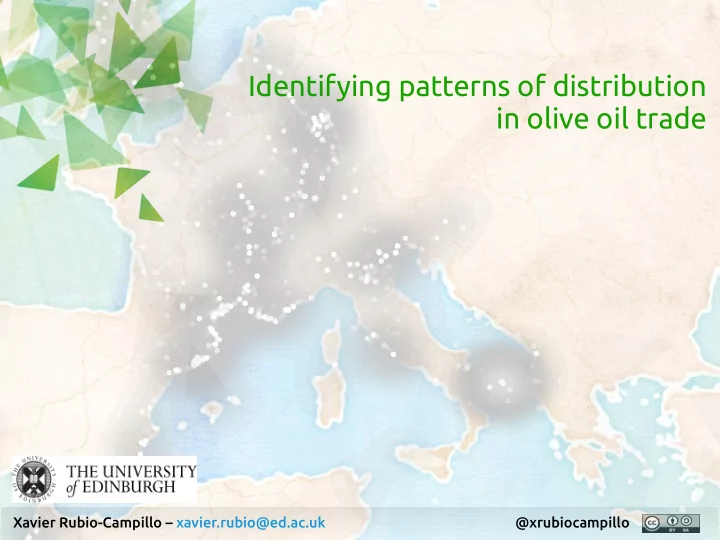
Identifying patterns of distribution in olive oil trade
Xavier Rubio-Campillo – xavier.rubio@ed.ac.uk @xrubiocampillo
SLIDE 2
A wishlist for Roman economy
SLIDE 3
A wishlist for Roman economy
SLIDE 4
A wishlist for Roman economy
SLIDE 5
A wishlist for Roman economy
SLIDE 6 Quantifying Roman economy
Broekaert, W. (2011). Oil for Rome during the second and third century AD: a confrontation of archaeological records and the Historia Augusta. Mnemosyne, 64(4), 591–623.
SLIDE 7 Quantifying Roman economy
Temin, P., 2013. The Roman Market Economy. Princeton University Press, p.75
SLIDE 8
Quantifying Roman economy Low sample size
SLIDE 9
Quantifying Roman economy Low sample size Archaeological biases
SLIDE 10
Quantifying Roman economy Low sample size Archaeological biases Multiple proxies
SLIDE 11
Quantifying Roman economy Low sample size High uncertainty Archaeological biases Multiple proxies
SLIDE 12
The challenges of the fjeld We need to use methods able to tackle these challenges We need informative proxies of economic activity
SLIDE 13 Amphoric stamps as proxies
Previous research suggests that the frequency distribution
- f amphoric stamps is a good proxy of economic activities
SLIDE 14 Amphoric stamps as proxies
Previous research suggests that the frequency distribution
- f amphoric stamps is a good proxy of economic activities
SLIDE 15 Amphoric stamps as proxies
Previous research suggests that the frequency distribution
- f amphoric stamps is a good proxy of economic activities
Rubio-Campillo, X. et al. In press. Bayesian analysis and free market trade within the Roman Empire, Antiquity.
“Our results show that the size of the economic agents involved in this massive market followed a power-law distribution. As a consequence, the model selection framework strongly indicates the presence of free market structures within the olive oil production feeding the city of Rome.”
SLIDE 16 Amphoric stamps as proxies
Previous research suggests that the frequency distribution
- f amphoric stamps is a good proxy of economic activities
Rubio-Campillo, X. et al. In press. Bayesian analysis and free market trade within the Roman Empire, Antiquity.
“Our results show that the size of the economic agents involved in this massive market followed a power-law distribution. As a consequence, the model selection framework strongly indicates the presence of free market structures within the olive oil production feeding the city of Rome.”
What about the rest of the Roman empire?
SLIDE 17
Research questions
Is there a relation between the distribution of amphoric stamps and the provincial structure?
SLIDE 18
Research questions
Is there a relation between the distribution of amphoric stamps and the provincial structure?
Q1: Do sites in the same province have similar stamps?
SLIDE 19
Research questions
Is there a relation between the distribution of amphoric stamps and the provincial structure?
Q1: Do sites in the same province have similar stamps? Q2: What provinces have similar stamps?
SLIDE 20
The distribution of amphoric stamps
SLIDE 21
Identifying province structure
Idea: Two sites of the same province will have more similar stamps than two sites located at difgerent provinces
SLIDE 22 Identifying province structure
Idea: Two sites of the same province will have more similar stamps than two sites located at difgerent provinces
There is no relation between the province
Null hypothesis
SLIDE 23 Identifying province structure
We need to...
...quantify the similarity of stamps
There is no relation between the province
Null hypothesis
SLIDE 24 Identifying province structure
We need to...
...quantify the similarity of stamps ...create a distance matrix of similarities between sites
There is no relation between the province
Null hypothesis
SLIDE 25 Identifying province structure
We need to...
...quantify the similarity of stamps ...create a distance matrix of similarities between sites ...compare similarities within/between provinces
There is no relation between the province
Null hypothesis
SLIDE 26
Quantifying similarity
We will use the Jaccard distance:
2 sites have exactly the same stamps → 2 sites have completely difgerent stamps 1 →
PNN QCM VIRG SRN Emporiae 1 1 1 Massalia 1 1 1 1 PNN QCM VIRG SRN Emporiae 1 1 1 Vindolanda 1 1
Jaccard distance: 0.25 Jaccard distance: 0.75
SLIDE 27 Multi-Response Permutation Procedure
MRPP allows us to assess if a specifjc grouping is linked to a dissimilarity matrix It evaluates statistical signifjcant difgerences between:
the mean distance within each group the mean distance for the entire dataset weighted by group sizes
Rodgers, P. (1987). Multi-Response permutation procedures. Computer and Quantitative Methods in Archaeology, 7957, 45–54. McCune, B., & Grace, J. (2002). MRPP (Multi-response Permutation Procedures) and related techniques. Analysis of Ecological Communities: MjM Software Design, Gleneden Beach, Oregon, USA, 188–197.
SLIDE 28
MRPP results
Mean distances average within provinces 0.995 between provinces 0.997 Efgect 0.002 Signifjcance: 0.001
SLIDE 29
MRPP results
Mean distances average within provinces 0.995 between provinces 0.997 Efgect 0.002 Signifjcance: 0.001
SLIDE 30
MRPP revisited
P-value < 0.01 for all tests
SLIDE 31 MRPP revisited
P-value < 0.01 for all tests
n=1
SLIDE 32 MRPP revisited
P-value < 0.01 for all tests
n=25
SLIDE 33 MRPP revisited
P-value < 0.01 for all tests
What provinces have similar stamps?
n=25
SLIDE 34 34
Similarity between provinces
SLIDE 35
Similarity between provinces
SLIDE 36
Similarity between provinces
SLIDE 37
Discussion
There is a relation between the province of a site and its stamps
SLIDE 38
Discussion
There is a relation between the province of a site and its stamps Stamp similarity is linked to common boundaries
SLIDE 39
Discussion
There is a relation between the province of a site and its stamps Stamp similarity is linked to common boundaries Exceptions can answer to political dynamics
SLIDE 40
Discussion
There is a relation between the province of a site and its stamps Stamp similarity is linked to common boundaries Exceptions can answer to political dynamics
Trade routes seem to emerge from province similarity
SLIDE 41
Concluding remarks
The framework can test new hypotheses
SLIDE 42
Concluding remarks
The framework can test new hypotheses
Riverine transport Atlantic vs Mediterranean
SLIDE 43
Concluding remarks
The framework can test new hypotheses
Independent military network Riverine transport Atlantic vs Mediterranean
SLIDE 44
Concluding remarks
The framework can test new hypotheses
Independent military network Riverine transport Atlantic vs Mediterranean Distribution of other goods
SLIDE 45
Concluding remarks
The framework can test new hypotheses A move from Descriptive statistics to Hypothesis Testing would improve our interpretations
Independent military network Riverine transport Atlantic vs Mediterranean Distribution of other goods
SLIDE 46 Concluding remarks
The framework can test new hypotheses A move from Descriptive statistics to Hypothesis Testing would improve our interpretations Any quantitative analysis should integrate the complexities
- f the archaeological record
Independent military network Riverine transport Atlantic vs Mediterranean Distribution of other goods
SLIDE 47 @xrubiocampillo
Thank you!
xavier.rubio@ed.ac.uk «Humans are pattern-seeking story-telling animals, and we are quite adept at telling stories about patterns, whether they exist or not» Michael Shermer
Source code and dataset available at: https://github.com/xrubio/ecologyStamps