Identification of the gene underlying pathotype 1(D1) identity: - - PowerPoint PPT Presentation

identification of the gene underlying
SMART_READER_LITE
LIVE PREVIEW

Identification of the gene underlying pathotype 1(D1) identity: - - PowerPoint PPT Presentation

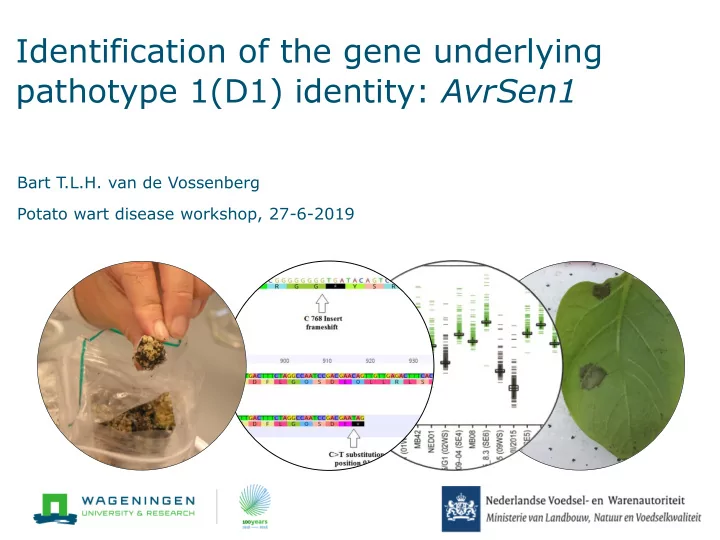
Identification of the gene underlying pathotype 1(D1) identity: AvrSen1 Bart T.L.H. van de Vossenberg Potato wart disease workshop, 27-6-2019 Synchytrium endobioticum pathotypes S. endobioticum isolates are further characterised as pathotypes

slide-1
SLIDE 1

Identification of the gene underlying pathotype 1(D1) identity: AvrSen1

Bart T.L.H. van de Vossenberg Potato wart disease workshop, 27-6-2019

slide-2
SLIDE 2

Synchytrium endobioticum pathotypes

▪ S. endobioticum isolates are further characterised as pathotypes

  • Glynne-Lemmerzahl or Spieckermann bioassay

▪ Based on their virulence on a reference set of potato cultivars ▪ Approximately 40 pathotypes described to date ▪ Pathotype identity lies at the basis of phytosanitary measures

2

slide-3
SLIDE 3

Resistance in potato

▪ Several major resistance genes and qualitative resistance loci for

  • S. endobioticum pathotypes have been identified in potato

▪ Major R genes

  • Sen1:

1(D1) resistance

  • Sen1-4: 1(D1) resistance
  • Sen2:

1(D1), 2(G1), 6(O1), 8(F1), 18(T1), 2(Ch1), 3(M1) and 39(P1) resistance

  • Sen3:

2(G1), 6(O1), and 18(T1) resistance

▪ Can we identify the S. endobioticum avirulence gene

corresponding to the potato Sen1 resistance gene?

3

slide-4
SLIDE 4

Invading the host

▪ Zoospores encyst on the potato host

cell

▪ spore content penetrates the host

cell leaving the empty cyst wall

  • utside

▪ Even in incompatible interactions,

zoospores penetrate host cells after which an immune response is triggered resulting in a localized cell death

4

Lange and Olson, Protoplasma 106, 97-108 (1981)

slide-5
SLIDE 5

A model for Plant-pathogen interactions

▪ Plants evolved a basal defense mechanism

against pathogens

  • Triggered by pattern recognition receptors (PRR)
  • Recognize pathogen/microbe associated molecular

patterns (PAMPs/MAMPs), e.g. chitin

  • The pathogen secretes effectors to prevent or

suppress the immune response

▪ Pathogens secrete effectors to manipulate

the host (e.g. hypertrophic growth)

  • Can be recognized by plant R genes (=Avr) and

trigger immune response

  • Loss of Avr potentially avoids recognition by the

host

  • Pathotype 1(D1) versus higher pathotypes

5

slide-6
SLIDE 6

The AvrSen1 candidate search profile

▪ Secreted (signal peptide, no TM domains or GPI anchors) ▪ Synchytrium endobioticum specific ▪ Present in pathotype 1(D1) isolates ▪ Absent in higher pathotypes

  • Functionally absent (SNPs changing protein)
  • Structurally absent (not present in the genome)

6

slide-7
SLIDE 7

7

Building from a solid basis

▪ Using the pathotype 1(D1)

isolate MB42 genome as reference

  • 786 scaffolds
  • 21.48 Mb
  • 8,031 genes
  • Hypothesized to contain

AvrSen1

▪ Read-mapping based

prediction of absence

  • Datasets from Van de

Vossenberg et al. 2018 (BMC Evol Biol, 18:136) used to assemble S. endobioticum mitogenomes

Van de Vossenberg & Warris et al. Nature Scientific Reports, 9: 8672 (2019)

slide-8
SLIDE 8

The AvrSen1 prediction pipeline

8

Van de Vossenberg et al. BioRxiv doi.org/10.1101/646984 (2019)

slide-9
SLIDE 9

The AvrSen1 candidate

9

▪ AvrSen1 gene candidacy was based on a combination of predicted structural

and functional absence in higher pathotypes

slide-10
SLIDE 10

Multiple predicted absence variants identified

10

Van de Vossenberg et al. BioRxiv doi.org/10.1101/646984 (2019)

slide-11
SLIDE 11

Agroinfiltration of the AvrSen1 candidate and variants

▪ Modular Golden

Gate Cloning system

▪ with and without

signal peptide

▪ Agroinfiltration in

plants with and without Sen1

11

slide-12
SLIDE 12

AvrSen1 triggers a HR in a Sen1 dependant manner

12

Van de Vossenberg et al. BioRxiv doi.org/10.1101/646984 (2019) Agroinfiltration scores: 0 = no cell death; 1 = 50% of area shows cell death ; 2 = 100% of area shows cell death

slide-13
SLIDE 13

Multiple AvrSen1 variants can co-exist in fungal isolates

13

Van de Vossenberg et al. BioRxiv doi.org/10.1101/646984 (2019)

slide-14
SLIDE 14

Dominant AvrSen1 variants

14

Van de Vossenberg et al. BioRxiv doi.org/10.1101/646984 (2019)

slide-15
SLIDE 15

Conclusions

15

▪ We identified the AvrSen1 gene in S. endobioticum pathotype

1(D1) isolates using a comparative genomics approach

▪ AvrSen1 is recognised by potato plants carrying the Sen1 R gene

and defines pathotype 1(D1) identity

▪ Paralogs in other pathotypes consist of truncated variants which

are not recognised by Sen1 plants

▪ S. endobioticum populations may contain both the avirulent

AvrSen1 as the truncated AvrSen1 variants

slide-16
SLIDE 16

Acknowledgements Thank you for your attention

WUR Plant Breeding Richard Visser, Jack Vossen, Gert van Arkel, Marjan Bergervoet, Charlotte Prodhomme WUR, Biointeractions and Plant Health Theo van der Lee, Marga van Gent-Pelzer, Balazs Brankovics WUR, Bioinformatics Sven Warris Other Jarek Przetakiewicz (IHAR, Poland) Margriet Boerma (HLB, NL) Gerard van Leeuwen, Patricia van Rijswick, Lucas van der Gouw, Annebeth Kloosterman (NVWA, NL) Hai Nguyen (AAFC, Canada)

slide-17
SLIDE 17

An alternative bioassay targeting aboveground plant parts

17

Van de Vossenberg et al. Phytopathology 109(6):1043-1052 (2019)

slide-18
SLIDE 18

Inoculated aboveground plant parts show same interactions as tuber-based assays

18

Potato cultivar Suspected interaction Inoculum

1(D1) 2(G1) 6(O1) 18(T1) mock

Deodara S: 1, 2, 6, 18 Inoculated buds 11 15 12 13 4 symptomatic 8 (72 %) 7 (47 %) 3 (25 %) 3 (23 %)c Producent S: 2, 6, 18; R:1 Inoculated buds 8 16 12 12 4 symptomatic 9 (56 %) 10 (83 %) 7 (58 %) Talent S: 2a, 6a, 18; R:1 Inoculated buds 8 10 12 12 4 symptomatic 1b 4b 4 (33 %)d Saphir S: 2; R:1, 6, 18 Inoculated buds 8 12 12 12 4 symptomatic 3 (25 %) Belita R:1, 2, 6, 18 Inoculated buds 8 12 12 12 4 symptomatic

▪ Opens up possibilities for to test candidate Avr genes using leaf-

based Agrobacterium tumefaciens mediated transient transformation assays