SLIDE 1
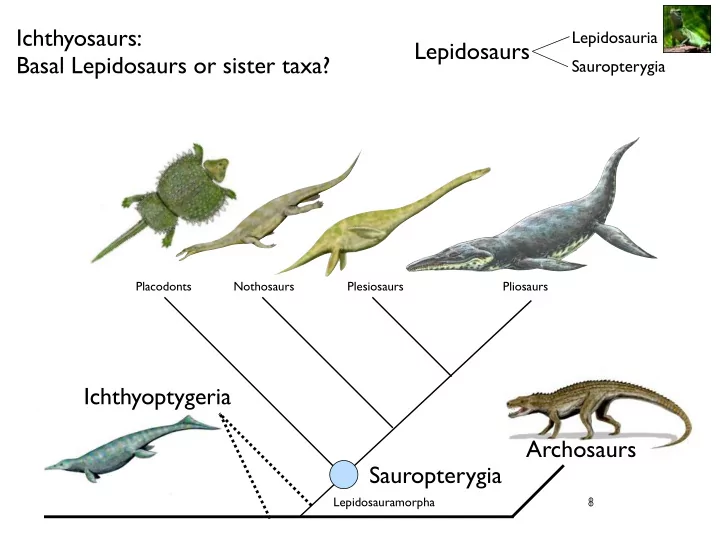
1 8 Placodonts Nothosaurs Plesiosaurs Pliosaurs
Ichthyosaurs:
Basal Lepidosaurs or sister taxa? Lepidosaurs
Lepidosauria Sauropterygia
Archosaurs Ichthyoptygeria Sauropterygia
Lepidosauramorpha
SLIDE 2
2
Boxy skull Tooth comb, crushing teeth Mollusk-strainer? Placodonts
SLIDE 3
3
Placodonts 2 Major groups: Placodontoids: unarmored Cyamodontoids: armored
SLIDE 4
4
Nothosaurs Triassic SEALS
Attributes: Mid Triassic of Eurasia Coastal environments ~ 12 ft long as adults Long neck, streamlined body Paddlelike forelimbs Reduced hindlimbs Webbed feet Small pointy teeth
Ceresiosaurus
SLIDE 5
5
Plesiosaurs
Attributes: Early Jurassic to Late Cretaceous Several Continents Front and hind limbs modified to flippers Stiff trunk, strong pectoral and pelvic girdles Short, boxy body with massive ventral ribs Long necks, short tails, small head, sharp teeth
SLIDE 6
6
Locomotion Likely slow swimmers Cruised below the water surface and used long neck to grab prey from below 4-flipper setup would give them an amazing amount of maneuverability Fins: propulsion
This would have been impossible
Plesiosaurs
SLIDE 7
7
Whales of the Mesozoic! Up to 40 feet in body length The skull was 1/3 of this length! Large and faster than Plesiosaurs Large, conical teeth
Pliosaurs
SLIDE 8
8
Attributes: Most ‘fish-like’ marine reptile Earlier forms had longer bodies Cretaceous forms are more dolphin-like Up to 50 ft in length!
Forelimbs modified into flippers Reduced hindlimbs, reduced pelvic girdle Ventrally-tipped tail and dorsal fin
Ichthyosaurs
Bi-lobed tail
SLIDE 9
9
Ichthyosaurs Early Triassic to Mid Cretaceous
SLIDE 10
10
Mosasaurs!
Closely related to Monitor Lizards & snakes 5 to 45 feet long Long and slender Blunt snouts (for ramming?) Large eyes, stout teeth APEX predator
SLIDE 11
11
Early to late Cretaceous Superseded Ichthyosaurs and Pliosaurs as the dominant Apex Predators
Mosasaurs!
SLIDE 12
12
Carinodens & Globidens: smallest, earliest mosasaurs (11 ft) Likely ate mollusks, small to medium arthropods ~ Shell crackers (blunt teeth)
SLIDE 13
13
It’s body plan suggests that it stalked prey, attacking in short, powerful bursts of speed ~ Great Whites
Mosasaurs!
SLIDE 14
14
Mosasaurs!
SLIDE 15
Derived Mosasaurs had double-hinged jaws ~ allowed them to swallow prey whole Mosasaurs have been found with large sharks in their ‘stomachs’ Covered in overlapping scales; keeled scales on the upper body and smooth scales on the lower body
Mosasaurs!
SLIDE 16
16
Mosasaurs!
SLIDE 17
17
SLIDE 18
18
Turtles & Crocodiles
SLIDE 19
19
Turtles Triassic - Present
Odontochelys Had teeth Aquatic Did not yet have a solid carapace, as do modern turtles
SLIDE 20
20
Proganochelys First fully shelled turtle, Late Triassic
SLIDE 21
21
Archelon (late Cretaceous)
A boney carapace rather than a solid shell Strong bite: mollusk and squid specialists
SLIDE 22
22
True Crocodiles: Late Cretaceous to present Crocodylomorpha (Archosaurs) mid-Triassic to present Marine Crocs: Teleosaurids Metriorynchids
SLIDE 23
Teleosaurid Crocs Early Jurassic to Early Cretaceous Long snouts (Piscivores) Very crocodile-like Worldwide distribution
Teleosaurus Mystriosuchus
SLIDE 24
24
Metriorynchid Crocs Mid Jurassic to Early Cretaceous Fully aquatic- evolved fish-like fins Lost their osteoderms Their body plan gives them maximum swimming efficiency
SLIDE 25 25
Dakosaurus
Flattened, serrated teeth Teeth analogous to Killer Whales Had salt glands in skull to deal with
SLIDE 26
From the oceans to freshwater habitats
SLIDE 27
SLIDE 28