
SLIDE 1
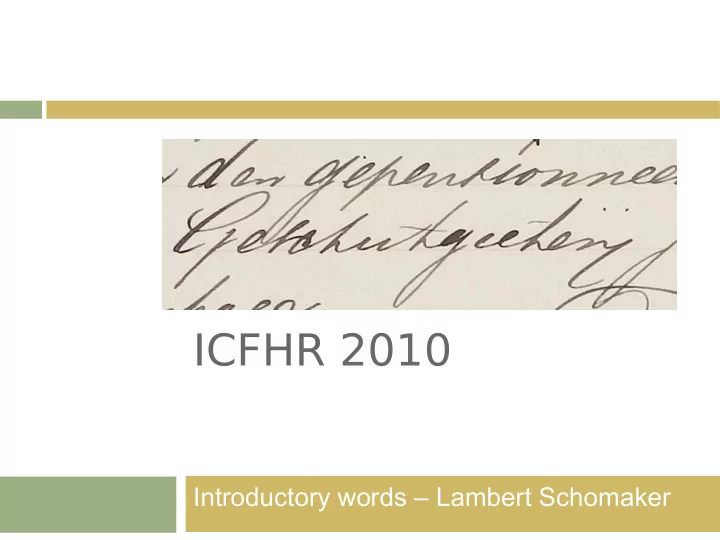
ICFHR 2010 Introductory words Lambert Schomaker International - - PowerPoint PPT Presentation
ICFHR 2010 Introductory words Lambert Schomaker International Workshop Conference on frontiers in Handwriting Recognition 2 Handwriting recognition is such a difficult problem that: We need to try out all newest methods asap;
Handwriting recognition is
We need to try out all newest methods asap; And invent our own new algorithms, some of which
Lambert Schomaker 2
Selected feats from ICFHR (1)
SVMs
from the AT&T group, Boser & Guyon with their seminal paper on margin maximization which was the direct result of the frustrations about the overly variable results on neural-network (MLP) training in on-line character recognition
Convolutional MLPs (LeCun) as a 2D generalization from TDNNs
IWFHR-1, CENPARMI Montreal, were based on character recognition
Lambert Schomaker 3
Selected feats from ICFHR (2)
Raw image skeletonization is too noisy, look further
than your nose and use algebra to prevent strange forkings! (Nishida, Suzuki & Mori, in Bonas, 1990)
MLPs and on-line character recognition, freezing the weights to the
hidden layer after preliminary training, then allowing the list of
(Guyon, in Bonas, 1990)
Lambert Schomaker 4
Selected feats from ICFHR (3)
US-post funding & adress reading saga at CEDAR,
end 80-ies, begin 90-ies in Buffalo (Srihari, Govindaraju)
Behavior Knowledge Space: Bayesian classifier
combination, avant la mode (Huang & Suen, in Buffalo 3rd IWFHR, 1992)
Lambert Schomaker 5
Selected feats from ICFHR, middle 90-ies
HMM revolution in on-line HWR: Manke,
HMM revolution in off-line postal-address
Lambert Schomaker 6
(M)NIST Unipen IAM IrOnOff …
Lambert Schomaker 7
ICDAR 1997, Ulm (D)
machine-print OCR is solved!
ICDAR 2009, Barcelona (E)
HWR is the buzzword
Solved? Not at all! Why so little HWR on iPad? Gestures? yes
free-style cursive? Not really
What happened to T
ablet PC?
How to deal with historical manuscripts? etc.
Lambert Schomaker 8
Example: KdK (Cabinet of
the Queen) 60 shelf meters
fan out: one running
meter of handwritten indexes provides access to about:
50 running meters of
chronologic arranged Royal decrees, laws and cabinet’s letters, mostly handwritten
the Queen's Cabinet
(era 1798-1988):
shelves
per box
Dutch archive Cabinet of the Queen,
+60k page scans of handwriting disk test bed: now1.5 PB towards 10 PB
Modern file systems (gpfs) Live 24/7 machine learning
13 Lambert Schomaker
One algorithmic idea One data set One PhD student Three to four years of tinkering Resulting in ‘95% recognition’ ‘our local hero has solved HWR’ The industry yawns
Lambert Schomaker 14
k-fold evaluation on a closed data set is not
Larger, time-variant data sets are needed! Data diversity is cool, not scary
Code projects like Ocropus, more cooperation
Lambert Schomaker 15
Scientific and engineering problems
character classification word recognition text retrieval writer identification layout analysis image processing 16 Lambert Schomaker
… Script types you never knew they existed ! … ML tricks you never thought of before ! … Image processing algorithms that are unseen ! … Applications presented here for the first time !
Let’s go identify the heros of today!
17 Lambert Schomaker