IBM Watson example https://www.youtube.com/watch?v=DywO4zksfXw - - PowerPoint PPT Presentation

ibm watson example
SMART_READER_LITE
LIVE PREVIEW

IBM Watson example https://www.youtube.com/watch?v=DywO4zksfXw - - PowerPoint PPT Presentation

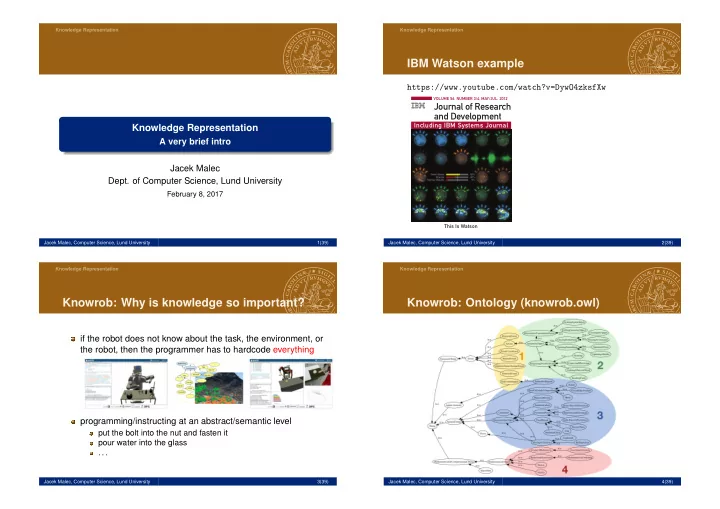
Knowledge Representation Knowledge Representation IBM Watson example https://www.youtube.com/watch?v=DywO4zksfXw VOLUME 56, NUMBER 3/4, MAY/JUL. 2012 Journal of Research and Development Including IBM Systems Journal Knowledge Representation


slide-1
SLIDE 1

Knowledge Representation

Knowledge Representation

A very brief intro Jacek Malec

  • Dept. of Computer Science, Lund University

February 8, 2017

Jacek Malec, Computer Science, Lund University 1(39) Knowledge Representation

IBM Watson example

https://www.youtube.com/watch?v=DywO4zksfXw

VOLUME 56, NUMBER 3/4, MAY/JUL. 2012

Journal of Research and Development

This Is Watson

Including IBM Systems Journal

Jacek Malec, Computer Science, Lund University 2(39) Knowledge Representation

Knowrob: Why is knowledge so important?

if the robot does not know about the task, the environment, or the robot, then the programmer has to hardcode everything programming/instructing at an abstract/semantic level

put the bolt into the nut and fasten it pour water into the glass . . .

Jacek Malec, Computer Science, Lund University 3(39) Knowledge Representation

Knowrob: Ontology (knowrob.owl)

Jacek Malec, Computer Science, Lund University 4(39)

slide-2
SLIDE 2

Knowledge Representation

Knowrob: A task ontology

Jacek Malec, Computer Science, Lund University 5(39) Knowledge Representation

Knowrob: A task ontology

Jacek Malec, Computer Science, Lund University 6(39) Knowledge Representation

Knowrob: Knowledge types

Jacek Malec, Computer Science, Lund University 7(39) Knowledge Representation

KnowRob Components

Jacek Malec, Computer Science, Lund University 8(39)

slide-3
SLIDE 3

Knowledge Representation

Knowrob: Procedural attachments

Compute symbolic knowledge on demand from data structures that already exist on the robot by attaching procedures to semantic classes and properties Re-use existing information and make sure abstract knowledge is grounded

Jacek Malec, Computer Science, Lund University 9(39) Knowledge Representation

Knowrob: Inferring storage location

Jacek Malec, Computer Science, Lund University 10(39) Knowledge Representation

Knowrob: Summary

declarative knowledge: ontologies procedural attachment logical inference multi-modal representation Video (13 mins): https://www.youtube.com/watch?v=4usoE981e7I

Jacek Malec, Computer Science, Lund University 11(39) Knowledge Representation

Plan for today

1

Knowledge-based systems

Tacit knowledge Inferred knowledge Domain-specific stuff Changing premises Uncertainty Semantic anchoring

2

Architectures

3

Self-awareness

Jacek Malec, Computer Science, Lund University 12(39)

slide-4
SLIDE 4

Knowledge Representation

Tacit knowledge

Facts about:

Jacek Malec, Computer Science, Lund University 13(39) Knowledge Representation

Tacit knowledge

Facts about:

  • bjects

Jacek Malec, Computer Science, Lund University 13(39) Knowledge Representation

Tacit knowledge

Facts about:

  • bjects

places

Jacek Malec, Computer Science, Lund University 13(39) Knowledge Representation

Tacit knowledge

Facts about:

  • bjects

places times

Jacek Malec, Computer Science, Lund University 13(39)

slide-5
SLIDE 5

Knowledge Representation

Tacit knowledge

Facts about:

  • bjects

places times events processes behaviours

Jacek Malec, Computer Science, Lund University 13(39) Knowledge Representation

Tacit knowledge

Facts about:

  • bjects

places times events processes behaviours vehicle dynamics rigid body interactions traffic laws . . .

Jacek Malec, Computer Science, Lund University 13(39) Knowledge Representation

Tacit knowledge

Background knowledge for all this includes:

Jacek Malec, Computer Science, Lund University 14(39) Knowledge Representation

Tacit knowledge

Background knowledge for all this includes:

  • ntologies

Jacek Malec, Computer Science, Lund University 14(39)

slide-6
SLIDE 6

Knowledge Representation

Tacit knowledge

Background knowledge for all this includes:

  • ntologies

theories

Jacek Malec, Computer Science, Lund University 14(39) Knowledge Representation

Tacit knowledge

Background knowledge for all this includes:

  • ntologies

theories physics mereology . . .

Jacek Malec, Computer Science, Lund University 14(39) Knowledge Representation

Tacit knowledge

Background knowledge for all this includes:

  • ntologies

theories physics mereology . . . Not everything needs to be explicit, nor expressed in one monolithic formalism

Jacek Malec, Computer Science, Lund University 14(39) Knowledge Representation

Inferred knowledge

(or: turning implicit into explicit)

1

logics (language)

2

theorem proving (mechanics)

3

modes of reasoning

Jacek Malec, Computer Science, Lund University 15(39)

slide-7
SLIDE 7

Knowledge Representation

Logics: modal

1

take a logical language, let α be a wff

2

⇤α is a wff

3

⌃α is a wff

4

normally ⇤α $ ¬⌃¬α Intended meaning?

Jacek Malec, Computer Science, Lund University 16(39) Knowledge Representation

Logics: modal

1

take a logical language, let α be a wff

2

⇤α is a wff

3

⌃α is a wff

4

normally ⇤α $ ¬⌃¬α Intended meaning?

1

⇤α means Necessarily α

Jacek Malec, Computer Science, Lund University 16(39) Knowledge Representation

Logics: modal

1

take a logical language, let α be a wff

2

⇤α is a wff

3

⌃α is a wff

4

normally ⇤α $ ¬⌃¬α Intended meaning?

1

⇤α means Necessarily α

2

⇤α means Agent knows α

Jacek Malec, Computer Science, Lund University 16(39) Knowledge Representation

Logics: modal

1

take a logical language, let α be a wff

2

⇤α is a wff

3

⌃α is a wff

4

normally ⇤α $ ¬⌃¬α Intended meaning?

1

⇤α means Necessarily α

2

⇤α means Agent knows α

3

⇤α means Agent believes α

Jacek Malec, Computer Science, Lund University 16(39)

slide-8
SLIDE 8

Knowledge Representation

Logics: modal

1

take a logical language, let α be a wff

2

⇤α is a wff

3

⌃α is a wff

4

normally ⇤α $ ¬⌃¬α Intended meaning?

1

⇤α means Necessarily α

2

⇤α means Agent knows α

3

⇤α means Agent believes α

4

⇤α means Always in the future α

Jacek Malec, Computer Science, Lund University 16(39) Knowledge Representation

Logics: modal

1

take a logical language, let α be a wff

2

⇤α is a wff

3

⌃α is a wff

4

normally ⇤α $ ¬⌃¬α Intended meaning?

1

⇤α means Necessarily α

2

⇤α means Agent knows α

3

⇤α means Agent believes α

4

⇤α means Always in the future α

5

Gα means Always in the future (or: Globally) α

Jacek Malec, Computer Science, Lund University 16(39) Knowledge Representation

Logics: Kripke semantics

Actually, meaning of modal formulae is defined on graph structures Nodes: possible worlds Edges: reachability relation

p,q,r ~p,q,r ~p,q,~r p,q,~r p,q,r ~p,~q,r p,~q,r p,q,~r

Jacek Malec, Computer Science, Lund University 17(39) Knowledge Representation

Logics: temporal

1

Globally (always): ⇤Φ

2

Finally (eventually): ⌃Φ

3

Next: Φ

4

Until: ΨUΦ

Jacek Malec, Computer Science, Lund University 18(39)

slide-9
SLIDE 9

Knowledge Representation

Logics: temporal

1

Globally (always): ⇤Φ

2

Finally (eventually): ⌃Φ

3

Next: Φ

4

Until: ΨUΦ

  • Cf. Richard Murray’s verification of autonomous car controller:

(Φe

init ^ ⇤Φe safe ^ ⇤⌃Φe prog) ! (Φs init ^ ⇤Φs safe ^ ⇤⌃Φs prog)

Jacek Malec, Computer Science, Lund University 18(39) Knowledge Representation

Logics: description

Earlier known as semantic networks. Formal version of semantic web languages (OIL, DAML, OWL). Effective reasoning: inheritance via SubsetOf (SubClass) and MemberOf (isA) links intersection paths special meaning of some links (e.g. cardinality constraints) classification, consistency, subsumption

Jacek Malec, Computer Science, Lund University 19(39) Knowledge Representation

Representation: ontologies

Lots of robot-related ontologies: knowrob, IEEE CORA (Standard 1872-2015), intelligent systems

  • ntology (2005, NIST), ...

Jacek Malec, Computer Science, Lund University 20(39) Knowledge Representation

Modes of reasoning: Deduction

RedLightAt(intersection1) 8(x)RedLightAt(x) ! StopBefore(x) thus StopBefore(intersection1) General Pattern:

1

prior facts

2

domain knowledge

3

  • bservations

Jacek Malec, Computer Science, Lund University 21(39)

slide-10
SLIDE 10

Knowledge Representation

Modes of reasoning: Deduction

RedLightAt(intersection1) 8(x)RedLightAt(x) ! StopBefore(x) thus StopBefore(intersection1) General Pattern:

1

prior facts

2

domain knowledge

3

  • bservations

4

conclusions Sound.

Jacek Malec, Computer Science, Lund University 21(39) Knowledge Representation

Modes of reasoning: Deduction

RedLightAt(intersection1) 8(x)RedLightAt(x) ! StopBefore(x) thus StopBefore(intersection1) General Pattern:

1

prior facts

2

domain knowledge

3

  • bservations

4

conclusions

  • Sound. But note:

Birds fly. Tweety is a penguin. Penguins are birds.

Jacek Malec, Computer Science, Lund University 21(39) Knowledge Representation

Modes of reasoning: Induction

OnDesk(monitor1) ^ Monitor(monitor1), OnDesk(monitor2) ^ Monitor(monitor2), OnDesk(monitor3) ^ Monitor(monitor3), OnDesk(monitor4) ^ Monitor(monitor4), OnDesk(monitor5) ^ Monitor(monitor5) thus 8(x)Monitor(x) ! OnDesk(x) General pattern:

1

Observe

2

Generalize

  • Fallible. Constructs hypotheses, not true facts. However, most of
  • ur practical reasoning, in particular learning, is of this kind.

Jacek Malec, Computer Science, Lund University 22(39) Knowledge Representation

Modes of reasoning: Abduction

General pattern:

1

prior facts

2

domain knowledge

3

  • bservations

Jacek Malec, Computer Science, Lund University 23(39)

slide-11
SLIDE 11

Knowledge Representation

Modes of reasoning: Abduction

General pattern:

1

prior facts

2

domain knowledge

3

  • bservations

4

explain the observation Given a theory T and observations O E is an explanation of O given T if E [ T | = O and E [ T is consistent. Usually we are interested in most plausible E, sometimes minimal E, most elegant E, ... Probablilistic abduction: maybe Elin will mention it.

Jacek Malec, Computer Science, Lund University 23(39) Knowledge Representation

What do we want to represent?

  • bjects

places times events processes behaviours vehicle dynamics rigid body interactions traffic laws . . .

Jacek Malec, Computer Science, Lund University 24(39) Knowledge Representation

Qualitative spatial reasoning

Jacek Malec, Computer Science, Lund University 25(39) Knowledge Representation

Qualitative spatial reasoning

Jacek Malec, Computer Science, Lund University 26(39)

slide-12
SLIDE 12

Knowledge Representation

Qualitative spatial reasoning

RCC8: region connection calculus Given e.g., contains(A, B) ^ covers(B, C) we can conclude contains(A, C) ⇤(meet(A, B) ! (meet(A, B) _ disjoint(A, B) _ overlap(A, B)))

Jacek Malec, Computer Science, Lund University 27(39) Knowledge Representation

Juggling example (Apt)

Jacek Malec, Computer Science, Lund University 28(39) Knowledge Representation

Interval calculus (Allen 1983)

Jacek Malec, Computer Science, Lund University 29(39) Knowledge Representation

Invalidating conclusions

Tweety is a bird. So it flies.

Jacek Malec, Computer Science, Lund University 30(39)

slide-13
SLIDE 13

Knowledge Representation

Invalidating conclusions

Tweety is a bird. So it flies. But Tweety is a penguin. So it doesn’t fly.

Jacek Malec, Computer Science, Lund University 30(39) Knowledge Representation

Invalidating conclusions

Tweety is a bird. So it flies. But Tweety is a penguin. So it doesn’t fly. Non-monotonic reasoning. Truth-maintenance systems. Default reasoning. Circumscription. Closed World Assumption. Negation as failure. . . .

Jacek Malec, Computer Science, Lund University 30(39) Knowledge Representation

Uncertainty

Every perception is associated with uncertainty. Account for that. (Yesterday lectures. Perception module.) Approaches: probabilistic representations fuzzy approaches multi-valued logics Transformations between representations as needed.

Jacek Malec, Computer Science, Lund University 31(39) Knowledge Representation

Back to KnowRob

Jacek Malec, Computer Science, Lund University 32(39)

slide-14
SLIDE 14

Knowledge Representation

KnowRob lessons

Beetz and Tenorth, AIJ, 2016:

1

No fixed levels of abstraction, no layers, no “black boxes”;

2

A knowledge base should reuse data structures of the robot’s control program;

3

Symbolic knowledge bases are useful, but not sufficient;

4

Robots need multiple inference methods;

5

Evaluating a robot knowledge base is difficult.

Jacek Malec, Computer Science, Lund University 33(39) Knowledge Representation

Architectures of knowledge-based systems

AIMA agents (cf. introductory lecture)

1

Logical agents - declarative, compositional

2

Rule-based systems - compositionality on the rule level

3

Layered systems (distribution of concerns)

4

Blackboards - compositionality of reasoners (knowledge sources) (KnowRob, our SIARAS system)

5

Stream-oriented reasoning - Heintz@LiU

Jacek Malec, Computer Science, Lund University 34(39) Knowledge Representation

KnowRob as a blackboard

Jacek Malec, Computer Science, Lund University 35(39) Knowledge Representation

Self-awareness: Autoepistemic logic

1

Distribution axiom K: (Kα ^ K(α ! β)) ! Kβ

2

Knowledge axiom T: Kα ! α

3

Positive introspection 4: Kα ! KKα

4

Negative introspection 5: ¬Kα ! K¬Kα

Jacek Malec, Computer Science, Lund University 36(39)

slide-15
SLIDE 15

Knowledge Representation

Self-awareness: motivation

1

true autonomy requires self-awareness

2

autoepistemic logic captures just one aspect: awareness of

  • wn knowledge

3

resource limitations: anytime algorithms, active logic

4

interaction: distributed knowledge

5

interaction: shared knowledge

6

explanation of own behaviour (trust)

Jacek Malec, Computer Science, Lund University 37(39) Knowledge Representation

References 1

https://www.youtube.com/watch?v=ymUFadN_MO4 (How Watson learns) DOI: 10.1147/JRD.2012.2186519, Automatic knowledge extraction from documents, J. Fan, A. Kalyanpur, D. C. Gondek, D. A. Ferrucci, IBM J. RES. DEV. VOL. 56 NO. 3/4 PAPER 5, 2012 YAGO2: A Spatially and Temporally Enhanced Knowledge Base from Wikipedia, Johannes Hoffart, Fabian M. Suchanek, Klaus Berberich, Gerhard Weikum, Artificial Intelligence Journal, vol. 194, pp. 28-61, 2013 Representations for robot knowledge in the KnowRob framework, Moritz Tenorth, Michael Beetz, Artificial Intelligence Journal, in press, available on the journal site Logics for Artificial Intelligence, Raymond Turner, Ellis Horwood, 1984

Jacek Malec, Computer Science, Lund University 38(39) Knowledge Representation

References 2

Logic In Action, Johan van Benthem, http://www.logicinaction.org, 2012 Rete: A Fast Algorithm for the Many Pattern/ Many Object Pattern Match Problem, Charles L. Forgy, Artificial Intelligence Journal, vol.19 (1982), pp. 17-37. https://arxiv.org/pdf/1201.4089.pdf, A Description Logic Primer, Markus Kroetzsch, Frantisek Simancik, Ian Horrocks Qualitative Spatial Representation and Reasoning, Anthony G Cohn and Jochen Renz, Handbook of Knowledge Representation,

  • pp. 551-596, Elsevier, 2008

Jacek Malec, Computer Science, Lund University 39(39)