I. Worldwide Increase in Disaster Over 18,000 mass disasters in the - - PDF document

i worldwide increase in disaster
SMART_READER_LITE
LIVE PREVIEW

I. Worldwide Increase in Disaster Over 18,000 mass disasters in the - - PDF document

24th Sept 2013 Outline Mental Health in Post-Disaster/Crisis : Systematic Approach 1. Worldwide Increase in Disasters 2. Disaster/Crisis Event in Thailand 3. Disaster/Crisis Mental Health Surveillance System in Thailand 4.


slide-1
SLIDE 1

24th Sept 2013

  • Mental Health in Post-Disaster/Crisis

: Systematic Approach

Pitakpol Boonyamalik, M.D., Ph.D., M.B.A.

Outline

1. Worldwide Increase in Disasters 2. Disaster/Crisis Event in Thailand 3. Disaster/Crisis Mental Health Surveillance System in Thailand 4. Disaster/Crisis Preparedness in Community

  • I. Worldwide Increase in Disaster

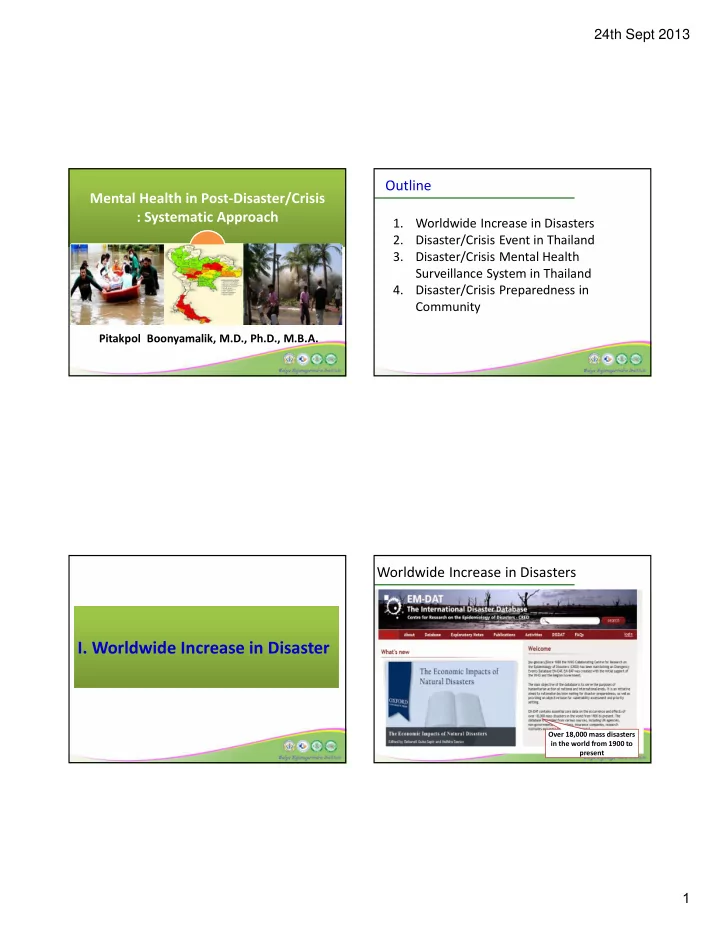
Worldwide Increase in Disasters

Over 18,000 mass disasters in the world from 1900 to present

slide-2
SLIDE 2

24th Sept 2013

  • II. Disaster/Crisis Event

in Thailand

Psychological Impacts of The 2011 Great Flood Victims

Severe flooding started at the end of July 2011, monsoon season in Thailand and persisted in some areas until mid- January 2012 Sixty-five of Thailand's 77 provinces were declared flood disaster zones 815 deaths (with 3 missing) Department of Mental Health together with Office of Public Health for mental health cared and enhanced community resilience

Stress, 6% Depression, 7.75%

Proportion of Victims, with Mental Health Problems

Source: Department of Mental Health

Background

Flash floods and mudslides hit Uttaradit province, northern Thailand, after a heavy monsoon rains in May, 2006 Northern Thailand's worst floods in 60 years killed at least 30 people and left nearly 100 missing Department of Mental Health together with Uttaradit Office of Public Health launched a one-year continuing psychological support for a group of victims

A cohort of the victims in the 2006 floods/mudslides in Uttaradit province, northern Thailand

slide-3
SLIDE 3

24th Sept 2013

  • Background (Cont.)

One village each in 3 affected districts, Lub Lae, Tah Pla, and Mueang districts, were selected. One village in a non-affected district, Thong San Khun was selected as the control. All of the villagers (892 persons) in selected villages were screened for mental disorders at 3 months after the incident. The victims with mental health problems were followed up 3 times every 3 months.

Incidence of Mental Health Problems among the Cohort of Mudslide Victims (Post 3 months)

10 20 30 40 50 60 70 80 Tha Pla Lub Lae Mueang Control

52.52 70.69 68.87 23.66

%

Incidence of Mental Disorders among the Cohort of Mudslide Victims (Post 3 months)

1 1 .8 9 4 .4 6 7 .8 9 .2 9 1 .6 9 3 .2 5 .4 6 1 5 .3 4 4 .6 5 .9 81 .2 2 2 .4 5 1 1 .2 7 2 .9 8 1 .9 1 7 .4 6

  • %

T a h P la L u b L a e M u e a n g C

  • n

tr

  • l

P T S D M D D S u ic id e A lc

  • h
  • l u

se d iso r d e r O th e r s

Incidence of PTSD among the Cohort of Mudslide Victims (Post 3 months vs. Post 12 months)

6 .6 1 1 .0 1 1 1 .8 9 1 .8 6 1 .6 9 .9 3 .9 8 0 .4 9

  • %

A ll d istr ic ts T a h P la L u b L a e M u e a n g C

  • n

tr

  • l

P

  • st 3

m

  • n

th s P

  • st 1

2 m

  • n

th s

slide-4
SLIDE 4

24th Sept 2013

  • 2004 South Indian Ocean Earthquake caused
  • ne of deadliest Tsunami on December 27,

2005.

  • Affected 6 southern provinces in Thailand:

Phuket, Phung Nga, Krabi, Ranong, and Satun.

  • Causing 5,392 deaths, 3100 missing, and

8,457 injured.

Background Psychological relief efforts for the victims

  • f 2004 Indian Ocean Tsunami

Incidence of Mental Health Problems among 2004 Tsunami Victims in Phung Nga, Krabi, and Phuket

5 10 15 20 25 30 35

Post 2 months Post 9 months

9.5 4.7 30.2 18.9 25.7 15.1 33.6 25.1

PTSD Stress Depress Anxiety Source: From Department of Mental Health conducted by Using SF-36, HSCL-25, HTQ

Psychological care for the victims of the violent events in the 4 southernmost provinces

Background

Southernmost area (Pattani, Yala, Narathiwat, and some parts of Songkla) have faced continuous violence problems since 2001. Mental health services system is not well established due to a scarcity of mental health professionals in the affected area. Shortage of psychiatrists in the southern border province (Pattani, Yala, Narathiwat).

slide-5
SLIDE 5

24th Sept 2013

  • Number of Violent Victims (%),

Classified by Province (1,048 cases)

Narathiwat, 469, 44.75% Yala, 247, 23.57% Pattani, 328, 31.3% Songkla, 4, 0.38% Source : Violent-Related Mental Health Surveillance (VMS) Report

No Risk , 966 cases Risk , 82 cases

Source : Violent-Related Mental Health Surveillance (VMS) Report

Number of Violent Victims with Mental Health Problems

PTSD, 3 cases

Depress, 2 Cases

The suicide rate of Thai people after the Asian financial crisis/ Tom Yam Kung Crisis in 1997 Background

The crisis began in July 1997, and raised fears of a worldwide economic meltdown due to financial contagion. Thailand's booming economy came to a halt amid massive layoffs in finance, real estate, and construction that resulted in huge numbers of workers returning to their villages in the countryside and 600,000 foreign workers being sent back to their home countries.

  • 2

4 6 8 1

  • The economic Recovery

1st round of economic crisis

The suicide rate in Thailand (Cases per 100,000 population) (1997-2012)

2nd round of economic crisis

slide-6
SLIDE 6

24th Sept 2013

  • III. Disaster/Crisis Mental

Health Surveillance System in Thailand

Pitakpol Boonyamalik, MD, PhD 22

Phases of Disaster

Warning Impact Heroic Disillusionment Reconstruction

Sources: Johns Hopkins Center for Health Preparedness and Response

Phases of Psychosocial Support for Disaster

Phase 1: Pre-disaster (Preparation) Phase 2: Crisis and Emergency (< 2 weeks)

  • Phase 2.1: Crisis (< 72 hours)
  • Phase 2.2: Emergency (72 hours – 2 weeks)

Phase 3: Post-disaster (2 weeks – 3 months) Phase 4: Rehabilitation (> 3 months)

Source: Department of Mental Health of Thailand

Phase 1: Pre-disaster (Preparation)

Policy formulation and planning process Set up responsible organizations Personnel training Other resource preparation guideline manuals to drills/tabletop exercises

National level Mental health professionals in psychiatric hospitals Health professionals in community and provincial hospitals

slide-7
SLIDE 7

24th Sept 2013

  • Phase 2 : Crisis and Emergency (< 2 weeks)

Phase 2.1: Crisis (< 72 hours)

  • Focusing on physical and social supports
  • Assessment of situation and preparation

Phase 2.2: Emergency (72 hours – 2 weeks)

  • Psychological first aid
  • Risk assessment and high-risk group surveillance

Phase 3: Post-disaster(2 weeks–3 months)

Screening for mental health problems

  • PISCES-18 for adults
  • Symptoms checklist for children (precaution with the

appropriate timing)

Diagnosis and treatments for mental disorders

  • M.I.N.I
  • Crisis intervention for the persons with severe

psychological reactions

Surveillance for mental disorders

  • Depression , suicide, PTSD and alcohol use disorders

Continued physical and social supports

Phase 4: Rehabilitation (> 3 months)

Screening for mental health problems

  • PISCES-18, Depression/ suicide screening, and

PTSD screening for adults

  • SDQ for children

Diagnosis and treatments for mental disorders

  • M.I.N.I

Continued surveillance for mental disorders

  • Depression , suicide, PTSD and alcohol use

disorders Psychosocial rehabilitation

  • Occupation
  • IV. Disaster/Crisis

Preparedness in Community

slide-8
SLIDE 8

24th Sept 2013

  • Capacity Building for Mental Health

System in Community

Mental Health Crisis Assessment and Treatment Team (MCATT)

Established in every district and personal training Training 40 Master Trainers In partnership with IMH to develop curriculum for community based workers

  • GRI. Together with IMH and Others

Partnerships with the Support of Temasek

Training 200 community based workers in 4 regions of Thailand (Northern, Northeastern, Central and Southern) Building Community Resilience

VIDEO Thank you