
SLIDE 1
i
i TABLE OF CONTENTS 01 United Nations Secretary-General 02 - - PDF document
i TABLE OF CONTENTS 01 United Nations Secretary-General 02 Under-Secretary-General for Peacekeeping Operations 03 Director UNMAS 05 UNMAS 2013 Snap Shot 07 Contributors 08 UNMAS Saves Lives 15 UNMAS Responds Rapidly and Efgectively
i
TABLE OF CONTENTS
01 United Nations Secretary-General 02 Under-Secretary-General for Peacekeeping Operations 03 Director UNMAS 05 UNMAS 2013 Snap Shot 07 Contributors 08 UNMAS Saves Lives 15 UNMAS Responds Rapidly and Efgectively 19 UNMAS Promotes New Technology 20 UNMAS Promotes International Standards 21 UNMAS Coordinates 24 UNMAS Advocates 25 UNMAS Communicates 29 UNMAS Partners with Regional Arrangements 31 UNMAS Financing and Funding 42 UNMAS Field Programmes 59 Acknowledgements
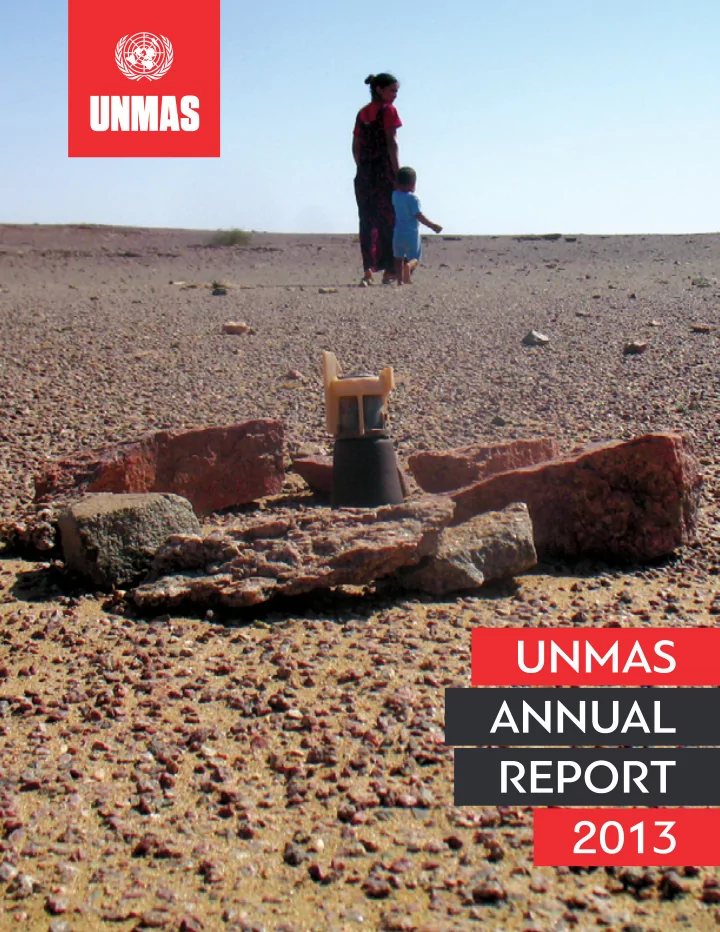
Cover Photo: A woman with her child in the Territory of Western Sahara walking away from an unexploded Mark 118 high-explosive-anti-tank cluster bomb. This cluster submunition would have been dropped from a cluster bomb unit holding more 240 anti-tank bombs. An unexploded Mark 118, embedded in the sand, is extremely dangerous and could be detonated if touched. UNMAS Photo “ Peace and stability are essential prerequisites for socioeconomic development. United Nations interventions and programmes in mine action continue to enable the protection of civilians, peacekeeping and political missions, humanitarian assistance, early recovery and
enables the safe deployment
access for humanitarian aid, the safe return of refugees and internally displaced persons and their access to basic services. As a direct result of mine action, socioeconomic and development programmes can be implemented.”
United Nations Secretary-General Ban Ki-moon, Report to the General Assembly
August 2013 (A/68/305)
Secretary-General Ban Ki-moon. UN Photo/ Eskinder Debebe01
02
FOREWORD
The United Nations has a proud record of helping millions of peo- ple in mine-afgected countries. In 2013, mines, explosive remnants
by killing or injuring thousands worldwide. The presence of a single landmine freezes development activities, stunts the deployment of peacekeepers and prevents or delays the delivery of essential hu- manitarian relief. The results of UNMAS interventions are immediate and long last-
contribute directly to stabilization and security, including through the employment of thousands of Afghans. In Mogadishu, freedom
Much has indeed been achieved and yet remaining challenges call for more intense and focused efgorts. The fmexible, innovative and forward thinking programming of UN- MAS is an important part of the United Nations “Force for the Future”. In practical terms, UNMAS is nimble and agile, able - at any time and without delay - to deploy specialized personnel and technical equip- ment to remove explosive hazards and clear the way for peacekeep- ers and humanitarian workers to access those most in need. UNMAS is versatile, able to train and establish national explosive
ammunition storage areas where they are needed to ensure security. In line with the Report of the United Nations Secretary-General on Assistance in Mine Action (A/68/305) and the related General Assem- bly resolution (A/RES/68/72), this Annual Report provides evidence of the central role of UNMAS in the protection of civilians, peacekeeping, peace-building, humanitarian relief and development, enabling mis- sions to deploy rapidly and assisting refugees and internally displaced persons to safely return to their homes. I would like thank all of the donors who supported the work of UNMAS in 2013. UNMAS continues to honour its commitment to continuous improvement of its processes to provide afgected coun- tries and donors with “value for money”. Your political and fjnancial support saved lives. It is vital that the United Nations vision of a world free from the threat of landmines and explosive remnants
development agendas. Hervé Ladsous Under-Secretary-General for Peacekeeping Operations
Under-Secretary-General Hervè Ladsous. UN Photo/ Eskinder Debebe 03
FROM THE DIRECTOR
During 2013, the expertise of UNMAS stafg and specialized equipment continued to be in incredibly high demand. UNMAS was requested to remove explosive threats caused by armed confmict and respond to emergencies in a dozen
also sought by many, in international and regional diplomatic and technical settings, from the conference rooms of Geneva and New York, to Mali and the Central African Republic. Thanks to partners’ support, UNMAS continued to create conditions conducive to sustainable peace, development and respect for human rights. Rapid response and expert interventions saved lives, released land for productive use, built national capacity and provided critical support to peacekeepers and the humanitarian community. In 2013 UNMAS made the world safer; UNMAS spearheaded humanitarian mine action in Mali, assisted United Nations deployment in the Central African Republic, completed the landmine survey of the 11 provinces in the Democratic Republic of the Congo, attained agreements to demine in the West Bank and built secure weapons storage facilities in Libya. In Abyei, Afghanistan, Somalia, South Sudan and the territory of Western Sahara, UNMAS coordinated, led and implemented large-scale clearance operations and risk awareness campaigns to facilitate freedom of movement and public safety. The crises in Libya, Mali, the Central African Republic and Somalia highlighted the dangerous consequences of unsecured and poorly managed stockpiles of weapons and ammunition, as well as Improvised Explosive Devices. As the United Nations lead entity on explosive hazards, UNMAS worked directly with national security forces and troop contributing countries, as well as the African Union, to strengthen their capacities to respond to these evolving threats. UNMAS, in New York, Geneva and through its 16 programmes, provided state-of-the-art mine action capabilities, enhanced coordination, and promoted the universalization
international humanitarian and human rights law. To demonstrate its commitment to inclusiveness and action-oriented partnership, UNMAS successfully engaged a wide range of partners to elaborate the UN Monitoring and Evaluation Framework. In line with the International Aid Transparency Initiative, UNMAS is actively promoting public access to information on its fjeld activities in partnership with UNOPS. To illustrate its active support to “One UN” in mine action and to meaningful coordination, UNMAS coordinated the drafuing of the 2013 Secretary-General’s Report on Assistance in Mine Action and supported the debate on the mine action resolution in the General Assembly. The UNMAS 2013 Annual Report demonstrates efgorts to increase cost-efgectiveness, accountability, transparency and build innovative partnerships, to serve United Nations Member States and afgected communities. UNMAS thrives toww secure maximum impact as a reliable service provider. With your support, UNMAS had a remarkable year. I am confjdent that joint initiatives will continue to demonstrate to all mine action stakeholders that supporting the work of UNMAS is a sound investment. I am pleased to present to you UNMAS accomplishments. Agnès Marcaillou Director, UNMAS
UNMAS Director Agnés Marcaillou. UN Photo/JC McIlwaine04
An UNMAS team of explosive experts transferred out of the centre of Bamako, dismantled and destroyed 85 SA3 missiles in Mali. This is the controlled blast of a few 05 06
in these 16 programmes
+
16 around the world
PROGRAMMES
staff
115
INTERNATIONAL
UNMAS STAFF
33
13,000
NATIONAL
staff
UNMAS
INCOME
Assessed Budget for Peacekeeping
$151.0 $0.978
UN Voluntary Trust Fund for Mine Action
$ 50.6
Peacekeeping Support Account
Top Ten Donors
24.0
$
3.8 3.7 2.4 2.7 2.3 1.4 1.3
MILLION
1.3 5.3
J A P A N U N I T E D K I N G D O M C A N A D A N E T H E R L A N D S D E N M A R K E U R O P E A N U N I O N F I N L A N D I T A L Y N E W Z E A L A N D U N I T E D S T A T E S
Aggregates
People from mine and ERW affected communities, UN personnel
(Côte d’Ivoire, Democratic Republic of the Congo, Libya, State of Palestine, Somalia, South Sudan)
landmines and explosive remnants
DESTROYED
1,480,000 1,810 832
RELEASED
apx.165 sq. km.
18,000 small arms. 1,900 tons of ammunition.
RAPID RESPONSE INTERVENTIONS
Central African Republic, Haiti & Mali
RISK EDUCATION CAPACITY OF STORAGE AREAS CONSTRUCTED
NATIONAL POLICE OFFICERS TRAINED NATIONAL MILITARY PERSONNEL TRAINED
in
in UNHQ & Geneva
unmas.org
07 Andorra Australia Austria Belgium Canada Colombia Denmark Estonia European Union Finland France Italy Japan Liechtenstein Netherlands New Zealand Oman Republic of Korea Spain Switzerland United Kingdom United States
CONTRIBUTORS
UNMAS is grateful to the Governments of Andorra, Australia, Austria, Belgium, Canada, Colombia, Denmark, Estonia, Finland, France, Italy, Japan, the Republic of Korea, Lichtenstein, Netherlands, New Zealand, Oman, Spain, Switzerland, the United Kingdom and the United States of America, for their generous contributions. UNMAS is also grateful for the support from the European Union and the Common Humanitarian Fund.
08
UNMAS SAVES LIVES
In 2013 UNMAS made the world safer. Whether it was through spearheading humanitarian mine action in Afghanistan and Mali, assisting United Nations deployment in the Central African Repub- lic, completing the landmine survey of the Democratic Republic of the Congo, attaining agree- ments to demine in the West Bank or building secure weapons storage facilities in Libya, the lead United Nations entity on explosives hazards saved lives. UNMAS carried out United Nations Secu- rity Council mandates, emergency humanitarian deployments and fulfjlled many requests from UN entities and governments to provide mine action assistance.
Survey and Clearance
The survey and clearance of landmines and explosive remnants of war continued in Abyei (Sudan/ South Sudan), Afghanistan, Darfur (Sudan), Libya, Mali, Somalia, South Sudan and the territory of Western Sahara. More than 1.4 million landmines and explosive remnants of war were destroyed. Approximately 165 square kilometres of land were released. In carrying out this work, UNMAS con- tinued to promote and comply with International Mine Action Standards.
Risk Education
UNMAS conducted risk education activities in Darfur (Sudan), the Democratic Republic of the Con- go, Somalia, South Sudan and coordinated risk education activities in Afghanistan, Libya, State of Palestine, Sudan and the Syrian Arab Republic. More than 2.1 million people from afgected regions were reached through these activities and thousands of United Nations and African Union peace- keepers were sensitized about risks in the areas where they were deployed.
Victim Assistance
UNMAS supported and implemented victim assistance activities in Afghanistan and South Sudan. In the State of Palestine, UNMAS supported community liaison activities that enabled the Pales- tinian Mine Action Centre to carry out a comprehensive census of mine and explosive remnants of war victims in the West Bank. UNMAS initiated discussions with the Palestinian Mine Action Centre and potential partners to facilitate the introduction of support mechanisms for victims. UNMAS called on governments to address and integrate the needs of landmine and explosive remnants of war victims into the wider context of the Convention of Rights of Persons with Disa-
Weapons and Ammunition Management
UNMAS continued to contribute to regional and national stability through improving weapons and ammunition management. UNMAS reduced stocks of degraded and obsolete munitions to prevent possible human, socioeconomic and environmental catastrophes caused by unplanned explosions
In Côte d’Ivoire, UNMAS continued to expand the capacity of the Ivorian security services to safe- ly manage and secure weapons and ammunition through the construction or renovation of 13 weapons and ammunition storage facilities including 5 major ammunition depots. In support of
09 UN peacekeeping disarmament, demobilization and reintegration operations, UNMAS destroyed more than 3,750 weapons and 250,000 rounds of small arms ammunition. In Libya, at the request of the Government, UNMAS conceived and implemented a number of weapons and ammunition management projects. These included the construction of temporary ammunition storage areas, a 400-ton capacity ammunition depot in Misrata, fjrst phase construc- tion of a depot in Zintan, the safe relocation of ammunition in line with international standards and the training of Libyan personnel to oversee these new facilities. In 2013, in response to a number of requests, UNMAS carried out weapons and ammunition man- agement projects in Abyei (Sudan/South Sudan), Central African Republic, Darfur (Sudan), Haiti, Liberia, Libya, Mali, Sierra Leone and South Sudan. UNMAS contributed to the development and roll-out of the International Ammunition Technical Guidelines and the International Small Arms Control Standards, guidance that is central to all UNMAS efgorts related to weapons and ammuni- tion security. UNMAS continued to provide expert advice to the inter-agency Coordinating Action in Small Arms network (CASA) Strategic Framework 2013-2018. In total, in Côte d’Ivoire, the Democratic Republic of the Congo, Libya, the State of Palestine and Somalia UNMAS oversaw the construction of more than 20 storage areas in 2013 with a total ca- pacity of almost 4,000 tons.
Protecting Peacekeepers
In accordance with United Nations Security Council mandates, UNMAS provided explosive ord- nance disposal and counter improvised explosive device training to peacekeepers to help prevent incidents and enable them to operate under quickly evolving and volatile security situations. In Somalia, UNMAS completed the basic and intermediate explosive ordnance disposal training
where AMISOM operates: Mogadishu, Kismayo, Baidoa and Belet Weyne.
UNMAS Protects Civilians
Civilians are all too ofuen victims of armed confmict. In response, since 1999 the United Nations Security Council has mandated some peacekeeping operations with explicit mandates to pro- tect civilians (POC) from physical violence. UNMAS operates under POC mandates in Abyei (Sudan/South Sudan), Côte d’Ivoire, Darfur (Sudan), Democratic Republic of the Congo, Mali, Somalia and South Sudan. Landmines, explosive remnants of war and improvised explosive devices are risk factors that afgect livelihoods, the freedom of movement, the safe return of refugees and internally displaced persons as well as economic recovery. Remnants of war also hinder humanitarian assistance. Following armed confmicts, UNMAS regularly undertakes rapid battle area clearance wherever it is deployed. Most recently, at the end of 2013 in South Su- dan UNMAS provided emergency clearance around and inside the United Nations sites where heavy fjghting had occurred to ensure the safety of civilians seeking shelter at these sites. In the Democratic Republic of the Congo, UNMAS quickly cleared a number of battlefjelds in the east
the resumption of humanitarian fmights.
10
11 In Mali, UNMAS provided extensive safety training to United Nations police, military and civilian peacekeepers about explosive risks in the country, types of munitions that have been found and types of improvised explosive devices or IEDs that were or could be used. As the UN peacekeeping
sic mission requirement. UNMAS prepared a Mali-specifjc explosive ordnance disposal and coun- ter-IED training package for all new and rotating MINUSMA peacekeepers. In addition to its mandated activities UNMAS provided risk education to thousands of UN de- ployed personnel in Mali.
Developing National Capacity
In line with the Strategy of the United Nations on Mine Action 2013-2018, UNMAS concentrated
in explosive ordnance disposal. Thirteen offjcers received training in stockpile management, 11 of- fjcers received training in medical trauma, 33 offjcers received counter improvised explosive device training and 11 offjcers received training in improvised explosive device disposal. The Somali police teams that UNMAS trained in 2012 and 2013 in explosive ordnance disposal be- came the “fjrst responders” for all explosive alerts in Mogadishu and Baidoa. These teams identifjed and secured over 1,300 items, including more than 100 improvised explosive devices. In Mali, 1,884 members of the Malian Defence and Security Forces were given explosive hazard awareness training. With technical support from the Swedish Civil Contingencies Agency, UNMAS provided 63 offjcers with intermediate level explosive ordnance disposal training. Working with the Humanitarian Demining Training Centre (CPADD) in Benin, UNMAS facilitated the ordnance disposal training of 20 Malian stafg offjcers to expert level. In January 2014, one year afuer the deployment of UNMAS to Mali, there was a fully qualifjed Malian explosive ordnance and bomb disposal capacity in the Malian army.
UNMAS Promotes Women in Mine Action
In all of its work UNMAS ensures that mine action data is disaggregated by gender and age. It adheres to gender requirements in United Nations contracting procedures and fund alloca-
Process scored higher on their gender marker than any year before. In line with the objectives
streaming and the implementation of the United Nations Gender Guidelines for Mine Action Programmes, UNMAS contracted the Gender in Mine Action Programme (GMAP). In 2013, GMAP completed baseline assessments and advised UNMAS programmes to design gender mainstreaming strategies for South Sudan and Afghanistan. In 2014, GMAP will work with two
dition, in its capacity as mine action coordinator for the Mine Action Global Protection Cluster, UNMAS promoted the integration of gender considerations into mine action programming and planning in the context of humanitarian interventions. A special meeting of the Mine Action Global Protection Cluster was held in 2013 to highlight this approach. Organized by UNMAS, GMAP and the Inter-Agency Standing Committee the UNMAS South Sudan programme was selected as a case study.
All mine action training was compliant with the International Mine Action Standards and the am- munition stockpile and management training was in accordance with the International Ammuni- tion Technical Guidelines. UNMAS continued to provide technical advisory and institutional managerial support to the mine action coordination centre in Afghanistan (MACCA) and to the Afghan Government’s Department
In the State of Palestine, UNMAS continued to coordinate and advise all stakeholders, Palestin- ian and Israeli, implementing partners, donors and UN development and humanitarian entities working in the region to enable and shape a solution acceptable to all parties and in line with International Mine Action Standards. As a result of these efgorts UNMAS received permission from the Israeli Ministry of Foreign Afgairs/Arms Control Department to clear 11 mined areas in central West Bank.
The UNMAS-Mali team demonstrate the new remote-controlled demining equipment to the Force Commander of the UN peacekeeping12
STORY FROM THE FIELD
Gender Mainstreaming Makes a Difgerence
In Afghanistan, young boys are ofuen sent to collect fjrewood or scrap metal which their families depend on for survival. In a country where in 2013 over 360 people were killed or injured by mines and explosive remnants of war, this can be an exceptionally dangerous task. This means that mine risk education campaigns in Afghanistan must be tailored to help young boys understand and avoid the risks. This is just one example of why understanding the difgerent roles of men, women, boys and girls within their local communities is crucial when developing humanitarian mine action programmes. “Putting this strategy into action will mean mine action interventions are tailored to the specifjc needs, attitudes and practices of Afghan women, men, boys and girls. It will also help partners to carry out their work as efgectively as possible,” explained Kurt Chesko, UNMAS Programme Offjcer for Afghanistan. Sasha Logie, UNMAS Programme Offjcer in South Sudan explained how the strategy is beginning to have an impact on national policy and programming: “The National Technical Standards and Guidelines now include the requirement for gender-balanced community liaison teams. This means we can better understand the needs, fears, expectations and knowledge of women, girls, boys and men in the communities where we work. It also helps us to gather the gender disaggregated data that can be fed back into programme design and prioritisation.” As the United Nations promotes more women into demining programmes, the impact resonates in societies. Women are proving their capability and courage in South Sudan, as much as in the Democratic Republic of Congo and the territory of Western Sahara. Micheline Yaisimbi, who has worked as a deminer in her home country of the Democratic Republic
“In African societies, there is a cultural tendency to separate jobs for men and women. Diffjcult and risky jobs are usually reserved for men, while women are expected to manage the household. Mine action shows that cultures and traditions change as society changes. Women continue to contrib- ute to the well-being and survival of their communities in new ways. Women are involved in land- mine clearance, risk education, contamination surveys and assistance to victims. Women are able to reach and engage communities that men cannot, making the projects better.” In the territory of Western Sahara, landmines are cleared by both men and women. Seeing that the women are capable of the physical and technical demands of the job has had a powerful impact on many, particularly the older generation who had initial reservations about women working as deminers. Responses to a survey demonstrated that the new roles of women have strengthened their status with the community, generated a new type of respect for the safety they create and the income they earn and they hope this will lead to a better standard of life for all women and their daughters. 13
14
15
UNMAS RESPONDS RAPIDLY AND EFFECTIVELY
Through the Rapid Response and Technical Support Capacity, UNMAS is uniquely prepared and equipped to rapidly deploy experts and specialized equipment to mitigate threats posed by landmines, explosive remnants of war and insecure ammunition and weapons stockpiles. UNMAS serves the United Nations as a global fjrst responder to assess, survey, secure, clear and destroy explosive hazards, arms and unsecured ammunition. Stopping the circulation of explosive material, which can be smuggled to other countries and used to make weapons or used to destabilize peace processes, continues to be a serious concern. The UNMAS Rapid Response and Tech- nical Support Capacity includes a counter-improvised explosive device (IED) capability as well. In 2013 peacekeepers were deployed to Somalia and Mali. The UNMAS Rapid Response and Technical Support Capacity provid- ed both emergency response capability, addressing urgent prob- lems like battle area clearance following armed fjghting and tech- nical support for United Nations entities and national authorities to tackle weapons and ammunition management issues. In Mali, UNMAS also enabled the coordination of mine action assistance and supported the establishment of the African-led International Support Mission to Mali (AFISMA). In the Central African Republic, UNMAS was requested by both the Government and the UN Integrated Peacebuilding Offjce in the Central African Republic (BINUCA) to provide technical sup- port for an emergency survey of explosive remnants of war and unsecured ammunition storage areas. UNMAS also provided plan- ning support and assessment for the transition of the peacekeep- ing mission from the African Union to the United Nations, which took place in early 2014. UNMAS responded quickly to an urgent request from the UN Stabilization Mission in Haiti (MINUSTAH) to safely destroy ex- pired ammunition that belonged to peacekeeping troops and the Haitian National Police. In record time and in a cost-efgective manner UNMAS successfully destroyed over 11 tons of ammu- nition and provided technical support to the Haitian police to improve their weapons and ammunition management capacity.
An UNMAS explosive ordnance disposal training for Malian Defence and Security Forces (MDFS) in Bamako. UNMAS Photo/Marc Vaillant16
STORY FROM THE FIELD
UNMAS Rapid Response and Technical Support Capacity: Protecting Civilans in the Central African Republic and Elsewhere
Explosive hazards lefu behind from confmict pose an immediate, life-threatening danger to civilians and UN personnel which means that the UNMAS rapid response team ofuen needs to be one of the fjrst in with experts and equipment on the ground. Gabrielle Chaizy is one of these mobile experts. Based in Entebbe, Uganda, Gabrielle is ofuen posted to support the set-up of new missions. A multilingual expert skilled in programme design and management, she ofuen also fulfjls the invaluable role of enabling efgective communication and seamless partnership be- tween technical mine action operators and national authorities. In the Central African Republic, UNMAS helped the UN Integrated Peacebuilding Offjce, (BINUCA), to protect civilians from arms and explosive threats by improving the safety of weapons and ammuni- tion in the country. Gabrielle described what she saw on her recent assignment and the progress of the project so far: “In the Central African Republic, the ammunition depots had been looted and much of the remaining ammunition was being stored in very unsafe ways in military camps in the heart of Bangui. If there were an explosion, many civilians would die and the damage to in- frastructure would be extreme. UNMAS started to clear the stores and destroy unsafe weapons. Quickly securing, destroying or safely storing this material reduced the threat of an accidental explosion and the diversion of explosives to various actors in the country. The faster this work can be done, the more efgective it is.”
An ammunition depot in an army barracks in the centre of Bangui that UNMAS helped to clean out – safely disposing of obsolete muni- tions and building new, secure and safe storage areas for the security services. UNMAS Photo18 17
UNMAS PROMOTES NEW TECHNOLOGY
UNMAS uses New Tools
UNMAS introduced a number of new tools to make mine action work safer and more effjcient. Remotely operated vehicles known as ROVs were used in Somalia to help security services and African Union peacekeepers safely identify and destroy improvised explosive devices. This pilot programme was expanded to Mali and will be launched in 2014. In the territory of Western Sahara UNMAS introduced a Vehicle Mounted Mine Detection System into landmine/explosive remnants of war clearance operations. This initiative resulted in a 400 per cent increase in clear- ance productivity.
UNMAS builds Mobile Applications
UNMAS Landmine and Explosive Remnants of War Safety Application was launched in 2013 to accompany the UNMAS Safety Handbook. It is available in IOS and Android formats in Arabic, Chinese, English, French, Japanese, Portuguese, Russian and Spanish. The application is an interac- tive training course that allows users to learn the basics about explosive devices they may fjnd while working in confmict afgected zones. It also enables anyone to send information about explosives to specialists based at UNMAS headquarters. Development of a similar training application for impro- vised explosive devices (IEDs) was initiated in 2013 and will be launched in 2014.
Mine action specialists in the UN peacekeeping operation in Lebanon (UNIFIL) demonstrate a remotely operated vehicle that can be used to safely check for explosives. UNMAS Photo19
UNMAS UPHOLDS AND PROMOTES INTERNATIONAL STANDARDS
UNMAS Promotes International Ammunition Technical Guidelines (IATG)
UNMAS continued to support, promote and implement the In- ternational Ammunition Techni- cal Guidelines (IATG) through the UN Department of Peacekeeping Operations.
UNMAS Chairs the International Mine Action Standards (IMAS) Review Board
UNMAS continued to serve as the Chair of the International Mine Action Standards (IMAS) review board as well as its Steering Committee. UNMAS supported several initiatives designed to increase the imple- mentation of IMAS. In order to increase access UNMAS part- nered with the Inter-American Defense Board to translate the standards from English to Span-
cate for the expansion of IMAS to take into account improvised explosive devices.
Non-standard storage of ammunition in Bouaké, Côte d’Ivoire. UNMAS assisted security services in Côte d’Ivoire to dispose of obsolete munitions including landmines and to catalogue, secure and safely store munitions and light weapons. UNMAS Photo20
21
UNMAS COORDINATES
UNMAS is the focal point for mine action in the United Nations system. UNMAS aims to strengthen inter-agency cooperation at headquarters and in fjeld operations and chairs the UN Inter-Agency Coordinatioon Group for mine action to ensure that the United Nations delivers coherently and effjciently.
Report of the Secretary-General on Assistance in Mine Action
At headquarters level UNMAS coordinated the drafuing of the Report of the Secretary-General on Assistance in Mine Action. The report was prepared by UNMAS, as the United Nations system-wide leader, convener and coordinator of mine action, in consultation with members of Inter-Agency Coordination Group for Mine Action, which represents the 14 United Nations entities that work on issues related to mine action. The Report demonstrates the people-centred approach of mine ac- tion initiatives, the link to protection of civilians and development initiatives, as well as the United Nations committment to “Deliver As One”.
General Assembly resolution A/RES/68/72 on Assistance in Mine Action
In December 2013 General Assembly resolution A/RES/68/72 on Assistance in Mine Action was adopted by consensus. UNMAS worked closely with Poland, which led the drafuing of the resolution
resolutions, takes note of the Strategy of the United Nations on Mine Action 2013-2018 and the efgorts of the UN to implement it, and introduces new language related to gender considerations, increased support for rapid response and victim assistance and encourages sustainable funding of mine action through multi-year arrangements.
United Nations Mine Action Monitoring and Evaluation Mechanism
The Strategy of the United Nations on Mine Action 2013-2018 committed to “establishing a mon- itoring and evaluation mechanism to assess progress made by the UN in the implementation of its vision, strategic objectives and internal initiatives”. In 2013 UNMAS led, implemented and coordi- nated the development of a United Nations mine action monitoring and evaluation mechanism. UNMAS consulted closely with UN partners and non-governmental organizations and sought to build on existing lessons learned and to ensure that approaches were complementary. In order to avoid duplication, UNMAS continued to prioritize strategic partnerships with entities such as the Landmine and Cluster Munition Monitor, the World Bank and many others. Three joint meetings were held with non-governmental and governmental organizations in 2013, including a three day practitioner’s workshop in Copenhagen hosted by UNMAS and the Danish Demining Group. Afuer a piloting period planned for early 2014, full roll-out of the mechanism is expected to begin later in the year.
Global Protection Cluster Mine Action Area of Responsibility
UNMAS continued to coordinate the Global Protection Cluster mine action Area of Responsibility via its offjce in Geneva and improved integration with UNMAS fjeld work. UNMAS also provided strategic advice to the Global Protection Cluster Coordinator (UNHCR), thus contributing to en- hancing the visibility of mine action as a protection and humanitarian issue at the global level. As a
22
23 result of integration of UNMAS fjeld components into the respective fjeld protection clusters, mine action was efgectively addressed within the Strategic Response Plans coordinated by UN Human- itarian Country Teams. Emergency response in Mali and the Central African Republic demanded rapid reaction and a coordinated response. Through the Global and Field Protection clusters, UN- MAS ensured that mine action was addressed coherently by the fjeld protection clusters and the United Nations Country Teams in Afghanistan, Central African Republic, Colombia, Côte d’Ivoire, Democratic Republic of the Congo, Mail, State of Palestine, Somalia, South Sudan and the Syrian Arab Republic.
Mine Action Coordination Centres/Offjces
UNMAS coordinated mine action in Afghanistan, Colombia, Democratic Republic of the Congo, Libya, Mali, South Sudan, Sudan and the territory of Western Sahara through the mine action coor- dination centres/offjces in support of national mine action authorities and peacekeeping missions. Strong coordination ensured the mine action response was properly prioritised, implementation supported national plans, the quality of work was undertaken to international and national mine action standards, data was centrally managed and donor funds delivered value for money.
Mine Action Support Group
In terms of donor coordination UNMAS continued to provide technical support and advice to the Chair of the Mine Action Support Group (MASG). UNMAS secured senior level DPKO participation in the MASG meeting held in October 2013 and assisted in maintaining the MASG website which is hosted on E-mine, the UN Mine Action Gateway.
Countering Improvised Explosive Devices (IEDs)
Asymmetric warfare and the increased use of IEDs constitute a serious emerging threat to civilians as well as UN presences and deployments. As the counter IED focal point for the Department of Peacekeeping Operations, UNMAS continued to advise, assist, train and equip UN personnel, na- tional security and defence forces of host countries and troop and police-contributing countries to the threat posed by IEDs. In 2013 UNMAS provided timely, relevant and lifesaving training and awareness packages to over 157,000 UN military, police and civilian personnel in countries where IEDs are a threat. UNMAS provided technical guidance and assistance to the United Nations Department of Safety and Security (UNDSS) for the development of IED implementation guidelines in support of the UN Safety and Security IED policy. The guidelines will provide sound processes and procedures designed to enhance the safety of United Nations stafg members. These guidelines are expected to be completed in 2014. UNMAS also coordinated a number of initiatives with UNDSS including participation in, and spon- sorship of technical forums and UNDSS accredited training courses including Hostage Incident Management, Emergency Trauma Bag and Security Certifjcate Practitioner.
UNMAS ADVOCATES
UNMAS advocated for those afgected by explosive hazards by providing technical and expert con- tributions in over thirty high level statements on behalf of the Inter-Agency Coordination Group for Mine Action. UNMAS delivered key United Nations positions at governmental meetings and conferences including the Anti-Personnel Mine Ban Convention (APMBC), the Convention on Cer- tain Conventional Weapons (CCW) and its amended Protocol II on mines, booby traps and other devices (APII) and Protocol V on Explosive Remnants of War; the Convention on Cluster Munitions (CCM) and the Convention on the Rights of Persons with Disabilities (CRPD). UNMAS contributed to reports and recommendations of the UN Secretary-General on specifjc countries and on the- matic topics, including the protection of civilians, the use of explosive weapons in populated areas, children and armed confmict and women, peace and security. UNMAS continued to advocate for the rights of persons with disabilities through building common United Nations approaches within the Inter-Agency Support Group for the CRPD and at fjeld level through lobbying and capacity building national bodies responsible for persons with disabilities in Afghanistan, Democratic Republic of the Congo, Libya, State of Palestine, South Sudan and Sudan (including Darfur). UNMAS initiated a consultative process aimed at updating the United Nations Victim Assistance Policy, a commitment made in the the Strategy of the United Nations on Mine Action 2013-2018. As part of this process, bilateral consultations were held with key partners including the Implemen- tation Support Unit of the Anti-Personnel Mine Ban Convention, the International Committee of the Red Cross, the Offjce of the High Commissioner for Human Rights and other experts. Work on the new policy will be completed in 2014.
Deminers in the Territory of Western Sahara “lend their legs” in support of the global campaign to eradicate landmines and explosive remnants of war. UNMAS Photo24
25
UNMAS COMMUNICATES
UNMAS communication and outreach efgorts consistently raised awareness throughout 2013 bringing attention to the fjve “pillars” of mine action - clearance, risk education, victim assistance, advocacy and stockpile destruction - emphasizing new explosive hazardous threats, including unsecured and unsafe ammunition stockpiles, the circulation of illicit small arms and light weapons and improvised explosive devices. Activities were conducted at headquarters and fjeld level.
Through Press and Mass Media
Through promotional work by UNMAS programmes in the fjeld and at UN Headquarters, media outlets continued to cover mine action issues and UNMAS regularly gave back- ground and on-the-record interviews. Numerous stories were fjled by national radio, TV and press as well as inter- national media outlets such as Al-Jazeera, BBC, Huffjngton Post, The Independent (UK), LA Times, Le Temps, La Repub- lica, People’s Daily, NHK, Asahi, Mainichi and TIME, to name a few. UN mine action work in Afghanistan, Cambodia, Laos, Leba- non, Mali and South Sudan received extensive press coverage locally and internationally as did many other programmes and issues. The continued oversight that the General Assem- bly provided to the global campaign to eradicate the threat
noted as was the Report of the Secretary-General on Mine
ic “Mine Action News” to hundreds of subscribers. This elec- tronic news bulletin highlights news stories about mine action from around the world.
Through E-Mine: The Digital United Na- tions Mine Action Gateway
UNMAS launched a new E-Mine website (mineaction.org) in 2013, making it easier to navigate and accessible through phones and tablets. UNMAS worked with the United Na- tions Dag Hammarskjöld Library and the United Nations Offjce in Geneva Library and Archives to provide a United Nations Research Guide on Landmines and Explosive Rem- nants of war which is accessible through the E-Mine site. E-Mine continues to host the Mine Action Support Group website.
The opening of a photo exhibition supported by the German Government, at the United Nations Headquarters in New York. UN Photo/JC McIlwaine26
Through Social Media
The constituency of UNMAS social media continued to grow, reaching, by the end of the year, more than 9,500 likes on the UNMAS Facebook page and almost 15,000 Twitter followers. UNMAS worked closely with the United Nations Department of Public Information to expand its Facebook and Twitter outreach in French and Spanish.
Through Films
UNMAS produced a new introductory fjlm describing the work of the United Nations and UNMAS and bringing into focus the new mandates under which UNMAS works including building ammu- nition storage and countering improvised explosive devices. This fjlm was produced in English and
widely distributed and used as part of the International Day for Mine Awareness and Assistance in Mine Action events on 4 April. UNMAS released through UNTV, UNIFEED and UN Multimedia two public service announcements in eight languages. UNMAS renewed the permanent exhibitions at the United Nations Visitor’s Centre with new installations and photos.
Through International Day for Mine Awareness and Assistance in Mine Action
UNMAS planed events to mark this Day in all of its programmes in partnership with national mine action authorities, United Nation entities and non-governmental organizations. In Addis Ababa, Brussels, New York and Geneva UNMAS organized special events, which included photo exhibi-
A demining demonstration in the lobby of the General Assembly at the United Nations Headquarters. UN Photo/JC McIlwaine27
28 tions, panel discussions and press conferences, to raise awareness about mine action work. An ac- companying digital media cam- paign yielded impressive results. With support from the United Na- tions Secretariat and other part- ners, more than 17 million unique followers were confjrmed to have been reached in just 24 hours.
With Communication Partnerships
UNMAS continued its partnership with Emmy award winning pho- tographer Marco Grob. Mr. Grob visited the UNMAS programme in South Sudan and produced a fjlm about mine action in South Sudan and created an exhibition
tos were auctioned ofg as part of a fundraising campaign to assist a non-governmental organization that provides victim assistance to landmine survivors. UNMAS partnered with the fjlm “Diana” and participated in the fjlm’s New York premiere. The fjlm features Princess Diana’s walk through a minefjeld in Angola with
rent UNMAS Deputy Director and Chief of Programmes. UNMAS in partnership with the production company Post Millennium produced two public service announcements to raise awareness about the perils of unexploded ordnance and landmines, the work of the United Nations and the need for fjnancial support to quickly and effjciently address these threats. The public service announcements were posted on You Tube, UN Multimedia and promoted through UNTV and UNIFEED in Arabic, Chinese, English, French, German, Japanese, Russian and Spanish. UNMAS continued to collaborate with the advertising agency The Brooklyn Brothers, working on short fjlms and other projects throughout the year.
A visitor to the mine action exhibition treading lightly on the “mine carpet”. UN Photo/JC McIlwaine 29
UNMAS PARTNERS WITH REGIONAL ARRANGEMENTS
African Union
With a full-time UN Mine Action Offjcer assigned to the United Nations Offjce to the African Union (UNOAU), UNMAS was able to assist the Peace and Security Division of the African Union (AU) in fjnalizing its mine action strategy. UNMAS also provided technical and planning support to the Af- rican Union Commission and the African Union operation in the Central African Republic. A joint AU/UN Mine Action training for African Union member states afgected by landmines and ex- plosive remnants of war was organized in December 2013. As part of its commitment to enhance the African Union’s regional training capacity, UNMAS conducted a joint AU/UN assessment visit to the West African Humanitarian Demining Training Centre (CPADD) in Benin.
NATO
UNMAS continued to develop a mutually reinforcing collaboration with NATO in the areas of weapons and ammunition management, defence sector reform, counter improvised explosive de- vices as well as physical security and stockpile management. Its engagement with NATO includes collaborative endeavours in United Nations missions and UNMAS programmes in Afghanistan, Central African Republic, Democratic Republic of the Congo, Libya, Mali and Somalia. UNMAS also increased its interaction and coordination with NATO through participation in NATO’s training ex- ercise Northern Challenge in Iceland in September 2013, stafg talks in November 2013, and ongo- ing collaboration with NATO-accredited training establishments in order to identify and develop mutually benefjcial specialist training courses.
Organization of American States and the Inter-American Defense Board
In 2013 UNMAS partnered with the Inter-American Defense Board in order to have the Interna- tional Mine Action Standards (IMAS) translated from English into Spanish. This initiative is ongoing and focused on producing the most technically sound translation possible.
Regional Expertise
In 2013, UNMAS began working with the Benin-based Humanitarian Demining Training Centre (CPADD) for West Africa. Seeking regional expertise for the advanced explosive disposal train- ing of Malian military offjcers, UNMAS assessed the centre’s capacity and potential to support its mission in Mali and assisted the Malian army to deploy offjcers for training. A Level 2 Explo- sive Ordnance Disposal course was conducted in September and October 2013. Additional courses are planned for 2014. This cooperation resulted in UNMAS overseeing the training of more than 60 Malian security and defence offjcers. Using regional centres saves money and reinforces regional connections in the area of explosive threat management.
30
31
UNMAS FINANCING AND FUNDING
UNMAS Enhances Transparency Through Partnerships and New Systems
UNMAS is committed to the highest standards of transparency and effjciency. In 2013, UNMAS in- corporated into its ProFi management and audit sofuware system a recommendation tracking tool to improve follow-up and decision making. Umoja, the new United Nations Enterprise Resource Planning (ERP) tool, was used for the fjrst time in mine action components of peacekeeping missions. Umoja enhances accountability, transparen- cy and internal controls for fjnancial resources. It improves decision making and planning capabili- ties by providing up-to-date and accurate reports and data. UNMAS played a key role in providing valuable inputs into the design of the Umoja grants management module that is expected to be implemented by 2015. In pursuance of General Assembly resolution 60/283 (2006), UNMAS began the transition to the International Public Sector Accounting Standards (IPSAS). In addition UNMAS affjliation with the International Aid Transparency Initiative (IATI) through its main implementing partner the United Nations Offjce for Project Services continues to constitute a major contribution to resource alloca- tion transparency.
UNMAS maintains strong Donor Relationships and Support
A key element of the UNMAS resource mobilization strategy 2011-2013 was to secure adequate fjnancial resources in order to provide a global mine action response to the threat posed by landmines and explosive remnants of war. In 2013, UNMAS continued to nurture strong part- nerships with existing donors while investing sustained efgorts to expand its donor base to new
US $50.6 million (including a direct contribution of $6 million by Japan through the special trust fund for Mali). Though UNMAS efficiently coordinated and led mine action operations, the 14 per cent de- crease in voluntary contributions from the 2012 level, curtailed or restricted some of the work that UNMAS was requested to undertake. UNMAS continued to appeal to donors and United Nations Member States for multi-year, fmex- ible and needs-based funding, in line with the Principles of Good Humanitarian Donorship. Given the sometimes urgent and crisis driven context in which UNMAS operates, predictable funding is essential to meet the needs of afgected countries and to ensure that activities started can be completed. Moreover, UNMAS strengthening of coordination activities together with its training, advocacy, policy and public information support to the mine action community requires that donors match their expectations with the provision of adequate resources to
into multi-year partnerships with UNMAS, allowing more predictable and efgective operational management.
UNMAS received fmexible contributions from Andorra, Lichtenstein and New Zealand in 2013. Do- nor’s contributions to the work of the United Nation in Mine Action complement their bilateral funding to international actors. Un-earmarked funding remains essential and gives UNMAS the fmexibility to efgectively coordinate and respond to increased country demands. UNMAS is grateful to the Governments of Andorra, Australia, Austria, Belgium, Canada, Colombia, Denmark, Estonia, Finland, France, Italy, Japan, the Republic of Korea, Lichtenstein, Netherlands, New Zealand, Oman, Spain, Switzerland, the United Kingdom and the United States of America, for their generous contributions. UNMAS is also grateful for the support from the European Union and the Common Humanitarian Fund. UNMAS also benefjted from in-kind contributions from Australia, Benin, France, Germany, Ireland, Sweden, Switzerland and the United States of America. 32
Flags of member nations flying at United Nations 33 34
Donor Advocacy Afghanistan Colombia Core Funding Democratic Republic of the Congo Flexible Lebanon Libya Mali Monitoring and Evaluation State of Palestine Somalia South Sudan Rapid Response and Tech Support Capacity Sudan Syria Western Sahara Grand Total Andorra 19,646 19,646 Australia 316,800 316,800 Austria 179,457 58,455 145,024 382,937 Belgium 332,700 332,700 Canada 3,826,717 3,826,717 Colombia 10,000 10,000 Common Humanitarian Fund 709,121 709,121 Denmark 525,142 50,000 2,150,000 2,725,142 Estonia 20,000 20,000 EU 1,006,577 795,300 569,042 2,370,919 Finland 1,060,080 1,199,340 2,259,420 France 130,220 130,220 Italy 176,369 269,060 342,300 69,904 68,127 68,127 417,043 1,410,929 Japan 3,500,000 104,240 3,600,000 1,827,360 6,000,000 4,000,000 5,000,000 24,031,600 Korea, Republic of 50,000 50,000 100,000 Liechtenstein 26,488 26,488 Netherlands 1,000,000 100,000 1,749,970 200,000 100,000 100,000 500,000 3,749,970 New Zealand 803,277 531,216 1,334,493 Oman 100,000 100,000 Spain 135,881 135,881 Switzerland 21,690 21,690 United Kingdom 1,985,899 352,851 2,978,710 5,317,461 United States 60,000 1,221,500 1,281,500 Grand Total 176,369 9,985,315 1,116,577 3,500,570 3,800,000 849,411 108,455 4,847,415 6,432,851 150,000 963,916 7,048,614 5,863,427 2,650,000 2,567,790 417,043 135,881 50,613,634Contributions to UNMAS in 2013
The United Nations Voluntary Trust Fund for Assistance in Mine Action
The United Nations Voluntary Trust Fund for Assistance in Mine Action (UN VTF) is an inter-agency mechanism established by the United Nations General Assembly in 1994 (A/RES/49/2015). The purpose of the UN VTF is to support a coherent multilateral humanitarian response to risks posed by mines and explosive remnants of war, including cluster munitions as well as by other conventional explosive hazards, such as unsafe munition stockpiles and improvised explosive de-
emergencies and other activities in situations where funding is not immediately available. As such, the UN VTF complements other funding mechanisms.
Management and Governance of the UN VTF
Under the authority and with overall oversight of the United Nations Secretariat Controller, the Director
tions in the Department of Peacekeeping Operations has been entrusted with the management of the UN VTF on behalf of the United Nations Secretary-General. The United Nations Offjce of Programme Planning, Budget and Accounts is also mandated to provide UNMAS with relevant advisory support. The UN VTF is governed by the United Nations Financial Regulations and Rules, as promulgated by Secretary-General’s Bulletin ST/SGB/2013/4 dated 1 July 2013, as well as by ST/SGB/188 on the “Establishment and Management of Trust Funds” and ST/AI/284 on “General Trust Funds”. Programme support costs amount to three percent. Should recipients of UN VTF funds, including implementing partners, decide to charge associated programme support costs the total costs shall not exceed the thirteen percent ceiling established by the United Nations General Assembly.
Transparency and Accountability
Donor contributions are formalized through agreements signed by the United Nations Secretar- iat Controller and recorded in the United Nations Integrated Management Information System. Income and expenditure are subject to United Nations fjnancial reports, certifjed by the United Nations Secretariat Accounts Division and sent to donors. Starting in 2014, the Division will publish annually, instead of biennially, audited fjnancial statements of UN VTF income and expenditures. This information is also refmected in UNMAS Annual Reports together with programmatic achieve-
United Nations Offjce for Project Services. Donors can contribute earmarked and/or un-earmarked funding to the UN VTF. Such contribu- tions shall comply with the UN VTF Terms of Reference and correspond to mandated activities. Un-earmarked contributions are essential to ensure efgective responses to emergencies as well as to the overall support of UNMAS in its mandated coordinating role. As in the case of earmarked contri- butions, the allocation of such contributions is subject to a rigorous consultation process with donors. The UN VTF is subject to United Nations internal and external audit and oversight mechanisms through the United Nations Offjce of Internal Oversight Services and the United Nations Board
Contributors
The UN VTF is open to voluntary contributions of Governments, organizations and individuals.
Trust in the Fund
Since its establishment in 1994 more than US$830 million has been channelled through the UN VTF to support assistance in mine action. More than sixty United Nations Member States and observers together with other public and private donors have contributed to the UN VTF to support assistance in mine action in dozens of countries and territories. Year afuer year, in resolutions adopted by consen- sus, the United Nations General Assembly has encouraged the use of the UN VTF .
Disposing of unexploded ordnance in Somalia. UN Photo/Tobin Jones36 35
37
Financial Performance Overview
Income received
Funds appropriated by the UN General Assembly for the mine action component of the peacekeeping budget $150,998,058 Voluntary contributions and funds received under inter-organizational arrangements $50,613,634 Funds appropriated by the UN General Assembly for the mine action component of the UN Peacekeeping Support Account $977,913 Total $202,589,605
Provisional expenditures
Funds appropriated by the UN General Assembly for the mine action component of the peacekeeping budget1 $104,842,043 Voluntary contributions and funds received under inter-organizational arrangements2 $59,441,768 Funds appropriated by the UN General Assembly for the mine action component of the Peacekeeping Support Account $938,055 Total $165,221,866
Analysis
Voluntary Trust Fund contributions decreased by 14 per cent in 2013. The US $ 150.9 million in appropriations by the United Nations General Assembly for mine action from the peacekeeping and regular budgets represents an increase of 29 per cent over 2012 which is a result of new peacekeeping missions. The US $ 977,913 from the Peacekeeping Support Account represents a slight increase of 1 per cent over 2012.
1 Peacekeeping budget cycle starts 1 July every year, hence the low provisional expenditures at the time of the production of the Annual Report. 2 Includes previous year’s carry over. 38
74.5% 25.0% 0.5%
Regular and Assessed Budget for Peacekeeping $150,998,059 74.5% UN Trust Funds (for mine action activities) $50,613,634 25% Peacekeeping Support Account for coordination $977,913 0.5%
Source of Funding in 2013 Income and Expenditure at Headquarters and in the Field
In 2013 UNMAS continued to spend only 3% on its HQ and Geneva Coordination costs compared to 97 % on Programmes. Programmes versus HQ Coordination expenditures trend over the past fjve years 180 160 140 120 100 80 60 40 20 2009 2010 2011 2012 2013 Programmes (97%) HQ/Coordination (3%)
39
UNMAS Core
Income (From Voluntary Trust Fund)
Donor Income Outstanding advances to implementing partners as of 31 December 2013 Expenditure for the period 1 January 2013 to 31 December 2013 Australia 316,800 Finland 1,199,340 France 130,220 Japan 104,240 Netherlands 1,749,970 Income Total 3,500,570
Expenditure (From Voluntary Trust Fund)
Expenditure Total 14,488 3,909,633 Total 3,500,570 14,488 3,909,633
UNMAS Joint Projects with United Nations Partners
Expenditure (From Voluntary Trust Fund)
Project Outstanding advances to implementing partners as of 31 December 2013 Expenditure for the period 1 January 2013 to 31 December 2013 Guinea-Bissau 13,468 124,108 Lao PDR 43,941 UNDP Completion Initiative 71,049 1,692,558 UNICEF Landmines and Small Arms Team 166,344 1,267,619 Total 250,862 3,128,226
40
Rapid Response and Technical Support Capacity
Income (From Voluntary Trust Fund)
Donor Income Outstand- ing advanc- es to imple- menting partners as
31 Decem- ber 2013 Expend- iture for the period 1 January 2013 to 31 De- cember 2013 Denmark 2,150,000 Netherlands 500,000 Income Total 2,650,000
Expenditure (From Voluntary Trust Fund)
Expenditure Total 33,197 2,645,676 Total 2,650,000 33,197 2,645,676 Expenditure breakdown (see Programmes Section for individual programmes and see Overview expenditures table below by source of funding).
41
Children playing near a remnant of war in Darfur, Sudan. UN Photo/Albert Gonzalez Farran 42
UNMAS FIELD PROGRAMMES
43 ABYEI (South Sudan/Sudan) 44 AFGHANISTAN 45 COLOMBIA 46 CÔTE D’IVOIRE 47 DARFUR (Sudan) 48 DEMOCRATIC REPUBLIC OF THE CONGO 49 LEBANON 50 LIBERIA 51 LIBYA 52 MALI 53 STATE OF PALESTINE 54 SOMALIA 55 SOUTH SUDAN 56 SUDAN 57 THE SYRIAN ARAB REPUBLIC 58 TERRITORY OF WESTERN SAHARA
43
ABYEI
The fjnal status of the Abyei area is one of the main unresolved issues between Sudan and South Sudan following the implementation of the Comprehensive Peace Agreement. In May 2011 Abyei was a war zone. The United Nations responded with Security Council resolutions 1990 and 2024 (2011) establishing the UN Interim Security Force for Abyei (UNISFA) and the Joint Border Verifjca- tion and Monitoring Mechanism (JBVMM). UNMAS deployed to oversee surveying, clearance and risk education for UN stafg in the region and to ensure the safe deployment of JBVMM Teams along the 2,200 kilometres border between Sudan and South Sudan.
Facts and Figures
and destroyed
Observers trained Income Expenditure for the period 1 January 2013 to 31 December 2013
Income (From UN Peacekeeping Assessed Budget)
Income Total 17,297,932
Expenditure (From UN Peacekeeping Assessed Budget)
Expenditure Total 11,984,232 Total 17,297,932 11,984,232
44
AFGHANISTAN
The Mine Action Programme of Afghanistan is one of the largest in the world. In 2002, the Government of Afghanistan entrusted interim responsibility for mine action to the United Nations, via a coordination body managed by UNMAS. In January 2008, through the modality of an InterMinisterial Board for Mine Action, the Government designated the Department of Mine Clearance under the Afghan National Disaster Man- agement Authority to work jointly with the UN coordination body, the Mine Action Coordination Centre of Afghanistan or MACCA. Mines and explosive remnants of war (ERW) afgect a signifjcant number of Afghan communities: 4,681 minefjelds and 192 battlefjeld areas threaten the lives and livelihoods of 1,655 Afghan communities in the country. Over 670,000 Afghans (3 per cent of the population) live within 500 metres
there was an increase in civilian ERW accidents caused by lefu-over contamination at closed International Security Assistance Force (ISAF) bases and fjring ranges.
Facts and Figures
Afghanistan
19 provinces work for these organizations
Source of Funding Income Outstanding advances to implementing partners as of 31 December 2013 Expenditure for the period 1 January 2013 to 31 December 2013
Income (From Voluntary Trust Fund)
Austria 179,457 Canada 3,826,717 Finland 1,060,080 Italy 269,060 Japan 3,500,000 Korea, Republic of 50,000 Netherlands 1,000,000 Oman 100,000 Income Total 9,985,315
Expenditure (From Voluntary Trust Fund)
Expenditure Total 5,965,540 21,055,482 Total 9,985,315 5,965,540 21,055,482
In-Kind Contribution
45
COLOMBIA
With over 10,500 victims of landmines reported since 1990 and 359 in 2013, Colombia is second
explosive remnants of war have been used by non-state armed groups and narcotics traffjckers throughout the 45-year confmict. As a result, 31 out of 32 departments of the country are thought to be contaminated. As in many countries in confmict, the presence or suspected presence of land- mines and unexploded ordnance is a major obstacle to stabilization and security, the safe return
in its operational transition to integrate civilian humanitarian demining organizations into the na- tional mine action framework. In September, the fjrst civilian demining operator commenced work. By mid-2013 the fjnal steps allowing the deployment of civilian demining operators were conclud-
ining operations.
Facts and Figures
Source of Funding Income Outstanding advances to implementing partners as of 31 December 2013 Expenditure for the period 1 January 2013 to 31 December 2013
Income (From Voluntary Trust Fund)
Columbia 10,000 EU 1,006,577 Netherlands 100,000 Income Total 1,116,577
Expenditure (From Voluntary Trust Fund)
Expenditure Total 114,471 901,916 Total 1,116,577 114,471 901,916
46
CÔTE D’IVOIRE
UNMAS deployed mine action stafg to Côte d’Ivoire in April 2011, in the immediate afuermath of the post-electoral crisis, in order to conduct an emergency assessment of the situation with regards to explosive remnants of war. Security Council resolution 2112 (2013) called on the United Nations to “ assist the national authorities […] in collecting, registering, securing and disposing of weapons and in clearing explosive remnants of war, as appropriate.” UNMAS has enhanced the protection and stabilization efgorts in Côte d’Ivoire by carrying out battle area clearance in Abidjan, develop- ing national standards for ammunition storage, assessing ammunition storage facilities throughout the country, training Ivorian security services in ammunition management and explosive ordnance
cluster munitions and has refurbished ammunition storage facilities and armouries. In support of the United Nations disarmament, demobilization and reintegration programme UNMAS provides small arms and light weapons disposal and assists in an armed violence reduction project.
Facts and Figures
ment, demobilization and reintegration operations conducted by the UN peacekeeping
Income Expenditure for the period 1 January 2013 to 31 December 2013
Income (From UN Peacekeeping Assessed Budget)
Income Total 6,312,050
Expenditure (From UN Peacekeeping Assessed Budget)
Expenditure Total 4,834,807 Total 6,312,050 4,834,807
47
DARFUR (Sudan)
In Darfur, explosive remnants of war continued to pose a serious threat. There were 26 accidents in 2013 that killed 20 people and injured 39. UNMAS continued to build national capacity and provided explosive ordnance disposal training to the stafg of national demining unit. UNMAS also trained Sudanese police offjcers at team sites around Darfur in explosive recognition. UN- MAS increased its cooperation with the Darfuri authorities, looking into arms and ammunitions management and increasing the explosive ordnance disposal training. UNMAS continued to support the National Mine Action Centre helping this body to establish and maintain offjces in three Darfur states.
Facts and Figures
ing 947 square kilometres
Income Expenditure for the period 1 January 2013 to 31 December 2013
Income (From UN Peacekeeping Assessed Budget)
Income Total 9,515,018
Expenditure (From UN Peacekeeping Assessed Budget)
Expenditure Total 6,367,999 Total 9,515,018 6,367,999
48
DEMOCRATIC REPUBLIC OF THE CONGO
In 2013 UNMAS completed the nationwide Landmine Contamination Survey, a multi-year project covering all 11 provinces of the country. The province of Bas-Congo was offjcially declared “free of landmines”. UNMAS released more than 500,000 square meters of land for agricultural and other development purposes and as- sessed more than 800 kilometres of roads, which facilitated freedom of movement and humanitarian access. UNMAS carried out risk education in afgected areas for humanitarian organizations, refugees and internally displaced persons. UNMAS conducted multiple emergency investigations and clearance in North-Kivu, South- Kivu, Province Orientale and Katanga regions. More than 30,000 items of unexploded ordnance were cleared and destroyed. UNMAS completed the construction of a new regional ammunition depot in Kisangani for the national army and six mobile armouries in Kinshasa in compliance with the International Ammunitions Techni- cal Guidelines. In July 2014 humanitarian demining will no longer be funded through UN peacekeeping. Source of Funding Income Outstanding advances to implementing partners as of 31 December 2013 Expenditure for the period 1 January 2013 to 31 December 2013
Income (From UN Peacekeeping Assessed Budget)
6,017,494
Income (From Voluntary Trust Fund)
Japan 3,600,000 Netherlands 200,000 Income Total 9,817,494
Expenditure (From UN Peacekeeping Assessed Budget)
4,489,682
Expenditure (From Voluntary Trust Fund)
312,640 4,088,991 Expenditure Total 312,640 8,578,672 Total 9,817,494 312,640 8,578,672
Facts and Figures
nition depot in Kisangani, Province Orientale
Contamination Survey of the country in 2013
“free of landmines”
stroyed in support of the UN peacekeeping
bilization and reinsertion programme
es of small arms ammunition destroyed
In-Kind Contributions
49
LEBANON
UNMAS supported demining activities on the Blue Line (the demarcation of the withdrawal line between Lebanon and Israel) and provided training support to demining teams and quality as- surance of the teams and operational sites. UNMAS provided the technical support for UN peace- keeping military demining teams to clear more than fjve square kilometres of land and destroy more than 35,000 explosives remnants of war, including landmines and cluster bombs, since 2006. UNMAS provided resource mobilization assistance to the Lebanon Mine Action Centre (LMAC) and supported non-governmental organizations working with the LMAC, by loaning vehicles to them for operational use in humanitarian demining.
Facts and Figures
Source of Funding Income Outstanding advances to implementing partners as
Expenditure for the period 1 January 2013 to 31 December 2013
Income (From UN Peacekeeping Assessed Budget)
1,254,700
Income (From Voluntary Trust Fund)
Austria 58,455 Korea, Republic of 50,000 Total Income 1,363,155
Expenditure (From UN Peacekeeping Assessed Budget)
932,959
Expenditure (From Voluntary Trust Fund)
67,708 365,445 Total Expenditure 67,708 1,298,405 Total 1,363,155 67,708 1,298,405
50
LIBERIA
The United Nations Mission in Liberia (UNMIL) has been responsible for all explosive ordnance disposal (EOD) in the country for the last 10 years. UNMIL is now in the process of transitioning security responsibilities to the Government and this includes EOD. By June 2014, seven of the 15 counties of Liberia will no longer host UNMIL military units and by 2015, it is anticipated that the UNMIL military capacity will be reduced to one engineering unit which will support EOD activi- ties throughout the country. In July 2013, UNMAS began assisting UNMIL military drawdown and transition by providing training and mentoring to the Armed Forces of Liberia and Liberia National
three dangerous explosive remnants of war are recovered in Liberia. Approximately 80 per cent are found in densely populated areas around the capital Monrovia and in three surrounding counties.
Facts and Figures
Income Expenditure for the period 1 January 2013 to 31 December 2013
Income (From UN Peacekeeping Assessed Budget)
Income Total 824,300
Expenditure (From UN Peacekeeping Assessed Budget)
Expenditure Total 414,236 Total 824,300 414,236
51
LIBYA
UNMAS supported the Libyan Government in its efgorts to build institutions that oversee arms and ammunition management and humanitarian mine action. UNMAS strengthened the Libyan security structure and ensured compliance with International Mine Action Standards and provided technical and operational support to the Ministries of Defence and Interior. UNMAS coordinated training on safe and secure ammunition management, decanting of toxic propellant from surface- to-air missiles and explosive ordnance disposal. UNMAS is supporting efgorts to establish a nation- al arms and ammunition management committee to improve coordination and decision-making between difgerent government ministries and agencies. UNMAS also assisted Libyan authorities at the local and national level to secure weapons and counter the illicit proliferation of arms and
Facts and Figures
toxic liquid propellant of missiles
International Ammunition Technical Guidelines Source of Funding Income Outstanding advances to implementing partners as of 31 December 2013 Expenditure for the period 1 January 2013 to 31 December 2013
Income (From Voluntary Trust Fund)
Austria 145,024 Denmark 525,142 Italy 342,300 Japan 1,827,360 Switzerland 21,690 United Kingdom 1,985,899 Income Total 4,847,415
Expenditure (From Voluntary Trust Fund)
Expenditure Total 1,463,201 5,961,048 Total 4,847,415 1,463,201 5,961,048
52
MALI
In January 2013, in the immediate afuermath of the crisis, UNMAS deployed stafg to Mali to conduct an emergency assessment of explosive threats in support of Security Council resolution 2085 (2012). Later mandated by Security Council resolution 2100 (2013) UNMAS contributed to the following objectives: mitigate explosive threats for the UN peacekeeping operation (MINUSMA) and United Nations personnel; enhance national capacity to mitigate explosive threats and enable compliance with treaty obligations and protect civilians from explosive hazards. UNMAS also coordinated humanitarian mine action in Mali and funded and tasked international operators to survey, mark and clear dangerous areas, as well as to provide risk education to afgected communities. UNMAS further ensured that operators complied with internation- al standards through quality assurance oversight from UNMAS fjeld offjces in Sévaré, Timbuktu and Gao. Source of Funding Income Expenditure for the period 1 January 2013 to 31 December 2013
Income (From UN Peacekeeping Assessed Budget)
20,004,980
Income (From Voluntary Trust Fund)
Estonia 20,000 United Kingdom 352,851 United States 60,000
Income (From Mali Trust Fund)
Japan 6,000,000 Total Income 26,437,831
Expenditure (From UN Peacekeeping Assessed Budget)
Total Expenditure 11,269,441 Total 26,437,831 11,269,441
Facts and Figures
cleared from priority contaminated areas
curity Forces (MDSF) completed basic explo- sive ordnance disposal training
management
MINUSMA and UN stafg)
11,664 items of small arms ammunition destroyed
remnants of war contamination
In-Kind Contributions
53
STATE OF PALESTINE
UNMAS implemented two projects contributing to a safer living environment for the Palestinian people and humanitarian and development partners, one in the West Bank and one in Gaza.
West Bank
There are 89 anti-personnel and anti-tank minefjelds in the West Bank. Most are in the border area with Jordan but a dozen are in the “central” areas of the West Bank in the governorates of Jenin, Tulkarm, Qal- qiliya, Bethlehem and Hebron. All of these minefjelds are located in Area C, which under the Oslo Accords falls under Israeli control; as a result, clearance operations are coordinated and controlled by the Israeli Mine Action Authority. In 2013 UNMAS completed agreements for clearance to begin in 2014 and has worked closely with the Palestinian Authority (PA) to establish a Palestinian Mine Action Centre (PMAC).
Gaza
The Gaza police have stored a large stockpile of explosive remnants of war, in the centre of Gaza City for a number of years. To protect civilians, UNMAS began working with the police to reduce the risk and precarious handling these explosive hazards. As a result, in 2013 the police safely removed most of the unexploded ordnance to outside of Gaza city, and, under the oversight of UNMAS, destroyed over 8.8 tons
for young people in the region, as most of the casualties in Gaza are young boys.
Facts and Figures
school offjcials in 397 governmental schools and in 243 UNRWA schools who in turn provided risk education to as many as 400,000 children in Gaza
Jordan, Lebanon and the Syrian Arab Republic Source of Funding Income Outstanding advances to implementing partners as of 31 December 2013 Expenditure for the period 1 January 2013 to 31 December 2013
Income (From Voluntary Trust Fund)
Belgium 332,700 Netherlands 100,000 New Zealand 531,216 Income Total 963,916
Expenditure (From Voluntary Trust Fund)
Expenditure Total 356,557 812,088 Total 963,916 356,557 812,088
54
SOMALIA
Explosive threats continue to represent one of the most prevalent challenges to security and stabilisation in Somalia today. Contamination continues and the use of improvised explosive devices by armed groups compounds the threats facing communities and aid organizations. UNMAS is the lead UN agency for mine action in Somalia. The UNMAS programme provided three distinct types of support: lifesaving humani- tarian programming; support to peacekeeping through the explosive management support to the African Union Mission in Somalia (AMISOM) and explosive management support to Somalian security services. UNMAS surveyed and cleared all known explosive remnants of war in the 13 central districts of Mogadishu. Areas of Northern Gedo and Hiran, accessible for the fjrst time due to an improvement in the security situation, were surveyed and cleared. Police explosive dog detection (EDD) capacity was established in
ammunition, building two armouries in Baidoa.
Facts and Figures
were provided with risk awareness including 291,000 in south-central Somalia and the newly accessible parts of the country Belet Weyne, Baidoa, Afgoye, Dollow and Luuq and along the Western Border where return- ees are crossing into Somalia from neigh- bouring Kenya
Somali Police Force became the fjrst re- sponder and identifjed and secured 1,079 explosive items and more than 140 impro- vised explosive devices
detection dog capacity was established , the Somali Police Force conducted 23,132 canine assisted searches Source of Funding Income Outstanding advances to implementing partners as
Expenditure for the period 1 January 2013 to 31 December 2013
Income (From UN Peacekeeping Assessed Budget)
43,750,000
Income (From Voluntary Trust Fund)
Italy 69,904 Japan 4,000,000 United Kingdom 2,978,710 Total Income 50,798,614
Expenditure (From UN Peacekeeping Assessed Budget)
32,803,908
Expenditure (From Voluntary Trust Fund)
4,036,789 6,169,222 Total Expenditure 4,036,789 38,973,131 Total 50,798,614 4,036,789 38,973,131
55 Source of Funding Income Outstanding advances to implementing partners as
Expenditure for the period 1 January 2013 to 31 December 2013
Income (From UN Peacekeeping Assessed Budget)
40,341,972
Income (From Voluntary Trust Fund)
EU 795,300 Italy 68,127 Japan 5,000,000 Total Income 46,205,398
Expenditure (From UN Peacekeeping Assessed Budget)
29,185,055
Expenditure (From Voluntary Trust Fund)
1,746,019 3,642,334 Total Expenditure 1,746,019 32,827,388 Total 46,205,398 1,746,019 32,827,388
SOUTH SUDAN
Following more than 50 years of civil war and a 6-year Comprehensive Peace Agreement (CPA) implemen- tation period, the Republic of South Sudan became the world’s newest country on 9 July 2011. Through-
sufgering widespread contamination. UNMAS provided humanitarian clearance, coordination and mine risk education throughout the country and focussing on high priority areas in the northern border state of Unity and the heavily contaminated Equatoria States. UNMAS supported the Juba based Japanese Engineering Contingent and the Japan International Cooperation Agency with the implementation of infrastructure
manitarian route clearance operations, creating access for safe delivery of aid. UNMAS supported projects to assist the South Sudan National Police Service (SSNPS) with armory rehabilitation, weapons training and ammunition management. Explosive ordnance disposal training to the SSNPS was delivered with Irish sup-
(UNMISS) in its efgorts to protect civilians and to asses new contamination.
In-Kind Contributions
Facts and Figures
constructed
56
SUDAN
In 2013, signifjcant progress was made in building national capacity to conduct land release operations. Mine action activities were mainly implemented by national counterparts in cooperation with National Mine Action Centre (NMAC). Although, signifjcant progress was made in the Eastern States, with 73 per cent of contaminated land released, the continuing confmict in the South Kordofan and Blue Nile regions reduced survey and clearance operations. The Government of Sudan applied for a fjve year extension of the deadline for completing the clearance of anti-personnel mines (from 2014 to 2019). In line with its commitment, renewed under the Strategy of the United Nations on Mine Action 2013-2018, UNMAS concluded an agreement with the United Nations Development Programme (UNDP) to transition respon- sibility for Mine Action coordination in Sudan to UNDP by the end of 2013.
Facts and Figures
released
Source of Funding Income Outstanding advances to implementing partners as of 31 December 2013 Expenditure for the period 1 January 2013 to 31 December 2013
Income (From Voluntary Trust Fund)
CHF 709,121 EU 569,042 Italy 68,127 United States 1,221,500 Income Total 2,567,790
Expenditure (From Voluntary Trust Fund)
Expenditure Total 798,116 4,083,764 Total 2,567,790 798,116 4,083,764
57
THE SYRIAN ARAB REPUBLIC
UNMAS projects for risk education were accepted into the national the Syrian Arab Republic Hu- manitarian Assistance Response Plan 2013. Conditions, political and fjnancial did not allow UNMAS to deploy in the country. Since the beginning of the crisis, however, UNMAS has supported the mine action community with a “clash database” recording strikes reported in public sources where clashes have occurred to inform the humanitarian response and reconstruction efgorts. Moreover, UNMAS has established and chaired a regional coordination body of mine action organizations to design a set of risk education materials appropriate for the Syrian Arab Republic.
Facts and Figures
war documented
In-Kind Contribution
Source of Funding Income Expenditure for the period 1 January 2013 to 31 December 2013
Income (From UN Peacekeeping Assessed Budget)
713,964
Income (From Voluntary Trust Fund)
Italy 417,043 Total Income 1,131,007
Expenditure (From UN Peacekeeping Assessed Budget)
Total Expenditure 451,620 Total 1,131,007 451,620
58
TERRITORY OF WESTERN SAHARA
Both sides of the 2,700 kilometres earthen berm which divides Western Sahara remain contami- nated with landmines and explosive remnants of war due to 16 years of fjghting. UNMAS continued clearance and risk education in 2013 and assisted the UN peacekeeping operation (MINURSO) to implement its mandate. UNMAS introduced Vehicle Mounted Mine Detection System into land- mine/explosive remnants of war clearance operations which resulted in a 400 per cent increase in clearance productivity.
Facts and Figures
Source of Funding Income Outstanding advances to implementing partners as
Expenditure for the period 1 January 2013 to 31 December 2013
Income (From UN Peacekeeping Assessed Budget)
2,997,150
Income (From Voluntary Trust Fund)
Spain 135,881 Total Income 3,133,031
Expenditure (From UN Peacekeeping Assessed Budget)
2,108,106
Expenditure (From Voluntary Trust Fund)
26,876 324,217 Total Expenditure 26,876 2,432,323 Total 3,133,031 26,876 2,432,323
59
ACKNOWLEDGEMENTS
UNMAS would like to thank its pro-bono partners: The Emmy award winning photographer Marco Grob (marcogrob.com) for his continued support
The Brooklyn Brothers (thebrooklynbrothers.com) marketing company for assistance with difger- ent outreach projects throughout 2013. Critical Mass (criticalmass.com) the global digital marketing agency for its outreach, digital market- ing and graphic design support. The production company Post Millenium (postmill.com) for producing two public service an- nouncements in 2013 to raise awareness about the perils of unexploded ordnance and landmines. Schonstedt Instrument Company (schonstedt.org) for its Humanitarian Demining Initiative that has donated more than 450 magnetic locators (mine detectors) to 26 demining programmes around the world. Award winning graphic designer Marko Srdanovic from the United Nations Department of Pub- lic Information Graphic Design Unit (www.un.org/depts/dpi/gdu/) for developing UNMAS branding and designing this Annual Report.
Follow us on Twitter: @UNMAS Like us on Facebook: UNMAS Visit us at: unmas.org