I dont see them in my practice The et ethics s of servin ving g - - PowerPoint PPT Presentation

i don t see them in my practice the et ethics s of servin
SMART_READER_LITE
LIVE PREVIEW

I dont see them in my practice The et ethics s of servin ving g - - PowerPoint PPT Presentation

Clinical Lecture Series I dont see them in my practice The et ethics s of servin ving g refugee ee and immigr igrant ant surviv vivor ors s of torture and trauma Laura a Garloc ock, , MSW Josh Hins nson, on, MSW, LCSW


slide-1
SLIDE 1

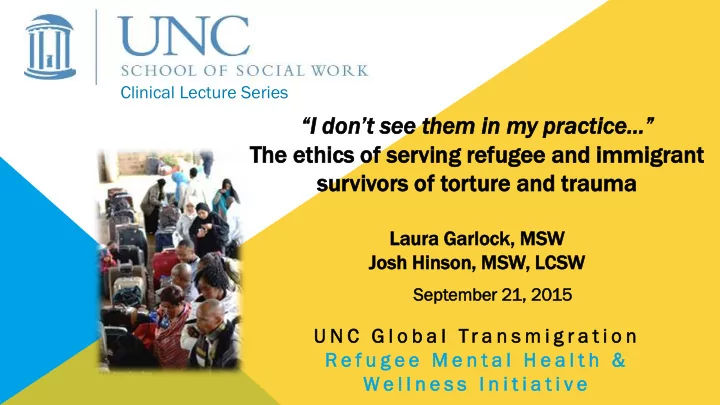
“I don’t see them in my practice…” The et ethics s of servin ving g refugee ee and immigr igrant ant surviv vivor

  • rs

s of torture and trauma

Laura a Garloc

  • ck,

, MSW Josh Hins nson,

  • n, MSW, LCSW

U N C G l o b a l Tr a n s m i g r a t i o n R e f u g e e M e n t a l H e a l t h & W e l l n e s s I n i t i a t i v e

Clinical Lecture Series Septemb ember er 21, 1, 2015

slide-2
SLIDE 2
slide-3
SLIDE 3

H T T P : / / W W W . U N H C R . O R G / P A G E S / 4 9 C 3 6 4 6 C 8 . H T M L

UN N HI HIGH H COMMI MMISSIONER SSIONER FOR REFU FUGEES GEES ANT NTÓNI ÓNIO GUTERR TERRES ES

slide-4
SLIDE 4

OBJECTIVES

  • The refugee

gee experie erience nce in North Carolina na

  • What is a refugee?
  • Trauma in the refugee experience.
  • An eviden

ence ce-based ased refugee gee mental al health th screen ening ng instru trumen ment

  • Refugee Health Screener – 15
  • Strateg

egie ies for mental al health th providers ers to work effecti ectively y with h interpret preter ers.

  • Princip

iples in in profess ssion ional codes of et ethics cs pertain ining ng to providin ding g services ices to re refugees gees in need of menta tal health th service ices.

slide-5
SLIDE 5
slide-6
SLIDE 6
slide-7
SLIDE 7
slide-8
SLIDE 8

REFUGEE MENTAL HEALTH

  • Prevalence
  • Greater levels of psychological disturbance (Fazel, Wheeler, & Danesh, 2005; Porter & Haslam, 2005)
  • Half of all refugees have mental health concerns (Brundtland, 2013; Rousseau, 1995)
  • PTSD 10-40%
  • Major Depression 5-15% (RHTAC, 2011)
  • Anxiety and stress-related disorders
  • Chronic physical illnesses, mental illnesses, and substance abuse (Palinkas et al., 2003)
  • Prevalence rates of torture range from 5-35% (Baker, 1992)
  • 40% of refugees in the United States need mental health services but cannot access them

(Ehntholt &Yule, 2006)

  • Failure to involve trained interpreters can disrupt services to refugees (Miller, Martell, Pazdirek,

Caruth, & Lopez, 2005; Bischoff et al., 2003)

  • Impact: Higher healthcare costs, persistent and severe mental illness, and worse

acculturation outcomes (Priebe et al., 2011; Pumariega, Rothe, & Pumariega, 2005)

slide-9
SLIDE 9

UNC Global Transmigration Refugee Mental Health And Wellness Initiative

slide-10
SLIDE 10

REFUGEE RESETTLEMENT

slide-11
SLIDE 11

RESEARCH PROCESS

Referral Schedule Screening Intake Treatment Rescreening

slide-12
SLIDE 12
slide-13
SLIDE 13

PATHWAYS TO WELLNESS: VISION

slide-14
SLIDE 14

THE TRIPLE TRAUMA PARADIGM

Trauma Narrative

trauma from country of

  • rigin

trauma in flight trauma in new country

slide-15
SLIDE 15

SETTING THE CONTEXT

WHO HO can n admi minist ister er the RHS HS-15? 5?

  • Self-admi

dmini nist stered red

  • Health

h work rkers (medica cal assistants sistants, nurses, ses, doctors, nurse se practi titione

  • ners,

, social work rkers), , resettl ttleme ment nt case work rkers

WHE HEN should uld the RHS HS-15 5 be admini nist stere ered?

  • At the same time

me as ot

  • ther

r health h scree eeni nings ngs or inta takes es to reduc uce sti tigma ma

  • Timing

ng may differ r based on the group, up, screen ening flow, time constraint straints s

  • r ot
  • ther

r consi sidera derati tions ns. .

slide-16
SLIDE 16

SETTING THE CONTEXT

Introduc

  • ductio

ion

  • During program intake or other case management meeting
  • Emphasize that screening will involve questions about how they

are doing both in their body AND in their mind. Timing ming

  • Before administering the RHS-15, remind the individual/group

that each person aged ed 14 4 and over er will be asked the questions about sadness, worries, body aches and pain, and other symptoms that may be bothersome to them. Normal alize ze

  • Lets the individual/group know that many refugees have a hard

time because of the difficult things they have been through, and because it is very stressful to come to a new country.

slide-17
SLIDE 17

SETTING THE CONTEXT

The case worker explains … “Some e refu fugees gees have mind nd and body y symptoms ms becau cause se of f difficult cult things they have been en throu rough gh, , and because cause it is very y stress essful ful to come e to a new w countr try. . The questi tions

  • ns we are

aski king ng help us find d people ple who are e having g a hard time e and d who might need ed extra ra suppo pport.

  • t. The answ

swer ers s are not

  • t shared

ed with anyone

  • ne else

e without ut your permis missi sion.

  • n.”
slide-18
SLIDE 18

RHS-15 INSTRUCTIONS

Read instruct tructions ions out t loud: : “How much in the last month have the symptoms below been bothersome to you?”

  • Point

nt to the numb mbers/i /ima mage ges s for the scale

  • Create a vi

visual al aid that shows ws patients ents the differenc ence e in the amoun unt. .

slide-19
SLIDE 19

SYMPTOMS

1.

  • 1. Muscle

cle, , bone, , joint nt pains ns

  • 2. Feeling

ng down, , sad, or blue most of the time

  • 3. Too
  • much think

nking ng or too many y though ughts

  • 4. Feeling

ng helples less

  • 5. Suddenl

nly y scared for no reason

  • 6. Faintne

ness ss, , dizzine ness, ss, or weakness ess

  • 7. Nervousn
  • usness

ss or shakiness ss inside

  • 8. Feeling restless, can’t sit still
  • 9. Crying

g easily

“How much in the last month have the symptoms below been bothersome to you?”

slide-20
SLIDE 20

TRAUMA SYMPTOMS

  • 10. Had the experienc

ence e of reliving ng the trauma; a; acting ng or feeling ng as if it were happeni pening ng again? n? 11.

  • 1. Been having

ng PHYSI SICAL AL reactions

  • ns

(for r examp mple, le, break out in a s sweat, heart beats fast) ) when remind nded d of the trauma? a?

  • 12. Felt emot
  • tion
  • nall

lly y numb mb (for r examp mple, le, feel sad but can’t cry, unable to have loving ng feeling ngs) s)? 13

  • 13. Been jump

mpier, , more easily y startled ed (for r examp mple, le, when n someon

  • ne wa

walks s up behind nd you) u)?

The following symptoms may be related to traumatic experiences during migration. How much in the past month have you:

slide-21
SLIDE 21

COPING

  • 14. Gener

erall ally y over er your r life, e, do you feel el that at you are: e: Ab Able le to handle e (cope pe with th) ) anything hing that t come mes s your way ..............................................0 Ab Able le to handle e (cope pe with th) ) most st things ngs that t come me your r way ...............................................1 Ab Able le to handle e (cope pe with th) ) some me things ngs, but not

  • t able

e to cope e with th ot

  • ther

er things ngs.....................2 Un Unabl ble e to cope e with th most st things ngs.........................................................................3 Un Unabl ble e to cope e with th anyth thing ng ......................................4

slide-22
SLIDE 22

DISTRESS THERMOMETER

slide-23
SLIDE 23

SCORING THE RHS-15

slide-24
SLIDE 24

REASSURANCE THAT THIS WILL WORK

Ask sking ing these se que questi stion

  • ns

s can ident ntif ify y someon

  • ne wh

who needs s suppor pport t and help get et them connec nected ed to care. e. Scree eening ning is s th the e veh ehicle cle th that t connect nects s someone

  • ne to a more

e comprehe prehensiv nsive e evalua luation ion and d suppor port. . The e res esett ettle lement ment agency ency tea eam is s th the e link to that conne nect cts s the client nt to this resour urce ce.

slide-25
SLIDE 25

CONSIDERATIONS

Will ask sking ng about ut sy symptoms ms of an f anxiety, , depress ession ion or PTSD re-trigger rigger so someone ne making ng it diffic icul ult t to get et through ugh the exam? What are avai vailable lable reso sour urces ces sh should d so someone ne need immediat iate care? e? Wha hat ha happen ens s if som f someo eone ne disc sclo loses ses somet ethin ing g that is painful nful for me to hear? Wha hat othe her res esour urces ces are e the here e for me me?

slide-26
SLIDE 26

HOW TO REFER TO REFUGEE WELLNESS

Offer er Ref efugee ugee Wel ellne ness coun unseli seling ng ser ervic ices es to the e clie ient

  • Suggested script on referral form

If clie ients s consen sent, t, fax ref efer erra ral l form rm to 919-962 962- 755 557, 7, atten ention ion: : Josh h Hin inson Cal all Lau aura a Gar arloc

  • ck:

: (9 (919) 9) 334-00 0072 72 ext. 4013

slide-27
SLIDE 27

RESEARCH PROCESS

Referral Schedule Screening Intake Treatment Rescreening

slide-28
SLIDE 28

PATHWAYS REFERRAL SCRIPT

“From your answers on the questions, it seems like you are having a difficult time.

  • e. You are not
  • t alone.
  • e. Lots
  • ts of refugees

fugees experie perience nce sadness, ness, too

  • many

worries, rries, bad memor

  • ries,

ies, or too

  • o much

ch stre ress, ss, becau cause se of ever erythi thing they y have e gone ne thr hrou

  • ugh

gh and nd beca cause use it is so difficult cult to adjus ust t to a ne new w coun untr try. . In th n the e Un United ed States, es, pe people

  • ple who

ho are e havi ving ng these ese type pes s of symptoms ms some metimes times find it helpfu lpful l to get et extr tra suppor port.

  • t. Thi

his s doe

  • es

s not

  • t mean that

t some meth thing ng is wrong

  • ng with

th them em or that t they y are e crazy azy. . So Sometimes times pe people le ne need ed help through ugh a diffic icult ult time.

  • me. I woul

uld d like e to connect nnect you u to a c coun unse selor lor. . In th n the e Un United ed States, es, a coun unselor selor/t /the herapis pist t is a type pe of healt lthcare hcare worker r who

  • will listen

en to you u and nd pr provide vide any guida dance ce and nd/or /or suppor pport.

  • t. You

u will talk about

  • ut what

t is bothe

  • thering

ng you u and nd they y will work k with h you

  • u to creat

eate e a pl plan n for r what t we hope e will make e you feel l bett tter er. . This is person son kee eeps s ever erythin ything g you say confide identi tial, l, whic ich h me means ns they y cann nnot t by law share are the e inf nformatio

  • rmation

n with h anyon

  • ne

e withou hout t your ur

  • agreement. Are you interested in being connected to these services?”
slide-29
SLIDE 29

RESEARCH PROCESS

Referral Schedule Screening Intake Treatment Rescreening

slide-30
SLIDE 30

CONGOLESE GROUP CASE STUDY

slide-31
SLIDE 31
slide-32
SLIDE 32

MASLOW’S HIERARCHY

S I M O N S , J . A . , I R W I N , D . B . , & D R I N N I E N , B . A . ( 1 9 8 7 ) . " P S Y C H O L O G Y : T H E S E A R C H F O R U N D E R S T A N D I N G . " W E S T P U B L I S H I N G C O M P A N Y , N E W Y O R K

slide-33
SLIDE 33

REFUGEE MENTAL HEALTH

B A S I C N E E D S

ESL classes, education Jobs, healthcare Housing, food, clothing

M E N TA L H E A LT H N E E D S

Trauma work Interpersonal Sleep

slide-34
SLIDE 34

M O L L I C A , R . ( 2 0 1 1 ) . H E A L T H P R O M O T I O N F O R T O R T U R E A N D T R A U M A S U R V I V O R S . R E T R I E V E D F R O M W W W . G C J F C S . O R G / R E F U G E E

slide-35
SLIDE 35

M O L L I C A , R . ( 2 0 1 1 ) . H E A L T H P R O M O T I O N F O R T O R T U R E A N D T R A U M A S U R V I V O R S . R E T R I E V E D F R O M W W W . G C J F C S . O R G / R E F U G E E

slide-36
SLIDE 36

M O L L I C A , R . ( 2 0 1 1 ) . H E A L T H P R O M O T I O N F O R T O R T U R E A N D T R A U M A S U R V I V O R S . R E T R I E V E D F R O M W W W . G C J F C S . O R G / R E F U G E E

slide-37
SLIDE 37

M O L L I C A , R . ( 2 0 1 1 ) . H E A L T H P R O M O T I O N F O R T O R T U R E A N D T R A U M A S U R V I V O R S . R E T R I E V E D F R O M W W W . G C J F C S . O R G / R E F U G E E

slide-38
SLIDE 38

TREATMENT MODALITIES TF TF-CBT DBT DBT Nar arrat ativ ive e Ther erap apie ies Motivation ivational Inter ervi viewin ing Communi mmunity ty Adj djustm ustment ent Sup uppo port t Groups ups Expr press essiv ive e Arts ts Groups ups

slide-39
SLIDE 39

Eight ht week curri ricul culum um. . Modul ules es include lude: :

  • Cultur

ture Shock ck

  • The Refugee

ugee Experience rience

  • Mental

al Health

  • The Mind

nd and Body Conne necti ction

  • Goals and Dreams
  • Creati

ting ng Wellne ness ss

  • Creati

ting ng a C Communi nity of Wellness ness

slide-40
SLIDE 40

WORKING WITH INTERPRETERS

Ac Access cess Using ng trained ed interpret preter ers Best st practi tices ces Set etting ting up the room Explain ining ng the role of the interpre preter er Ad Advoc

  • cat

ating ng for menta tal health th trainin ing g for interpret preter ers Vicariou ious s trauma mati tizat ation ion confidenti identialit ity y and dual roles Voice ce of Love

slide-41
SLIDE 41

INTERPRETATION OPTIONS

Fluent nt Languag uage e Solu lutions:

  • ns: 800-752

752-60 6096

  • Duke Hospitals, Monarch Behavioral Health Care, Lincoln Community Health Center
  • Face-to-face, telephonic, and video interpretation in 280 languages

Langua uage ge Resour

  • urce

ce Center: : (704 04) 464-00 0016

  • Face-to-face and telephonic interpretation

US Committee e for Refug ugee ees s and Immigr grant ants s (USCRI) I) Interpr rpret etation: n: (919) 9) 334-00 0072

  • Face-to-face and scheduled over-the-phone interpretation
  • Most affordable option for infrequent interpretation needs ($40/hour, 1 hour minimum)
slide-42
SLIDE 42

CULTURAL COMPETENCY

Cult ultural ural Orien entation tation Resour source e Cent nter er Adopting ting the position ition as learn rner er, , and empowering ering the refugee client to be the expert in their culture’s healthc lthcare are belief iefs

slide-43
SLIDE 43

RESOURCES FOR REFERRAL

Rese settle ttlemen ment t Agenc ncies ies Equity ity Collab llabor

  • rati

ative Transp ansplanti lanting g Tradi aditi tions

  • ns

Art t Therap rapy y Insti titu tute Piedmont edmont Health lth Servic vices es Linc ncoln

  • ln Cent

nter er

slide-44
SLIDE 44

JANE ADDAMS AND HULL HOUSE

slide-45
SLIDE 45

Josh Hinson, MSW, LCSW Assistant Professor, School of Social Work Program Director, Graduate Certificate in Global Transmigration University of North Carolina at Chapel Hill qhinson@email.unc.edu