I-90 ALLSTON INTERMODAL PROJECT Independent Review Team Report - - PowerPoint PPT Presentation

i 90 allston intermodal project
SMART_READER_LITE
LIVE PREVIEW

I-90 ALLSTON INTERMODAL PROJECT Independent Review Team Report - - PowerPoint PPT Presentation

I-90 ALLSTON INTERMODAL PROJECT Independent Review Team Report Joint Board Meeting October 15, 2018 JOINT BOARD MEETING October 15, 2018 Goals of this Presentation Preview the Independent Review Team report to the Secretary on


slide-1
SLIDE 1

JOINT BOARD MEETING – October 15, 2018
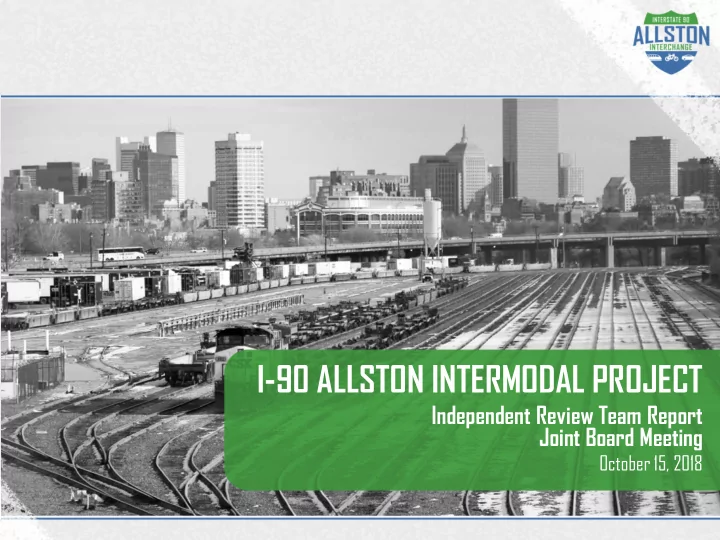
I-90 ALLSTON INTERMODAL PROJECT

Independent Review Team Report Joint Board Meeting

October 15, 2018

slide-2
SLIDE 2

JOINT BOARD MEETING – October 15, 2018

Goals of this Presentation

  • Preview the Independent Review Team report to the Secretary
  • n evaluation of Alternatives for “The Throat” that will be

released Wednesday at the Task Force meeting for 30 day review and comment period

  • Discuss with the Board the findings presented in the report to

the Secretary

  • Discuss how the process will address the proposed Elevated

Multi-Use Path Concept submitted by A Better City on October 5, 2018

  • Summarize schedule and next steps on reaching a preferred

alternative for the Throat

2

slide-3
SLIDE 3

JOINT BOARD MEETING – October 15, 2018

Reminder:

The Scope of the Independent Review Team Effort

  • Only focused on “The Throat”

– MassDOT Allston team continuing to work on West Station, bicycle/pedestrian infrastructure and other highway issues

  • Convened to take a fresh look at the three families of DEIR Alternatives

(Highway Viaduct, At Grade, Hybrid) and modify DEIR Alternatives if potential improvements are found

  • Develop an evaluation matrix to allow apples-to-apples comparison of
  • riginal DEIR and IRT Alternatives across multiple evaluation criteria
  • Gather information about the Alternatives
  • Present facts and findings on those Alternatives in a Report to the

Secretary by conclusion of 90-day review period

– Today the Secretary is releasing the executive summary, with the full report to be released for 30 day public comment period on Wednesday at the Task Force meeting – The IRT report does not and will not recommend a preferred Alternative

3

slide-4
SLIDE 4

JOINT BOARD MEETING – October 15, 2018

Materials Provided to the Board

  • This deck summarizing results of the evaluation of Alternatives

by the Independent Review team

  • A separate deck with a recap of the three “families” of

Alternatives including cross sections and renderings for each

  • The executive summary of the Independent Review Team report

to the Secretary

  • Executive summary released to Task Force/public today
  • Full report with all technical materials is being printed and will

be released to the Task Force and Board and for public comment on Wednesday October 17, 2018

  • Public comment period will run through November 16, 2018

4

slide-5
SLIDE 5

JOINT BOARD MEETING – October 15, 2018

Transportation Elements in Throat

  • All transportation elements in The Throat must be included in
  • rder to meet the overall project purpose and need

– Interstate highway: Eight lanes of I-90 – Commuter rail: Two tracks of the Worcester Main Line – Freight rail: Two tracks of the Grand Junction Railroad – Limited access parkway: Four lanes of Soldiers Field Road – Pedestrian/bicycle path: Paul Dudley White Path

5

slide-6
SLIDE 6

JOINT BOARD MEETING – October 15, 2018

Review of Alternatives and Variants

  • At-grade Family of Alternatives (all elements at-grade)

– DEIR At-Grade Alternative – IRT At-Grade Variant

  • Highway Viaduct Family of Alternatives (elevated I-90)

– DEIR Highway Viaduct Alternative – IRT Highway Viaduct Variant

  • Hybrid Family of Alternatives (some elements elevated, some

at-grade)

– DEIR Hybrid Alternative – IRT Hybrid Variant

6

slide-7
SLIDE 7

JOINT BOARD MEETING – October 15, 2018

At-grade Family: Key Components

  • All elements at-grade
  • I-90: 11-foot lanes, 2-foot shoulders (if FHWA approves)
  • Soldiers Field Road: 10-foot lanes, 1-foot shoulders
  • Paul Dudley White Path – relocation creates river impacts
  • Greatest degree of permitting risk due to resource impacts
  • Requires 7 feet of Boston University land
  • Allows north-south pedestrian/bicycle connections

to the river

7

slide-8
SLIDE 8

JOINT BOARD MEETING – October 15, 2018

Changes for IRT At-grade Variant

  • DEIR At-Grade Alternative

– I-90 at-grade – Grand Junction on retained fill – Slightly elevated Soldiers Field Road for noise protection

  • IRT At-Grade Variant

– Slope Grand Junction Line at 2% on fill and lower Grand Junction fly

  • ver I-90
  • Grand Junction crosses at lower

elevation = less retained fill, reducing Grand Junction closure and construction duration

– Explored cantilevered Paul Dudley White Path at river’s edge, but does not solve permitting issues

8

slide-9
SLIDE 9

JOINT BOARD MEETING – October 15, 2018

Highway Viaduct Family: Key Components

  • Elevated I-90: 12-foot lanes, 4-foot (inside)

and 8-foot (outside) shoulders

  • I-90 structure

– height = 28 feet above rail (minimum), width = 127 feet, closest distance to river = 82 feet

  • Rail and Soldiers Field Road at-grade
  • Difficult north-south pedestrian-bicycle connections
  • Room for expanded open space
  • Expanded Paul Dudley White Path
  • Does not require any property from Boston University

9

slide-10
SLIDE 10

JOINT BOARD MEETING – October 15, 2018

Changes for IRT Highway Viaduct Variant

  • DEIR Highway Viaduct

Alternative

– 4-column viaduct scheme – Soldiers Field Road aligned along northernly edge of viaduct – Complex staging to maintain traffic during construction

  • IRT Highway Viaduct Variant

– 3-column viaduct scheme – Soldiers Field Road tucked under northern edge of I-90 WB viaduct provides additional parkland/open space/Paul Dudley White Path improvements – Stormwater management system within or underneath green space – Simplified staging due to fewer foundations

10

slide-11
SLIDE 11

JOINT BOARD MEETING – October 15, 2018

Hybrid Family: Key Components

  • One element on viaduct, others at-grade
  • I-90: 11-foot lanes, 2-foot shoulders
  • Expanded Paul Dudley White Path
  • Room for expanded open space
  • Allows north-south pedestrian/bicycle connections to the river
  • Uses 0 – 7 feet of Boston University land

11

slide-12
SLIDE 12

JOINT BOARD MEETING – October 15, 2018

Changes for IRT Hybrid Variant

  • DEIR Hybrid Alternative

– Grand Junction on viaduct – Replaces Paul Dudley White Path without width improvements – Long Grand Junction closure during construction – Long runs for rail grade changes – Can accommodate N-S pedestrian/bike connections – Rail viaduct height = ~23.5 feet

  • IRT Hybrid Variant

– Soldiers Field Road on viaduct over at or below-grade I-90 WB lanes – Potential improved Paul Dudley White Path and expanded parkland/open space – Reduces Grand Junction closure duration during construction – Shorter length of Grand Junction

  • n retained fill

– Easier to accommodate north-south pedestrian/bike connections due to shorter Soldiers Field Road viaduct – Soldiers Field Road viaduct height = 20 feet above I-90 WB

12

slide-13
SLIDE 13

JOINT BOARD MEETING – October 15, 2018

EVALUATION CRITERIA FINDINGS

13

slide-14
SLIDE 14

JOINT BOARD MEETING – October 15, 2018

Evaluation Criteria Findings: Constructability

  • The IRT Variants provide slightly improved construction

timeframes (ranging from 6.5 to 7.5 years) from the respective DEIR Alternatives (ranging from 6.5 to 8 years)

  • The IRT Variants shorten the closures and restrictions for

railroad service through the throat

  • The IRT At-Grade and IRT Hybrid Variants reduce impacts to

use of Grand Junction Railroad

14

slide-15
SLIDE 15

JOINT BOARD MEETING – October 15, 2018

Constructability

15

slide-16
SLIDE 16

JOINT BOARD MEETING – October 15, 2018

Constructability Part 2

16

slide-17
SLIDE 17

JOINT BOARD MEETING – October 15, 2018

  • The At-Grade and Highway Viaduct IRT Variants are more

expensive to construct (7-15%) than the respective DEIR Alternative

  • The At-Grade and Highway Viaduct IRT Variants have a higher

life cycle cost (8-10%) than the respective DEIR Alternative

  • The Hybrid IRT Variant is less expensive (7% in construction

cost, 25% in lifecycle cost) than the Hybrid DEIR Alternative

  • Life cycle costs for IRT Variants range from $59 million for the

At-Grade variant to $78.8 million for the Hybrid Variant

  • Construction costs for IRT Variants range from $1.1 billion for

the At-Grade variant to $1.13 billion for the Hybrid Variant

Evaluation Criteria Findings: Cost

17

slide-18
SLIDE 18

JOINT BOARD MEETING – October 15, 2018

Criteria

DEIR At-grade DEIR Highway Viaduct DEIR Hybrid IRT At-Grade IRT Highway Viaduct IRT Hybrid

Construction cost

$987 million $1 billion $1.2 billion $1.1 billion $1.2 billion $1.1 billion

Life-cycle cost

$54 million $71.8 million $81.5 million $59 million $78.9 million $60.5 million

Need to acquire/take property

11,860 SF 0 SF 9,605 SF 3,820 SF 0 SF 3,820 SF

Mitigation Costs

Relatively greater risk of mitigation costs Relatively lesser risk of mitigation costs Relatively lesser risk of mitigation costs Relatively greater risk of mitigation costs Relatively lesser risk of mitigation costs Relatively lesser risk of mitigation costs

Cost

18

slide-19
SLIDE 19

JOINT BOARD MEETING – October 15, 2018

  • The At-Grade IRT Variant and DEIR Alternative have impacts to
  • pen space, historic resources, wetlands and tidelands

generally above what is estimated for Hybrid and Highway Viaduct IRT Variants and DEIR Alternatives

  • All Alternatives and Variants have temporary impacts on open

space, historic resources, wetlands and tidelands

Evaluation Criteria Findings: Environment

19

slide-20
SLIDE 20

JOINT BOARD MEETING – October 15, 2018

Environment

20

slide-21
SLIDE 21

JOINT BOARD MEETING – October 15, 2018

Environment Part 2

21

slide-22
SLIDE 22

JOINT BOARD MEETING – October 15, 2018

Environment Part 3

22

slide-23
SLIDE 23

JOINT BOARD MEETING – October 15, 2018

  • The At-Grade IRT Variant and DEIR Alternative have greater

permitting risk under wetlands permitting, and likely under

  • pen space and historic reviews
  • The IRT At-Grade Variant has high overall risk of not receiving

necessary permits:

– MassDEP State Wetlands Permit – US Army Corps of Engineers Federal Wetlands Permit – MassDEP Section 401 Water Quality Certification – MassDEP State Tidelands (Chapter 91) Permit

Evaluation Criteria Findings: Permitting

23

slide-24
SLIDE 24

JOINT BOARD MEETING – October 15, 2018

Permitting

24

slide-25
SLIDE 25

JOINT BOARD MEETING – October 15, 2018

Permitting Part 2

25

slide-26
SLIDE 26

JOINT BOARD MEETING – October 15, 2018

Permitting Part 3

26

slide-27
SLIDE 27

JOINT BOARD MEETING – October 15, 2018

Criteria

DEIR At-grade DEIR Highway Viaduct DEIR Hybrid IRT At-Grade IRT Highway Viaduct IRT Hybrid

Existence of alternative with lesser impact to wetlands, tidelands, parklands or historic resources

Yes for wetlands and tidelands, Potentially for parklands

  • r historic

resources No for wetland and tidelands, Potentially for parklands

  • r historic

resources No for wetlands and tidelands, Potentially for parklands

  • r historic

resources Yes for wetlands, No for tidelands, Potentially for parklands

  • r historic

resources No for wetlands and tidelands, Potentially for parklands

  • r historic

resources No for wetland and tidelands Potentially for parklands

  • r historic

resources

4(f) parkland impacts

Medium risk -

  • utcome depends on

whether another alternative is judged

  • superior. This

alternative has lesser area of riverfront

  • pen space

Low - Medium risk -

  • utcome depends on

whether another alternative is judged

  • superior. This

alternative has greater area of riverfront

  • pen space

Low - Medium risk -

  • utcome depends on

whether another alternative is judged

  • superior. This

alternative has greater area of riverfront

  • pen space

Medium risk -

  • utcome depends on

whether another alternative is judged

  • superior. This

alternative has lesser area of riverfront

  • pen space

Low - Medium risk -

  • utcome depends on

whether another alternative is judged

  • superior. This

alternative has greater area of riverfront

  • pen space

Low - Medium risk -

  • utcome depends on

whether another alternative is judged

  • superior. This

alternative has greater area of riverfront

  • pen space
  • Sect. 106 historic

resource impacts

Medium risk - outcome depends on whether another alternative is judged superior; This alternative has lesser area of riverfront open space Low - Medium risk -

  • utcome depends on

whether another alternative is judged superior; This alternative has greater area of riverfront open space Low - Medium risk -

  • utcome depends on

whether another alternative is judged superior; This alternative has greater area of riverfront open space Medium risk - outcome depends on whether another alternative is judged superior; This alternative has lesser area of riverfront open space Low - Medium risk -

  • utcome depends on

whether another alternative is judged superior; This alternative has greater area of riverfront open space Low - Medium risk -

  • utcome depends on

whether another alternative is judged superior; This alternative has greater area of riverfront open space

Risk of I-90 inundation by 50-year flood

No No No No No No

Permitting Part 4

27

slide-28
SLIDE 28

JOINT BOARD MEETING – October 15, 2018

  • The Highway Viaduct IRT Variant and DEIR Alternative create

more connectivity challenges than the At-Grade and Hybrid Variants/Alternatives

  • The Hybrid IRT Variant creates new opportunities for

multimodal connections compared to the DEIR Alternative

  • All IRT Variants equally accommodate expandability of West

Station

Evaluation Criteria Findings: Multimodal Connectivity

28

slide-29
SLIDE 29

JOINT BOARD MEETING – October 15, 2018

Multimodal Connectivity

29

slide-30
SLIDE 30

JOINT BOARD MEETING – October 15, 2018

Multimodal Connectivity Part 2

30

slide-31
SLIDE 31

JOINT BOARD MEETING – October 15, 2018

  • The Highway Viaduct IRT Variant and DEIR Alternative have

challenges to riverfront access, visual impact and noise – however the IRT Variant does provide additional open space

  • The At-Grade IRT Variant and DEIR Alternative remove the

visual barrier of a viaduct and allow improved connections – however, they provide the least open space, and the adjacency to highway along the path is a concern

  • The Hybrid IRT Variant and DEIR Alternative reduce, but don’t

remove, the visual barrier of a viaduct – however, the IRT Variant provides the greatest amount of additional open space

  • Each Variant/Alternative has mixed impacts for noise,

depending on the receptor and direction

Evaluation Criteria Findings: Public Realm

31

slide-32
SLIDE 32

JOINT BOARD MEETING – October 15, 2018

Public Realm

32

slide-33
SLIDE 33

JOINT BOARD MEETING – October 15, 2018

Criteria

DEIR At-grade DEIR Highway Viaduct DEIR Hybrid IRT At-Grade IRT Highway Viaduct IRT Hybrid Effects on visual quality of the riverfront and other open spaces

"Wall" effect of viaduct is eliminated, all vegetation is removed and replaced with retained fill "Wall" effect of highway, slightly increased space for landscaping between SFRd and PDW, little to no change in man- made elements with potential for improved path "Wall" effect of rail viaduct is shorter than existing, no change to river's edge, no added vegetation "Wall" effect of viaduct is eliminated, all vegetation is removed and replaced with paved area "Wall" effect of highway, increased space for landscaping between SFR and PDW, reduced presence of man-made roads in existing parkland area "Wall" effect reduced with lower viaduct, large increase in space for landscaping between SFR and PDW, increased presence of man-made elements with multiple roads adjacent to parkland, potential for improved PDW man- made facilities

Increases/ decreases navigable water sheet area available

Decreases by 481 SF No Change No Change Decreases by 1,760 SF No Change No Change

Effects on physical quality of

  • pen space and PDW through

amenities

No additional open

  • space. Additional

furniture or green space is not an option. Provides the most space for the PDW and green space/buffer. No additional open

  • space. Opportunity to

increase the PDW width by 2 feet. No additional open

  • space. Additional

furniture or green space is not an option. Provides additional space compared to the DEIR Option for the PDW and green space/buffer. Shading impacts due to the proximity of the SFR over I-90 WB viaduct to the PDW. Provides additional space for expanding the PDW or for green space/buffer.

Acres of open space added

  • 0.66
  • 0.09
  • 0.23
  • 0.61

0.27 0.55

Effect on quality of riverfront access points

Low, gradual access across throat. Requires additional space for landing stairs/ramps along river. Barriers along edges. Very high access across throat with stairs and ramps at both ends. Barriers along edges. Very high access across throat with stairs and ramps at both ends. Barriers along edges. Low, gradual access across throat. Requires additional space for landing stairs/ramps along river. Barriers along edges. Very high access across throat with stairs and ramps at both ends. Barriers along edges. Medium-high access with stairs and ramps required only along river. Barriers along edges

Public Realm Part 2

33

slide-34
SLIDE 34

JOINT BOARD MEETING – October 15, 2018

  • The areas vulnerable to flooding from storms and sea level rise

do not substantively change between each Variant/Alternative

  • Space for stormwater runoff is provided within the Highway

Viaduct and Hybrid Variants/Alternatives; more complex stormwater management would be required for the At-Grade Alternative and Variant

  • Only the Hybrid IRT Variant reduces impervious surface area

significantly from the DEIR Alternatives

Evaluation Criteria Findings: Resiliency

34

slide-35
SLIDE 35

JOINT BOARD MEETING – October 15, 2018

Resiliency

35

slide-36
SLIDE 36

JOINT BOARD MEETING – October 15, 2018

Resiliency Part 2

36

slide-37
SLIDE 37

JOINT BOARD MEETING – October 15, 2018

  • The Highway Viaduct IRT Variant and DEIR Alternative provide for

8’ outside shoulders, while other variants/alternatives provide for 2’-3’ outside shoulders – wider shoulders provide improved

  • perations during breakdowns, accidents, maintenance and

drainage

  • Safety analysis shows that total predicted crash rates are

relatively similar across Alternatives with the Highway Viaduct DEIR Alternative having a marginally lower total predicted crash rate than the other Alternatives

  • The Highway Viaduct IRT Variant and the DEIR Hybrid Alternatives

have marginally higher total predicted crash rates than the other Alternatives

  • The IRT Hybrid and IRT Highway Viaduct Variants provide flexibility

for the separation of modes on the Paul Dudley White Path

Evaluation Criteria Findings: Safety and Operations

37

slide-38
SLIDE 38

JOINT BOARD MEETING – October 15, 2018

Criteria

DEIR At-grade DEIR Highway Viaduct DEIR Hybrid IRT At-Grade IRT Highway Viaduct IRT Hybrid

Effects on safety for I-90

10 crashes 0.86 crashes/MVMT No safe place for vehicles to pull out of traffic 11 crashes 0.94 crashes/MVMT 11 crashes 0.94 crashes/MVMT No safe place for vehicles to pull out of traffic 11 crashes 0.94 crashes/MVMT No safe place for vehicles to pull out of traffic 10 crashes 0.86 crashes/MVMT 11 crashes 0.94 crashes/MVMT No safe place for vehicles to pull out of traffic

Effects on safety for SFR

16 crashes 1.60 crashes/MVMT 13 crashes 1.30 crashes/MVMT 16 crashes 1.60 crashes/MVMT 15 crashes 1.50 crashes/MVMT 17 crashes 1.70 crashes/MVMT 15 crashes 1.50 crashes/MVMT

Effects on operations and maintenance on I-90

Substandard shoulders result in impact to traffic

  • perations and

worker safety issues when there is a breakdown or accident; Trench drains full length of throat area or drain inlets every 5-10 feet are required to prevent 10-year storm gutter flow spreading into travel lanes 8-foot shoulders provide safe refuge area for breakdowns and responders; Drain inlets every 190 feet are required to prevent 10-year storm gutter flow spreading into travel lanes Substandard shoulders result in impact to traffic

  • perations and

worker safety issues when there is a breakdown or accident; Drain inlets every 15-20 feet are required to prevent 10-year storm gutter flow spreading into travel lanes Substandard shoulders result in impact to traffic

  • perations and

worker safety issues when there is a breakdown or accident; Trench drains full length of throat area or drain inlets every 5-10 feet are required to prevent 10-year storm gutter flow spreading into travel lanes 8-foot shoulder provides safe refuge area; Drain inlets every 350 feet are required to prevent 10-year storm gutter flow spreading into travel lanes Substandard shoulders result in impact to traffic

  • perations and

worker safety issues when there is a breakdown or accident; Trench drains full length of throat area or drain inlets every 5-10 feet are required to prevent 10-year storm gutter flow spreading into travel lanes

Effects on operations and maintenance on SFR

No opportunity for maintenance vehicles to pull over. Limited snow storage. Opportunity for maintenance vehicles to pull over. More snow storage. No opportunity for maintenance vehicles to pull over. Limited snow storage. No opportunity for maintenance vehicles to pull over. Limited snow storage. Opportunity for maintenance vehicles to pull over. More snow storage. No opportunity for maintenance vehicles to pull over. Limited snow storage.

Safety and Operations

38

slide-39
SLIDE 39

JOINT BOARD MEETING – October 15, 2018

Criteria

DEIR At-grade DEIR Highway Viaduct DEIR Hybrid IRT At-Grade IRT Highway Viaduct IRT Hybrid

Requires design exception from NHS Design Standards

Yes - shoulder, lane Yes - shoulder Yes - shoulder, lane Yes - shoulder, lane Yes - shoulder, lane, vertical clearance Yes - shoulder, lane, vertical clearance

Accommodates addition of shoulders

2-foot shoulder 8-foot shoulder 2-3-foot shoulder 2-foot shoulder 8-foot shoulder 2-foot shoulder

Allows separation of modes on PDW Path

No separation

  • f modes (8.5').

Concrete barrier separation from

  • traffic. Edge of

path is 2.5' from travel lane. No separation

  • f modes (12').

Guard rail and landscaped buffer separation from

  • traffic. Edge of

path is 11.5' from travel lane. No separation

  • f modes (12').

Guard rail separation from

  • traffic. Edge of

path is 3' from travel lane. No separation

  • f modes (8.5' -

12'). Various separation alternatives from traffic (vertical and horizontal). Edge of path is 2.5' from travel lane or vertically separated. Room for separation of modes (26'). Various option for separation from traffic including guard rail and landscaped

  • buffer. Edge of

path is 8'-18' from travel lane. Room for separation of modes (26'). Various option for separation from traffic including guard rail and landscaped

  • buffer. Edge of

path is 20-'30' from travel lane.

Safety and Operations Part 2

39

slide-40
SLIDE 40

JOINT BOARD MEETING – October 15, 2018

  • Cross section submitted on October 5, 2018 - Source: A Better City
  • The IRT will further review and analyze the submission separate from this report

by the end of the comment period

Report Addendum:

Proposed Elevated Multi-Use Path Concept

40

slide-41
SLIDE 41

JOINT BOARD MEETING – October 15, 2018

  • The IRT will further review and analyze the submission separate

from this report

  • The IRT worked with A Better City (ABC), the primary proponent of

the At-Grade Alternative (meetings, phone calls, material exchange)

  • The IRT believes that there would be a high permitting risk for the

At-Grade Alternative under state wetlands regulations

  • ABC sought to develop variants to avoid environmental

impacts/permitting challenges

  • At the September 26 Task Force meeting, ABC proposed a new

concept for consideration

  • A Better City submitted new materials to MassDOT and the IRT on

October 5, 2018

Report Addendum:

Proposed Elevated Multi-Use Path Concept Part 2

41

slide-42
SLIDE 42

JOINT BOARD MEETING – October 15, 2018

  • Task Force meeting on Wednesday

– Full Independent Review Team report will be released for 30 days of public comment (through November 16)

  • Additional analytic work by IRT on the Throat

– IRT has been extended to allow for additional analytic work – Will include full “matrix” analysis of proposed Elevated Multi-Use Path Concept submitted by A Better City on October 5

  • Allston Multimodal Team continues to work on issues outside the

throat

  • Secretary will make decision on preferred alternative for the

Throat following close of public comment period and consideration

  • f comments submitted and additional analytic work by IRT

What Happens Next?

42

slide-43
SLIDE 43

JOINT BOARD MEETING – October 15, 2018

QUESTIONS?

43